

Why should Christians study the humanities?
 |
Description
Book Introduction
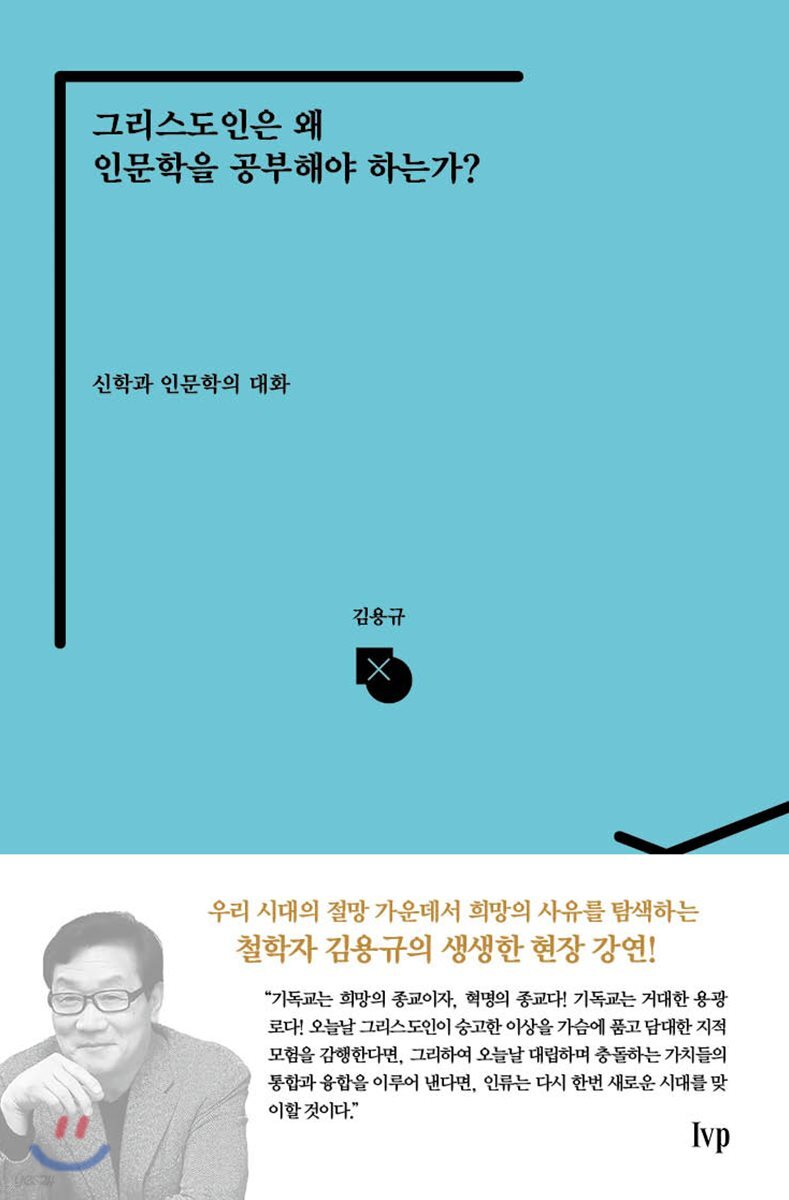
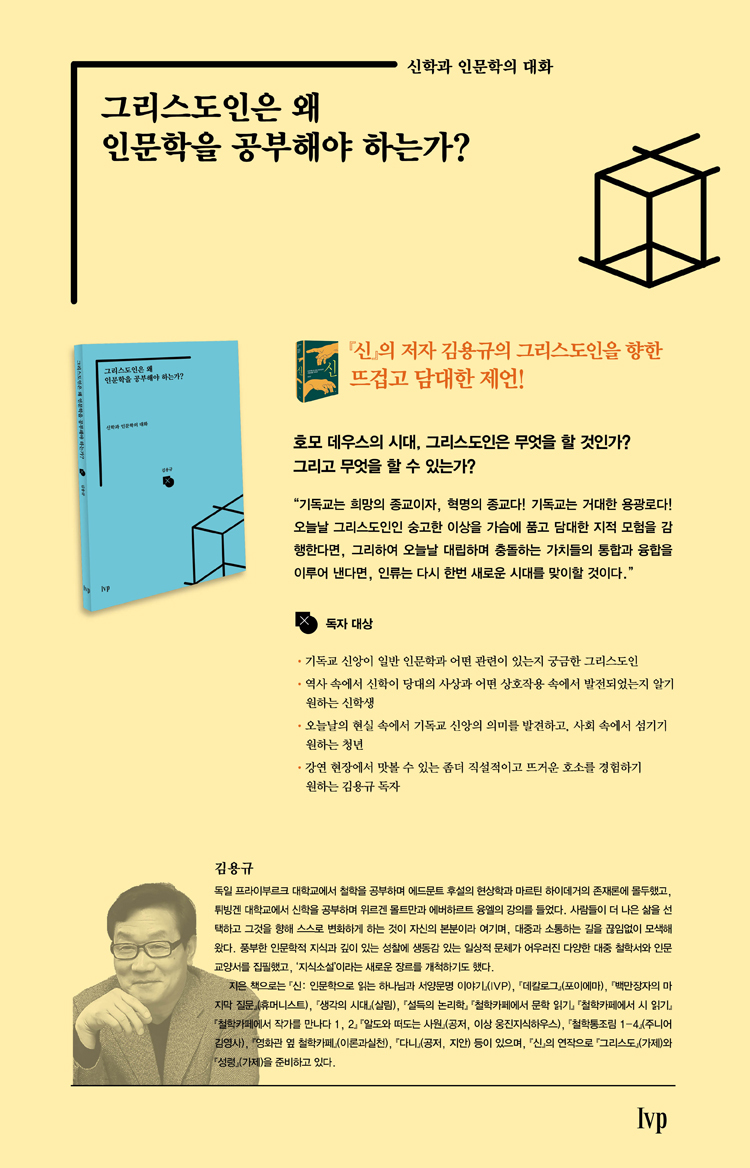
A passionate and bold suggestion for Christians from Kim Yong-gyu, author of "God"!
In the Age of Homo Deus, What Will Christians Do?
And what can be done?
We live in the landscape of the death of God and its aftermath, as predicted by Nietzsche.
As we experience the reality that the death of God leads to the death of humanity, and that the fall of theistic values leads to the fall of humanistic values, global anxiety and fear now grip our daily lives.
In the age of Homo Deus, existential cries asking where humans belong are erupting everywhere.
Where will we find our way, each walking the path of "self-preservation" amidst the violence, both large and small, of modernity and post-modernity? Facing this urgent question, this book historically examines the relationship between Christian theology and the humanities, finding clues to a solution. It also delivers a prophetic call grounded in the author's profound reflection and insight.
In the Age of Homo Deus, What Will Christians Do?
And what can be done?
We live in the landscape of the death of God and its aftermath, as predicted by Nietzsche.
As we experience the reality that the death of God leads to the death of humanity, and that the fall of theistic values leads to the fall of humanistic values, global anxiety and fear now grip our daily lives.
In the age of Homo Deus, existential cries asking where humans belong are erupting everywhere.
Where will we find our way, each walking the path of "self-preservation" amidst the violence, both large and small, of modernity and post-modernity? Facing this urgent question, this book historically examines the relationship between Christian theology and the humanities, finding clues to a solution. It also delivers a prophetic call grounded in the author's profound reflection and insight.
- You can preview some of the book's contents.
Preview
index
Preface _Be part of a great tradition!
Orthodox theology and Platonism
Medieval theology and Aristotelianism
Reformation theology and humanism
Liberal theology and liberalism
Postmodern theology and postmodernism
The Essence and Mission of Christian Theology
The Death of God and the Scenes Thereafter
Risk Society and Fluid Fear
A new religion created by Silicon Valley
The Impossibility of Atheistic Humanism
Violence born from a small story
The Broken Staff of Moses
The path between emptiness and blindness
You too, be perfect.
For complete values, complete theology
main
Orthodox theology and Platonism
Medieval theology and Aristotelianism
Reformation theology and humanism
Liberal theology and liberalism
Postmodern theology and postmodernism
The Essence and Mission of Christian Theology
The Death of God and the Scenes Thereafter
Risk Society and Fluid Fear
A new religion created by Silicon Valley
The Impossibility of Atheistic Humanism
Violence born from a small story
The Broken Staff of Moses
The path between emptiness and blindness
You too, be perfect.
For complete values, complete theology
main
Detailed image
Into the book
Christian theology is the first discipline in that it pursues higher ideals than any other discipline, explores broader values than any other discipline, and precisely because of this, it is the foundation from which all other disciplines must begin.
I believe we can be proud of Christian theology, at least in this respect! And this pride stems from the traditions of the apostles, martyrs, great theologians, and faithful Christians who sacrificed their lives for the coming of God's kingdom to this earth over the past two thousand years.
I wrote this little book to encourage readers to take pride in being part of this great tradition.
In the “Preface”
This phenomenon can be said to have begun as early as when Tertullian (?160-?220), known as the 'father of Latin theology,' exclaimed, "What has Athens to do with Jerusalem? What agreement is there between the Academy and the Church?"
This argument has become particularly prominent since the modern era, and has recently been on people's lips in the form of "Why should Christians study the humanities?"
This article can be considered my answer to that.
In “Why Should Christians Study Humanities?”
Therefore, objectively speaking, the meeting of ancient Greek philosophy and the new Hebrew religion was a fortuitous event in the long journey of history, and a complete union of the two was virtually impossible.
But when seen through the eyes of faith, it is completely different.
The meeting of these two seems as if God had prepared it for Christianity long ago.
Because Greek philosophy, under the name of Platonism, had been developing and refining theories that were ideal for rationally explaining the Word of God given through revelation for hundreds of years.
That is why early Christian theologians praised Plato (427-347 BC) as “a Christian who lived 400 years before the birth of Jesus” or “a Moses who wrote in Greek.”
In “Orthodox Theology and Platonism”
This painting is “The Triumph of Saint Thomas Aquinas,” painted in 1341 by Francesco Traini, a painter who was popular in the 14th century.
As you can see, Christ is seated at the top center of this painting, which is placed behind the altar of the Basilica of Santa Caterina in Pisa, Italy.
According to iconographers, on the left are Matthew and Luke, each holding their own gospels, and Paul, also holding his own epistles. On the right are Moses, holding the two stone tablets of the Ten Commandments, and John and Mark, also holding their own gospels.
In the center of the platform below, Thomas Aquinas sits holding his Summa Theologica, while to his left, Aristotle holds his Metaphysics and to his right, Plato stands holding his Timaeus, both looking up at Aquinas.
At the bottom center is Ibn Rushid (Averroes), the Arab philosopher who introduced Aristotle's philosophy to the West, sitting diagonally, with philosophers and rhetoricians gathered on either side of him.
This arrangement of the characters naturally implies that theology reigns over the humanities, such as philosophy and rhetoric, but it can also be interpreted as showing that Christian theology is founded on the humanities.
In “Medieval Theology and Aristotelianism”
What is striking about this book is that Calvin interprets Seneca's original text using the same method as Erasmus did in interpreting the text, and that he uses the same writing style as Guillaume Bude (1467-1540) in his commentary on the Justinian Code.
In the West, this writing method is still taught as a typical example of "humanistic writing," as it is an excellent method for writing humanities books.
Actually, I use this method often, so let me briefly introduce it as follows.
First, the writing begins with a philological explanation, second, the writing develops solely based on grammar and logic, third, rhetorical expressions are inserted, and lastly, classical knowledge left behind by ancient authors is utilized.
The fact that Calvin and other Christian humanists of the time followed this writing method shows that they valued not only philosophy but also all humanities, such as philology, logic, and rhetoric.
In “Reformation Theology and Humanism”
The Social Gospel movement, which developed primarily in the United States and Canada in the 19th century, is worth deep reflection on, as it clearly shows the light and shadow of liberal theology.
In short, theology that deviates from orthodoxy and relies on human reason? The greater the degree of deviance, the more rational it is, but also the more imperfect it is.
The crucial problem with liberal theology is that it places the focus of theology not on God's Word and traditional confessions or creeds, but on human reason, personal emotions, and cultural and contextual interpretations, ultimately transforming Christian theology into a humanistic and individualistic one.
Then resistance arose.
First, the humanistic nature of liberal theology revealed its limitations and contradictions during World War I.
In “Liberal Theology and Liberalism”
Taylor's deconstructive theology is criticized for leading to extreme relativism and nihilism, as is Derrida's claim that by thoroughly dismantling God, the self, history, and all that is the product of reason, all violence is eliminated.
From the standpoint of orthodox theology, which holds that God is the source of all existence, the origin of all truth, and the pinnacle of all values, the death of God would instantly render all existence, truth, and values meaningless and worthless.
“There was no true atheism until the advent of postmodernism.
The words of British literary critic Terry Eagleton, “It is just a repetition of what appears to be atheism but is not,” are at least an appropriate assessment of deconstructionist philosophy and theology.
In “Postmodern Theology and Postmodernism”
Christian theology is a beautiful and vast spiritual structure created by Hebraism and Hellenism, faith and reason, biblical revelation and the humanities.
It is a rich, robust, comprehensive, and systematic study that Christianity has accumulated over two thousand years.
Moreover, as the following diagram shows, Christian theology is a strong bridge connecting the Kingdom of God and our world.
It is a sound bridge connecting the word of God and worldly learning.
In this respect, it is by no means easy to find a spiritual heritage of this magnitude among human civilizations.
In “The Essence and Mission of Christian Theology”
And today, he has begun to mock God just as much as neo-evolutionists like Richard Dawkins and Christopher Hitchens.
For example, Mortimer Collins (1827-1876), a British writer and positivist who lived at about the same time as Nietzsche, sang of the triumph of man over God as follows:
“Life and the universe show spontaneity,/Now let the nonsense of God disappear!/Church and doctrine are lost in the fog,/Truth must be sought from the positivists.”
In “The Death of God and the Landscape Thereafter”
Zygmunt Bauman (1925-2017), a Polish-Jewish sociologist, described this phenomenon by saying that the unification of humanity brought about by globalization “means that there is fundamentally nowhere to run.”
Yes! Even if we haven't experienced it directly yet, humanity could face catastrophe someday, in the worst-case scenario: a terrorist attack or war using weapons of mass destruction like nuclear or biological weapons, or an attack by a new virus that possesses both the ferocious virulence of avian influenza and the uncontrollable infectiousness of a new flu.
In short, the self-destructive potential of civilization is growing by the day.
It's no secret that the 'clock of destiny' is ticking forward by the day.
In “Risk Society and Fluid Fear”
According to Lyotard, the various natural and social scientific knowledge and beliefs developed by modern reason, such as the Enlightenment, scientism, social Darwinism, capitalism, Hegelian dialectics, historicism, Marxism, and psychoanalysis, are merely "small stories" (petit recit) that have legitimacy only in their own domain, and by justifying themselves as truth, they have become "big stories" (grands recit) that encompass and explain all other stories.
And then, under the pretext of realizing universality, they went beyond their own limitations and encroached on various other areas such as culture, art, politics, economy, and religion, and committed violence by acting as their masters.
In “The Impossibility of Atheistic Humanism”
In my opinion, Christianity is a huge melting pot.
As the doctrine testifies, and as we have seen, Christianity began from the very beginning as a fusion of Hebrew revelation and Greek philosophy, like water and oil.
Since then, we have faced countless challenges from disparate and hostile ideas and currents of thought in each era. However, instead of rejecting them, we have embraced them and ultimately made them our own, thereby walking the path of enrichment and strength.
In the big picture, the church's footsteps were no different.
As church history testifies, the early church began by overcoming the “blood racism” of Judaism and the “cultural racism” of Greece.
In “The Path Between Emptiness and Blindness”
What this means is that we must first restore theocratic values. This means that we must restore humanistic values based on theocratic values, and then build post-modern values based on those values to establish "complete values."
This also means that postmodern values should not deviate from humanistic values, and humanistic values should not deviate from theocratic values.
In this crucible of integration and fusion, the emptiness of existing values and the blindness of new values, which inevitably emerge anew in each era, must be mutually resolved and complemented, leading to the rebirth of complete values.
So that we will not live in fear, trembling under a sky where God's grace has disappeared, on a land where human solidarity and cooperation have disappeared.
Also, this way, we won't be asking computer algorithms for directions, like Alice in Wonderland asking the cat for directions.
In “For Complete Value, Complete Theology”
I believe we can be proud of Christian theology, at least in this respect! And this pride stems from the traditions of the apostles, martyrs, great theologians, and faithful Christians who sacrificed their lives for the coming of God's kingdom to this earth over the past two thousand years.
I wrote this little book to encourage readers to take pride in being part of this great tradition.
In the “Preface”
This phenomenon can be said to have begun as early as when Tertullian (?160-?220), known as the 'father of Latin theology,' exclaimed, "What has Athens to do with Jerusalem? What agreement is there between the Academy and the Church?"
This argument has become particularly prominent since the modern era, and has recently been on people's lips in the form of "Why should Christians study the humanities?"
This article can be considered my answer to that.
In “Why Should Christians Study Humanities?”
Therefore, objectively speaking, the meeting of ancient Greek philosophy and the new Hebrew religion was a fortuitous event in the long journey of history, and a complete union of the two was virtually impossible.
But when seen through the eyes of faith, it is completely different.
The meeting of these two seems as if God had prepared it for Christianity long ago.
Because Greek philosophy, under the name of Platonism, had been developing and refining theories that were ideal for rationally explaining the Word of God given through revelation for hundreds of years.
That is why early Christian theologians praised Plato (427-347 BC) as “a Christian who lived 400 years before the birth of Jesus” or “a Moses who wrote in Greek.”
In “Orthodox Theology and Platonism”
This painting is “The Triumph of Saint Thomas Aquinas,” painted in 1341 by Francesco Traini, a painter who was popular in the 14th century.
As you can see, Christ is seated at the top center of this painting, which is placed behind the altar of the Basilica of Santa Caterina in Pisa, Italy.
According to iconographers, on the left are Matthew and Luke, each holding their own gospels, and Paul, also holding his own epistles. On the right are Moses, holding the two stone tablets of the Ten Commandments, and John and Mark, also holding their own gospels.
In the center of the platform below, Thomas Aquinas sits holding his Summa Theologica, while to his left, Aristotle holds his Metaphysics and to his right, Plato stands holding his Timaeus, both looking up at Aquinas.
At the bottom center is Ibn Rushid (Averroes), the Arab philosopher who introduced Aristotle's philosophy to the West, sitting diagonally, with philosophers and rhetoricians gathered on either side of him.
This arrangement of the characters naturally implies that theology reigns over the humanities, such as philosophy and rhetoric, but it can also be interpreted as showing that Christian theology is founded on the humanities.
In “Medieval Theology and Aristotelianism”
What is striking about this book is that Calvin interprets Seneca's original text using the same method as Erasmus did in interpreting the text, and that he uses the same writing style as Guillaume Bude (1467-1540) in his commentary on the Justinian Code.
In the West, this writing method is still taught as a typical example of "humanistic writing," as it is an excellent method for writing humanities books.
Actually, I use this method often, so let me briefly introduce it as follows.
First, the writing begins with a philological explanation, second, the writing develops solely based on grammar and logic, third, rhetorical expressions are inserted, and lastly, classical knowledge left behind by ancient authors is utilized.
The fact that Calvin and other Christian humanists of the time followed this writing method shows that they valued not only philosophy but also all humanities, such as philology, logic, and rhetoric.
In “Reformation Theology and Humanism”
The Social Gospel movement, which developed primarily in the United States and Canada in the 19th century, is worth deep reflection on, as it clearly shows the light and shadow of liberal theology.
In short, theology that deviates from orthodoxy and relies on human reason? The greater the degree of deviance, the more rational it is, but also the more imperfect it is.
The crucial problem with liberal theology is that it places the focus of theology not on God's Word and traditional confessions or creeds, but on human reason, personal emotions, and cultural and contextual interpretations, ultimately transforming Christian theology into a humanistic and individualistic one.
Then resistance arose.
First, the humanistic nature of liberal theology revealed its limitations and contradictions during World War I.
In “Liberal Theology and Liberalism”
Taylor's deconstructive theology is criticized for leading to extreme relativism and nihilism, as is Derrida's claim that by thoroughly dismantling God, the self, history, and all that is the product of reason, all violence is eliminated.
From the standpoint of orthodox theology, which holds that God is the source of all existence, the origin of all truth, and the pinnacle of all values, the death of God would instantly render all existence, truth, and values meaningless and worthless.
“There was no true atheism until the advent of postmodernism.
The words of British literary critic Terry Eagleton, “It is just a repetition of what appears to be atheism but is not,” are at least an appropriate assessment of deconstructionist philosophy and theology.
In “Postmodern Theology and Postmodernism”
Christian theology is a beautiful and vast spiritual structure created by Hebraism and Hellenism, faith and reason, biblical revelation and the humanities.
It is a rich, robust, comprehensive, and systematic study that Christianity has accumulated over two thousand years.
Moreover, as the following diagram shows, Christian theology is a strong bridge connecting the Kingdom of God and our world.
It is a sound bridge connecting the word of God and worldly learning.
In this respect, it is by no means easy to find a spiritual heritage of this magnitude among human civilizations.
In “The Essence and Mission of Christian Theology”
And today, he has begun to mock God just as much as neo-evolutionists like Richard Dawkins and Christopher Hitchens.
For example, Mortimer Collins (1827-1876), a British writer and positivist who lived at about the same time as Nietzsche, sang of the triumph of man over God as follows:
“Life and the universe show spontaneity,/Now let the nonsense of God disappear!/Church and doctrine are lost in the fog,/Truth must be sought from the positivists.”
In “The Death of God and the Landscape Thereafter”
Zygmunt Bauman (1925-2017), a Polish-Jewish sociologist, described this phenomenon by saying that the unification of humanity brought about by globalization “means that there is fundamentally nowhere to run.”
Yes! Even if we haven't experienced it directly yet, humanity could face catastrophe someday, in the worst-case scenario: a terrorist attack or war using weapons of mass destruction like nuclear or biological weapons, or an attack by a new virus that possesses both the ferocious virulence of avian influenza and the uncontrollable infectiousness of a new flu.
In short, the self-destructive potential of civilization is growing by the day.
It's no secret that the 'clock of destiny' is ticking forward by the day.
In “Risk Society and Fluid Fear”
According to Lyotard, the various natural and social scientific knowledge and beliefs developed by modern reason, such as the Enlightenment, scientism, social Darwinism, capitalism, Hegelian dialectics, historicism, Marxism, and psychoanalysis, are merely "small stories" (petit recit) that have legitimacy only in their own domain, and by justifying themselves as truth, they have become "big stories" (grands recit) that encompass and explain all other stories.
And then, under the pretext of realizing universality, they went beyond their own limitations and encroached on various other areas such as culture, art, politics, economy, and religion, and committed violence by acting as their masters.
In “The Impossibility of Atheistic Humanism”
In my opinion, Christianity is a huge melting pot.
As the doctrine testifies, and as we have seen, Christianity began from the very beginning as a fusion of Hebrew revelation and Greek philosophy, like water and oil.
Since then, we have faced countless challenges from disparate and hostile ideas and currents of thought in each era. However, instead of rejecting them, we have embraced them and ultimately made them our own, thereby walking the path of enrichment and strength.
In the big picture, the church's footsteps were no different.
As church history testifies, the early church began by overcoming the “blood racism” of Judaism and the “cultural racism” of Greece.
In “The Path Between Emptiness and Blindness”
What this means is that we must first restore theocratic values. This means that we must restore humanistic values based on theocratic values, and then build post-modern values based on those values to establish "complete values."
This also means that postmodern values should not deviate from humanistic values, and humanistic values should not deviate from theocratic values.
In this crucible of integration and fusion, the emptiness of existing values and the blindness of new values, which inevitably emerge anew in each era, must be mutually resolved and complemented, leading to the rebirth of complete values.
So that we will not live in fear, trembling under a sky where God's grace has disappeared, on a land where human solidarity and cooperation have disappeared.
Also, this way, we won't be asking computer algorithms for directions, like Alice in Wonderland asking the cat for directions.
In “For Complete Value, Complete Theology”
--- From the text
Publisher's Review
A lively lecture by philosopher Yonggyu Kim, exploring the meaning of hope amidst the despair of our times!
This book comes from a vivid lecture scene where the lecturer and audience make eye contact and breathe together.
Following the publication of 『Shin』 (IVP) in 2018, several lectures were held, and the manuscripts of the lectures on the relationship between theology and the humanities, which focused on those lectures, became the first draft of this book.
Because of this, this book contains points that are not easily found in the author's other books.
In other words, readers can encounter a passionate appeal with solid pathos beyond the author's calm logic.
Faith and reason, the roots of Christian theology, learn from its two-thousand-year history.
In this book, the author first reveals that Christian theology is a vast and beautiful spiritual structure created over the past two thousand years by the encounter between biblical revelation and the humanities of the times, faith and reason, Hebraism and Hellenism—two disparate and sometimes contradictory forces.
Moreover, for this reason, Christian theology traces the accumulation of logic, knowledge, wisdom, and experience in each era that can achieve integration and fusion of opposing elements.
And it goes on to say that Christian theology, with its characteristics of integration and fusion, can save us from the era of division, conflict, and catastrophe we face today.
Christian theology is a branch of the humanities, but it is the discipline that offers the most hope for the humanities!
The author boldly asserts that Christian theology is the primal science (scientia prima) amidst the various perceptions and misunderstandings about Christian theology today.
In other words, Christian theology is the highest discipline in that it pursues the highest ideal imaginable to man, yet aims at the salvation of the secular world.
Christian theology is the first discipline, and Christians can and should be proud of it, in that it pursues higher ideals than any other discipline, explores broader values than any other discipline, and precisely because of this, it is the foundation from which all other disciplines must begin.
At the same time, on the other hand, we have an important responsibility to apply and develop such things in the midst of today's world.
What can Christians say in the face of the crisis of their times?
In the contemporary context of the death of God that we face today, as diagnosed by Friedrich Nietzsche, the author analyzes today's rumors of despair and destruction and seeks alternatives, citing the reflections of contemporary scholars such as Yuval Harari, Ulrich Beck, Zygmunt Bauman, and Terry Eagleton.
Based on the historical characteristics of Christian theology traced above, instead of simply asking, "Is it this or that?", I suggest that we unravel the thread by telling small stories while also telling big stories.
We seek the possibility of a 'complete discourse' and appeal to overcome the despair and pain of our times together.
Ultimately, the author, who advocates for the "restoration of neo-capitalist values," presents readers with the task of overcoming the misunderstandings and prejudices we commonly encounter around us, by exploring the true meaning of words we may have already heard.
This is the way for Christians today to become part of the great tradition called Christianity.
For readers
Christians who are curious about how Christian faith relates to the general humanities.
A theology student who wants to know how theology developed through interaction with contemporary thought throughout history.
Young people who discover the meaning of Christian faith in today's reality and want to serve society and the community.
Readers like Yonggyu Kim who want to experience the author's direct and passionate appeal that can only be experienced at lectures.
This book comes from a vivid lecture scene where the lecturer and audience make eye contact and breathe together.
Following the publication of 『Shin』 (IVP) in 2018, several lectures were held, and the manuscripts of the lectures on the relationship between theology and the humanities, which focused on those lectures, became the first draft of this book.
Because of this, this book contains points that are not easily found in the author's other books.
In other words, readers can encounter a passionate appeal with solid pathos beyond the author's calm logic.
Faith and reason, the roots of Christian theology, learn from its two-thousand-year history.
In this book, the author first reveals that Christian theology is a vast and beautiful spiritual structure created over the past two thousand years by the encounter between biblical revelation and the humanities of the times, faith and reason, Hebraism and Hellenism—two disparate and sometimes contradictory forces.
Moreover, for this reason, Christian theology traces the accumulation of logic, knowledge, wisdom, and experience in each era that can achieve integration and fusion of opposing elements.
And it goes on to say that Christian theology, with its characteristics of integration and fusion, can save us from the era of division, conflict, and catastrophe we face today.
Christian theology is a branch of the humanities, but it is the discipline that offers the most hope for the humanities!
The author boldly asserts that Christian theology is the primal science (scientia prima) amidst the various perceptions and misunderstandings about Christian theology today.
In other words, Christian theology is the highest discipline in that it pursues the highest ideal imaginable to man, yet aims at the salvation of the secular world.
Christian theology is the first discipline, and Christians can and should be proud of it, in that it pursues higher ideals than any other discipline, explores broader values than any other discipline, and precisely because of this, it is the foundation from which all other disciplines must begin.
At the same time, on the other hand, we have an important responsibility to apply and develop such things in the midst of today's world.
What can Christians say in the face of the crisis of their times?
In the contemporary context of the death of God that we face today, as diagnosed by Friedrich Nietzsche, the author analyzes today's rumors of despair and destruction and seeks alternatives, citing the reflections of contemporary scholars such as Yuval Harari, Ulrich Beck, Zygmunt Bauman, and Terry Eagleton.
Based on the historical characteristics of Christian theology traced above, instead of simply asking, "Is it this or that?", I suggest that we unravel the thread by telling small stories while also telling big stories.
We seek the possibility of a 'complete discourse' and appeal to overcome the despair and pain of our times together.
Ultimately, the author, who advocates for the "restoration of neo-capitalist values," presents readers with the task of overcoming the misunderstandings and prejudices we commonly encounter around us, by exploring the true meaning of words we may have already heard.
This is the way for Christians today to become part of the great tradition called Christianity.
For readers
Christians who are curious about how Christian faith relates to the general humanities.
A theology student who wants to know how theology developed through interaction with contemporary thought throughout history.
Young people who discover the meaning of Christian faith in today's reality and want to serve society and the community.
Readers like Yonggyu Kim who want to experience the author's direct and passionate appeal that can only be experienced at lectures.
GOODS SPECIFICS
- Date of issue: March 4, 2019
- Page count, weight, size: 120 pages | 192g | 125*190*20mm
- ISBN13: 9788932816975
- ISBN10: 8932816972
You may also like
카테고리
korean


korean

![GQ KOREA Mark (Monthly): December [2025]](http://librairie.coreenne.fr/cdn/shop/files/8ef265dbbfbf186523ed75ba7319009d.jpg?v=1765340328&width=3840)


