

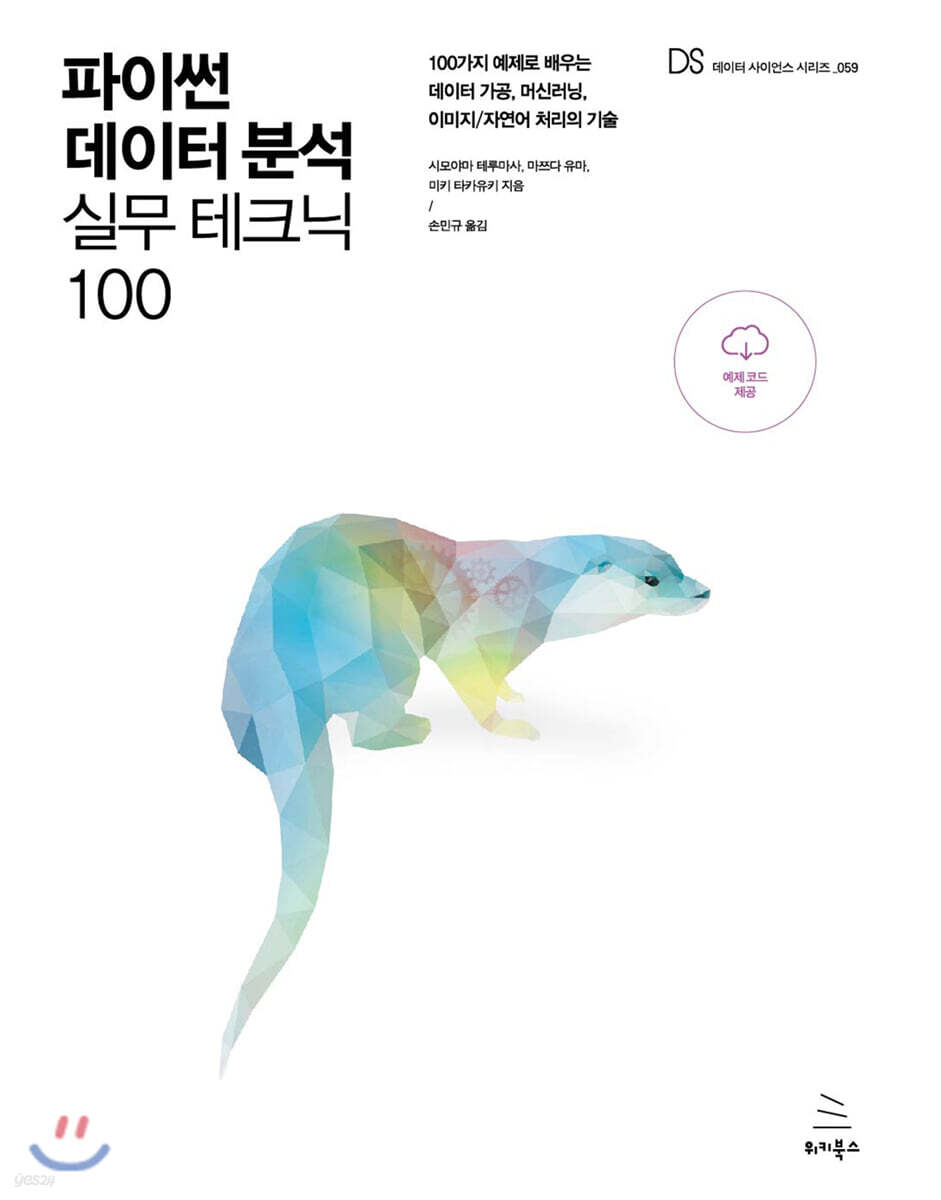
100 Practical Python Data Analysis Techniques
 |
Description
Book Introduction
"100 Practical Python Data Analysis Techniques" is a workbook designed to help you become familiar with the field and develop the ability to apply techniques appropriate to the field by solving 100 examples that can be encountered in real-world business settings.
Learning 100 data analysis techniques won't immediately allow you to apply them in the field, but by gaining practical experience, you can cultivate the skills to naturally transition into the business world.
This will certainly be helpful for those who, after learning about data analysis and machine learning online or through introductory books, think, "I want to do data analysis that is more useful than classifying irises," or "I want to know how these technologies are applied in business settings."
- You can preview some of the book's contents.
Preview
index
[Part 1] Basics: Data Processing
▣ Chapter 1: 10 Techniques for Analyzing Order Counts on the Web
Let's read the 001 data
002 Let's combine (union) data
003 Let's combine (join) sales data.
004 Let's combine (join) master data.
005 Let's create the necessary data columns.
006 Let's check the data
007 Let's look at various statistics.
008 Let's aggregate the data by month.
009 Let's aggregate data by month and product.
010 Let's visualize sales trends by product.
▣ Chapter 2: 10 Techniques for Processing Agency Data
Let's read the 011 data
Let's look at the errors in the 012 data.
Let's aggregate the 013 data with errors.
014 Let's fix the product name error.
Let's correct the missing value of amount 015
016 Let's fix the customer name error.
017 Let's fix the date error
018 Let's combine (join) two data using customer name as the key.
019 Let's dump the refined data.
Let's aggregate the 020 data
[Part 2] Practical Applications ①: Machine Learning
▣ Chapter 3: 10 Techniques for Understanding Your Customers' Full Profile
021 Let's read and check the data.
022 Let's process customer data
023 Let's aggregate customer data
024 Let's aggregate the latest customer data.
025 Let's aggregate usage history data.
026 Create a regular usage flag from usage history data.
027 Let's combine customer data and usage history data.
028 Let's calculate the membership period
029 Let's understand various statistics on customer behavior.
030 Understand the difference between a member who has left and a member who continues to stay.
▣ Chapter 4: 10 Techniques for Predicting Customer Behavior
031 Let's read and check the data.
032 Let's group members using clustering.
033 Let's analyze the clustering results.
034 Let's visualize the clustering results.
035 Let's understand the trends of members who have left the group based on the clustering results.
036 Let's prepare data to predict the number of users next month.
037 Let's add a characteristic variable
038 Let's build a model to predict the number of uses next month.
Let's check the variables that contribute to the 039 model.
040 Let's predict the number of uses next month.
▣ Chapter 5: 10 Techniques for Predicting Member Withdrawals
041 Let's read the data and modify the usage data.
042 Let's create the customer data for the month before withdrawal.
043 Let's create data for continuing members.
044 Let's write the expected monthly attendance period.
045 Let's remove missing values
046 Let's process string variables so that they can be processed.
047 Let's build a withdrawal prediction model using a decision tree.
048 Let's evaluate the prediction model and tune the model.
Let's check the variables that contribute to the 049 model.
Let's predict 050 member withdrawals.
[Part 3] Practical Part 2: Optimization Problems
▣ Chapter 6: 10 Techniques for Consulting on Optimal Logistics Routes
051 Let's load logistics data
052 Let's check the current shipping volume and cost.
053 Let's visualize the network
054 Let's add a node to the network.
Let's weight the 055 path
056 Let's load the transport route information.
057 Let's visualize the network with transport route information.
058 Let's write a transportation cost function
059 Let's create a constraint
060 Let's change the transportation route and check the change in the transportation cost function.
▣ Chapter 7: 10 Techniques for Optimal Logistics Network Design
061 Let's solve the transportation optimization problem.
062 Let's check the optimal transport route through the network.
063 Let's check if the optimal transport route satisfies the constraints.
064 Let's load the production plan data.
065 Let's create a function that calculates profit.
066 Let's solve the production optimization problem.
067 Let's check whether the optimal production plan satisfies the constraints.
Let's solve the logistics network design problem 068.
069 Let's calculate the transportation costs and their details for the optimal network.
070 Let's calculate the production cost and its details for the optimal network.
▣ Chapter 8: 10 Techniques for Predicting Consumer Behavior Using Numerical Simulation
071 Let's visualize the human relationship network.
072 Let's visualize the spread of information through word of mouth.
073 Let's graph the time series change in the number of word-of-mouth rumors.
074 Let's simulate the time series change in the number of members.
Let's look at the entire 075 parameter by looking at the 'correlation'.
076 Let's load the actual data.
077 Let's visualize the distribution of the number of links.
078 Let's estimate parameters from real data for simulation.
079 Let's compare actual data and simulations.
Let's predict the future with 080 simulation.
[Part 4] Development: Image Processing / Language Processing
▣ Chapter 9: 10 Image Recognition Techniques for Identifying Potential Customers
081 Let's load the image data
082 Let's load the video data
083 Let's split the video into images and save them.
084 Let's detect where people are in the image.
085 Let's detect human faces in images.
086 Let's detect which way the person's face is facing in the image.
087 Let's create a time-lapse by synthesizing the detected information.
088 Let's visualize the entire picture in a graph.
Let's check the change in distance on a graph.
Let's calculate the 090 moving average to remove noise.
▣ Chapter 10: 10 Natural Language Processing Techniques for Questionnaire Analysis
Let's load the 091 data and figure it out.
092 Remove unnecessary characters
093 Let's count the number of characters and display it as a histogram.
094 Let's break down sentences using morphological analysis.
095 Let's extract 'verbs' and 'nouns' from sentences using morphological analysis.
096 Let's check out frequently appearing nouns through morphological analysis.
097 Let's remove irrelevant words
098 Let's examine the relationship between customer satisfaction and frequently occurring words.
Let's express the 099 opinion as a feature
Find 100 similar questionnaires
▣ Appendix
001 Data Combination and Normalization
002 Machine Learning
003 Optimization Problem
▣ Conclusion
Detailed image

Publisher's Review
This book is divided into four parts, covering a wide range of topics from basics to practical application.
◎ In Part 1 (Basics), you will learn the data processing methods necessary to analyze data in business settings.
We will practice data processing using relatively "clean" Internet product order data and agency data that is "messy" and difficult to read.
◎ In Part 2 (Practical Edition 1), you will learn the know-how needed to analyze customers using machine learning technology and discover and solve problems using actual data.
◎ In Part 3 (Practical Part 2), you will learn the know-how to apply optimization technology and practice improving business situations.
◎ In Part 4 (Development), you will learn and practice know-how that can be applied in business settings, such as identifying potential customer needs using non-digitized information using image recognition technology and natural language processing technology, also known as AI.
GOODS SPECIFICS
- Date of issue: July 30, 2020
- Page count, weight, size: 292 pages | 175*235*17mm
- ISBN13: 9791158392178
- ISBN10: 1158392176
You may also like
카테고리
korean


korean


