

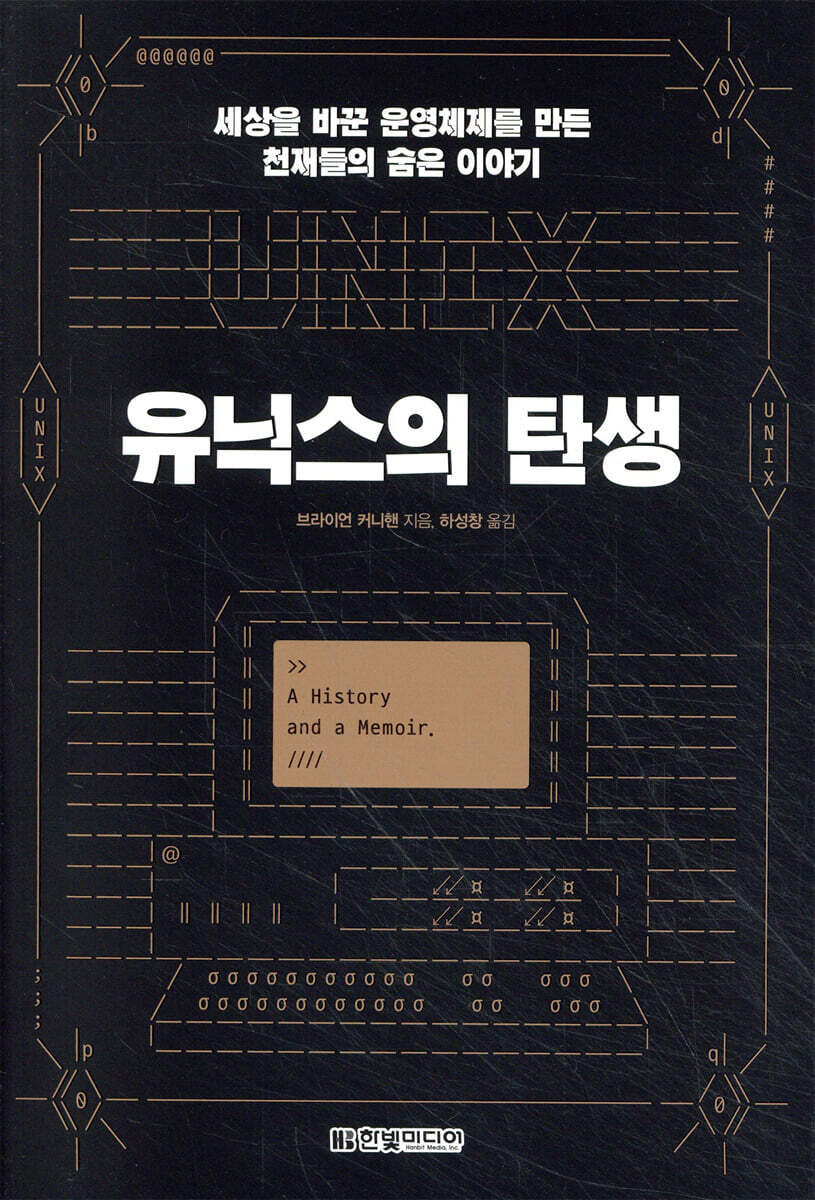
The Birth of Unix
 |
Description
Book Introduction
Brian Kernighan tells us
The birth and development of UNIX, and the stories of its genius developers and contributors.
"The Birth of Unix" is a book that records the history of Unix and is a memoir of those who were involved in the development of Unix.
It meticulously records what Unix is, why it was developed, and what process it went through to develop.
At the same time, it vividly captures the stories of geniuses who challenged countless possibilities while displaying limitless creativity, as well as the Bell Labs site that provided a free research environment.
I hope that as you read this book, you will experience the joy of creating something new and making the world a better place.
The birth and development of UNIX, and the stories of its genius developers and contributors.
"The Birth of Unix" is a book that records the history of Unix and is a memoir of those who were involved in the development of Unix.
It meticulously records what Unix is, why it was developed, and what process it went through to develop.
At the same time, it vividly captures the stories of geniuses who challenged countless possibilities while displaying limitless creativity, as well as the Bell Labs site that provided a free research environment.
I hope that as you read this book, you will experience the joy of creating something new and making the world a better place.
- You can preview some of the book's contents.
Preview
index
Chapter 1 Bell Labs
__ Natural Science Research at Bell Labs
__ Communication Technology and Computer Science
__ Heading to Bell Labs
__ Office Neighbors
__ 137 → 127 → 1127 → 11276
Chapter 2: Unix Prototypes (1969)
__ A little technical background
__CTSS and Multics
__The Origins of Unix
__ Origin of the name
__ Character Exploration: Ken Thompson
Chapter 3: Unix, First Edition (1971)
__ Unix for patent application creation
__ Unix room
__Unix Programmer's Manual
__ A few words about memory
__ Character Exploration: Dennis Ritchie
Chapter 4: Unix, Sixth Edition (1975)
__ file system
__ system call
__ shell
__ pipe
__ grep
__ regular expression
__ C programming language
__ Software tools and ratpo
__ Character Exploration: Douglas McIlroy
Chapter 5: Unix, Seventh Edition (1976–1979)
__ Bourne shell
__ Yacc, Lex, Make
__ Create Document
__ Sed and Awk
__ other languages
__ Other contributions
Chapter 6 Beyond the Lab
__ Programmer's Workbench
__ University License
__ User Groups and Usenix
__ John Lyons' commentary
__ portability
Chapter 7 Commercialization
__ Corporate spin-off
__ USL and SVR4
__ UNIXTM
__ promotional activities
Chapter 8 Descendants
__BSD
__ Unix Wars
__ Minix and Linux
__ Plan 9
__ disbandment
Chapter 9 Legacy
__Technical aspects
__ Organizational aspect
__ Recognition and Evaluation
__ Can history repeat itself?
__ Natural Science Research at Bell Labs
__ Communication Technology and Computer Science
__ Heading to Bell Labs
__ Office Neighbors
__ 137 → 127 → 1127 → 11276
Chapter 2: Unix Prototypes (1969)
__ A little technical background
__CTSS and Multics
__The Origins of Unix
__ Origin of the name
__ Character Exploration: Ken Thompson
Chapter 3: Unix, First Edition (1971)
__ Unix for patent application creation
__ Unix room
__Unix Programmer's Manual
__ A few words about memory
__ Character Exploration: Dennis Ritchie
Chapter 4: Unix, Sixth Edition (1975)
__ file system
__ system call
__ shell
__ pipe
__ grep
__ regular expression
__ C programming language
__ Software tools and ratpo
__ Character Exploration: Douglas McIlroy
Chapter 5: Unix, Seventh Edition (1976–1979)
__ Bourne shell
__ Yacc, Lex, Make
__ Create Document
__ Sed and Awk
__ other languages
__ Other contributions
Chapter 6 Beyond the Lab
__ Programmer's Workbench
__ University License
__ User Groups and Usenix
__ John Lyons' commentary
__ portability
Chapter 7 Commercialization
__ Corporate spin-off
__ USL and SVR4
__ UNIXTM
__ promotional activities
Chapter 8 Descendants
__BSD
__ Unix Wars
__ Minix and Linux
__ Plan 9
__ disbandment
Chapter 9 Legacy
__Technical aspects
__ Organizational aspect
__ Recognition and Evaluation
__ Can history repeat itself?
Into the book
“As I recall, it started with a group of people, including Ken, Dennis, and Peter Neumann, standing at the entrance to the office and talking.
“At the time, the system didn't have a name, so (if I remember correctly) I said that it should be called 'UNICS', based on the Latin root, since Multics offered 'everything', whereas the new system offered at most one feature, which was a pun on 'multi' being replaced with 'uni'.”
--- p.83 From “The Origin of the Name”
“The Unix room was just a fun place, there was always something going on.
Some people worked almost exclusively in the Unix room and rarely used the office, while others stopped by several times a day for coffee or conversation.
“The Unix Room was incredibly important in helping us learn about what our colleagues were working on and fostering and maintaining a sense of community.”
--- p.104 From "Unix Room"
“With the advent of the C language, it became possible to write the entire operating system in a high-level language.
In 1973, work was completed to convert Unix from its original assembly language form to the C language.
This makes the system much easier to maintain and modify.
Another major advancement was the ability to port an operating system from its original PDP-11 computer to other computers with different architectures.
Since most of the system code was written in C, porting the operating system didn't require much more than porting the C compiler.”
--- p.117 From "Character Exploration: Dennis Ritchie"
Douglas is a very good technology critic and is often the first to try out new programs or ideas.
He tested programs and ideas as early as possible and had a keen eye.
His opinions on what was good and what needed to be improved were invaluable.
His office was constantly filled with people seeking advice or critique on just about anything, from ideas and algorithms to programs and documents.
Bjarne Stroustrup would first stop by my office to discuss C++ and explain his new ideas, then walk down the hall to Douglas's office a few rooms away to get some serious feedback on the language design.
--- p.162 From "Character Exploration: Douglas McIlroy"
The size of Bell Labs' organization and the scope of its research demonstrated that it had a large number of experts in every technical area, and that these were often world-leading researchers in their respective fields.
Moreover, the culture of the lab was very cooperative and supportive.
It was perfectly normal procedure to walk into someone's office and ask for help.
In almost all cases, the person asked stepped forward and offered help.
There was also a first-class technical library, open 24/7, with a wide range of journals, and remote access to other libraries.
It was similar to a university library, but focused on science and technology.
“At the time, the system didn't have a name, so (if I remember correctly) I said that it should be called 'UNICS', based on the Latin root, since Multics offered 'everything', whereas the new system offered at most one feature, which was a pun on 'multi' being replaced with 'uni'.”
--- p.83 From “The Origin of the Name”
“The Unix room was just a fun place, there was always something going on.
Some people worked almost exclusively in the Unix room and rarely used the office, while others stopped by several times a day for coffee or conversation.
“The Unix Room was incredibly important in helping us learn about what our colleagues were working on and fostering and maintaining a sense of community.”
--- p.104 From "Unix Room"
“With the advent of the C language, it became possible to write the entire operating system in a high-level language.
In 1973, work was completed to convert Unix from its original assembly language form to the C language.
This makes the system much easier to maintain and modify.
Another major advancement was the ability to port an operating system from its original PDP-11 computer to other computers with different architectures.
Since most of the system code was written in C, porting the operating system didn't require much more than porting the C compiler.”
--- p.117 From "Character Exploration: Dennis Ritchie"
Douglas is a very good technology critic and is often the first to try out new programs or ideas.
He tested programs and ideas as early as possible and had a keen eye.
His opinions on what was good and what needed to be improved were invaluable.
His office was constantly filled with people seeking advice or critique on just about anything, from ideas and algorithms to programs and documents.
Bjarne Stroustrup would first stop by my office to discuss C++ and explain his new ideas, then walk down the hall to Douglas's office a few rooms away to get some serious feedback on the language design.
--- p.162 From "Character Exploration: Douglas McIlroy"
The size of Bell Labs' organization and the scope of its research demonstrated that it had a large number of experts in every technical area, and that these were often world-leading researchers in their respective fields.
Moreover, the culture of the lab was very cooperative and supportive.
It was perfectly normal procedure to walk into someone's office and ask for help.
In almost all cases, the person asked stepped forward and offered help.
There was also a first-class technical library, open 24/7, with a wide range of journals, and remote access to other libraries.
It was similar to a university library, but focused on science and technology.
--- p.305 From “Cooperative Environment”
Publisher's Review
2019 marked the 50th anniversary of the birth of Unix.
To coincide with this, author Brian Kernighan, a living witness to the history of UNIX, having witnessed its birth, development, prosperity, and decline at Bell Labs, published this book, containing facts gathered from various sources as well as his own recollections.
The author first introduces the historical background surrounding Bell Labs before the creation of Unix, and then reveals lesser-known facts such as Bell Labs' organizational structure and evaluation system.
Next, we'll focus on the creation of Unix, focusing on two men: Ken Thompson and Dennis Ritchie, and how their genius elevated existing technology to the pinnacle of operating systems.
Next, we'll take a closer look at Doug McIlroy, a Unix development team manager and unsung hero.
This passage reminds us again of how important a great mentor is in achieving great things.
In addition, the book introduces many anecdotes about how the author and supporting actors contributed to the development of computer technology, starting with Unix.
In fact, they are all great figures in the field of computer science, so it would be meaningful to search for them one by one and read about them.
(...)
I know full well that a friendly and free environment like that of the Bell Labs Unix development team is rare in real life (especially in today's competitive environment).
Still, I think it's sometimes necessary to learn from stories that have produced generational results, like Unix, and dream of the ideal.
I hope everyone, from students aspiring to develop software to those nostalgic for the Unix days, will enjoy this book.
- From the translator's note
Good books to read together (title + ISBN)
Hacker, Rhapsody of Madness (9791162241752)
How Calculators Became Artificial Intelligence (9791162241752)
● "I am a LINE developer" (9791162241752)
How to Live as a Programmer (9791162241387)
To coincide with this, author Brian Kernighan, a living witness to the history of UNIX, having witnessed its birth, development, prosperity, and decline at Bell Labs, published this book, containing facts gathered from various sources as well as his own recollections.
The author first introduces the historical background surrounding Bell Labs before the creation of Unix, and then reveals lesser-known facts such as Bell Labs' organizational structure and evaluation system.
Next, we'll focus on the creation of Unix, focusing on two men: Ken Thompson and Dennis Ritchie, and how their genius elevated existing technology to the pinnacle of operating systems.
Next, we'll take a closer look at Doug McIlroy, a Unix development team manager and unsung hero.
This passage reminds us again of how important a great mentor is in achieving great things.
In addition, the book introduces many anecdotes about how the author and supporting actors contributed to the development of computer technology, starting with Unix.
In fact, they are all great figures in the field of computer science, so it would be meaningful to search for them one by one and read about them.
(...)
I know full well that a friendly and free environment like that of the Bell Labs Unix development team is rare in real life (especially in today's competitive environment).
Still, I think it's sometimes necessary to learn from stories that have produced generational results, like Unix, and dream of the ideal.
I hope everyone, from students aspiring to develop software to those nostalgic for the Unix days, will enjoy this book.
- From the translator's note
Good books to read together (title + ISBN)
Hacker, Rhapsody of Madness (9791162241752)
How Calculators Became Artificial Intelligence (9791162241752)
● "I am a LINE developer" (9791162241752)
How to Live as a Programmer (9791162241387)
GOODS SPECIFICS
- Date of issue: August 3, 2020
- Page count, weight, size: 328 pages | 153*223*30mm
- ISBN13: 9791162243282
- ISBN10: 1162243287
You may also like
카테고리
korean


korean

![GQ KOREA Mark (Monthly): December [2025]](http://librairie.coreenne.fr/cdn/shop/files/8ef265dbbfbf186523ed75ba7319009d.jpg?v=1765340328&width=3840)


