

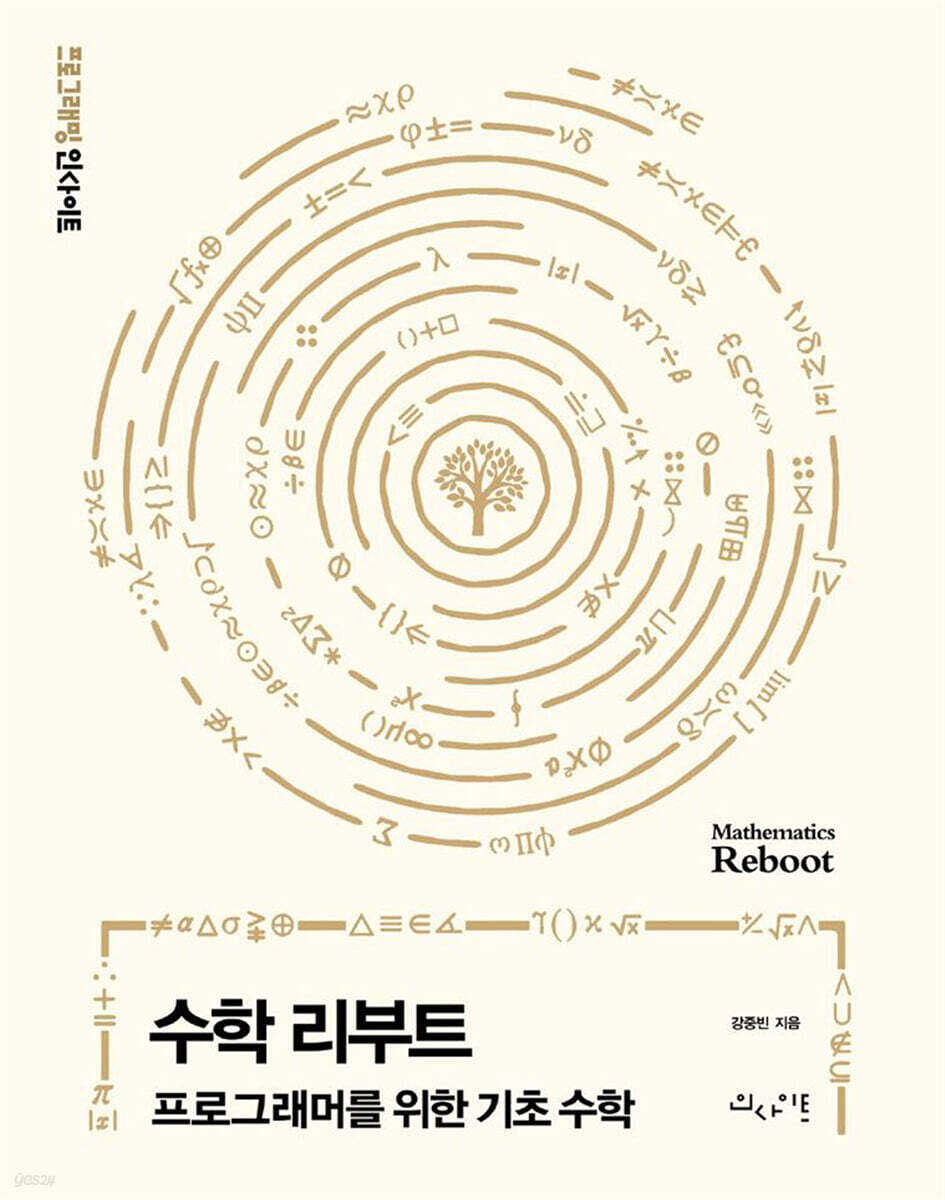
Math Reboot
 |
Description
Book Introduction
It provides a solid foundation in mathematics!
"Math Reboot" began with the idea of serving as a guide for those who want to solidify their mathematical foundations but are unsure of where to start and what to study.
Recently, as artificial intelligence, including deep learning, has become a hot topic, there has been an increase in the number of books covering various mathematical fields related to it. However, many of these books follow the rote learning and memorization method of just pouring in formulas without context, making them difficult to read for those who are not confident in the basics.
This book logically explains the fundamental mathematical concepts necessary for understanding computer science, and also points out their connection to programming.
If you follow the flow of the book and learn it step by step, you will be able to reach the last page without difficulty, as if climbing a spiral staircase.
"Math Reboot" began with the idea of serving as a guide for those who want to solidify their mathematical foundations but are unsure of where to start and what to study.
Recently, as artificial intelligence, including deep learning, has become a hot topic, there has been an increase in the number of books covering various mathematical fields related to it. However, many of these books follow the rote learning and memorization method of just pouring in formulas without context, making them difficult to read for those who are not confident in the basics.
This book logically explains the fundamental mathematical concepts necessary for understanding computer science, and also points out their connection to programming.
If you follow the flow of the book and learn it step by step, you will be able to reach the last page without difficulty, as if climbing a spiral staircase.
- You can preview some of the book's contents.
Preview
index
Part 1
Chapter 1: The Foundations of Logic
1.1 Propositions and Logical Operations
Programming and Mathematics: Programming and Logical Operations
1.2 Types of sets and operations
[Programming and Mathematics] Using Set Data Types
Chapter 2: The Basics of Numbers
2.1 Integer
[Programming and Mathematics] Be Careful with the Range of Integers
2.2 Base method
[Programming and Mathematics] Bitwise Operations
2.3 Rational numbers
[Programming and Mathematics] Using the Rational Number Library
2.4 Irrational numbers and real numbers
Chapter 3: The Basics of Formulas
3.1 Basic form of formula
3.2 Systems of equations and inequalities
3.3 Calculating polynomials
3.4 Quadratic equations
[Programming and Mathematics] Computers and Formula Computation
Chapter 4: Fundamentals of Functions
4.1 Functions and their graphs
[Programming and Mathematics] 'Functional' Programming
4.2 Linear functions and graphs
4.3 Quadratic functions and graphs
[Programming and Mathematics] Graphing Functions
4.4 Rational and irrational functions
4.5 Composite functions and inverse functions
Chapter 5: Fundamentals of Probability and Statistics
5.1 Number of cases
5.2 Probability
5.3 Statistics
[Programming and Mathematics] Monte Carlo Method for Finding Answers Using Statistics
Chapter 6: Basics of Shapes
6.1 Lines and Angles
[Programming and Math] Vector Graphics vs.
Raster graphics
6.2 Triangle I
6.3 Polygons
6.4 Circles and sectors
6.5 Triangle II
6.6 Pythagorean theorem
6.7 Trigonometric Ratios
Chapter 7: The Basics of Large and Small Numbers
7.1 Expansion of square roots and exponents
7.2 Significant Figures and Exponent Notation
7.3 Meaning and properties of logs
[Programming and Mathematics] Algorithm Complexity and Logarithms
7.4 Exponential and Logarithmic Functions
Part 2
Chapter 8 Logic
8.1 Propositions and truth sets
[Programming and Mathematics] Knowledge Representation and Inference
8.2 Sets and Relations
[Programming and Mathematics] 'Relational' Databases
8.3 Proof
Chapter 9: Cases and Probability
9.1 Permutations and Combinations
9.2 Binomial theorem
9.3 Conditional probability and Bayes' theorem
[Programming and Math] Compressing Data with Probability
Chapter 10 Sequences and Limits
10.1 Various sequences
10.2 Sum of a sequence
10.3 Limits of sequences
10.4 Limits of series
10.5 Irrational Number e and Natural Logarithms
[Programming and Mathematics] Calculating Mathematical Functions with Series
Chapter 11 Trigonometric Functions and Complex Numbers
11.1 Trigonometric functions
11.2 Properties of trigonometric functions
11.3 Graphs of Trigonometric Functions
11.4 Complex numbers
11.5 Complex Plane and Polar Form
[Programming and Mathematics] Fractal Structures Made with Complex Numbers
Chapter 12 Vectors and Matrices
12.1 Vectors
12.2 Meaning and operations of matrices
12.3 Properties of matrix multiplication
[Programming and Mathematics] A library for linear algebra calculations
12.4 Examples of using vectors and matrices
Chapter 13 Differential Calculus
13.1 Instantaneous rate of change and differentiation
13.2 Limits of functions
13.3 Calculating derivatives (1)
13.4 Calculating derivatives (2)
13.5 Examples of Differentiation
[Programming and Math] Optimizing with Gradient Descent
Chapter 14 Integration
14.1 Area and definite integrals of a region
14.2 Fundamental Theorem of Calculus
14.3 Calculating Integrals
14.4 Examples of Applications of Integration
[Programming and Mathematics] Calculating Definite Integers Using Computers
Practice Problem Answers
Chapter 1: The Foundations of Logic
1.1 Propositions and Logical Operations
Programming and Mathematics: Programming and Logical Operations
1.2 Types of sets and operations
[Programming and Mathematics] Using Set Data Types
Chapter 2: The Basics of Numbers
2.1 Integer
[Programming and Mathematics] Be Careful with the Range of Integers
2.2 Base method
[Programming and Mathematics] Bitwise Operations
2.3 Rational numbers
[Programming and Mathematics] Using the Rational Number Library
2.4 Irrational numbers and real numbers
Chapter 3: The Basics of Formulas
3.1 Basic form of formula
3.2 Systems of equations and inequalities
3.3 Calculating polynomials
3.4 Quadratic equations
[Programming and Mathematics] Computers and Formula Computation
Chapter 4: Fundamentals of Functions
4.1 Functions and their graphs
[Programming and Mathematics] 'Functional' Programming
4.2 Linear functions and graphs
4.3 Quadratic functions and graphs
[Programming and Mathematics] Graphing Functions
4.4 Rational and irrational functions
4.5 Composite functions and inverse functions
Chapter 5: Fundamentals of Probability and Statistics
5.1 Number of cases
5.2 Probability
5.3 Statistics
[Programming and Mathematics] Monte Carlo Method for Finding Answers Using Statistics
Chapter 6: Basics of Shapes
6.1 Lines and Angles
[Programming and Math] Vector Graphics vs.
Raster graphics
6.2 Triangle I
6.3 Polygons
6.4 Circles and sectors
6.5 Triangle II
6.6 Pythagorean theorem
6.7 Trigonometric Ratios
Chapter 7: The Basics of Large and Small Numbers
7.1 Expansion of square roots and exponents
7.2 Significant Figures and Exponent Notation
7.3 Meaning and properties of logs
[Programming and Mathematics] Algorithm Complexity and Logarithms
7.4 Exponential and Logarithmic Functions
Part 2
Chapter 8 Logic
8.1 Propositions and truth sets
[Programming and Mathematics] Knowledge Representation and Inference
8.2 Sets and Relations
[Programming and Mathematics] 'Relational' Databases
8.3 Proof
Chapter 9: Cases and Probability
9.1 Permutations and Combinations
9.2 Binomial theorem
9.3 Conditional probability and Bayes' theorem
[Programming and Math] Compressing Data with Probability
Chapter 10 Sequences and Limits
10.1 Various sequences
10.2 Sum of a sequence
10.3 Limits of sequences
10.4 Limits of series
10.5 Irrational Number e and Natural Logarithms
[Programming and Mathematics] Calculating Mathematical Functions with Series
Chapter 11 Trigonometric Functions and Complex Numbers
11.1 Trigonometric functions
11.2 Properties of trigonometric functions
11.3 Graphs of Trigonometric Functions
11.4 Complex numbers
11.5 Complex Plane and Polar Form
[Programming and Mathematics] Fractal Structures Made with Complex Numbers
Chapter 12 Vectors and Matrices
12.1 Vectors
12.2 Meaning and operations of matrices
12.3 Properties of matrix multiplication
[Programming and Mathematics] A library for linear algebra calculations
12.4 Examples of using vectors and matrices
Chapter 13 Differential Calculus
13.1 Instantaneous rate of change and differentiation
13.2 Limits of functions
13.3 Calculating derivatives (1)
13.4 Calculating derivatives (2)
13.5 Examples of Differentiation
[Programming and Math] Optimizing with Gradient Descent
Chapter 14 Integration
14.1 Area and definite integrals of a region
14.2 Fundamental Theorem of Calculus
14.3 Calculating Integrals
14.4 Examples of Applications of Integration
[Programming and Mathematics] Calculating Definite Integers Using Computers
Practice Problem Answers
Detailed image

Publisher's Review
〉〉 What this book covers
ㆍLogic
ㆍNumbers and formulas
ㆍFunction
ㆍShapes
ㆍLarge and small numbers
ㆍNumber of cases and probability
ㆍSequences and limits
ㆍTrigonometric functions and complex numbers
ㆍVectors and matrices
ㆍDifferential calculus
ㆍIntegral calculus
ㆍLogic
ㆍNumbers and formulas
ㆍFunction
ㆍShapes
ㆍLarge and small numbers
ㆍNumber of cases and probability
ㆍSequences and limits
ㆍTrigonometric functions and complex numbers
ㆍVectors and matrices
ㆍDifferential calculus
ㆍIntegral calculus
GOODS SPECIFICS
- Date of issue: July 6, 2020
- Page count, weight, size: 748 pages | 1,421g | 188*240*40mm
- ISBN13: 9788966262625
- ISBN10: 8966262627
You may also like
카테고리
korean


korean

![GQ KOREA Mark (Monthly): December [2025]](http://librairie.coreenne.fr/cdn/shop/files/8ef265dbbfbf186523ed75ba7319009d.jpg?v=1765340328&width=3840)


