

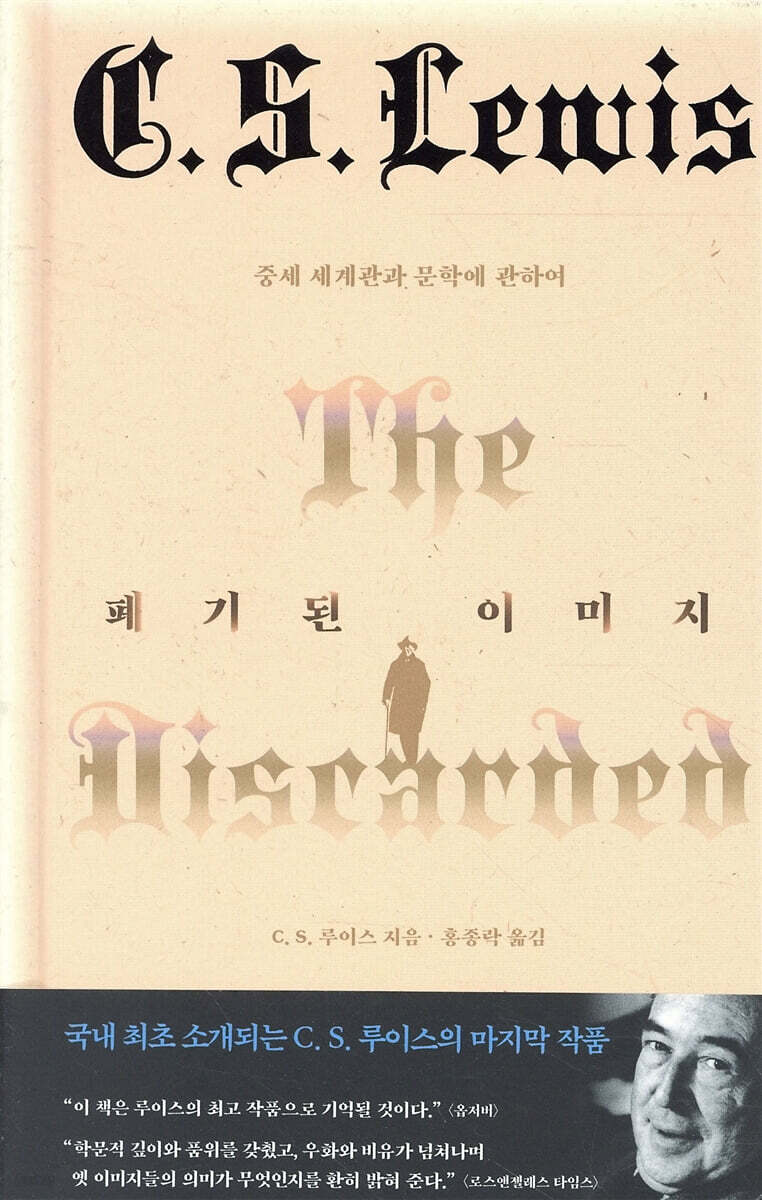
Discarded image
 |
Description
Book Introduction
“This book will be remembered as Lewis’s finest work.” _[Observer]
Lewis's final work, "Discarded Images," is being introduced for the first time in Korea.
C opens another way to read the classics.
S. Lewis's Lecture on the Medieval Worldview
- Courses in Medieval and Renaissance Literature at Oxford University
- 'Narnia', an invitation to the world that served as the backdrop for Lewis's works.
An introduction to medieval and Renaissance literature that reveals Lewis's true colors as an English scholar.
"The Discarded Image," a compilation of Lewis's two most famous lectures at Oxford, "Introduction to Medieval Studies" and "Introduction to Renaissance Studies," is a guide to the medieval worldview that vividly restores the historical and cultural background of medieval and Renaissance literature.
In this book, Lewis presents primary sources from classical, medieval, and Renaissance literature, which he has read extensively, in an accessible and engaging way, persuading the reader that the "model of the universe" created by medieval people was not only the greatest work of art in the Middle Ages but, in a sense, the central work of the Middle Ages.
This cosmic 'image', laid down by classical authors, perfected by medieval people, and having a lasting influence since the Renaissance, is the very essence of medieval synthesis, organizing theology, science, and history into a single, complex and harmonious mental 'cosmic model'.
Because most of the individual works are contained within this cosmic model, and the individual works constantly refer to this model and draw a lot of strength from it.
This book, which has been praised as “the final monumental work of a great scholar, teacher, and wise and noble intellect,” will serve as a guide for you as you enjoy your journey into the forest of classical literature.
Lewis's final work, "Discarded Images," is being introduced for the first time in Korea.
C opens another way to read the classics.
S. Lewis's Lecture on the Medieval Worldview
- Courses in Medieval and Renaissance Literature at Oxford University
- 'Narnia', an invitation to the world that served as the backdrop for Lewis's works.
An introduction to medieval and Renaissance literature that reveals Lewis's true colors as an English scholar.
"The Discarded Image," a compilation of Lewis's two most famous lectures at Oxford, "Introduction to Medieval Studies" and "Introduction to Renaissance Studies," is a guide to the medieval worldview that vividly restores the historical and cultural background of medieval and Renaissance literature.
In this book, Lewis presents primary sources from classical, medieval, and Renaissance literature, which he has read extensively, in an accessible and engaging way, persuading the reader that the "model of the universe" created by medieval people was not only the greatest work of art in the Middle Ages but, in a sense, the central work of the Middle Ages.
This cosmic 'image', laid down by classical authors, perfected by medieval people, and having a lasting influence since the Renaissance, is the very essence of medieval synthesis, organizing theology, science, and history into a single, complex and harmonious mental 'cosmic model'.
Because most of the individual works are contained within this cosmic model, and the individual works constantly refer to this model and draw a lot of strength from it.
This book, which has been praised as “the final monumental work of a great scholar, teacher, and wise and noble intellect,” will serve as a guide for you as you enjoy your journey into the forest of classical literature.
- You can preview some of the book's contents.
Preview
index
Commentary
introduction
i.
medieval situation
ii.
Things to note
iii.
Selected Materials: Classical Period
A. "Scipio's Dream"
B.
Lucanus
C.
Statius, Claudius, and Lady Natura
D.
Apuleius's "On the Gods of Socrates"
iv.
Selected Materials: The Dawn of the Middle Ages
A.
Chalcidius
B.
Macrobius
C.
Pseudo-Dionysius
D.
Boethius
v.
sky
A.
various parts of the universe
B.
The workings of various parts of the universe
C.
inhabitants of various parts of the universe
vi.
Long-lived beings
vii.
Earth and its inhabitants
A.
earth
B.
Beasts
C.
human soul
D.
rational soul
E.
The soul of sense and growth
F.
soul and body
G.
human body
H.
human past
I.
7 liberal arts
viii.
The influence of medieval cosmological models
Reviews
Translator's Note
main
Search
introduction
i.
medieval situation
ii.
Things to note
iii.
Selected Materials: Classical Period
A. "Scipio's Dream"
B.
Lucanus
C.
Statius, Claudius, and Lady Natura
D.
Apuleius's "On the Gods of Socrates"
iv.
Selected Materials: The Dawn of the Middle Ages
A.
Chalcidius
B.
Macrobius
C.
Pseudo-Dionysius
D.
Boethius
v.
sky
A.
various parts of the universe
B.
The workings of various parts of the universe
C.
inhabitants of various parts of the universe
vi.
Long-lived beings
vii.
Earth and its inhabitants
A.
earth
B.
Beasts
C.
human soul
D.
rational soul
E.
The soul of sense and growth
F.
soul and body
G.
human body
H.
human past
I.
7 liberal arts
viii.
The influence of medieval cosmological models
Reviews
Translator's Note
main
Search
Into the book
When we talk about the Middle Ages as an age of authority, we often think of the authority of the church.
However, the Middle Ages was a time when multiple authorities coexisted, not just the authority of the church.
When we view medieval culture as a response to its environment, it reacted most actively to manuscripts among the elements that make up its environment.
Every medieval writer based his writings on an earlier author whenever possible, following a classical author, preferably a Latin one.
This is the difference between the Middle Ages and barbarism, and also the difference between modern civilization.
--- p.30
In terms of main characteristics, medieval man was neither a dreamer nor a wanderer.
He was an organizer, a compiler, a system builder.
He wanted “a place for everything, and everything in its place.”
It was his delight to distinguish, define and diagram.
--- p.36
But, as I see it, there is a third work that can be placed next to the Summa Theologica and the Divine Comedy.
This is the very essence of medieval synthesis, a mental 'model of the universe' that organized their theology, science, and history in a complex and harmonious way.
The two factors I mentioned earlier that influenced the construction of this model are the book-centered nature of their culture and their fervent love of structure.
--- p.37
I want to convince the reader that this 'model of the universe' is not only the greatest work of medieval art, but in some sense the central work of the Middle Ages.
Most of the individual works are contained within this cosmic model, and the individual works constantly refer to this model and draw a great deal of strength from it.
However, the Middle Ages was a time when multiple authorities coexisted, not just the authority of the church.
When we view medieval culture as a response to its environment, it reacted most actively to manuscripts among the elements that make up its environment.
Every medieval writer based his writings on an earlier author whenever possible, following a classical author, preferably a Latin one.
This is the difference between the Middle Ages and barbarism, and also the difference between modern civilization.
--- p.30
In terms of main characteristics, medieval man was neither a dreamer nor a wanderer.
He was an organizer, a compiler, a system builder.
He wanted “a place for everything, and everything in its place.”
It was his delight to distinguish, define and diagram.
--- p.36
But, as I see it, there is a third work that can be placed next to the Summa Theologica and the Divine Comedy.
This is the very essence of medieval synthesis, a mental 'model of the universe' that organized their theology, science, and history in a complex and harmonious way.
The two factors I mentioned earlier that influenced the construction of this model are the book-centered nature of their culture and their fervent love of structure.
--- p.37
I want to convince the reader that this 'model of the universe' is not only the greatest work of medieval art, but in some sense the central work of the Middle Ages.
Most of the individual works are contained within this cosmic model, and the individual works constantly refer to this model and draw a great deal of strength from it.
--- p.39
Publisher's Review
Oxford University Literature Lectures Showcasing Lewis's True Face as an English Literature Scholar
'The greatest Christian apologist of the 20th century' (Time) C.
This is an introduction to medieval and Renaissance literature that shows the true face of S. Lewis as an English scholar.
Lewis's most famous lectures at Oxford University, where he taught from 1925 to 1954 (after moving to Cambridge University), were two series of 16 lectures entitled "Introduction to Medieval Studies" and "Introduction to Renaissance Studies."
In this book, which Lewis completed in 1962 but passed away in 1963 and was published posthumously in 1964, he clearly demonstrates his abilities as a first-class English scholar, possessing both the breadth of his extensive reading and the ability to use a wide range of sources covering almost the entire medieval and Renaissance period, and the detail to present even the most minute details of each source in the right place.
Following his guidance, you get a vivid feeling as if you are looking into the minds of people at that time.
By the late 1930s, he had already established a reputation as an outstanding Oxford lecturer, drawing audiences larger than other lecturers could ever imagine, and this book will give you the experience of attending his lectures live, as if you were there with him, carrying only brief notes and captivating his audience with his fluent lectures.
The "Model of the Universe," the greatest work of the Middle Ages and a central reference point for the Middle Ages
The worldview and world view of the Middle Ages and Renaissance that Lewis reconstructs in a large picture in this book, the 'cosmological model' as he puts it in this book, is a worldview that modern people have rejected and thus discarded, but it is a worldview that Lewis found extremely fascinating and that he studied throughout his life and actively utilized in his writings.
He cites the “Model of the Universe” as the third work that can be placed next to the Summa Theologica (Thomas Aquinas) and the Divine Comedy (Dante), which are representative works of the Middle Ages, and convinces the reader that this “Model of the Universe” is not only the greatest work of art in the Middle Ages, but in some sense, the central work of the Middle Ages.
This is because most of the individual works are contained within this cosmic model, and the individual works constantly refer to this model and draw a lot of strength from it.
And it is argued that two key elements of medieval culture influenced the construction of these models: their book-centered nature and their fervent love of systematics.
Lewis's pursuit of a medieval cosmology cannot be seen as a preference for a particular era, as if the past was the best or the present is superior to the past.
Rather, it is based on his 'philosophy of eternity' that "everything that is not eternal is eternally outdated" (The Four Loves).
In other words, in the zeal of medieval people who were trying to establish a system for a complete world (universe), they discovered a piece of unchanging truth and were fascinated by it.
There is no doubt that the quest for the eternal led Lewis to rediscover his Christian faith and became the backdrop for many of his works, including The Chronicles of Narnia.
A discarded but valid worldview: a window into Lewis's world.
In one essay, Lewis spoke about why we should read old books, recommending, “After reading a new book, read an old one,” or, “If that’s too much, read an old one after reading three new books.”
The reason is that every era has its own perspective, each era has its own truths it grasps particularly well, and each era has its own mistakes it is particularly prone to making, so we need books that will correct the typical mistakes of our time.
That is what old books are, and old books free us from the 'chronological philistinism' and 'worship of modernity' that the new and the latest are always right and better.
In "Discarded Images," readers can discover how the universe and ideas of Plato and Aristotle were accepted, transformed, and flourished in the Middle Ages, exerting influence even in modern times. They can also confirm how the efforts and images of the world depicted in countless literary works to comprehensively view it have continued to impact our world.
The model of the universe that Lewis explored extensively, calling it the "discarded image," not only forces readers to reexamine their current way of thinking, but also invites them to consider what they have lost in the process of coming to think as they do today, and whether there is a way to recover it.
'The greatest Christian apologist of the 20th century' (Time) C.
This is an introduction to medieval and Renaissance literature that shows the true face of S. Lewis as an English scholar.
Lewis's most famous lectures at Oxford University, where he taught from 1925 to 1954 (after moving to Cambridge University), were two series of 16 lectures entitled "Introduction to Medieval Studies" and "Introduction to Renaissance Studies."
In this book, which Lewis completed in 1962 but passed away in 1963 and was published posthumously in 1964, he clearly demonstrates his abilities as a first-class English scholar, possessing both the breadth of his extensive reading and the ability to use a wide range of sources covering almost the entire medieval and Renaissance period, and the detail to present even the most minute details of each source in the right place.
Following his guidance, you get a vivid feeling as if you are looking into the minds of people at that time.
By the late 1930s, he had already established a reputation as an outstanding Oxford lecturer, drawing audiences larger than other lecturers could ever imagine, and this book will give you the experience of attending his lectures live, as if you were there with him, carrying only brief notes and captivating his audience with his fluent lectures.
The "Model of the Universe," the greatest work of the Middle Ages and a central reference point for the Middle Ages
The worldview and world view of the Middle Ages and Renaissance that Lewis reconstructs in a large picture in this book, the 'cosmological model' as he puts it in this book, is a worldview that modern people have rejected and thus discarded, but it is a worldview that Lewis found extremely fascinating and that he studied throughout his life and actively utilized in his writings.
He cites the “Model of the Universe” as the third work that can be placed next to the Summa Theologica (Thomas Aquinas) and the Divine Comedy (Dante), which are representative works of the Middle Ages, and convinces the reader that this “Model of the Universe” is not only the greatest work of art in the Middle Ages, but in some sense, the central work of the Middle Ages.
This is because most of the individual works are contained within this cosmic model, and the individual works constantly refer to this model and draw a lot of strength from it.
And it is argued that two key elements of medieval culture influenced the construction of these models: their book-centered nature and their fervent love of systematics.
Lewis's pursuit of a medieval cosmology cannot be seen as a preference for a particular era, as if the past was the best or the present is superior to the past.
Rather, it is based on his 'philosophy of eternity' that "everything that is not eternal is eternally outdated" (The Four Loves).
In other words, in the zeal of medieval people who were trying to establish a system for a complete world (universe), they discovered a piece of unchanging truth and were fascinated by it.
There is no doubt that the quest for the eternal led Lewis to rediscover his Christian faith and became the backdrop for many of his works, including The Chronicles of Narnia.
A discarded but valid worldview: a window into Lewis's world.
In one essay, Lewis spoke about why we should read old books, recommending, “After reading a new book, read an old one,” or, “If that’s too much, read an old one after reading three new books.”
The reason is that every era has its own perspective, each era has its own truths it grasps particularly well, and each era has its own mistakes it is particularly prone to making, so we need books that will correct the typical mistakes of our time.
That is what old books are, and old books free us from the 'chronological philistinism' and 'worship of modernity' that the new and the latest are always right and better.
In "Discarded Images," readers can discover how the universe and ideas of Plato and Aristotle were accepted, transformed, and flourished in the Middle Ages, exerting influence even in modern times. They can also confirm how the efforts and images of the world depicted in countless literary works to comprehensively view it have continued to impact our world.
The model of the universe that Lewis explored extensively, calling it the "discarded image," not only forces readers to reexamine their current way of thinking, but also invites them to consider what they have lost in the process of coming to think as they do today, and whether there is a way to recover it.
GOODS SPECIFICS
- Date of issue: January 17, 2019
- Format: Hardcover book binding method guide
- Page count, weight, size: 348 pages | 412g | 135*209*30mm
- ISBN13: 9791188255252
- ISBN10: 1188255258
You may also like
카테고리
korean


korean

![GQ KOREA Mark (Monthly): December [2025]](http://librairie.coreenne.fr/cdn/shop/files/8ef265dbbfbf186523ed75ba7319009d.jpg?v=1765340328&width=3840)


