

200 SQL Questions for Beginners (PL/SQL)
 |
Description
Book Introduction
The best way to leverage your data!
Although countless programming-related technologies have emerged over the years, SQL (Structure Query Language) has consistently held its place as the technology for searching and handling data.
『200 SQL Questions for Beginners (PL/SQL)』 consists of 5 parts and 200 examples.
It is structured to help you reach the top ranks of Kaggle by building a solid foundation in SQL through step-by-step examples and running programs yourself, using SQL for machine learning data analysis.
If you install Oracle 19c, which has machine learning capabilities, and learn by entering examples one by one and comparing them with the results in the book, data analysis will soon become easy.
You can learn by connecting to the Oracle database through the SQL*PLUS prompt window via the command prompt of the Windows OS, or you can learn through SQL DEVELOPER.
The sample code and data files included in the book can be downloaded from the data room on the Information Culture Publishing website (infopub.co.kr).
Additionally, you can obtain sufficient knowledge through self-study as you can provide feedback on the author's homepage (cafe.daum.net/oracleoracle) if you have any questions while studying.
Although countless programming-related technologies have emerged over the years, SQL (Structure Query Language) has consistently held its place as the technology for searching and handling data.
『200 SQL Questions for Beginners (PL/SQL)』 consists of 5 parts and 200 examples.
It is structured to help you reach the top ranks of Kaggle by building a solid foundation in SQL through step-by-step examples and running programs yourself, using SQL for machine learning data analysis.
If you install Oracle 19c, which has machine learning capabilities, and learn by entering examples one by one and comparing them with the results in the book, data analysis will soon become easy.
You can learn by connecting to the Oracle database through the SQL*PLUS prompt window via the command prompt of the Windows OS, or you can learn through SQL DEVELOPER.
The sample code and data files included in the book can be downloaded from the data room on the Information Culture Publishing website (infopub.co.kr).
Additionally, you can obtain sufficient knowledge through self-study as you can provide feedback on the author's homepage (cafe.daum.net/oracleoracle) if you have any questions while studying.
- You can preview some of the book's contents.
Preview
index
PART 1: "Introduction" Taking Your First Steps with SQL
Selecting specific columns from table 001
Output all columns from table 002
003 Changing the output column name using column aliases
004 Using the concatenation operator (||)
005 Output by removing duplicate data (DISTINCT)
006 Sorting and outputting data (ORDER BY)
007 Learning the WHERE Clause 1 (Retrieving Numeric Data)
008 Learning the WHERE Clause 2 (Searching for Characters and Dates)
009 Learning Arithmetic Operators (*, /, +, -)
010 Learning Comparison Operators 1(〉, 〈, 〉=, 〈=, =, !=, 〈〉, ^=)
011 Learning Comparison Operators 2 (BETWEEN AND)
012 Learning Comparison Operators 3 (LIKE)
013 Learning Comparison Operators 4 (IS NULL)
014 Learning Comparison Operators 5 (IN)
015 Learning Logical Operators (AND, OR, NOT)
PART 2: Build a Foundation for SQL
016 Learning case conversion functions (UPPER, LOWER, INITCAP)
Extracting specific letters from characters 017 (SUBSTR)
018 Print the length of a string (LENGTH)
019 Output the position of a specific letter in a string (INSTR)
020 Replace a specific spelling with another spelling (REPLACE)
021 Fill in N specific letters (LPAD, RPAD)
022 Trimming specific spellings (TRIM, RTRIM, LTRIM)
023 Rounding and printing (ROUND)
024 TRUNC the number and output it
025 Output the remainder after division (MOD)
026 Print the number of months between dates (MONTHS_BETWEN)
027 Print the date with the number of months added (ADD_MONTHS)
028 Print the date of the day following a specific date (NEXT_DAY)
029 Print the last day of the month with a specific date (LAST_DAY)
030 Converting data type to character type (TO_CHAR)
031 Converting data type to date type (TO_DATE)
032 Understanding Implicit Type Conversion
033 Outputting other data instead of NULL values (NVL, NVL2)
034 Implementing IF Statements in SQL 1 (DECODE)
035 Implementing IF Statements in SQL 2 (CASE)
036 Output the maximum value (MAX)
037 Output the minimum value (MIN)
038 Output the average value (AVG)
039 Output total value (SUM)
040 Print the number of cases (COUNT)
041 Outputting Rankings with Data Analysis Function 1 (RANK)
042 Outputting Ranks with Data Analysis Function 2 (DENSE_RANK)
043 Outputting grades using data analysis function (NTILE)
044 Outputting the Rank Ratio with Data Analysis Function (CUME_DIST)
045 Outputting data horizontally using data analysis function (LISTAGG)
046 Outputting the previous and next rows using data analysis functions (LAG, LEAD)
047 Outputting COLUMN as ROW 1 (SUM+DECODE)
048 Outputting COLUMN as ROW 2 (PIVOT)
Outputting 049 ROW as COLUMN (UNPIVOT)
050 Outputting cumulative data using data analysis function (SUM OVER)
051 Outputting ratios using data analysis functions (RATIO_TO_REPORT)
052 Outputting aggregate results using data analysis function 1 (ROLLUP)
053 Outputting Aggregation Results with Data Analysis Functions 2 (CUBE)
054 Outputting Aggregation Results with Data Analysis Functions 3 (GROUPING SETS)
055 Numbering output results using data analysis function (ROW_NUMBER)
PART 3: Build Your Intermediate SQL Skills
056 Limiting the rows to be printed 1 (ROWNUM)
057 Limiting the number of rows output 2 (Simple TOP-n Queries)
058 Joining and outputting data from multiple tables 1 (EQUI JOIN)
059 Joining and outputting data from multiple tables 2 (NON EQUI JOIN)
060 Joining and outputting data from multiple tables 3 (OUTER JOIN)
061 Joining and outputting data from multiple tables 4 (SELF JOIN)
062 Joining and outputting data from multiple tables 5 (ON clause)
063 Joining and outputting data from multiple tables 5 (USING clause)
064 Joining and outputting data from multiple tables 6 (NATURAL JOIN)
065 Joining and Outputting Data from Multiple Tables 7 (LEFT/RIGHT OUTER JOIN)
066 Joining and outputting data from multiple tables 8 (FULL OUTER JOIN)
067 Connecting data up and down with set operators 1 (UNION ALL)
068 Connecting data up and down with set operators 2 (UNION)
069 Outputting the intersection of data sets using set operators (INTERSECT)
070 Outputting the difference in data using a set operator (MINUS)
071 Using Subqueries 1 (Single-Row Subqueries)
072 Using Subqueries 2 (Multi-Row Subqueries)
073 Using Subqueries 3 (NOT IN)
074 Using Subqueries 4 (EXISTS and NOT EXISTS)
075 Using Subqueries 5 (Subqueries in the HAVING Clause)
076 Using Subqueries 6 (Subqueries in the FROM Clause)
077 Using Subqueries 7 (Subqueries in the SELECT Clause)
078 Entering data (INSERT)
079 Modify data (UPDATE)
080 Deleting data (DELETE, TRUNCATE, DROP)
081 Saving and canceling data (COMMIT, ROLLBACK)
082 Enter, edit, and delete data all at once (MERGE)
083 Understanding LOCK
084 Understanding the SELECT FOR UPDATE Clause
085 Entering data using subqueries
086 Modifying Data Using Subqueries
087 Deleting data using subqueries
088 Merging data using subqueries
089 Outputting data by giving a sequence using a hierarchical query 1
090 Outputting data by giving a sequence using a hierarchical query 2
091 Outputting data by giving a sequence using a hierarchical query 3
092 Outputting data by giving a sequence using a hierarchical query 4
093 Creating a General Table (CREATE TABLE)
094 Creating a Temporary Table (CREATE TEMPORAY TABLE)
095 Simplifying Complex Queries 1 (VIEW)
096 Simplifying Complex Queries 2 (VIEW)
097 Speeding up data retrieval (INDEX)
098 Creating a number that is never duplicated (SEQUENE)
099 Recovering accidentally deleted data 1 (FLASHBACK QUERY)
100 Recovering Accidentally Deleted Data 2 (FLASHBACK TABLE)
101 Recovering Accidentally Deleted Data 3 (FLASHBACK DROP)
102 Recovering Accidentally Deleted Data 4 (FLASHBACK VERSION QUERY)
103 Recovering Accidentally Deleted Data 5 (FLASHBACK TRANSACTION QUERY)
104 Improving Data Quality 1 (PRIMARY KEY)
105 Improving Data Quality 2 (UNIQUE)
106 Improving Data Quality 3 (NOT NULL)
107 Improving Data Quality 4 (CHECK)
108 Improving Data Quality 5 (FOREIGN KEY)
109 Using the WITH Clause 1 (WITH ~ AS)
110 Using the WITH Clause 2 (SUBQUERY FACTORING)
111 Solving Algorithm Problems with SQL 1 (Printing the Multiplication Table 2)
112 Solving Algorithm Problems with SQL 2 (Printing Multiplication Tables 1-9)
113 Solving Algorithm Problems with SQL 3 (Right Triangle Output)
114 Solving Algorithm Problems with SQL 4 (Triangle Output)
115 Solving Algorithm Problems with SQL 5 (Rhombus Output)
116 Solving Algorithm Problems with SQL 6 (Rectangular Output)
117 Solving Algorithm Problems with SQL 7 (Sum of Numbers 1 through 10)
118 Solving Algorithm Problems with SQL 8 (Multiplication of Numbers 1 through 10)
119 Solving Algorithm Problems with SQL 9 (Printing Only Even Numbers from 1 to 10)
120 Solving Algorithm Problems with SQL 10 (Printing only prime numbers from 1 to 10)
121 Solving Algorithm Problems with SQL 11 (Greatest Common Divisor)
Solving Algorithm Problems with SQL 12 (Least Common Multiple)
Solving Algorithm Problems with SQL 123 13 (Pythagorean Theorem)
Solving Algorithm Problems with SQL 14 (Monte Carlo Algorithm)
Solving Algorithm Problems with SQL 125 (Finding Euler's Constant and Natural Constants)
PART 4: "Utilization" Mastering SQL Applications
126 How to load Excel data into a database
127 What is the most common word in Steve Jobs' speeches?
128 Are there more positive or negative words in Steve Jobs' speeches?
129 What day of the week does theft occur the most?
130 Which university has the highest tuition fees in your country?
131 What are the most expensive items and prices in Seoul?
132 Where do most murders occur?
133 What is the biggest type of crime resulting from domestic discord?
134 What is the biggest cause of arson?
135 Where in the country does the most traffic accidents occur?
136 What year had the most chicken restaurant closures?
137 Which country has the longest working hours in the world?
138 What are the most common cancers in men and women?
139 Understanding PL/SQL Variables 1
140 Understanding PL/SQL Variables 2
141 Understanding PL/SQL IF 1 (IF ~ ELSE Statements)
142 Understanding PL/SQL IF 2 (IF ~ ELSIF ~ ELSE Statements)
143 Understanding PL/SQL Basic Loops
144 Understanding PL/SQL While Loops
145 Understanding PL/SQL for Loop
146 Understanding PL/SQL Double Loop Statements
147 Understanding PL/SQL Cursor Statements (BASIC LOOP)
148 Understanding PL/SQL Cursor Statement (FOR LOOP)
149 Understanding the PL/SQL Cursor for Loop Statement
Implementing Procedure 150
Implementing Function 151
152 Implementing Mathematical Expressions 1 (Absolute Value)
153 Implementing Mathematical Expressions 2 (Right Triangles)
154 Implementing Mathematical Expressions 3 (Exponential Functions)
155 Implementing Mathematical Expressions 4 (Log Function)
156 Implementing Mathematical Expressions 5 (Permutations)
157 Implementing Mathematical Expressions 6 (Combination)
158 Implementing Basic Statistics 1 (Average)
159 Implementing Basic Statistics 2 (Median)
160 Implementing Basic Statistics 3 (Mode)
161 Implementing Basic Statistics 4 (Variance and Standard Deviation)
162 Implementing Basic Statistics 5 (Covariance)
163 Implementing Basic Statistics 6 (Correlation Coefficient)
164 Implementing Basic Statistics 7 (Probability 1)
165 Implementing Basic Statistics 8 (Probability 2)
166 Implementing Basic Statistics 9 (Binomial Distribution)
167 Implementing Basic Statistics 10 (Normal Distribution)
168 Solving Algorithm Problems with PL/SQL 1 (Triangle Output)
169 Solving Algorithm Problems with PL/SQL 2 (Rectangular Output)
Solving Algorithm Problems with PL/SQL 3 (Pythagorean Theorem)
Solving Algorithm Problems with PL/SQL 4 (Factorial)
Solving Algorithm Problems with PL/SQL 5 (Greatest Common Divisor)
Solving Algorithm Problems with PL/SQL 6 (Least Common Multiple)
Solving Algorithm Problems with PL/SQL 7 (Bubble Sort)
Solving Algorithm Problems with PL/SQL 8 (Insertion Sort)
Solving Algorithm Problems with PL/SQL 9 (Sequential Search)
Solving Algorithm Problems with PL/SQL 10 (Monte Carlo Algorithm)
Solving Algorithm Problems with PL/SQL 11 (Greedy Algorithm)
PART 5 "Practical": Mastering SQL Practice
179 Implementing Machine Learning with SQL 1 (NAIVEBAYES)
Implementing Machine Learning with SQL 2 (NAIVEBAYES)
Implementing Machine Learning with SQL 3 (NAIVEBAYES)
Implementing Machine Learning with SQL 4 (Decision Tree)
Implementing Machine Learning with SQL 5 (Decision Tree)
Implementing Machine Learning with SQL 6 (RANDOM FOREST)
Implementing Machine Learning with SQL 7 (RANDOM FOREST)
Implementing Machine Learning with SQL 8 (RANDOM FOREST)
187 Implementing Machine Learning with SQL (Neural Networks)
Implementing Machine Learning with SQL 10 (Neural Networks)
Implementing Machine Learning with SQL 11 (Neural Networks)
Implementing Machine Learning with SQL 12 (Support Vector Machine)
Implementing Machine Learning with SQL 13 (Support Vector Machine)
Implementing Machine Learning with SQL 14 (Support Vector Machine)
Implementing Machine Learning with SQL 15 (REGRESSION)
Implementing Machine Learning with SQL 16 (REGRESSION)
Implementing Machine Learning with SQL 17 (Creating Derived Variables)
Implementing Machine Learning with SQL 18 (Creating Derived Variables)
Implementing Machine Learning with SQL 19 (APRIORI)
Implementing Machine Learning with SQL 20 (APRIORI)
Implementing Machine Learning with SQL 21 (K-MEANS)
Implementing Machine Learning with SQL 200 (K-MEANS)
APPENDIX
001 Challenge the top ranks of Kaggle 1
002 Challenge the top ranks of Kaggle 2
Selecting specific columns from table 001
Output all columns from table 002
003 Changing the output column name using column aliases
004 Using the concatenation operator (||)
005 Output by removing duplicate data (DISTINCT)
006 Sorting and outputting data (ORDER BY)
007 Learning the WHERE Clause 1 (Retrieving Numeric Data)
008 Learning the WHERE Clause 2 (Searching for Characters and Dates)
009 Learning Arithmetic Operators (*, /, +, -)
010 Learning Comparison Operators 1(〉, 〈, 〉=, 〈=, =, !=, 〈〉, ^=)
011 Learning Comparison Operators 2 (BETWEEN AND)
012 Learning Comparison Operators 3 (LIKE)
013 Learning Comparison Operators 4 (IS NULL)
014 Learning Comparison Operators 5 (IN)
015 Learning Logical Operators (AND, OR, NOT)
PART 2: Build a Foundation for SQL
016 Learning case conversion functions (UPPER, LOWER, INITCAP)
Extracting specific letters from characters 017 (SUBSTR)
018 Print the length of a string (LENGTH)
019 Output the position of a specific letter in a string (INSTR)
020 Replace a specific spelling with another spelling (REPLACE)
021 Fill in N specific letters (LPAD, RPAD)
022 Trimming specific spellings (TRIM, RTRIM, LTRIM)
023 Rounding and printing (ROUND)
024 TRUNC the number and output it
025 Output the remainder after division (MOD)
026 Print the number of months between dates (MONTHS_BETWEN)
027 Print the date with the number of months added (ADD_MONTHS)
028 Print the date of the day following a specific date (NEXT_DAY)
029 Print the last day of the month with a specific date (LAST_DAY)
030 Converting data type to character type (TO_CHAR)
031 Converting data type to date type (TO_DATE)
032 Understanding Implicit Type Conversion
033 Outputting other data instead of NULL values (NVL, NVL2)
034 Implementing IF Statements in SQL 1 (DECODE)
035 Implementing IF Statements in SQL 2 (CASE)
036 Output the maximum value (MAX)
037 Output the minimum value (MIN)
038 Output the average value (AVG)
039 Output total value (SUM)
040 Print the number of cases (COUNT)
041 Outputting Rankings with Data Analysis Function 1 (RANK)
042 Outputting Ranks with Data Analysis Function 2 (DENSE_RANK)
043 Outputting grades using data analysis function (NTILE)
044 Outputting the Rank Ratio with Data Analysis Function (CUME_DIST)
045 Outputting data horizontally using data analysis function (LISTAGG)
046 Outputting the previous and next rows using data analysis functions (LAG, LEAD)
047 Outputting COLUMN as ROW 1 (SUM+DECODE)
048 Outputting COLUMN as ROW 2 (PIVOT)
Outputting 049 ROW as COLUMN (UNPIVOT)
050 Outputting cumulative data using data analysis function (SUM OVER)
051 Outputting ratios using data analysis functions (RATIO_TO_REPORT)
052 Outputting aggregate results using data analysis function 1 (ROLLUP)
053 Outputting Aggregation Results with Data Analysis Functions 2 (CUBE)
054 Outputting Aggregation Results with Data Analysis Functions 3 (GROUPING SETS)
055 Numbering output results using data analysis function (ROW_NUMBER)
PART 3: Build Your Intermediate SQL Skills
056 Limiting the rows to be printed 1 (ROWNUM)
057 Limiting the number of rows output 2 (Simple TOP-n Queries)
058 Joining and outputting data from multiple tables 1 (EQUI JOIN)
059 Joining and outputting data from multiple tables 2 (NON EQUI JOIN)
060 Joining and outputting data from multiple tables 3 (OUTER JOIN)
061 Joining and outputting data from multiple tables 4 (SELF JOIN)
062 Joining and outputting data from multiple tables 5 (ON clause)
063 Joining and outputting data from multiple tables 5 (USING clause)
064 Joining and outputting data from multiple tables 6 (NATURAL JOIN)
065 Joining and Outputting Data from Multiple Tables 7 (LEFT/RIGHT OUTER JOIN)
066 Joining and outputting data from multiple tables 8 (FULL OUTER JOIN)
067 Connecting data up and down with set operators 1 (UNION ALL)
068 Connecting data up and down with set operators 2 (UNION)
069 Outputting the intersection of data sets using set operators (INTERSECT)
070 Outputting the difference in data using a set operator (MINUS)
071 Using Subqueries 1 (Single-Row Subqueries)
072 Using Subqueries 2 (Multi-Row Subqueries)
073 Using Subqueries 3 (NOT IN)
074 Using Subqueries 4 (EXISTS and NOT EXISTS)
075 Using Subqueries 5 (Subqueries in the HAVING Clause)
076 Using Subqueries 6 (Subqueries in the FROM Clause)
077 Using Subqueries 7 (Subqueries in the SELECT Clause)
078 Entering data (INSERT)
079 Modify data (UPDATE)
080 Deleting data (DELETE, TRUNCATE, DROP)
081 Saving and canceling data (COMMIT, ROLLBACK)
082 Enter, edit, and delete data all at once (MERGE)
083 Understanding LOCK
084 Understanding the SELECT FOR UPDATE Clause
085 Entering data using subqueries
086 Modifying Data Using Subqueries
087 Deleting data using subqueries
088 Merging data using subqueries
089 Outputting data by giving a sequence using a hierarchical query 1
090 Outputting data by giving a sequence using a hierarchical query 2
091 Outputting data by giving a sequence using a hierarchical query 3
092 Outputting data by giving a sequence using a hierarchical query 4
093 Creating a General Table (CREATE TABLE)
094 Creating a Temporary Table (CREATE TEMPORAY TABLE)
095 Simplifying Complex Queries 1 (VIEW)
096 Simplifying Complex Queries 2 (VIEW)
097 Speeding up data retrieval (INDEX)
098 Creating a number that is never duplicated (SEQUENE)
099 Recovering accidentally deleted data 1 (FLASHBACK QUERY)
100 Recovering Accidentally Deleted Data 2 (FLASHBACK TABLE)
101 Recovering Accidentally Deleted Data 3 (FLASHBACK DROP)
102 Recovering Accidentally Deleted Data 4 (FLASHBACK VERSION QUERY)
103 Recovering Accidentally Deleted Data 5 (FLASHBACK TRANSACTION QUERY)
104 Improving Data Quality 1 (PRIMARY KEY)
105 Improving Data Quality 2 (UNIQUE)
106 Improving Data Quality 3 (NOT NULL)
107 Improving Data Quality 4 (CHECK)
108 Improving Data Quality 5 (FOREIGN KEY)
109 Using the WITH Clause 1 (WITH ~ AS)
110 Using the WITH Clause 2 (SUBQUERY FACTORING)
111 Solving Algorithm Problems with SQL 1 (Printing the Multiplication Table 2)
112 Solving Algorithm Problems with SQL 2 (Printing Multiplication Tables 1-9)
113 Solving Algorithm Problems with SQL 3 (Right Triangle Output)
114 Solving Algorithm Problems with SQL 4 (Triangle Output)
115 Solving Algorithm Problems with SQL 5 (Rhombus Output)
116 Solving Algorithm Problems with SQL 6 (Rectangular Output)
117 Solving Algorithm Problems with SQL 7 (Sum of Numbers 1 through 10)
118 Solving Algorithm Problems with SQL 8 (Multiplication of Numbers 1 through 10)
119 Solving Algorithm Problems with SQL 9 (Printing Only Even Numbers from 1 to 10)
120 Solving Algorithm Problems with SQL 10 (Printing only prime numbers from 1 to 10)
121 Solving Algorithm Problems with SQL 11 (Greatest Common Divisor)
Solving Algorithm Problems with SQL 12 (Least Common Multiple)
Solving Algorithm Problems with SQL 123 13 (Pythagorean Theorem)
Solving Algorithm Problems with SQL 14 (Monte Carlo Algorithm)
Solving Algorithm Problems with SQL 125 (Finding Euler's Constant and Natural Constants)
PART 4: "Utilization" Mastering SQL Applications
126 How to load Excel data into a database
127 What is the most common word in Steve Jobs' speeches?
128 Are there more positive or negative words in Steve Jobs' speeches?
129 What day of the week does theft occur the most?
130 Which university has the highest tuition fees in your country?
131 What are the most expensive items and prices in Seoul?
132 Where do most murders occur?
133 What is the biggest type of crime resulting from domestic discord?
134 What is the biggest cause of arson?
135 Where in the country does the most traffic accidents occur?
136 What year had the most chicken restaurant closures?
137 Which country has the longest working hours in the world?
138 What are the most common cancers in men and women?
139 Understanding PL/SQL Variables 1
140 Understanding PL/SQL Variables 2
141 Understanding PL/SQL IF 1 (IF ~ ELSE Statements)
142 Understanding PL/SQL IF 2 (IF ~ ELSIF ~ ELSE Statements)
143 Understanding PL/SQL Basic Loops
144 Understanding PL/SQL While Loops
145 Understanding PL/SQL for Loop
146 Understanding PL/SQL Double Loop Statements
147 Understanding PL/SQL Cursor Statements (BASIC LOOP)
148 Understanding PL/SQL Cursor Statement (FOR LOOP)
149 Understanding the PL/SQL Cursor for Loop Statement
Implementing Procedure 150
Implementing Function 151
152 Implementing Mathematical Expressions 1 (Absolute Value)
153 Implementing Mathematical Expressions 2 (Right Triangles)
154 Implementing Mathematical Expressions 3 (Exponential Functions)
155 Implementing Mathematical Expressions 4 (Log Function)
156 Implementing Mathematical Expressions 5 (Permutations)
157 Implementing Mathematical Expressions 6 (Combination)
158 Implementing Basic Statistics 1 (Average)
159 Implementing Basic Statistics 2 (Median)
160 Implementing Basic Statistics 3 (Mode)
161 Implementing Basic Statistics 4 (Variance and Standard Deviation)
162 Implementing Basic Statistics 5 (Covariance)
163 Implementing Basic Statistics 6 (Correlation Coefficient)
164 Implementing Basic Statistics 7 (Probability 1)
165 Implementing Basic Statistics 8 (Probability 2)
166 Implementing Basic Statistics 9 (Binomial Distribution)
167 Implementing Basic Statistics 10 (Normal Distribution)
168 Solving Algorithm Problems with PL/SQL 1 (Triangle Output)
169 Solving Algorithm Problems with PL/SQL 2 (Rectangular Output)
Solving Algorithm Problems with PL/SQL 3 (Pythagorean Theorem)
Solving Algorithm Problems with PL/SQL 4 (Factorial)
Solving Algorithm Problems with PL/SQL 5 (Greatest Common Divisor)
Solving Algorithm Problems with PL/SQL 6 (Least Common Multiple)
Solving Algorithm Problems with PL/SQL 7 (Bubble Sort)
Solving Algorithm Problems with PL/SQL 8 (Insertion Sort)
Solving Algorithm Problems with PL/SQL 9 (Sequential Search)
Solving Algorithm Problems with PL/SQL 10 (Monte Carlo Algorithm)
Solving Algorithm Problems with PL/SQL 11 (Greedy Algorithm)
PART 5 "Practical": Mastering SQL Practice
179 Implementing Machine Learning with SQL 1 (NAIVEBAYES)
Implementing Machine Learning with SQL 2 (NAIVEBAYES)
Implementing Machine Learning with SQL 3 (NAIVEBAYES)
Implementing Machine Learning with SQL 4 (Decision Tree)
Implementing Machine Learning with SQL 5 (Decision Tree)
Implementing Machine Learning with SQL 6 (RANDOM FOREST)
Implementing Machine Learning with SQL 7 (RANDOM FOREST)
Implementing Machine Learning with SQL 8 (RANDOM FOREST)
187 Implementing Machine Learning with SQL (Neural Networks)
Implementing Machine Learning with SQL 10 (Neural Networks)
Implementing Machine Learning with SQL 11 (Neural Networks)
Implementing Machine Learning with SQL 12 (Support Vector Machine)
Implementing Machine Learning with SQL 13 (Support Vector Machine)
Implementing Machine Learning with SQL 14 (Support Vector Machine)
Implementing Machine Learning with SQL 15 (REGRESSION)
Implementing Machine Learning with SQL 16 (REGRESSION)
Implementing Machine Learning with SQL 17 (Creating Derived Variables)
Implementing Machine Learning with SQL 18 (Creating Derived Variables)
Implementing Machine Learning with SQL 19 (APRIORI)
Implementing Machine Learning with SQL 20 (APRIORI)
Implementing Machine Learning with SQL 21 (K-MEANS)
Implementing Machine Learning with SQL 200 (K-MEANS)
APPENDIX
001 Challenge the top ranks of Kaggle 1
002 Challenge the top ranks of Kaggle 2
Detailed image
Publisher's Review
The best way to leverage your data!
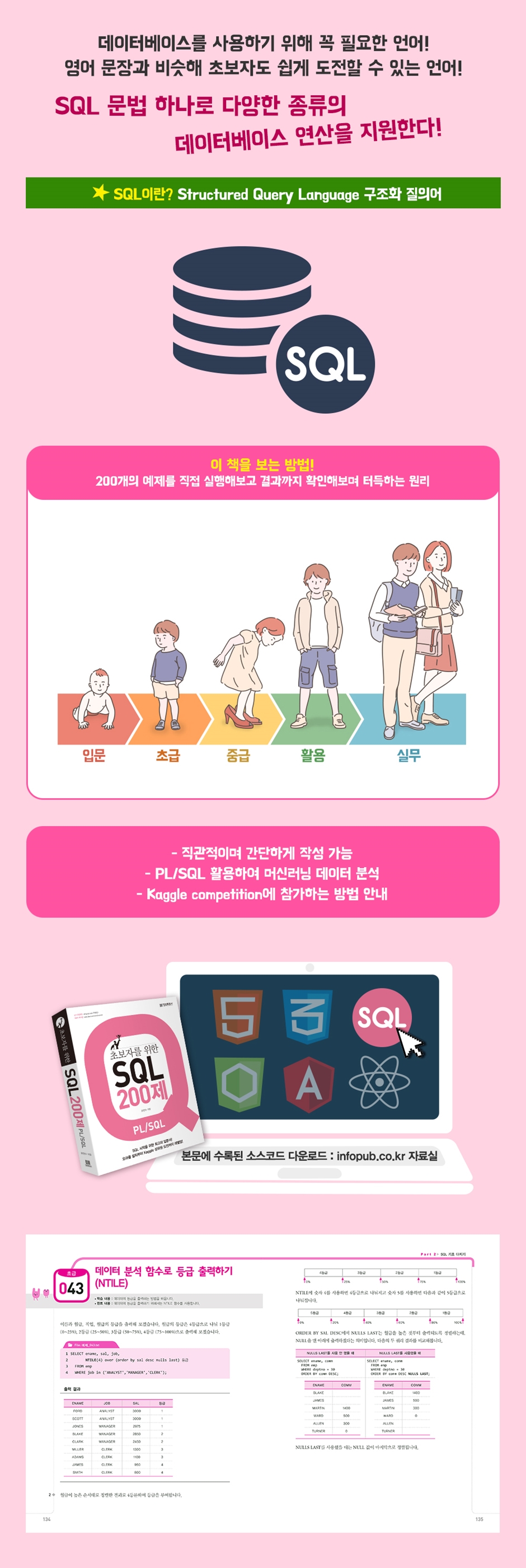
Although countless programming-related technologies have emerged over the years, SQL (Structure Query Language) has consistently held its place as the technology for searching and handling data.
This book consists of five parts and 200 examples.
This course is designed to help you build a solid foundation in SQL through step-by-step examples and practice running programs yourself, enabling you to reach the top ranks of Kaggle with machine learning data analysis using SQL.
If you install Oracle 19c, which includes machine learning capabilities, and learn by entering examples one by one and comparing them with the results in the book, data analysis will soon become easy.
You can learn by connecting to the Oracle database through the SQL*PLUS prompt window via the command prompt of the Windows OS, or you can learn through SQL DEVELOPER.
The sample code and data files included in the book can be downloaded from the data room on the Information Culture Publishing website (infopub.co.kr).
Additionally, you can provide feedback on any questions you may have while studying on the author's website (cafe.daum.net/oracleoracle), so you can acquire the knowledge sufficiently through self-study.
Learn machine learning, data analysis, and even Kaggle challenges in one book!
The power of data is playing a significant role in preventing the spread of COVID-19, which has recently been plaguing the entire world.
The Korea Centers for Disease Control and Prevention collects and analyzes confirmed cases data every day and does its best to prevent the spread.
In addition, SQL is being used in various ways to find answers to social phenomena.
SQL, a powerful language for finding information in databases where all data is stored, is also implementing machine learning with increasingly large amounts of data.
This book will help beginners learn SQL from the grammar and eventually reach a level where they can analyze data.
Additionally, you can naturally approach data management by solving algorithmic problems using PL/SQL.
And if you start learning based on the 30-day scheduler provided for beginners who are feeling overwhelmed, you can experience the experience of getting used to it naturally.
Although countless programming-related technologies have emerged over the years, SQL (Structure Query Language) has consistently held its place as the technology for searching and handling data.
This book consists of five parts and 200 examples.
This course is designed to help you build a solid foundation in SQL through step-by-step examples and practice running programs yourself, enabling you to reach the top ranks of Kaggle with machine learning data analysis using SQL.
If you install Oracle 19c, which includes machine learning capabilities, and learn by entering examples one by one and comparing them with the results in the book, data analysis will soon become easy.
You can learn by connecting to the Oracle database through the SQL*PLUS prompt window via the command prompt of the Windows OS, or you can learn through SQL DEVELOPER.
The sample code and data files included in the book can be downloaded from the data room on the Information Culture Publishing website (infopub.co.kr).
Additionally, you can provide feedback on any questions you may have while studying on the author's website (cafe.daum.net/oracleoracle), so you can acquire the knowledge sufficiently through self-study.
Learn machine learning, data analysis, and even Kaggle challenges in one book!
The power of data is playing a significant role in preventing the spread of COVID-19, which has recently been plaguing the entire world.
The Korea Centers for Disease Control and Prevention collects and analyzes confirmed cases data every day and does its best to prevent the spread.
In addition, SQL is being used in various ways to find answers to social phenomena.
SQL, a powerful language for finding information in databases where all data is stored, is also implementing machine learning with increasingly large amounts of data.
This book will help beginners learn SQL from the grammar and eventually reach a level where they can analyze data.
Additionally, you can naturally approach data management by solving algorithmic problems using PL/SQL.
And if you start learning based on the 30-day scheduler provided for beginners who are feeling overwhelmed, you can experience the experience of getting used to it naturally.
GOODS SPECIFICS
- Date of issue: May 20, 2020
- Page count, weight, size: 580 pages | 1,054g | 187*235*35mm
- ISBN13: 9788956748504
- ISBN10: 8956748500
You may also like
카테고리
korean


korean

![GQ KOREA Mark (Monthly): December [2025]](http://librairie.coreenne.fr/cdn/shop/files/8ef265dbbfbf186523ed75ba7319009d.jpg?v=1765340328&width=3840)


