

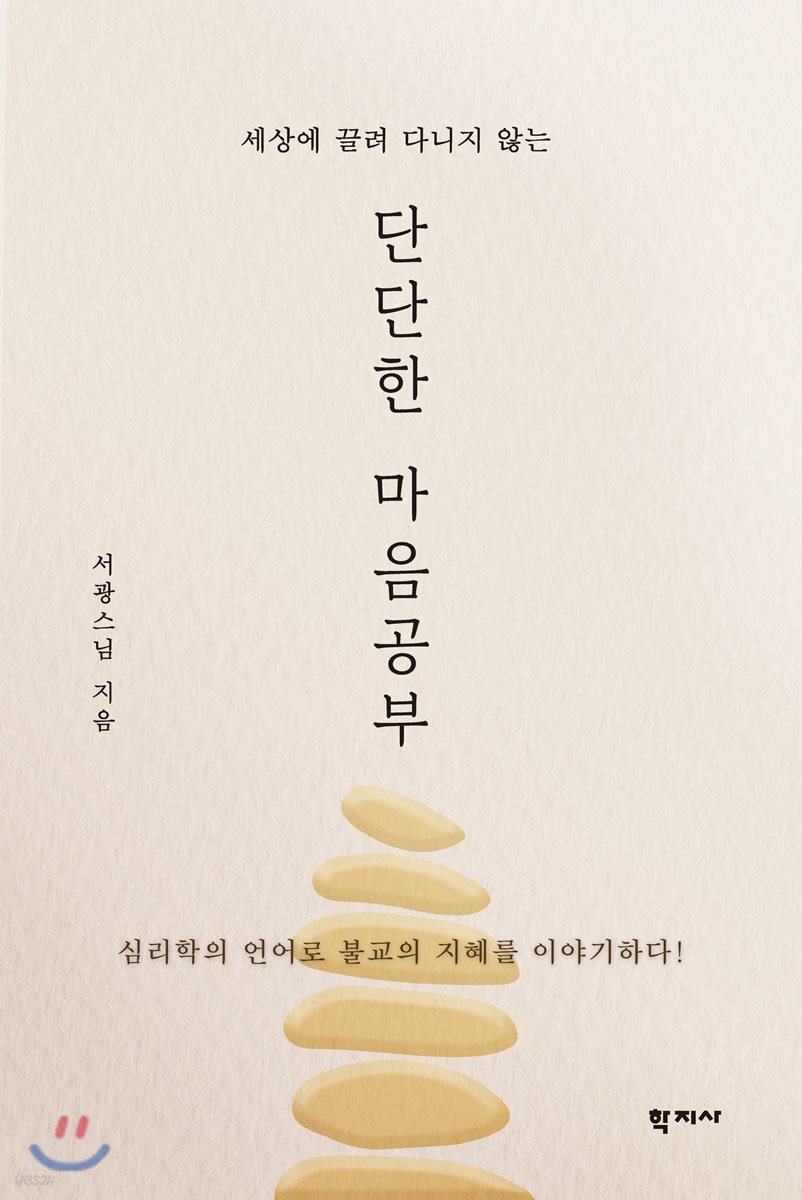
Strong mind study
 |
Description
Book Introduction
Speaking Buddhist Wisdom Through the Language of Psychology
Why do people always live in pain?
The reason can be defined in one word: 'Because we feel, think, and act self-centeredly.
Self-centered behavior causes suffering.
Another cause of suffering is ‘change’.
We instinctively want to hold on to what we want and like, and we want to keep it that way.
But nothing in the world is fixed and unchanging.
So people live in pain.
We need to know our mind well.
Everything we know, feel, judge and think is different.
Instead of saying, 'Why is that person like that?', you need to realize that I understood it differently than he did.
When you 'know' that, you can have true communication.
We must respect the other person's thoughts and respect our own, leaving space and room in between.
This book, "Mind Study," advises everyone to never put an end to life's experiences.
Why do people always live in pain?
The reason can be defined in one word: 'Because we feel, think, and act self-centeredly.
Self-centered behavior causes suffering.
Another cause of suffering is ‘change’.
We instinctively want to hold on to what we want and like, and we want to keep it that way.
But nothing in the world is fixed and unchanging.
So people live in pain.
We need to know our mind well.
Everything we know, feel, judge and think is different.
Instead of saying, 'Why is that person like that?', you need to realize that I understood it differently than he did.
When you 'know' that, you can have true communication.
We must respect the other person's thoughts and respect our own, leaving space and room in between.
This book, "Mind Study," advises everyone to never put an end to life's experiences.
- You can preview some of the book's contents.
Preview
index
Chapter 1 What is consciousness?
Why did the Yusik come into existence?
Why we need food
Love with knowledge!
The psychology of consciousness, essential for modern life
Blueprint of the psychology of consciousness
Chapter 2: How the Mind Comes into Being
Chapter 3: Memory Clearing Method
Awareness is healing
Life is connected only when you connect
Chapter 4 Who am I?
Why are we suffering?
That's not me
Who am I?
Two causes of suffering
The human relationships that protect me
My Self-Consciousness, Good VS Evil
Chapter 5: How to Tune Your Mind
How to check your psychological health
Chapter 6: Question Marks on the Road to Enlightenment
Emotions are expressed through bodily signals.
Chapter 7: Can Personality Be Changed?
Destiny can be changed
Chapter 8: Three Prescriptions for a Happy Life
A trap created by illusion
Chapter 9: Breaking Out of Your Prison
Chapter 10: The Path to Enlightenment
Chapter 11: Ignite the Heart of Wisdom
Chapter 12: It's possible! It's possible! I become a conscious being.
The Five-Step Healing Method of Conscious Psychology
Meditation: How to Use It
Rereading the Conceptual Principles of the 30 Songs of Vijñāna
Why did the Yusik come into existence?
Why we need food
Love with knowledge!
The psychology of consciousness, essential for modern life
Blueprint of the psychology of consciousness
Chapter 2: How the Mind Comes into Being
Chapter 3: Memory Clearing Method
Awareness is healing
Life is connected only when you connect
Chapter 4 Who am I?
Why are we suffering?
That's not me
Who am I?
Two causes of suffering
The human relationships that protect me
My Self-Consciousness, Good VS Evil
Chapter 5: How to Tune Your Mind
How to check your psychological health
Chapter 6: Question Marks on the Road to Enlightenment
Emotions are expressed through bodily signals.
Chapter 7: Can Personality Be Changed?
Destiny can be changed
Chapter 8: Three Prescriptions for a Happy Life
A trap created by illusion
Chapter 9: Breaking Out of Your Prison
Chapter 10: The Path to Enlightenment
Chapter 11: Ignite the Heart of Wisdom
Chapter 12: It's possible! It's possible! I become a conscious being.
The Five-Step Healing Method of Conscious Psychology
Meditation: How to Use It
Rereading the Conceptual Principles of the 30 Songs of Vijñāna
Detailed image

Into the book
“The reason I teach you how to love is because the more you remove the obstacles that stand in your way, the more the world looks different.” (p. 36)
“The subject and object are not as independent and separate as we think, but rather interact with each other in a causal manner.
My thoughts and feelings cause the thoughts and feelings of others, and the thoughts and feelings of others flow directly into my thoughts and feelings.
(Page 49)
“When we look at a Buddha statue or the stars in the sky, we feel sacred not because the Buddha statue or the stars are sacred, but because sacredness exists within us.” (p. 62)
“Generally, the more mentally ill a person is, the more he or she tends to focus on the negative aspects.
“The more you are not loved or have unresolved deficiencies within yourself, the more you will unconsciously be drawn to the negative side.” (p. 63)
“Usually when we get too angry or in pain, we just avoid it.
I have to move my attention quickly because otherwise I feel like I'm going to explode.
Of course, if you can't stand it, it's wise to avoid it.
But it's better if you can face those feelings.
“If you face it head on, you may fall down, but if you have the will to endure and the belief that you can overcome it, you will eventually see self-awareness.” (p. 85)
“Emotional disorder is an emotional disorder that mainly causes difficulty in controlling anger and anxiety.
The stronger the so-called stubbornness, the stronger the obsession with the ego, the more likely it is that emotions will burst out.
“If you touch their pride or self-esteem, their emotions will rise and they will show aggression.” (p. 96)
“Try sitting in a sitting position and straightening your spine.
Take two or three natural breaths, then think of someone you hate very much and hate them very hard.
“It won’t work out.” (p. 103)
“We do not remain in a constantly good or bad psychological state.
And good and bad psychological states never operate at the same time.
These are like the principles that light and darkness cannot coexist.
However, our mind switches between good and bad psychological states so quickly that it seems as if they are operating simultaneously, but this is because it cannot keep up with the speed of the mind.
(Page 123)
“The subject and object are not as independent and separate as we think, but rather interact with each other in a causal manner.
My thoughts and feelings cause the thoughts and feelings of others, and the thoughts and feelings of others flow directly into my thoughts and feelings.
(Page 49)
“When we look at a Buddha statue or the stars in the sky, we feel sacred not because the Buddha statue or the stars are sacred, but because sacredness exists within us.” (p. 62)
“Generally, the more mentally ill a person is, the more he or she tends to focus on the negative aspects.
“The more you are not loved or have unresolved deficiencies within yourself, the more you will unconsciously be drawn to the negative side.” (p. 63)
“Usually when we get too angry or in pain, we just avoid it.
I have to move my attention quickly because otherwise I feel like I'm going to explode.
Of course, if you can't stand it, it's wise to avoid it.
But it's better if you can face those feelings.
“If you face it head on, you may fall down, but if you have the will to endure and the belief that you can overcome it, you will eventually see self-awareness.” (p. 85)
“Emotional disorder is an emotional disorder that mainly causes difficulty in controlling anger and anxiety.
The stronger the so-called stubbornness, the stronger the obsession with the ego, the more likely it is that emotions will burst out.
“If you touch their pride or self-esteem, their emotions will rise and they will show aggression.” (p. 96)
“Try sitting in a sitting position and straightening your spine.
Take two or three natural breaths, then think of someone you hate very much and hate them very hard.
“It won’t work out.” (p. 103)
“We do not remain in a constantly good or bad psychological state.
And good and bad psychological states never operate at the same time.
These are like the principles that light and darkness cannot coexist.
However, our mind switches between good and bad psychological states so quickly that it seems as if they are operating simultaneously, but this is because it cannot keep up with the speed of the mind.
(Page 123)
--- From the text
Publisher's Review
Saving Your Life with Buddhist Psychology
Recently, a new wind has been blowing in Buddhism.
Buddhism, which used to function only as a religion, is now receiving much attention as a 'psychology that cultivates the mind.'
This can be seen as a reflection of the psychology of people who want to find balance in their lives as the influence of digital grows.
In fact, Buddhism is the best explanation of the 'mind-working principles' of people who are suffering, anxious, and worried.
For example, Western psychology distinguishes between you and me and recognizes each as an individual being.
But we cannot know whether the countless experiences of love will come out as love, jealousy, or mercy.
Because the background and conditions may be different.
Rather, the world is closer to the Buddhist worldview that everything is connected rather than individual.
Therefore, Buddhist psychology is attracting the attention of modern people not only for healing the mind but also as a solution to various problems such as human relationships and attitudes toward the world.
The meeting of Buddhist insight, which teaches us how to cultivate and store our spiritual energy, and psychology, which analyzes the complexities of the human mind, may be the most essential compass for modern people living in an age of intense thought.
Buddhist Psychology's Guide to Mind Purification
If you are in a place with a strong smell of cigarettes, your clothes and hair will smell strongly of cigarettes, and everyone you meet will ask if you smoke.
Our life is also like this.
Our unconscious becomes physically and mentally polluted without us even realizing it.
Without my knowledge, the polluted memories are stored in the abyss of my heart, in my memories, where they cannot be found.
Sometimes, when we face unexpected or unwanted situations, we get angry because of our roughly stored memories.
In this book, “Mind Study,” it is said that there are no good or bad memories.
It is impossible to judge until memory is expressed in action.
Because it is a seed that has not sprouted.
If there is enough moisture, rice weevils can emerge from the rice grains and fruit flies can emerge from the garbage.
This is the condition of karma, a profound teaching of Buddhism.
If we are suffering, it is because the conditions have already ripened, so we cannot eliminate suffering by asking why this happened to me.
Instead of asking why or looking for an object of resentment, it is important to become aware of and notice the existence of suffering itself.
The important thing is to be aware.
I need to realize how polluted I am.
We must observe the stored past experiences arising and disappearing in present consciousness.
This is how you purify your memories.
As your memory clears, you can see the other person more clearly.
This means 'seeing from the other person's perspective' or 'seeing the other person as they are'.
When we lose this awareness, our ego quickly kicks in and we turn into a raging bull.
The author of this book, Monk Seo Gwang, a doctor of transpersonal psychology, runs a mind healing program developed using a transpersonal approach based on consciousness-based psychology.
This program was created to help you discover and experience the true happiness of life. It helps you clearly recognize what you are currently experiencing through 'Touch & Let Go' and helps you find a sense of balance in your mind without bias.
Through the 'mind tuning' that you experience through this program, you can achieve unity between body and mind, and adjust emotional imbalance, thought imbalance, and memory imbalance.
In addition, we help people practice well-being for themselves and others through spiritual training, and transition to an eco-centered worldview through a lifelong focus on acting.
How to Use Buddhist Psychology's "Mind Study"
· This book, ‘Mind Study,’ teaches us how to ‘understand myself, understand my neighbors, and understand the world.’
To benefit from this study, I must be able to become aware of and look at my experiences, my memories, and my actions.
This book is not a self-help book that conveys information or is lightly consumed.
This book teaches you how to understand yourself and the outside world by touching your inner self.
I should read it while thinking about what message Buddhism and psychology are giving me.
Focus on being honest about your memories, thoughts, emotions, and feelings that arise at that time, and on becoming aware of and clarifying them.
· This book does not teach difficult Buddhism.
There's no need to open a world map to go from Seoul to Busan.
If you are feeling depressed, distressed, or jealous, it is important to address these issues directly.
From the easy to the necessary.
· This book is based on the 『Yogītāra』, which most perfectly explains the mental processes, functions, and structure of suffering beings, the process of progressing to enlightenment, and the mental structure and functions of an enlightened Buddha.
This book deals with ‘Yusik’ from a psychological perspective.
It's not philosophy.
Philosophy may be sufficient to think, but psychology is not.
Psychological theories are closely linked to psychotherapy.
This book goes beyond Western psychology.
We aim for holistic and total freedom, including our senses, emotions, thoughts, and memories.
Recently, a new wind has been blowing in Buddhism.
Buddhism, which used to function only as a religion, is now receiving much attention as a 'psychology that cultivates the mind.'
This can be seen as a reflection of the psychology of people who want to find balance in their lives as the influence of digital grows.
In fact, Buddhism is the best explanation of the 'mind-working principles' of people who are suffering, anxious, and worried.
For example, Western psychology distinguishes between you and me and recognizes each as an individual being.
But we cannot know whether the countless experiences of love will come out as love, jealousy, or mercy.
Because the background and conditions may be different.
Rather, the world is closer to the Buddhist worldview that everything is connected rather than individual.
Therefore, Buddhist psychology is attracting the attention of modern people not only for healing the mind but also as a solution to various problems such as human relationships and attitudes toward the world.
The meeting of Buddhist insight, which teaches us how to cultivate and store our spiritual energy, and psychology, which analyzes the complexities of the human mind, may be the most essential compass for modern people living in an age of intense thought.
Buddhist Psychology's Guide to Mind Purification
If you are in a place with a strong smell of cigarettes, your clothes and hair will smell strongly of cigarettes, and everyone you meet will ask if you smoke.
Our life is also like this.
Our unconscious becomes physically and mentally polluted without us even realizing it.
Without my knowledge, the polluted memories are stored in the abyss of my heart, in my memories, where they cannot be found.
Sometimes, when we face unexpected or unwanted situations, we get angry because of our roughly stored memories.
In this book, “Mind Study,” it is said that there are no good or bad memories.
It is impossible to judge until memory is expressed in action.
Because it is a seed that has not sprouted.
If there is enough moisture, rice weevils can emerge from the rice grains and fruit flies can emerge from the garbage.
This is the condition of karma, a profound teaching of Buddhism.
If we are suffering, it is because the conditions have already ripened, so we cannot eliminate suffering by asking why this happened to me.
Instead of asking why or looking for an object of resentment, it is important to become aware of and notice the existence of suffering itself.
The important thing is to be aware.
I need to realize how polluted I am.
We must observe the stored past experiences arising and disappearing in present consciousness.
This is how you purify your memories.
As your memory clears, you can see the other person more clearly.
This means 'seeing from the other person's perspective' or 'seeing the other person as they are'.
When we lose this awareness, our ego quickly kicks in and we turn into a raging bull.
The author of this book, Monk Seo Gwang, a doctor of transpersonal psychology, runs a mind healing program developed using a transpersonal approach based on consciousness-based psychology.
This program was created to help you discover and experience the true happiness of life. It helps you clearly recognize what you are currently experiencing through 'Touch & Let Go' and helps you find a sense of balance in your mind without bias.
Through the 'mind tuning' that you experience through this program, you can achieve unity between body and mind, and adjust emotional imbalance, thought imbalance, and memory imbalance.
In addition, we help people practice well-being for themselves and others through spiritual training, and transition to an eco-centered worldview through a lifelong focus on acting.
How to Use Buddhist Psychology's "Mind Study"
· This book, ‘Mind Study,’ teaches us how to ‘understand myself, understand my neighbors, and understand the world.’
To benefit from this study, I must be able to become aware of and look at my experiences, my memories, and my actions.
This book is not a self-help book that conveys information or is lightly consumed.
This book teaches you how to understand yourself and the outside world by touching your inner self.
I should read it while thinking about what message Buddhism and psychology are giving me.
Focus on being honest about your memories, thoughts, emotions, and feelings that arise at that time, and on becoming aware of and clarifying them.
· This book does not teach difficult Buddhism.
There's no need to open a world map to go from Seoul to Busan.
If you are feeling depressed, distressed, or jealous, it is important to address these issues directly.
From the easy to the necessary.
· This book is based on the 『Yogītāra』, which most perfectly explains the mental processes, functions, and structure of suffering beings, the process of progressing to enlightenment, and the mental structure and functions of an enlightened Buddha.
This book deals with ‘Yusik’ from a psychological perspective.
It's not philosophy.
Philosophy may be sufficient to think, but psychology is not.
Psychological theories are closely linked to psychotherapy.
This book goes beyond Western psychology.
We aim for holistic and total freedom, including our senses, emotions, thoughts, and memories.
GOODS SPECIFICS
- Date of issue: January 10, 2019
- Page count, weight, size: 268 pages | 365g | 132*195*20mm
- ISBN13: 9788999717208
- ISBN10: 8999717208
You may also like
카테고리
korean


korean

![GQ KOREA Mark (Monthly): December [2025]](http://librairie.coreenne.fr/cdn/shop/files/8ef265dbbfbf186523ed75ba7319009d.jpg?v=1765340328&width=3840)


