

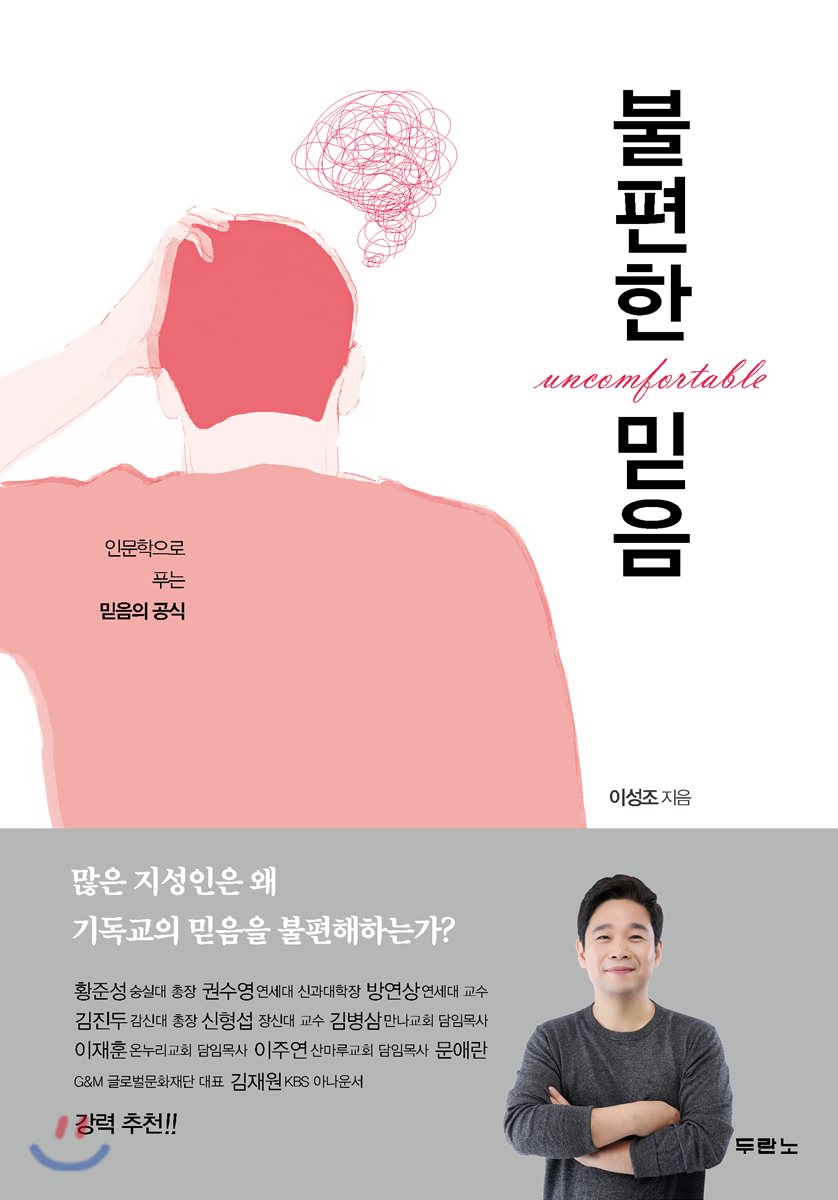
Uncomfortable faith
 |
Description
Book Introduction
Why are many intellectuals uncomfortable with the Christian faith? True faith shatters our comfort. Because it breaks the stable framework of intelligence. But that 'uncomfortable' belief has a surprising power in life. The formula for faith that allows you to live in heaven with an uncomfortable faith Is Christian faith irrational and unintellectual? “You can go to heaven just by believing?!” Many intellectuals are uncomfortable with the Christian faith. Frankly, wouldn't it be a bit upsetting if someone who had done nothing but evil their entire life were to believe in Jesus right before they died and go to heaven? Furthermore, many Christian intellectuals are uncomfortable with the idea that someone who lived a good life would be sent to hell simply for not believing in Jesus. Also, when I see believers who say they believe in God but are more selfish and commit more evil acts than non-believers, I often feel ashamed and angry and want to hide somewhere. Why does Christian faith cause such discomfort in the world today? And is faith as irrational and unintellectual as many people think? |
- You can preview some of the book's contents.
Preview
index
Recommendation
prolog
Chapter 1: If I just believe, I'll go to heaven?
A person who worked for 1 hour and I who worked for 8 hours are the same?
The Formula of Faith That Creates Heaven
Chapter 2 Our Faith vs.
God's love
Love, vulnerability is a power
The meaning of the only begotten son that no one teaches
Chapter 3 What Does It Mean to Believe?
If you believe, it will fall apart
A life of love is eternal life
Chapter 4: The Formula of Faith Solved Through the Humanities
The Second Epistle to the Romans, Les Misérables
The Christian faith that has led human history
Chapter 5: How to Gain the Power of Faith: Standing Before Others
The power of faith begins with tribulation.
Jairus's faith must be broken to be gained
Faith is not confidence, but fear, Peter's faith
The protagonist of heaven, the faith of a robber
Chapter 6: The Power of Faith to Communicate with the World
Can faith change the world?
The real answer lies outside the fence.
prolog
Chapter 1: If I just believe, I'll go to heaven?
A person who worked for 1 hour and I who worked for 8 hours are the same?
The Formula of Faith That Creates Heaven
Chapter 2 Our Faith vs.
God's love
Love, vulnerability is a power
The meaning of the only begotten son that no one teaches
Chapter 3 What Does It Mean to Believe?
If you believe, it will fall apart
A life of love is eternal life
Chapter 4: The Formula of Faith Solved Through the Humanities
The Second Epistle to the Romans, Les Misérables
The Christian faith that has led human history
Chapter 5: How to Gain the Power of Faith: Standing Before Others
The power of faith begins with tribulation.
Jairus's faith must be broken to be gained
Faith is not confidence, but fear, Peter's faith
The protagonist of heaven, the faith of a robber
Chapter 6: The Power of Faith to Communicate with the World
Can faith change the world?
The real answer lies outside the fence.
Into the book
As someone who works to communicate Christianity to non-Christians, especially college students, there is one person I am most grateful to.
It is none other than the great French author Victor Hugo.
I call his novel Les Misérables the second Romans.
This book asks: is there truly a tomorrow in this world filled with war, pain, oppression, and violence? If so, how can we hope for that tomorrow?
This question is actually a theological question.
How can we usher in the kingdom of God in this miserable world through eternal life obtained through faith? How can we live a heavenly life on earth through faith? Someone has the answer to this question.
Ironically, of all these characters, the most miserable was Jean Valjean, who could not even dare to hope for tomorrow.
[Pages 107-108]
A college student poured out his troubles.
The moment you tell your friends that you go to church, you are labeled as a hardened, extreme conservative who lives in his own world.
This is also how the world views the church.
Most Christian intellectuals cite exclusivity and the resulting lack of communication with the world as the causes of the decline of Korean Christianity.
The purpose of faith is not to make the church the kingdom of God.
The church plays the role of light and salt in the world, restoring the world to the kingdom of God.
But can we be the light and salt of the world if we cannot communicate with the world?
[Page 127]
Throughout human history, the ancestors of faith who were justified by faith had something in common.
It means standing in front of a real typist.
There is a batter that needs to be looked at first.
It is the absolute God.
Then, we must stand before the suffering and pain of the people of this land.
So, I have no choice but to shed the infinite love I have received because of the other person's pain and vulnerability.
Because Jean Valjean stood before the bishop and became a sinner, he was able to become a righteous man who poured out his love unconditionally to the hopeless on the streets.
[Page 157]
The greatness of Jairus is that he waited for Jesus until the very end, even in moments of doubt.
I was afraid, doubtful, and even angry because the situation and environment did not go according to my beliefs, but I waited with faith until the end.
Just then, someone arrives from Jairus' house.
“Your daughter just died.
“So don’t bother Jesus any longer.” This means that now that her daughter is dead, there is no need to bother Jesus any longer.
Wasn't this the reason for your faith?
(...)
“I knew it!” Jairus must have wanted to snap at Jesus.
At that moment Jesus speaks.
“Do not be afraid; only believe.” What we should note is that this is the first time Jesus mentioned “faith” to Jairus.
That is the time to truly believe.
When our faith crumbles and everything becomes scary, that's when the faith we have is real faith.
This belief brings about great miracles that we could not have expected or imagined.
[Page 172]
The belief that trust is not based on one's own reason, but on the infinity of God, cannot be learned on a ship.
This belief in trust does not grow within one's comfort zone, where one's own thoughts, efforts, and strength can sufficiently explain it.
The reason is simple.
Because there is really no reason to believe it.
As I walk leisurely on the ground with both feet, I say, 'Lord, I really rely on you.
Saying 'I believe!' is belief, not trust.
Inside the ship, you already have a direction in which you want to go.
You cannot learn trust by rowing diligently in that direction with your own strength and wisdom like the disciples.
As true faith, trust demands a boundary called belief, something beyond that.
It's like taking a step into an ocean whose depth you don't know.
Only then can we truly learn what it means to believe in Jesus.
[Page 179]
It is none other than the great French author Victor Hugo.
I call his novel Les Misérables the second Romans.
This book asks: is there truly a tomorrow in this world filled with war, pain, oppression, and violence? If so, how can we hope for that tomorrow?
This question is actually a theological question.
How can we usher in the kingdom of God in this miserable world through eternal life obtained through faith? How can we live a heavenly life on earth through faith? Someone has the answer to this question.
Ironically, of all these characters, the most miserable was Jean Valjean, who could not even dare to hope for tomorrow.
[Pages 107-108]
A college student poured out his troubles.
The moment you tell your friends that you go to church, you are labeled as a hardened, extreme conservative who lives in his own world.
This is also how the world views the church.
Most Christian intellectuals cite exclusivity and the resulting lack of communication with the world as the causes of the decline of Korean Christianity.
The purpose of faith is not to make the church the kingdom of God.
The church plays the role of light and salt in the world, restoring the world to the kingdom of God.
But can we be the light and salt of the world if we cannot communicate with the world?
[Page 127]
Throughout human history, the ancestors of faith who were justified by faith had something in common.
It means standing in front of a real typist.
There is a batter that needs to be looked at first.
It is the absolute God.
Then, we must stand before the suffering and pain of the people of this land.
So, I have no choice but to shed the infinite love I have received because of the other person's pain and vulnerability.
Because Jean Valjean stood before the bishop and became a sinner, he was able to become a righteous man who poured out his love unconditionally to the hopeless on the streets.
[Page 157]
The greatness of Jairus is that he waited for Jesus until the very end, even in moments of doubt.
I was afraid, doubtful, and even angry because the situation and environment did not go according to my beliefs, but I waited with faith until the end.
Just then, someone arrives from Jairus' house.
“Your daughter just died.
“So don’t bother Jesus any longer.” This means that now that her daughter is dead, there is no need to bother Jesus any longer.
Wasn't this the reason for your faith?
(...)
“I knew it!” Jairus must have wanted to snap at Jesus.
At that moment Jesus speaks.
“Do not be afraid; only believe.” What we should note is that this is the first time Jesus mentioned “faith” to Jairus.
That is the time to truly believe.
When our faith crumbles and everything becomes scary, that's when the faith we have is real faith.
This belief brings about great miracles that we could not have expected or imagined.
[Page 172]
The belief that trust is not based on one's own reason, but on the infinity of God, cannot be learned on a ship.
This belief in trust does not grow within one's comfort zone, where one's own thoughts, efforts, and strength can sufficiently explain it.
The reason is simple.
Because there is really no reason to believe it.
As I walk leisurely on the ground with both feet, I say, 'Lord, I really rely on you.
Saying 'I believe!' is belief, not trust.
Inside the ship, you already have a direction in which you want to go.
You cannot learn trust by rowing diligently in that direction with your own strength and wisdom like the disciples.
As true faith, trust demands a boundary called belief, something beyond that.
It's like taking a step into an ocean whose depth you don't know.
Only then can we truly learn what it means to believe in Jesus.
[Page 179]
--- From the text
Publisher's Review
Why faith is uncomfortable
The author, who engages with the public across the fields of business administration, theology, education, and philosophy, offers a compelling, humanistic perspective on the nature and power of faith at a time when Christianity and faith are being ignored by the world.
The author argues that the reason we feel uncomfortable with faith is not because it is irrational or unintellectual, but because it breaks the stable framework of intellect.
However, doctrinal beliefs that do not cause inconvenience in life (beliefs that are believed out of habit or only in the head) or self-beliefs that are not God-given cannot communicate with the world.
In other words, it has no ability to change the world.
Vulnerability is a skill
The greatest human desire is security.
Christians also become anxious when they cannot grasp many things while believing in Jesus, and they worry when things do not go their way.
This is because the ego has not yet died.
That is, they cannot completely believe in God's love.
But only when our faith is shattered and everything becomes fearful, when we become vulnerable, can we truly learn to have faith.
Our faith begins when, like Peter, we step into the depths of the sea.
Those who possess true faith can enjoy uncertainty.
Live in heaven by faith
This book clearly explains to intellectuals who have lost the power of Christianity or misunderstood the faith due to doctrinal and comfortable beliefs the relationship between believing in Jesus and obtaining eternal life, and what it means to live by faith against the laws of the world.
It helps those who fear the world by relying only on their own thoughts and strength, while always saying they believe, to fight against the laws of the world and win.
A must-read for all intellectuals who stand firm in their faith and seek to transform the world into a paradise.
The author, who engages with the public across the fields of business administration, theology, education, and philosophy, offers a compelling, humanistic perspective on the nature and power of faith at a time when Christianity and faith are being ignored by the world.
The author argues that the reason we feel uncomfortable with faith is not because it is irrational or unintellectual, but because it breaks the stable framework of intellect.
However, doctrinal beliefs that do not cause inconvenience in life (beliefs that are believed out of habit or only in the head) or self-beliefs that are not God-given cannot communicate with the world.
In other words, it has no ability to change the world.
Vulnerability is a skill
The greatest human desire is security.
Christians also become anxious when they cannot grasp many things while believing in Jesus, and they worry when things do not go their way.
This is because the ego has not yet died.
That is, they cannot completely believe in God's love.
But only when our faith is shattered and everything becomes fearful, when we become vulnerable, can we truly learn to have faith.
Our faith begins when, like Peter, we step into the depths of the sea.
Those who possess true faith can enjoy uncertainty.
Live in heaven by faith
This book clearly explains to intellectuals who have lost the power of Christianity or misunderstood the faith due to doctrinal and comfortable beliefs the relationship between believing in Jesus and obtaining eternal life, and what it means to live by faith against the laws of the world.
It helps those who fear the world by relying only on their own thoughts and strength, while always saying they believe, to fight against the laws of the world and win.
A must-read for all intellectuals who stand firm in their faith and seek to transform the world into a paradise.
GOODS SPECIFICS
- Publication date: November 14, 2018
- Page count, weight, size: 224 pages | 318g | 145*210*20mm
- ISBN13: 9788953133396
- ISBN10: 8953133394
You may also like
카테고리
korean


korean

![GQ KOREA Mark (Monthly): December [2025]](http://librairie.coreenne.fr/cdn/shop/files/8ef265dbbfbf186523ed75ba7319009d.jpg?v=1765340328&width=3840)


