

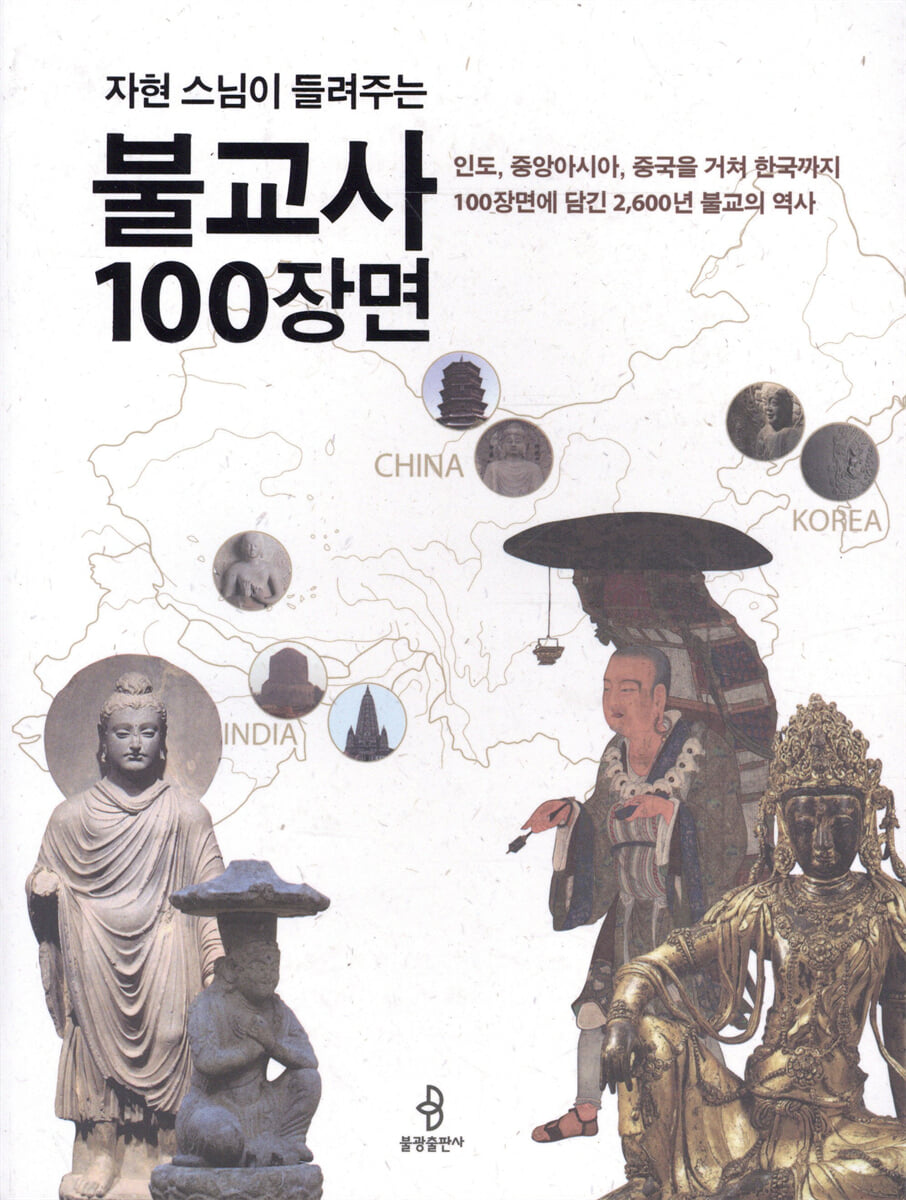
100 Scenes from Buddhist History Told by Monk Ja-Hyeon
 |
Description
Book Introduction
Buddhism: An Essential Guide to Understanding Asian Culture and History
In order to understand Western history and culture more easily and accurately, what you absolutely must know is ‘Greek and Roman mythology’ and ‘Christianity.’
Knowing Greek and Roman mythology makes it easier to understand Western art in general, such as painting and sculpture, and how the Reformation, an event that occurred within Christianity in the 16th and 17th centuries, led to social and political changes in Europe.
In this way, if the ideas that must be known to study history in the West are Greco-Roman mythology and Christianity, then in Asia it is Buddhism.
Buddhism, which originated in India, a region of Asia, about 2,600 years ago, is considered one of many religions today, but in Asia, especially in China and Korea, it was not simply a 'religion' but an ideology.
Especially in the case of Korea, the introduction and recognition of Buddhism meant exchange with China, which was the cultural center of East Asia.
So, by accepting Buddhism, the country's system was reorganized and developed, and by building temples, pagodas, and Buddhist paintings, architectural styles and art were developed.
So, Buddhism was able to remain as the ‘dominant ideology’ until the Joseon Dynasty, when Neo-Confucianism became the mainstream ideology in East Asia.
Therefore, in order to understand our history and culture more easily and accurately, we must understand the development and transformation of Buddhism.
In addition, understanding the development and transformation of Buddhism, from China, which introduced Buddhism to Korea, to India, the origin of Buddhism, can be said to provide a foundation for understanding Korean history and, by extension, East Asian history.
In order to understand Western history and culture more easily and accurately, what you absolutely must know is ‘Greek and Roman mythology’ and ‘Christianity.’
Knowing Greek and Roman mythology makes it easier to understand Western art in general, such as painting and sculpture, and how the Reformation, an event that occurred within Christianity in the 16th and 17th centuries, led to social and political changes in Europe.
In this way, if the ideas that must be known to study history in the West are Greco-Roman mythology and Christianity, then in Asia it is Buddhism.
Buddhism, which originated in India, a region of Asia, about 2,600 years ago, is considered one of many religions today, but in Asia, especially in China and Korea, it was not simply a 'religion' but an ideology.
Especially in the case of Korea, the introduction and recognition of Buddhism meant exchange with China, which was the cultural center of East Asia.
So, by accepting Buddhism, the country's system was reorganized and developed, and by building temples, pagodas, and Buddhist paintings, architectural styles and art were developed.
So, Buddhism was able to remain as the ‘dominant ideology’ until the Joseon Dynasty, when Neo-Confucianism became the mainstream ideology in East Asia.
Therefore, in order to understand our history and culture more easily and accurately, we must understand the development and transformation of Buddhism.
In addition, understanding the development and transformation of Buddhism, from China, which introduced Buddhism to Korea, to India, the origin of Buddhism, can be said to provide a foundation for understanding Korean history and, by extension, East Asian history.
- You can preview some of the book's contents.
Preview
index
introduction
Indian Buddhism
Ⅰ.
The flow of Buddhism's dawn and the background of its birth
001 The Rise of the Indus Civilization and the Aryan Invasion
002 The development of city-states and the formation of new Buddhist sects
003 Differences between Brahmanism and Buddhism on Reincarnation and Liberation
004 The emergence of the military academy and its ideological characteristics
Ⅱ.
The emergence of Buddha and the establishment of Buddhism The life of Buddha and Buddhism
005 Prince of Kapilavastu, the Birth of Buddha
006 Life in the Kingdom and the Fourfold Path
007 Buddha's Leaving Home and Asceticism
008 Buddha's Enlightenment
009 Development of Teachings and Formation of the Church
010 The first teachings of the Buddha
011 The Establishment of the Precepts and the Ten Great Disciples
012 The Flexibility of the Middle Way as Seen Through Replication
013 Buddhism was the first world religion to allow female clergy.
014 The uproar of Devadatta who raised the issue of the five laws
015 Buddha's Nirvana and the Triumph of Rigorism
016 The first council led by Mahakasyapa
017 The relationship between Mahakasyapa and Ananda
Ⅲ.
The development of Buddhism and the emergence of countercurrents. The beginning of sectarian Buddhism.
018 The Cracks That Occurred in Expanding Buddhism
019 King Ashoka's unification of India and promotion of Buddhism
020 Buddhism Re-divides into Twenty Sects
Ⅳ.
The People's Demand for Easy Buddhism and the Emergence of Mahayana Buddhism
021 The Writing of the Scriptures and the Emergence of Mahayana Buddhism
022 Mahayana Buddhism reflecting longing for Buddha
023 People who thought of Buddha centered around the pagoda
024 People who try to see Buddha through Buddha statues
025 Those who understand Buddha as the truth itself
026 Yongsu's public thought and those who follow it
027 Sechin's epistemology and those who follow it
028 The Demand for Atman and the Possibility of Buddha
V.
The Decline and Revival of Indian Buddhism: From the Emergence of Esoteric Buddhism to the New Buddhist Movement
029 Esoteric Buddhism, where Buddha is not the completion but the beginning
030 Buddhism Collapses into Hinduism and Islam
031 The Migration to Tibet and the Rebirth of Buddhism
Chinese Buddhism
Ⅰ.
Buddhism in the early stages of Buddhism entering China
032 The spread of Buddhism began with the development of the Silk Road.
033 The spread of Buddhism to Central Asia
034 The spread of Buddhism to China
035 China's first temple, Baima Temple, and the Forty-Two Chapter Sutra
036 Entry of Foreign Monks and Translation of Sutras
037 The Nomadic Conquest of China and the Spread of Buddhism
Ⅱ.
Buddhism that conquered China Buddhism of the Wei, Jin, Southern and Northern Dynasties
038 Indian Design and Chinese Kumara House
039 Yeosan Hyewon and Personal Gangnam Buddhism
040 Gangbuk Buddhism, where the emperor and Buddha are identified
041 List of scriptures and their lineage
042 Longing for India and a Journey to Seek the Dharma
Ⅲ.
Buddhism Transformed into Chinese Style? Buddhism of the Tang Dynasty
043 The Establishment of a World Empire and the Development of China
044 The problem of numbers and the first Chinese Buddhism, Tiantai sect
045 The World's Most Powerful Tang Dynasty and Buddhism on Mount Jongnam
046 China's greatest true world-class person, Xuanzang
047 Chinese Buddhism Reaching the People
048 China's Only Female Emperor and the Longmen Grottoes
049 Hwaeom Thought: Speaking of True Unity
050 Dharma's Arrival in China and His Longing for Zen
051 Economic Stability and the Revenge of Southern Culture
052 The Development of Esoteric Buddhism and the Stagnation of Thought
053 The Ansa Rebellion, Encouraging the Blossoming of the Southern Clan
054 The most Chinese but not mainstream Zen Buddhism
055 The Embryos of Neo-Confucianism and the Response of Buddhism
056 Problems of Buddhism brought to the surface by the Hoechang Incident
Ⅳ.
The collapse of Buddhism and the Buddhism of the Song, Yuan, Ming, and Qing Dynasties in China
057 The Blooming of Bureaucratic Society and the Institutionalization of Zen Buddhism
058 Criticism of Buddhism in the Southern Song Dynasty and the Han Chinese
059 The Most Powerful Empire in World History and Tibetan Buddhism
060 The emergence of another world citizen within the great empire
061 Buddhism Becomes Part of China
062 Buddhism in Confucian clothing
063 The Emperor Leaving Home, China Falling
Korean Buddhism
Ⅰ.
The introduction of Buddhism and the development of the Three Kingdoms period
064 Buddhism transmitted to the Korean Peninsula
065 Goguryeo and Baekje actively accepted Buddhism
066 Silla was the last of the three kingdoms to adopt Buddhism.
067 Establishing the Foundation of an Ancient Nation through Buddhism
068 The country ruled by King Sudhana and Queen Maya
069 Aspiring for the revival of Baekje based on the belief in Maitreya
070 The Maitreya faith and Won-gwang's five secular precepts combined in Hwarangdo
071 Jajang, who laid the foundation for Silla Buddhism
072 The Appearance of Kim Chun-chu and the Shaking of Buddhism
Ⅱ.
Buddhism in full bloom during the Unified Silla period
073 Outsiders of Silla Buddhism Open a New Era
074 Wonhyo, who tried to resolve division and conflict through the idea of reconciliation
075 Clothing that implemented reform through enlightenment
076 Protecting the country and uniting the scattered people
077 The Princes of Silla Who Became the Flower of Chinese Buddhism
078 Kim Ji-jang, praised as Ksitigarbha Bodhisattva in China
079 Silla people beyond East Asia
080 Practicing Great Unity through the Pure Land
Ⅲ.
The development of Seon Buddhism, a new trend in Silla Buddhism, and the Later Three Kingdoms period
081 Mountain temples and Zen practice, the development of Zen Buddhism
082 The Development of the Gusan Seonmun and the Transition from Silla to Goryeo
083 Later Three Kingdoms, Awakening Maitreya
Ⅳ.
Changes and trends in Goryeo Buddhism Buddhism in the Goryeo Dynasty
084 Goryeo, the country that adopted Buddhism as its state religion
085 Implementation of the Sangha System and Unification of Buddhist Sects
086 The engraving of the Tripitaka Koreana and the publication of Uicheon's textbook
087 Jinul, proclaiming Zen Buddhism, including teachings
088 Ilyeon, who recorded Buddhism in an age of chaos
089 Efforts to purify the mind are being made, centered on the Zen sect.
090 The Dying Light of Buddhist Revival and Goryeo
V.
Buddhism in the Joseon Dynasty: Suppressed Buddhism and the People's Aspirations
091 Consolidation of Buddhist Orders and Reduction of the Number of Temples
092 Buddhism Faces Criticism of Neo-Confucianism
093 The royal family and monks who joined forces to create Hangul
094 The Shadow of Joseon Buddhism Determined by the Gyeongguk Daejeon
095 Queen Munjeong's support of Buddhism and Heo Eung's Buddhist revival
096 Buddhism Burning in the Nation's Crisis
097 The Uncontrolled State and the Development of Buddhism
098 Choeui and Chusa Discuss Tea and Buddhism
099 Buddhism in the late Joseon Dynasty and intellectuals gathered around Buddhism
100 The Light and Darkness of Buddhism during the Japanese Colonial Period and the Establishment of the Jogye Order
Search
Indian Buddhism
Ⅰ.
The flow of Buddhism's dawn and the background of its birth
001 The Rise of the Indus Civilization and the Aryan Invasion
002 The development of city-states and the formation of new Buddhist sects
003 Differences between Brahmanism and Buddhism on Reincarnation and Liberation
004 The emergence of the military academy and its ideological characteristics
Ⅱ.
The emergence of Buddha and the establishment of Buddhism The life of Buddha and Buddhism
005 Prince of Kapilavastu, the Birth of Buddha
006 Life in the Kingdom and the Fourfold Path
007 Buddha's Leaving Home and Asceticism
008 Buddha's Enlightenment
009 Development of Teachings and Formation of the Church
010 The first teachings of the Buddha
011 The Establishment of the Precepts and the Ten Great Disciples
012 The Flexibility of the Middle Way as Seen Through Replication
013 Buddhism was the first world religion to allow female clergy.
014 The uproar of Devadatta who raised the issue of the five laws
015 Buddha's Nirvana and the Triumph of Rigorism
016 The first council led by Mahakasyapa
017 The relationship between Mahakasyapa and Ananda
Ⅲ.
The development of Buddhism and the emergence of countercurrents. The beginning of sectarian Buddhism.
018 The Cracks That Occurred in Expanding Buddhism
019 King Ashoka's unification of India and promotion of Buddhism
020 Buddhism Re-divides into Twenty Sects
Ⅳ.
The People's Demand for Easy Buddhism and the Emergence of Mahayana Buddhism
021 The Writing of the Scriptures and the Emergence of Mahayana Buddhism
022 Mahayana Buddhism reflecting longing for Buddha
023 People who thought of Buddha centered around the pagoda
024 People who try to see Buddha through Buddha statues
025 Those who understand Buddha as the truth itself
026 Yongsu's public thought and those who follow it
027 Sechin's epistemology and those who follow it
028 The Demand for Atman and the Possibility of Buddha
V.
The Decline and Revival of Indian Buddhism: From the Emergence of Esoteric Buddhism to the New Buddhist Movement
029 Esoteric Buddhism, where Buddha is not the completion but the beginning
030 Buddhism Collapses into Hinduism and Islam
031 The Migration to Tibet and the Rebirth of Buddhism
Chinese Buddhism
Ⅰ.
Buddhism in the early stages of Buddhism entering China
032 The spread of Buddhism began with the development of the Silk Road.
033 The spread of Buddhism to Central Asia
034 The spread of Buddhism to China
035 China's first temple, Baima Temple, and the Forty-Two Chapter Sutra
036 Entry of Foreign Monks and Translation of Sutras
037 The Nomadic Conquest of China and the Spread of Buddhism
Ⅱ.
Buddhism that conquered China Buddhism of the Wei, Jin, Southern and Northern Dynasties
038 Indian Design and Chinese Kumara House
039 Yeosan Hyewon and Personal Gangnam Buddhism
040 Gangbuk Buddhism, where the emperor and Buddha are identified
041 List of scriptures and their lineage
042 Longing for India and a Journey to Seek the Dharma
Ⅲ.
Buddhism Transformed into Chinese Style? Buddhism of the Tang Dynasty
043 The Establishment of a World Empire and the Development of China
044 The problem of numbers and the first Chinese Buddhism, Tiantai sect
045 The World's Most Powerful Tang Dynasty and Buddhism on Mount Jongnam
046 China's greatest true world-class person, Xuanzang
047 Chinese Buddhism Reaching the People
048 China's Only Female Emperor and the Longmen Grottoes
049 Hwaeom Thought: Speaking of True Unity
050 Dharma's Arrival in China and His Longing for Zen
051 Economic Stability and the Revenge of Southern Culture
052 The Development of Esoteric Buddhism and the Stagnation of Thought
053 The Ansa Rebellion, Encouraging the Blossoming of the Southern Clan
054 The most Chinese but not mainstream Zen Buddhism
055 The Embryos of Neo-Confucianism and the Response of Buddhism
056 Problems of Buddhism brought to the surface by the Hoechang Incident
Ⅳ.
The collapse of Buddhism and the Buddhism of the Song, Yuan, Ming, and Qing Dynasties in China
057 The Blooming of Bureaucratic Society and the Institutionalization of Zen Buddhism
058 Criticism of Buddhism in the Southern Song Dynasty and the Han Chinese
059 The Most Powerful Empire in World History and Tibetan Buddhism
060 The emergence of another world citizen within the great empire
061 Buddhism Becomes Part of China
062 Buddhism in Confucian clothing
063 The Emperor Leaving Home, China Falling
Korean Buddhism
Ⅰ.
The introduction of Buddhism and the development of the Three Kingdoms period
064 Buddhism transmitted to the Korean Peninsula
065 Goguryeo and Baekje actively accepted Buddhism
066 Silla was the last of the three kingdoms to adopt Buddhism.
067 Establishing the Foundation of an Ancient Nation through Buddhism
068 The country ruled by King Sudhana and Queen Maya
069 Aspiring for the revival of Baekje based on the belief in Maitreya
070 The Maitreya faith and Won-gwang's five secular precepts combined in Hwarangdo
071 Jajang, who laid the foundation for Silla Buddhism
072 The Appearance of Kim Chun-chu and the Shaking of Buddhism
Ⅱ.
Buddhism in full bloom during the Unified Silla period
073 Outsiders of Silla Buddhism Open a New Era
074 Wonhyo, who tried to resolve division and conflict through the idea of reconciliation
075 Clothing that implemented reform through enlightenment
076 Protecting the country and uniting the scattered people
077 The Princes of Silla Who Became the Flower of Chinese Buddhism
078 Kim Ji-jang, praised as Ksitigarbha Bodhisattva in China
079 Silla people beyond East Asia
080 Practicing Great Unity through the Pure Land
Ⅲ.
The development of Seon Buddhism, a new trend in Silla Buddhism, and the Later Three Kingdoms period
081 Mountain temples and Zen practice, the development of Zen Buddhism
082 The Development of the Gusan Seonmun and the Transition from Silla to Goryeo
083 Later Three Kingdoms, Awakening Maitreya
Ⅳ.
Changes and trends in Goryeo Buddhism Buddhism in the Goryeo Dynasty
084 Goryeo, the country that adopted Buddhism as its state religion
085 Implementation of the Sangha System and Unification of Buddhist Sects
086 The engraving of the Tripitaka Koreana and the publication of Uicheon's textbook
087 Jinul, proclaiming Zen Buddhism, including teachings
088 Ilyeon, who recorded Buddhism in an age of chaos
089 Efforts to purify the mind are being made, centered on the Zen sect.
090 The Dying Light of Buddhist Revival and Goryeo
V.
Buddhism in the Joseon Dynasty: Suppressed Buddhism and the People's Aspirations
091 Consolidation of Buddhist Orders and Reduction of the Number of Temples
092 Buddhism Faces Criticism of Neo-Confucianism
093 The royal family and monks who joined forces to create Hangul
094 The Shadow of Joseon Buddhism Determined by the Gyeongguk Daejeon
095 Queen Munjeong's support of Buddhism and Heo Eung's Buddhist revival
096 Buddhism Burning in the Nation's Crisis
097 The Uncontrolled State and the Development of Buddhism
098 Choeui and Chusa Discuss Tea and Buddhism
099 Buddhism in the late Joseon Dynasty and intellectuals gathered around Buddhism
100 The Light and Darkness of Buddhism during the Japanese Colonial Period and the Establishment of the Jogye Order
Search
Detailed image
Into the book
Personal computers have limited storage capacity, but when you access the Internet through Explorer, you encounter infinity beyond finiteness.
In Brahmanism, this is called the union of Atman (我) and Brahman (梵), or 'Brahma-Il-Yeo (梵我一如).
When the individual Atman and the creator Brahman become one, Atman, which is bound to change and finiteness, is reborn into infinite and unchanging freedom.
This is liberation from bondage, and its object is the endlessly turning wheel of repetition, that is, reincarnation.
This is the conclusion of the religion and philosophy of the Upanishads.
However, this logic requires the premise of ‘God as Creator.’
Ultimately, if the existence of God cannot be proven, then this argument is flawed and the entire logical structure collapses.
In fact, the existence of God has been accepted through faith and belief since time immemorial, but it cannot be proven.
That is why the problem cannot be avoided.
From this perspective, Buddhism rules out the existence of an unverifiable god.
In that case, neither Atman, Brahman, nor the structure of the Oneness of the Self can be established.
The alternative presented is An-Atman, the 'changing entity'.
And when we realize this change, I believe that humans will attain complete freedom like the wind.
In the end, there is a fundamental difference between the liberation that Buddhism speaks of and the liberation that Brahmanism speaks of.
- 003.
Differences between Brahmanism and Buddhism on reincarnation and liberation (pp. 30-31)
It appears that Mahakasyapa came to dominate the religious order because the monks from Rajagaha who followed Sariputra and Maudgalyayana tacitly supported Mahakasyapa, who was also from the vicinity of Rajagaha.
In fact, in Volume 32 of the 『Mākassāṇāṇā Vinaya』, it is recorded that when Mahakassapa led the first council to organize the Buddha's teachings, he placed the Buddha's seat in the center and symbolically placed the seats of Sariputra and Maudgalyayana on either side of it.
This means that Mahakasyapa became the leader of the Buddhist sect by embracing the supporters of Sariputra and Maudgalyayana.
- 015.
Buddha's Nirvana and the Triumph of Rigorism (pp. 87-88)
The establishment and development of sectarian Buddhism signifies competition within Buddhism.
Because of this, Buddhism becomes increasingly detailed and difficult.
It will be easy to understand if you think about how, as Buddhist studies develop, they focus on increasingly smaller conceptual differences, and these become the mainstream of the discipline.
As sectarian Buddhism continued to develop, monks became increasingly isolated from the lives of the common people.
At this time, some people began to advocate religious reform, pointing out that the reason Buddha began to spread the Dharma after attaining enlightenment was to educate the people.
The Mahayana Buddhist movement was started by them.
- 020.
Buddhism Re-divides into Twenty Sects (p. 116)
The 'An' of An Shigao, a monk who translated the scriptures in the early days of Chinese Buddhism, refers to the country of Anshi, or Parthia.
Ansego is a monk named Sego from Anshikguk.
Another early monk, Jiru Gacam, was from the Yuezhi Kingdom, the Kushan Kingdom.
In addition, there are also Kang Mengxiang and Kang Seunghoe, who were from Kangju State in present-day East Turkestan.
And the monk from India indicated it by inserting the character 'chuk' from India.
Examples of this include the Chukbeopran and Chuksakbul.
Also, sometimes, the character ‘Buddha’ was added, such as in ‘Buddha Dojeong’.
Looking at it this way, we can also see that there has been a Chinese cultural judgment on Buddhism in China since the beginning.
- 036.
The Entry of Foreign Monks and the Translation of Sutras (pp. 192-193)
The period during which Beop-gwa was a Taoist monk was from 396 to 398, and in Volume 114 of the Book of Wei, “Stone Record,” there is a record of some surprising words that Beop-gwa said during this period.
That is, “Taejo is a monarch who loves Buddhism, so the emperor is the current Buddha.
Therefore, the passage says, “The monks must be respectful.”
Besides, “He who extends the way to the people is a monarch.
There is also a line that says, “I do not bow to the emperor, but to Buddha.”
This is quite a contrast when we consider that at a slightly later time in Gangnam, Hye-won was developing the 『Samunbulgyeong Prince Theory』.
Buddhism in Gangbuk, like Gangnam, gave up on operating an independent religious order and chose the safe path of being subordinate to the government and receiving protection.
- 040.
Gangbuk Buddhism, where the emperor and Buddha are identified (p. 220)
Samgyegyo became explosively popular during the war as a religious community based on self-sacrifice.
However, after the establishment of the Su?dang unified empire, these relief activities became targets of suppression due to the risk of inciting resentment against the state system.
Furthermore, the criticism that the teachings of all sects except Samgyegyo are wrong has also caused a backlash within Chinese Buddhism.
Eventually, as the party entered its mid-term, the Samgyegyo completely disappeared.
Even during China's Spring and Autumn Period and the Warring States Period, there was Mohism, which competed with Confucianism.
Mohism also took action for the poor and the collective rather than for individuals.
As a result, it was popular enough to put pressure on Confucianism during the turbulent Warring States period, but it disappeared under state oppression during the unified empire of the Qin and Han dynasties.
Today, religious relief activities are encouraged by the state, but in dynastic societies, they were easily perceived as actions that threatened the ruling class.
Looking at it this way, we can say that the Samgyegyo is a Buddhist re-emergence of the problems and demands experienced by the Chinese people during the chaotic period of the Wei, Jin, Southern and Northern Dynasties.
- 047.
Chinese Buddhism Approaching the People (pp. 264-265)
Both Brahmanism and Hinduism in India are secular religions.
That's why rites of passage have developed.
Confucianism also has highly developed rites of passage from the perspective of etiquette.
This can be confirmed through the Book of Rites in the Five Classics and the Book of Rites in Neo-Confucianism.
The fact that Buddhism does not have its own rites of passage means that Confucian values continued to be utilized in relation to rites of passage even during the Buddhist era.
In other words, Confucianism continued to maintain a relationship with the people through rites of passage.
This becomes the basic background for the revival of Confucianism when Buddhism weakens.
- 055.
The Embryos of Neo-Confucianism and Buddhism's Response (p. 304)
In a situation where Chinese Buddhism is no longer able to create new trends and is stagnant, the fact that its energy has shifted to Neo-Confucianism means two things.
First, there was a lack of driving energy within Chinese Buddhism, and second, as Yangmingism replaced Zen Buddhism, it became difficult for Zen Buddhism to develop.
This can be said to virtually mean the 'end of East Asian Buddhism.'
In reality, the four great monks of the late Ming Dynasty were not figures who promoted new energy, but rather figures who comprehensively rejected existing values.
At that time, Chinese Buddhism was too weak to lead changes that suited the times and enlighten society.
- 062.
Buddhism in Confucian Clothing (p. 348)
However, according to Volume 4 of the Samguk Sagi, “Silla Annals,” etc., King Jinpyeong’s name was Baekjeong (白淨) and his wife was Lady Maya.
Baekjeong is another name for Jeongban, the father of Sakyamuni.
In other words, the names of King Jinpyeong and his wife are the same as those of King Jeongpan and Queen Maya, the parents of Sakyamuni.
In addition, according to the “Nine-story Wooden Pagoda of Hwangryongsa Temple” in Volume 3 of the “Memorabilia of the Three Kingdoms,” the Silla royal family was recorded to be of the same Indian Chaljeli tribe as Sakyamuni, that is, the Kshatriya class.
This can be understood as an attempt to secure Buddhist legitimacy and legitimacy by placing the Buddhistization of the Silla royal family in a relationship with Buddha, in the same context as the theory of the divine right of kings.
By borrowing the name of the Silla royal family and associating the Silla royal family with the Kshatriya, the highest caste that ruled India along with the Brahmans, Silla attempted to stabilize its royal authority and promote national development.
The idea that the royal family of Silla is the clan of Shakyamuni is called the ‘Shakyamuni True Seed Theory’.
- 068.
The country ruled by King Sudhana and Queen Maya (pp. 380-381)
Because China has traditionally been an agricultural culture, sowing in spring and harvesting in autumn are important.
I valued it.
Therefore, the aspect representing the flow of time, namely the Spring and Autumn Period, came to mean history, and the age of humans also came to be called the Spring and Autumn Period.
In other words, 'Spring and Autumn Annals' is used to mean both the history of a nation and the history of an individual.
In addition, the Spring and Autumn Annals is one of the Five Classics (五經) along with the Book of Songs, the Book of Documents, the Book of Changes (I Ching), and the Book of Rites.
This representative Confucian classic appears under the name of Kim Chun-chu.
As mentioned earlier, Kim Chun-chu's uncle's name was Yongsu, a very Buddhist name meaning Yongsu Bodhisattva, the founder of the Indian Madhyamaka school.
However, the Spring and Autumn Annals, one generation later, differ greatly in that they are entirely Confucian names.
Through this, we can speculate that the development of Buddhism during the reigns of King Jinpyeong and Queen Seondeok may have actually led to some opposition to Buddhism.
- 072.
The Rise of Kim Chun-chu and the Rising of Buddhism (pp. 400-401)
Of course, within Buddhism, there was a conflict between the aristocratic sect that was the forerunner and the commoner Seon sect that came later.
It was natural that Wang Geon, the founder of the new dynasty, would be drawn to Seon Buddhism, which advocated human equality, saying that "anyone can become Buddha if they just enlighten their mind."
This is because, just as in Zen Buddhism, one can become a Buddha by enlightening one's mind, it can be argued that Wang Geon, who was not a member of the royal family, became a founding monarch through great effort.
In other words, Seon Buddhism provided an ideology that was advantageous for establishing Wang Geon's legitimacy as a monarch.
- 084.
Goryeo, the country that adopted Buddhism as its state religion (p. 472)
The fact that Buddhism, despite being suppressed by government policy during the Joseon Dynasty, remains Korea's representative religion to this day shows that the decline of Buddhism during this period was not solely due to state suppression.
In other words, in addition to external shocks, there were also internal factors within Buddhism that contributed to the decline of Buddhism at that time.
The biggest reason for this is that Buddhism was isolated from the people.
From the Three Kingdoms period when Buddhism was introduced to the Goryeo Dynasty, Buddhism was protected by the economic support of kings and nobles.
As this situation continued for over a thousand years, Buddhism became increasingly alienated from the people.
If Buddhism had enjoyed the firm support of the people at the time, it would have been difficult for the rulers to control Buddhism.
- 091.
Consolidation of Buddhist Orders and Reduction of the Number of Temples (p. 516)
The Seunggun's participation in the Imjin War then unfolded in a completely unexpected direction.
Because Japan was a country with strong Buddhism, it did not destroy temples relatively often when the Buddhist army did not participate in the war.
However, as the victorious army emerged as a powerful enemy, indiscriminate destruction of temples began.
Also, after the Imjin War, the Joseon Dynasty government used monks to build and manage Namhansanseong and Bukhansanseong.
In addition, the fighting ability of the monks demonstrated during the war led the Joseon government to conclude that the monks could be dangerous.
As a result, monks were indiscriminately mobilized for forced labor related to national reconstruction as a way to weaken their power.
In other words, the victorious army fought for Joseon, but Joseon remained a country of Neo-Confucianism even after that.
- 096.
Buddhism Burning in the Nation's Crisis (p. 540)
In Brahmanism, this is called the union of Atman (我) and Brahman (梵), or 'Brahma-Il-Yeo (梵我一如).
When the individual Atman and the creator Brahman become one, Atman, which is bound to change and finiteness, is reborn into infinite and unchanging freedom.
This is liberation from bondage, and its object is the endlessly turning wheel of repetition, that is, reincarnation.
This is the conclusion of the religion and philosophy of the Upanishads.
However, this logic requires the premise of ‘God as Creator.’
Ultimately, if the existence of God cannot be proven, then this argument is flawed and the entire logical structure collapses.
In fact, the existence of God has been accepted through faith and belief since time immemorial, but it cannot be proven.
That is why the problem cannot be avoided.
From this perspective, Buddhism rules out the existence of an unverifiable god.
In that case, neither Atman, Brahman, nor the structure of the Oneness of the Self can be established.
The alternative presented is An-Atman, the 'changing entity'.
And when we realize this change, I believe that humans will attain complete freedom like the wind.
In the end, there is a fundamental difference between the liberation that Buddhism speaks of and the liberation that Brahmanism speaks of.
- 003.
Differences between Brahmanism and Buddhism on reincarnation and liberation (pp. 30-31)
It appears that Mahakasyapa came to dominate the religious order because the monks from Rajagaha who followed Sariputra and Maudgalyayana tacitly supported Mahakasyapa, who was also from the vicinity of Rajagaha.
In fact, in Volume 32 of the 『Mākassāṇāṇā Vinaya』, it is recorded that when Mahakassapa led the first council to organize the Buddha's teachings, he placed the Buddha's seat in the center and symbolically placed the seats of Sariputra and Maudgalyayana on either side of it.
This means that Mahakasyapa became the leader of the Buddhist sect by embracing the supporters of Sariputra and Maudgalyayana.
- 015.
Buddha's Nirvana and the Triumph of Rigorism (pp. 87-88)
The establishment and development of sectarian Buddhism signifies competition within Buddhism.
Because of this, Buddhism becomes increasingly detailed and difficult.
It will be easy to understand if you think about how, as Buddhist studies develop, they focus on increasingly smaller conceptual differences, and these become the mainstream of the discipline.
As sectarian Buddhism continued to develop, monks became increasingly isolated from the lives of the common people.
At this time, some people began to advocate religious reform, pointing out that the reason Buddha began to spread the Dharma after attaining enlightenment was to educate the people.
The Mahayana Buddhist movement was started by them.
- 020.
Buddhism Re-divides into Twenty Sects (p. 116)
The 'An' of An Shigao, a monk who translated the scriptures in the early days of Chinese Buddhism, refers to the country of Anshi, or Parthia.
Ansego is a monk named Sego from Anshikguk.
Another early monk, Jiru Gacam, was from the Yuezhi Kingdom, the Kushan Kingdom.
In addition, there are also Kang Mengxiang and Kang Seunghoe, who were from Kangju State in present-day East Turkestan.
And the monk from India indicated it by inserting the character 'chuk' from India.
Examples of this include the Chukbeopran and Chuksakbul.
Also, sometimes, the character ‘Buddha’ was added, such as in ‘Buddha Dojeong’.
Looking at it this way, we can also see that there has been a Chinese cultural judgment on Buddhism in China since the beginning.
- 036.
The Entry of Foreign Monks and the Translation of Sutras (pp. 192-193)
The period during which Beop-gwa was a Taoist monk was from 396 to 398, and in Volume 114 of the Book of Wei, “Stone Record,” there is a record of some surprising words that Beop-gwa said during this period.
That is, “Taejo is a monarch who loves Buddhism, so the emperor is the current Buddha.
Therefore, the passage says, “The monks must be respectful.”
Besides, “He who extends the way to the people is a monarch.
There is also a line that says, “I do not bow to the emperor, but to Buddha.”
This is quite a contrast when we consider that at a slightly later time in Gangnam, Hye-won was developing the 『Samunbulgyeong Prince Theory』.
Buddhism in Gangbuk, like Gangnam, gave up on operating an independent religious order and chose the safe path of being subordinate to the government and receiving protection.
- 040.
Gangbuk Buddhism, where the emperor and Buddha are identified (p. 220)
Samgyegyo became explosively popular during the war as a religious community based on self-sacrifice.
However, after the establishment of the Su?dang unified empire, these relief activities became targets of suppression due to the risk of inciting resentment against the state system.
Furthermore, the criticism that the teachings of all sects except Samgyegyo are wrong has also caused a backlash within Chinese Buddhism.
Eventually, as the party entered its mid-term, the Samgyegyo completely disappeared.
Even during China's Spring and Autumn Period and the Warring States Period, there was Mohism, which competed with Confucianism.
Mohism also took action for the poor and the collective rather than for individuals.
As a result, it was popular enough to put pressure on Confucianism during the turbulent Warring States period, but it disappeared under state oppression during the unified empire of the Qin and Han dynasties.
Today, religious relief activities are encouraged by the state, but in dynastic societies, they were easily perceived as actions that threatened the ruling class.
Looking at it this way, we can say that the Samgyegyo is a Buddhist re-emergence of the problems and demands experienced by the Chinese people during the chaotic period of the Wei, Jin, Southern and Northern Dynasties.
- 047.
Chinese Buddhism Approaching the People (pp. 264-265)
Both Brahmanism and Hinduism in India are secular religions.
That's why rites of passage have developed.
Confucianism also has highly developed rites of passage from the perspective of etiquette.
This can be confirmed through the Book of Rites in the Five Classics and the Book of Rites in Neo-Confucianism.
The fact that Buddhism does not have its own rites of passage means that Confucian values continued to be utilized in relation to rites of passage even during the Buddhist era.
In other words, Confucianism continued to maintain a relationship with the people through rites of passage.
This becomes the basic background for the revival of Confucianism when Buddhism weakens.
- 055.
The Embryos of Neo-Confucianism and Buddhism's Response (p. 304)
In a situation where Chinese Buddhism is no longer able to create new trends and is stagnant, the fact that its energy has shifted to Neo-Confucianism means two things.
First, there was a lack of driving energy within Chinese Buddhism, and second, as Yangmingism replaced Zen Buddhism, it became difficult for Zen Buddhism to develop.
This can be said to virtually mean the 'end of East Asian Buddhism.'
In reality, the four great monks of the late Ming Dynasty were not figures who promoted new energy, but rather figures who comprehensively rejected existing values.
At that time, Chinese Buddhism was too weak to lead changes that suited the times and enlighten society.
- 062.
Buddhism in Confucian Clothing (p. 348)
However, according to Volume 4 of the Samguk Sagi, “Silla Annals,” etc., King Jinpyeong’s name was Baekjeong (白淨) and his wife was Lady Maya.
Baekjeong is another name for Jeongban, the father of Sakyamuni.
In other words, the names of King Jinpyeong and his wife are the same as those of King Jeongpan and Queen Maya, the parents of Sakyamuni.
In addition, according to the “Nine-story Wooden Pagoda of Hwangryongsa Temple” in Volume 3 of the “Memorabilia of the Three Kingdoms,” the Silla royal family was recorded to be of the same Indian Chaljeli tribe as Sakyamuni, that is, the Kshatriya class.
This can be understood as an attempt to secure Buddhist legitimacy and legitimacy by placing the Buddhistization of the Silla royal family in a relationship with Buddha, in the same context as the theory of the divine right of kings.
By borrowing the name of the Silla royal family and associating the Silla royal family with the Kshatriya, the highest caste that ruled India along with the Brahmans, Silla attempted to stabilize its royal authority and promote national development.
The idea that the royal family of Silla is the clan of Shakyamuni is called the ‘Shakyamuni True Seed Theory’.
- 068.
The country ruled by King Sudhana and Queen Maya (pp. 380-381)
Because China has traditionally been an agricultural culture, sowing in spring and harvesting in autumn are important.
I valued it.
Therefore, the aspect representing the flow of time, namely the Spring and Autumn Period, came to mean history, and the age of humans also came to be called the Spring and Autumn Period.
In other words, 'Spring and Autumn Annals' is used to mean both the history of a nation and the history of an individual.
In addition, the Spring and Autumn Annals is one of the Five Classics (五經) along with the Book of Songs, the Book of Documents, the Book of Changes (I Ching), and the Book of Rites.
This representative Confucian classic appears under the name of Kim Chun-chu.
As mentioned earlier, Kim Chun-chu's uncle's name was Yongsu, a very Buddhist name meaning Yongsu Bodhisattva, the founder of the Indian Madhyamaka school.
However, the Spring and Autumn Annals, one generation later, differ greatly in that they are entirely Confucian names.
Through this, we can speculate that the development of Buddhism during the reigns of King Jinpyeong and Queen Seondeok may have actually led to some opposition to Buddhism.
- 072.
The Rise of Kim Chun-chu and the Rising of Buddhism (pp. 400-401)
Of course, within Buddhism, there was a conflict between the aristocratic sect that was the forerunner and the commoner Seon sect that came later.
It was natural that Wang Geon, the founder of the new dynasty, would be drawn to Seon Buddhism, which advocated human equality, saying that "anyone can become Buddha if they just enlighten their mind."
This is because, just as in Zen Buddhism, one can become a Buddha by enlightening one's mind, it can be argued that Wang Geon, who was not a member of the royal family, became a founding monarch through great effort.
In other words, Seon Buddhism provided an ideology that was advantageous for establishing Wang Geon's legitimacy as a monarch.
- 084.
Goryeo, the country that adopted Buddhism as its state religion (p. 472)
The fact that Buddhism, despite being suppressed by government policy during the Joseon Dynasty, remains Korea's representative religion to this day shows that the decline of Buddhism during this period was not solely due to state suppression.
In other words, in addition to external shocks, there were also internal factors within Buddhism that contributed to the decline of Buddhism at that time.
The biggest reason for this is that Buddhism was isolated from the people.
From the Three Kingdoms period when Buddhism was introduced to the Goryeo Dynasty, Buddhism was protected by the economic support of kings and nobles.
As this situation continued for over a thousand years, Buddhism became increasingly alienated from the people.
If Buddhism had enjoyed the firm support of the people at the time, it would have been difficult for the rulers to control Buddhism.
- 091.
Consolidation of Buddhist Orders and Reduction of the Number of Temples (p. 516)
The Seunggun's participation in the Imjin War then unfolded in a completely unexpected direction.
Because Japan was a country with strong Buddhism, it did not destroy temples relatively often when the Buddhist army did not participate in the war.
However, as the victorious army emerged as a powerful enemy, indiscriminate destruction of temples began.
Also, after the Imjin War, the Joseon Dynasty government used monks to build and manage Namhansanseong and Bukhansanseong.
In addition, the fighting ability of the monks demonstrated during the war led the Joseon government to conclude that the monks could be dangerous.
As a result, monks were indiscriminately mobilized for forced labor related to national reconstruction as a way to weaken their power.
In other words, the victorious army fought for Joseon, but Joseon remained a country of Neo-Confucianism even after that.
- 096.
Buddhism Burning in the Nation's Crisis (p. 540)
--- From the text
Publisher's Review
From India to China to Korea
2,600 Years of Buddhist History in 100 Key Scenes
『100 Scenes from Buddhist History Told by Monk Ja-Hyeon』 describes how Buddhism originated, how it was transmitted, and how it changed and developed in each country through 100 key scenes from India to Central Asia, China, and finally to Korea.
Most books on Buddhist history up to now have focused on a single country, such as India, China, or Korea, making them difficult to understand, or have covered too many countries in one volume, leaving readers feeling disappointed.
However, this book introduces only the essential information that we, who live here and now, must know in an easy-to-understand manner.
So, I will describe the history of Buddhism in India, the birthplace of Buddhism, China, which spread Buddhism to our country and influenced it, and Korea.
It is structured in the same way that Buddhism spread from India to China and Korea.
The 100 key scenes are arranged first by country and then by era, but not strictly chronologically.
While most people focus on 'knowing the events' that occurred during a specific period when studying history, this book aims to 'understand the flow'.
So, rather than listing specific events, this book focuses on the situations that gave rise to characters and ideas.
In this way, we can find a 'law' that in times of national turmoil due to war or rebellion, the tendency to seek an ideal world beyond reality, such as the Pure Land or Maitreya thoughts, becomes stronger, but the background of the same phenomenon can appear differently depending on the regional and temporal circumstances.
For example, if we compare the reasons why the Hwaeom sect, which advocates for "mutual equality and harmony," grew with the support of the ruling powers in China and Korea around the same time, we can see that in the case of China, it was used to secure the legitimacy of the ascension of the female emperor, Empress Wu Zetian, and in the case of Korea, it was used for the purpose of uniting the country in turmoil after the unification of the Three Kingdoms.
Reading a narrative that focuses on this type of connection will allow you to understand the overall 'flow' even while reading the 'scenes' that are segmented individually.
History, culture, and thought all in one book
Comprehensive Buddhist textbook
Known as the person with the most doctorates in Korea and an author with notebooks full of unpublished manuscripts, Monk Ja-Hyeon is often called an "all-round intellectual."
The author's doctoral degree is not limited to a single field, such as philosophy, art history, or history education, and his published books have also dealt with Buddhism from a broad perspective based on philosophical, historical, and cultural knowledge.
This book, like the author's previously published books, introduces the history of Buddhism from a broad perspective.
So, while explaining the limited topic of 'History of Buddhism', it contains insights into the cultural background and ideological history of the country, as well as the situation in neighboring countries.
If previous books on Buddhist history or Buddhist thought were fragmentary, this book has the advantage of providing a comprehensive overview, allowing one to grasp the entire topic at a glance.
This kind of holistic perspective is important because it serves as the basis for detailed understanding later on.
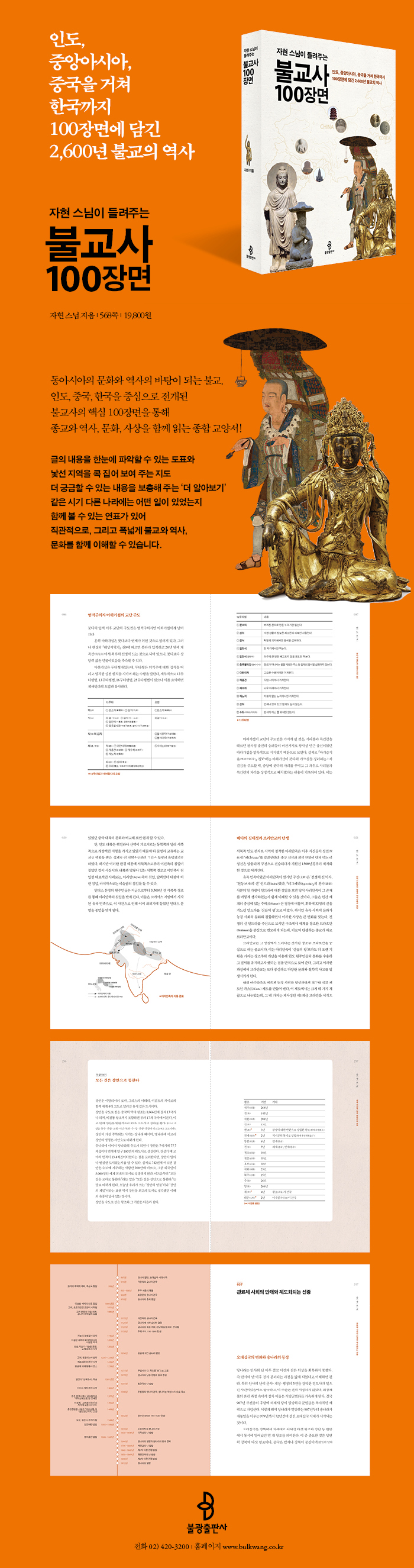
In addition, there are about 20 diagrams that help you understand the content of the text at a glance, 13 maps that helpfully highlight areas that may be unfamiliar to us, articles that explain the content of the text in more detail, such as ‘Vedas and Caste,’ ‘Jainism,’ ‘The Eighth Boundary,’ and ‘Buddhist Purification Movement,’ and ‘Learn More’ sections that introduce cultural aspects, such as ‘The Differences Between Indian and Korean Temples,’ and ‘What is the Significance of Chang’an in Chinese History?’ This helps you understand the history and culture of India, China, and Korea.
From this perspective, this book can be said to be an excellent comprehensive textbook for studying not only Buddhism but also East Asian history.
2,600 Years of Buddhist History in 100 Key Scenes
『100 Scenes from Buddhist History Told by Monk Ja-Hyeon』 describes how Buddhism originated, how it was transmitted, and how it changed and developed in each country through 100 key scenes from India to Central Asia, China, and finally to Korea.
Most books on Buddhist history up to now have focused on a single country, such as India, China, or Korea, making them difficult to understand, or have covered too many countries in one volume, leaving readers feeling disappointed.
However, this book introduces only the essential information that we, who live here and now, must know in an easy-to-understand manner.
So, I will describe the history of Buddhism in India, the birthplace of Buddhism, China, which spread Buddhism to our country and influenced it, and Korea.
It is structured in the same way that Buddhism spread from India to China and Korea.
The 100 key scenes are arranged first by country and then by era, but not strictly chronologically.
While most people focus on 'knowing the events' that occurred during a specific period when studying history, this book aims to 'understand the flow'.
So, rather than listing specific events, this book focuses on the situations that gave rise to characters and ideas.
In this way, we can find a 'law' that in times of national turmoil due to war or rebellion, the tendency to seek an ideal world beyond reality, such as the Pure Land or Maitreya thoughts, becomes stronger, but the background of the same phenomenon can appear differently depending on the regional and temporal circumstances.
For example, if we compare the reasons why the Hwaeom sect, which advocates for "mutual equality and harmony," grew with the support of the ruling powers in China and Korea around the same time, we can see that in the case of China, it was used to secure the legitimacy of the ascension of the female emperor, Empress Wu Zetian, and in the case of Korea, it was used for the purpose of uniting the country in turmoil after the unification of the Three Kingdoms.
Reading a narrative that focuses on this type of connection will allow you to understand the overall 'flow' even while reading the 'scenes' that are segmented individually.
History, culture, and thought all in one book
Comprehensive Buddhist textbook
Known as the person with the most doctorates in Korea and an author with notebooks full of unpublished manuscripts, Monk Ja-Hyeon is often called an "all-round intellectual."
The author's doctoral degree is not limited to a single field, such as philosophy, art history, or history education, and his published books have also dealt with Buddhism from a broad perspective based on philosophical, historical, and cultural knowledge.
This book, like the author's previously published books, introduces the history of Buddhism from a broad perspective.
So, while explaining the limited topic of 'History of Buddhism', it contains insights into the cultural background and ideological history of the country, as well as the situation in neighboring countries.
If previous books on Buddhist history or Buddhist thought were fragmentary, this book has the advantage of providing a comprehensive overview, allowing one to grasp the entire topic at a glance.
This kind of holistic perspective is important because it serves as the basis for detailed understanding later on.
In addition, there are about 20 diagrams that help you understand the content of the text at a glance, 13 maps that helpfully highlight areas that may be unfamiliar to us, articles that explain the content of the text in more detail, such as ‘Vedas and Caste,’ ‘Jainism,’ ‘The Eighth Boundary,’ and ‘Buddhist Purification Movement,’ and ‘Learn More’ sections that introduce cultural aspects, such as ‘The Differences Between Indian and Korean Temples,’ and ‘What is the Significance of Chang’an in Chinese History?’ This helps you understand the history and culture of India, China, and Korea.
From this perspective, this book can be said to be an excellent comprehensive textbook for studying not only Buddhism but also East Asian history.
GOODS SPECIFICS
- Publication date: November 12, 2018
- Page count, weight, size: 568 pages | 1,028g | 172*225*35mm
- ISBN13: 9788974794767
- ISBN10: 8974794764
You may also like
카테고리
korean


korean

![GQ KOREA Mark (Monthly): December [2025]](http://librairie.coreenne.fr/cdn/shop/files/8ef265dbbfbf186523ed75ba7319009d.jpg?v=1765340328&width=3840)


