

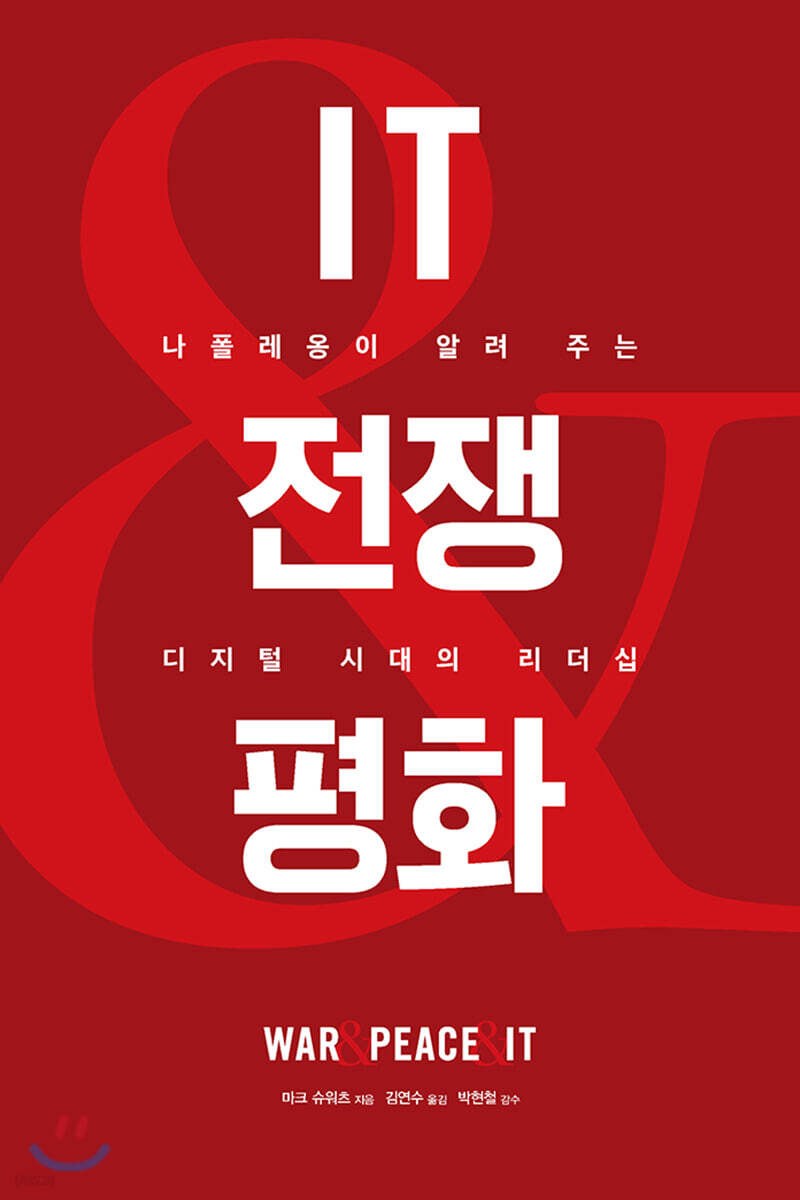
IT, War and Peace
 |
Description
Book Introduction
Beyond focusing on agile software development methodologies, it explains how a company's IT and non-IT organizations should collaborate under the broader theme of "digital transformation."
It provides ideas for resolving tensions and conflicts in transformation, a massive transformation that is not a simple change.
It covers the long-standing relationship between business and IT, the complexity and uncertainty that permeate modern business, the agility and leanness needed to overcome them, and various management methods for developing agile software.
And you'll gain the insights you need to achieve a successful digital transformation, from implementing a plan to executing all these methods to building a leadership team to encourage members to participate in the transformation.
- You can preview some of the book's contents.
Preview
index
Part 1.
principle
Chapter 1.
Business and IT
Chapter 2.
Complexity and uncertainty
Chapter 3.
Agility and Leanness
Take a break - Graph
Chapter 4. The Business Value of IT
Part 2.
actually
Taking a Break - Chapter 5: Assets Off the Balance Sheet
Chapter 6.
Risks and Opportunities
Chapter 7.
Governance and Investment Management
Take a break - Innovation
Chapter 8.
Bureaucracy and Culture
Take a break - Security
Chapter 9.
Planning and Reporting
Taking a Break - Cloud and the Future
3-part prescription
Chapter 10.
Action plan
Chapter 11.
Leadership Team
In conclusion
Publisher's Review
★ What this book covers ★
ㆍ There have been problems with the model used for collaboration between business and IT for a long time.
ㆍ This model is deeply connected to a flawed way of thinking about risk and opportunity.
ㆍ IT practitioners have long recognized and reinforced this model, but only recently have they recognized its problems.
ㆍ An environment full of high risk, uncertainty, and change demands a completely different mental model than one demanded in a more predictable environment.
ㆍ Software and cloud infrastructure are flexible.
Despite some misconceptions, software and cloud infrastructure are actually the easiest for businesses to change, making them ideal allies in dealing with uncertainty.
ㆍ Agility is a definite corporate asset, although it does not appear on the balance sheet.
Part 1, "Principles," explains why the traditional relationship between IT and business hinders digital transformation.
Part 2, "The Facts," details the stereotypes held by many companies that collaborate with their IT organizations and explains how these stereotypes can serve as a foundation for equipping companies for the digital world.
Part 3, "Prescription," outlines an action plan for moving immediately into the digital world.
★ Target audience for this book ★
If you're a CEO, you'll want to focus on growth and innovation for your company.
So now we need to seriously consider how to integrate IT with other organizations within the company.
This book will teach you how to leverage IT as a strategic element of your business and, as a result, drive business performance.
If you're a CFO, you might want to talk to me.
The position you stand in today is completely different from the past.
You must find new sources of value while growing your business and safeguarding your core business.
If you're a non-IT C-suite, you'll learn how to get help from the CIO to achieve your goals.
Maybe you're afraid of the relationship between IT and the rest of the organization, or maybe you have no expectations at all.
But IT also exists to achieve corporate goals.
In areas where you haven't spent much time becoming an expert, you'll need to rely on the expertise of IT professionals.
Of course, we also need to learn how to help them more effectively.
As a CIO or IT leader, you've probably started implementing agile development using Lean and DevOps, but you may have encountered obstacles along the way to unlocking the full value of agile development.
Now you need to have a conversation about that idea with other leadership in your organization.
This book will be that conversation.
Leaders in other business sectors will find this book a valuable resource for learning how to successfully collaborate with IT.
The results you achieve depend on what you achieve from IT or with IT.
If you're part of another business or IT community, I encourage you to discuss the economic and strategic impact of organizational agility based on the technologies described in this book.
This book will help both technical and non-technical business leaders solidify their team's goals.
★ Author's Note ★
Digital transformation creates numerous conflicts within existing organizations, but only one: the conflict between those who find joy in achieving business results and those who find joy in working with technology.
But conflicts also exist between moving quickly and maintaining control, between improving and sticking to a plan, between creating new competitive advantages and destroying old ones.
Reconciliation between two diametrically opposed entities seems impossible.
It's like a war.
A fleeting glimpse of peace comes only while we are in the makeshift barracks…
Historically, philosophers, scientists, writers, and religious thinkers have argued for the tension between opposing forces, whether it be the yin and yang of Chinese philosophy, the forces of good and evil in Zoroastrianism, the rise and fall of Hinduism, or the arguments and contrasts of Hegel's dialectic.
Great thinkers recognized that this tension was the driving force that drove the world forward, the essence of transformation and change.
If your company members agree on digital transformation, you should move forward with them.
From Napoleon and the early wars, to Krishna driving a chariot between the Pandavas and Kauravas, to the dead of ancient Egypt, we can find our way to the wonders of the digital world.
You can trust me.
★ Translator's Note ★
In 2001, 17 software gurus (Kent Beck, James Grenning, Robert C. Martin) who were at the center of software development innovation at the time
Martin, Ken Schwaber, Jeff Sutherland, etc.) gathered in Snowbird, Utah, USA.
They were trying to improve the 'waterfall development method' (a method in which detailed requirements and implementation plans are created by someone, fixed, and passed on to the next organization in the development process), which was accepted as the correct answer in the software development field at the time, but many people questioned its effectiveness.
The gurus gathered at Snowbird announce the Agile, Agile Software Development Manifesto, which marks a historic milestone in the way of thinking and acting about software development, just as Moses in the Bible came down from Mount Sinai with the stone tablets inscribed with the Ten Commandments.
The Agile Software Development Manifesto consists of four values and twelve principles, which are as follows:
We develop software and help others develop software, all the while finding better ways to do it.
This work has led us to value:
Individuals and interactions rather than processes and tools
Working software is better than comprehensive documentation.
Collaboration with customers rather than contract negotiations
Respond to change rather than follow a plan
What I mean by "valuing" here is that while things on the left (like "processes and tools" or "comprehensive documentation") are valuable, I place a higher value on things on the right (like "interacting with individuals" or "working software").
The agile movement is rooted in hacker culture, but rather than completely rejecting past software development methodologies, it is a new approach that complements past methods to respond more agilely to a rapidly changing environment.
Mark Schwartz has incorporated his extensive experience as a CIO and CEO at various companies into this book.
This book goes beyond agile software development methodologies and explains how a company's IT and non-IT organizations should collaborate under the broader theme of "digital transformation."
It provides ideas for resolving tensions and conflicts in transformation, a massive transformation that is not a simple change.
Gain the insights needed to achieve successful digital transformation, from the long-standing relationship between business and IT, the complexity and uncertainty that permeate the modern business world, the agility and leanness required to overcome them, the various management methods for developing agile software, and even the planning and execution of all these methods to the formation of a leadership team to encourage members to participate in the transformation.
Agile isn't simply a set of "practices" or "frameworks," but a question of values: "What do you prioritize in your way of thinking and acting?"
The goal that every company, organization, or department within a company must achieve is to 'effectively deliver value to customers.'
And the patterns that emerge in the way members think and act to achieve value come together to create a culture of agility.
Culture is not created by the efforts of one or two people alone.
A better culture can only be created when everyone, from the organization's top leaders to the employees who meet customers on the ground, looks in the same direction and moves forward together.
Mark Schwartz's experience will be of great help in creating an agile organizational culture.
★ Reviewer's Note ★
Around the time I was assigned to review this book, I visited Switzerland for training at the SAFe Program Consultant (SPC), a SAFe (Scaled Agile Framework) consultant course, to enhance core competencies that can lead the future.
Surprisingly, this book had a lot in common with what I had learned in Switzerland and covered a lot of the topics I wanted to discuss.
The world changes very quickly.
While some organizations perceive this situation as a serious crisis, others see it as a once-in-a-lifetime opportunity and leverage it for business success.
What is the difference? This is what I focused on most while reviewing the book.
This book doesn't cover SAFe at all.
Nevertheless, SAFe and this book emphasize the importance of understanding what, how, and why changes occur, and developing the capacity to proactively respond to the increasing complexity and uncertainty that change brings. As someone with consulting experience in traditional process and maturity-based frameworks like SPICE, CMMi, and ITIL, SAFe truly embodies the principles, practices, guides, and case studies needed to build an organization that proactively adapts to a rapidly changing world. SAFe specifically defines corporate business strategy, value stream strategy, and roles and activities centered around market and customer requirements (Epic, Capability, Feature, Story, Functionality, and Nonfunctionality).
It also emphasizes DevOps-based continuous delivery system and lead time optimization based on on-demand continuous exploration, continuous integration, and continuous deployment according to customer requests.
In addition, to embrace a system of aligned collaboration between various executives, leaders, and practitioners within the organization, various roles, activities, results, and guides are defined based on Lean-Agile-related values, principles, and core.
These are all areas that are emphasized in this book.
The insights of the publisher who selected this book and the translator are remarkable, but the author's insights, based on his diverse experiences as a CEO and CIO, are equally striking.
While the ability to manage complexity and uncertainty to reflect improvement and innovation within an organization is crucial, internalizing it to create sustainable growth and competitive advantage is by no means easy.
In this book, the author, drawing on a variety of historical narratives, management, and statistical knowledge, gradually and calmly unravels the context necessary to secure future competitiveness.
Many leaders across various industries sometimes need a moment of refreshment and respite as they contemplate what to do next.
This book provides a shelter containing forms and experiences that contain knowledge.
I hope this book will help you become a digital leader who can gradually break down this complex and uncertain world and transform it into organizational capabilities and customer value.
GOODS SPECIFICS
- Date of issue: December 31, 2019
- Page count, weight, size: 336 pages | 152*228*19mm
- ISBN13: 9791161753577
- ISBN10: 1161753575
You may also like
카테고리
korean


korean


