

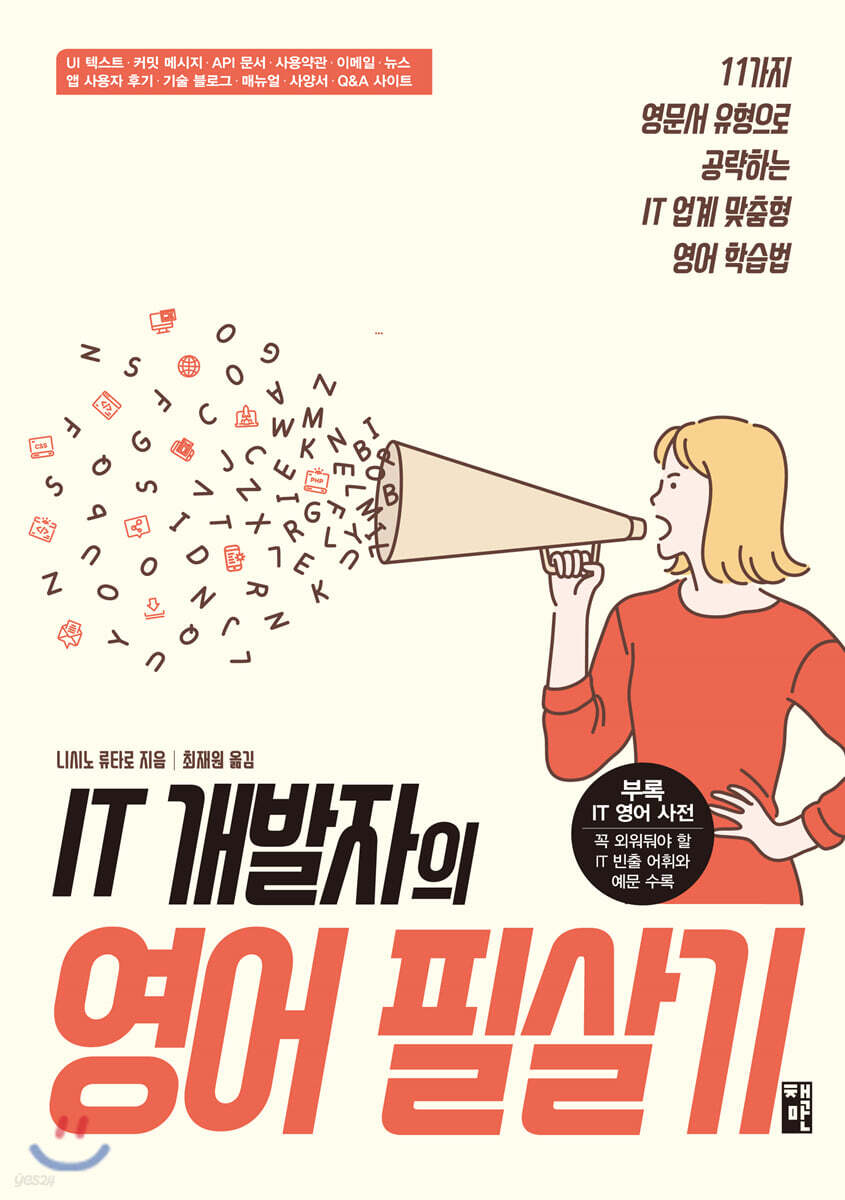
IT Developer's Secret English Skills
 |
Description
Book Introduction
The essential language for becoming a competitive developer is not C or Java, but English.
The ultimate goal of this book is to 'read IT English documents.'
While it's good to build your foundation by reading long English passages, this book aims to help you acquire skills you can use in survival English starting today, in a short period of time.
This book presents a customized English learning method for IT developers, engineers, job seekers, and students who want to re-establish their basic English skills.
This book analyzes 11 types of English documents, including UI text, commit messages, API documentation, terms of use, emails, app user reviews, news, technical blogs, manuals, specifications, and Q&A sites. By utilizing examples and identifying their characteristics, you will acquire the know-how to read IT English more easily.
By studying the 'frequently used IT vocabulary, idioms, and practical examples' included in the special appendix, 'IT English Dictionary,' you can acquire essential skills to lay the foundation for IT English.
The ultimate goal of this book is to 'read IT English documents.'
While it's good to build your foundation by reading long English passages, this book aims to help you acquire skills you can use in survival English starting today, in a short period of time.
This book presents a customized English learning method for IT developers, engineers, job seekers, and students who want to re-establish their basic English skills.
This book analyzes 11 types of English documents, including UI text, commit messages, API documentation, terms of use, emails, app user reviews, news, technical blogs, manuals, specifications, and Q&A sites. By utilizing examples and identifying their characteristics, you will acquire the know-how to read IT English more easily.
By studying the 'frequently used IT vocabulary, idioms, and practical examples' included in the special appendix, 'IT English Dictionary,' you can acquire essential skills to lay the foundation for IT English.
- You can preview some of the book's contents.
Preview
index
Chapter 0: How to Master IT English?
__01 Have you ever had trouble with English at work?
__02 English is essential for IT developers.
__03 English Reading You Can't Avoid
__04 Why is it difficult to read and understand English?
__05 How can I understand English documents more easily?
__06 Structure of this book
Chapter 1: Knowledge and Techniques Needed for Reading English
__01 Four Pillars of Reading
__02 The foundation of English reading is vocabulary.
__03 English Grammar You Need to Know for IT English Reading
__04 Let's pay attention to the discourse structure of the entire sentence.
__05 Expertise is understood in the native language.
__06 English Speed Reading Techniques
Chapter 2: How to Read English Text Frequently Encountered at Work (1)
- Document requiring caution due to unique expressions -
__00 Study tips for chapters 2 and 3
__01 UI Text: Reading Commands, Confirmations, Instructions, and Error Messages
__02 Commit Message: Omit the subject and use a verb to express it briefly.
__03 API Documentation: Methods are concisely described as verbs.
__04 Terms of Use: Strong legal document nature and characterized by expressions such as shall
__05 Email: It consists of a pattern of greeting, body, and conclusion.
__06 App User Reviews: Get helpful information from user reviews and ratings.
Chapter 3: How to Read English Text Frequently Encountered at Work (2)
- A document with a lot of information that needs to be read efficiently -
__01 News: Gather information by paying attention to the title.
__02 Tech Blog: Efficiently Understanding Content from Titles or Headings
__03 Manual: Reading verbs used in order or headings
__04 Technical Specifications: Get the full story with the table of contents and avoid misunderstandings with the term definitions.
__05 Q&A site: Let's guess what kind of Q&A it is from the question title.
Chapter 4: Essential Tools for Improving Your English Skills
__01 The secret to learning English is a dictionary
__02 Things to keep in mind when looking at an English dictionary
__03 Types of dictionaries that are useful when you have more questions
__04 English Speed Reading Techniques Using Pop-up Dictionary Tools
__05 Vocabulary Difficulty Measurement
Chapter 5: Gathering English-language information to help you with your work
Google search tips using the __01 operator
__02 Discover information with clear search keywords
__03 Efficient information collection with RSS reader
__04 Add keywords of interest to Google Alerts
__05 SNS real-time information search
Chapter 6: Essential Skills for Writing and Listening in English
Writing English emails using the __01 configuration pattern
__02 When explaining usage or operation sequence, use imperative or you.
__03 Choose carefully which verb to start sentences in commit messages.
__04 Writing in English using an automatic translator
__05 English listening using video subtitles
__06 How to read Arisong English: Check Google Translate
[Appendix] IT English Dictionary: Useful IT Vocabulary and N-gram Expressions
__01 Have you ever had trouble with English at work?
__02 English is essential for IT developers.
__03 English Reading You Can't Avoid
__04 Why is it difficult to read and understand English?
__05 How can I understand English documents more easily?
__06 Structure of this book
Chapter 1: Knowledge and Techniques Needed for Reading English
__01 Four Pillars of Reading
__02 The foundation of English reading is vocabulary.
__03 English Grammar You Need to Know for IT English Reading
__04 Let's pay attention to the discourse structure of the entire sentence.
__05 Expertise is understood in the native language.
__06 English Speed Reading Techniques
Chapter 2: How to Read English Text Frequently Encountered at Work (1)
- Document requiring caution due to unique expressions -
__00 Study tips for chapters 2 and 3
__01 UI Text: Reading Commands, Confirmations, Instructions, and Error Messages
__02 Commit Message: Omit the subject and use a verb to express it briefly.
__03 API Documentation: Methods are concisely described as verbs.
__04 Terms of Use: Strong legal document nature and characterized by expressions such as shall
__05 Email: It consists of a pattern of greeting, body, and conclusion.
__06 App User Reviews: Get helpful information from user reviews and ratings.
Chapter 3: How to Read English Text Frequently Encountered at Work (2)
- A document with a lot of information that needs to be read efficiently -
__01 News: Gather information by paying attention to the title.
__02 Tech Blog: Efficiently Understanding Content from Titles or Headings
__03 Manual: Reading verbs used in order or headings
__04 Technical Specifications: Get the full story with the table of contents and avoid misunderstandings with the term definitions.
__05 Q&A site: Let's guess what kind of Q&A it is from the question title.
Chapter 4: Essential Tools for Improving Your English Skills
__01 The secret to learning English is a dictionary
__02 Things to keep in mind when looking at an English dictionary
__03 Types of dictionaries that are useful when you have more questions
__04 English Speed Reading Techniques Using Pop-up Dictionary Tools
__05 Vocabulary Difficulty Measurement
Chapter 5: Gathering English-language information to help you with your work
Google search tips using the __01 operator
__02 Discover information with clear search keywords
__03 Efficient information collection with RSS reader
__04 Add keywords of interest to Google Alerts
__05 SNS real-time information search
Chapter 6: Essential Skills for Writing and Listening in English
Writing English emails using the __01 configuration pattern
__02 When explaining usage or operation sequence, use imperative or you.
__03 Choose carefully which verb to start sentences in commit messages.
__04 Writing in English using an automatic translator
__05 English listening using video subtitles
__06 How to read Arisong English: Check Google Translate
[Appendix] IT English Dictionary: Useful IT Vocabulary and N-gram Expressions
Detailed image
.jpg)
Publisher's Review
[Structure of this book]
Chapter 1 explains the knowledge and techniques needed to read English.
We will examine the four pillars of reading (vocabulary, grammar, discourse structure, and specialized knowledge) one by one, and also introduce techniques for speed reading.
Chapters 2 and 3 then occupy a significant portion of the book. They explain 11 types of documents IT developers encounter in their work (UI text, API documentation, terms of use, news, manuals, etc.).
We will look at the vocabulary difficulty, vocabulary diversity, and discourse structure of each document type, and also introduce frequently occurring words of that type.
After reading this chapter, you will recognize that there are various document types in IT English and acquire reading techniques for each document type.
Chapter 4 explores useful tools for people who don't speak English well.
We introduce several tools that make reading English easier, including various dictionaries (English-Korean, English-English, etc.) and pop-up dictionaries.
Chapter 5 introduces how to find good information in English.
We introduce how to effectively use Google search, how to use RSS readers, and how to utilize Google Alerts.
Chapter 6 covers writing and listening in English.
All of the writing and listening techniques introduced in Chapter 6 can be applied immediately in the workplace.
Finally, the appendix provides a special dictionary for readers, titled 'Useful IT-related vocabulary and N-gram expressions.'
We have compiled practical examples, interpretations, and explanations of the frequent words and N-gram representations covered in Chapters 2 and 3.
[Key Features of this Book]
■ A customized survival English learning method for IT professionals
■ Learning about 11 types of English IT documents, including commit messages and technical blogs.
■ Convenient tools and information gathering know-how to help you read English
■ Special Appendix: Includes a list of frequently used IT vocabulary and practical examples.
[For whom this book is intended]
■ Developers and engineers working in the field who have spent a long time building a wall with English
■ All students and IT job seekers who want to solidify their basic English skills
■ Planners and designers who need to communicate with IT developers
■ All IT professionals who want to fully understand the unique characteristics of IT English
[Author's Note]
For IT developers, English is an unavoidable gateway.
Among these, English reading skills are necessary even if you only work and live in Korea.
Although developers rarely speak or present in English, they often have to read and understand English.
First of all, most of the IT-related information you can find on the web is in English.
However, there are quite a few IT developers who think they are not good at English.
The topic of this book is reading IT-related English documents.
This book will teach you the basic knowledge and techniques needed to read IT English documents.
Rather than building a foundation by calmly reading long English passages, this book aims to help you acquire skills that can be applied to reading English starting tomorrow in a short period of time.
The book explains the four pillars needed to read English.
We then look at the characteristics of different types of English documents (UI, Terms of Use, API documentation, specifications, manuals, etc.).
Knowing the characteristics of each document type will help you understand the document's contents more easily.
In addition, we introduce tools that can help you read English and techniques for gathering English information.
This book's intended audience includes new IT developers, high school students, college or graduate students seeking employment in the IT industry, and working developers who feel their English reading skills are somewhat lacking.
I work as a professional translator in the IT field, and as a software developer, I've also been involved in developing applications for English-speaking countries.
Therefore, this book contains all the knowledge I have gained from my experiences.
Some people believe that to be able to read English fluently, you need to be a native speaker or have lived abroad as a child.
But I am neither of those two, and I learned to read and write English in my home country without ever having been abroad.
You can develop your English reading skills without having to go abroad.
I hope that through this book, readers will acquire the knowledge and techniques necessary to read IT English.
[Translator's Note]
The phrase “studying English” actually has a very broad and vague meaning.
Because important information is missing before and after the word 'English'.
For example, TOEIC is a test that measures 'business English reading and listening' skills.
So, to get a good TOEIC score, you need to focus on studying business-related English, especially reading and listening.
Likewise, TOEFL measures academic English reading, listening, and writing skills, so your study method should be tailored to that purpose.
Rather than studying English vaguely like this, clearly setting your English learning goals and choosing a study method that suits them is a shortcut to effectively achieving your goals in a short period of time.
But if you think about it, we've been studying English for quite a long time, but I don't remember ever formally learning 'IT English'.
If you majored in computer engineering or a similar discipline, you're probably already familiar with some of the most common terms used in the IT field.
However, this is a byproduct of learning IT itself. While I studied IT terms and their Korean equivalents one-to-one, I rarely had the opportunity to systematically teach or learn the meanings of words or sentence structures that differ from general English, using lengthy IT English texts like IT blogs, news, contracts, and manuals as teaching materials.
It's surprising that there aren't many English textbooks or learning content focused on "IT English," despite the fact that the IT field is rapidly evolving and English is crucial for quickly acquiring knowledge.
In that respect, the significance of this book, “English Essentials for IT Developers,” is not small.
As the author also emphasizes, there are many differences between 'general English' and 'IT English'.
Above all, we must first recognize that ‘difference’.
Only then can developers and engineers working in the IT field, or those seeking employment at IT companies, develop effective English learning strategies tailored to their specific goals.
To achieve this, this book will help you study "IT English reading and writing." It provides a wealth of useful information and tips for studying IT English.
In particular, the part that divides IT English into 11 document types and densely and concisely organizes the characteristics of English and frequently used words and meanings for each document type is very impressive and I expect it will be of great help to readers.
Additionally, the appendix of the book, 'IT English Dictionary: Useful IT Vocabulary and N-gram Expressions', explains the use of words and idioms in the context of 'IT English' along with abundant examples that were not covered in the main text, making it extremely useful for developers, students, and job seekers who are somewhat familiar with general English but want to organize IT English separately.
As someone who works in the IT field more than anyone else, this book will be like a drop in the bucket for those who have given up on English and have not been able to fully grasp it in their academic studies.
As with all other studies, learning a language requires consistent and continuous effort.
In addition, in the vast and deep ocean of English, like the Pacific Ocean, you must set your own learning goals and target level appropriately to avoid getting lost and struggling.
This one book won't completely teach you IT English, but I'm confident it will at least guide you on the path to the most effective way to study IT English.
As the translator of this book, I hope it will serve as a new opportunity for you to learn English.
Chapter 1 explains the knowledge and techniques needed to read English.
We will examine the four pillars of reading (vocabulary, grammar, discourse structure, and specialized knowledge) one by one, and also introduce techniques for speed reading.
Chapters 2 and 3 then occupy a significant portion of the book. They explain 11 types of documents IT developers encounter in their work (UI text, API documentation, terms of use, news, manuals, etc.).
We will look at the vocabulary difficulty, vocabulary diversity, and discourse structure of each document type, and also introduce frequently occurring words of that type.
After reading this chapter, you will recognize that there are various document types in IT English and acquire reading techniques for each document type.
Chapter 4 explores useful tools for people who don't speak English well.
We introduce several tools that make reading English easier, including various dictionaries (English-Korean, English-English, etc.) and pop-up dictionaries.
Chapter 5 introduces how to find good information in English.
We introduce how to effectively use Google search, how to use RSS readers, and how to utilize Google Alerts.
Chapter 6 covers writing and listening in English.
All of the writing and listening techniques introduced in Chapter 6 can be applied immediately in the workplace.
Finally, the appendix provides a special dictionary for readers, titled 'Useful IT-related vocabulary and N-gram expressions.'
We have compiled practical examples, interpretations, and explanations of the frequent words and N-gram representations covered in Chapters 2 and 3.
[Key Features of this Book]
■ A customized survival English learning method for IT professionals
■ Learning about 11 types of English IT documents, including commit messages and technical blogs.
■ Convenient tools and information gathering know-how to help you read English
■ Special Appendix: Includes a list of frequently used IT vocabulary and practical examples.
[For whom this book is intended]
■ Developers and engineers working in the field who have spent a long time building a wall with English
■ All students and IT job seekers who want to solidify their basic English skills
■ Planners and designers who need to communicate with IT developers
■ All IT professionals who want to fully understand the unique characteristics of IT English
[Author's Note]
For IT developers, English is an unavoidable gateway.
Among these, English reading skills are necessary even if you only work and live in Korea.
Although developers rarely speak or present in English, they often have to read and understand English.
First of all, most of the IT-related information you can find on the web is in English.
However, there are quite a few IT developers who think they are not good at English.
The topic of this book is reading IT-related English documents.
This book will teach you the basic knowledge and techniques needed to read IT English documents.
Rather than building a foundation by calmly reading long English passages, this book aims to help you acquire skills that can be applied to reading English starting tomorrow in a short period of time.
The book explains the four pillars needed to read English.
We then look at the characteristics of different types of English documents (UI, Terms of Use, API documentation, specifications, manuals, etc.).
Knowing the characteristics of each document type will help you understand the document's contents more easily.
In addition, we introduce tools that can help you read English and techniques for gathering English information.
This book's intended audience includes new IT developers, high school students, college or graduate students seeking employment in the IT industry, and working developers who feel their English reading skills are somewhat lacking.
I work as a professional translator in the IT field, and as a software developer, I've also been involved in developing applications for English-speaking countries.
Therefore, this book contains all the knowledge I have gained from my experiences.
Some people believe that to be able to read English fluently, you need to be a native speaker or have lived abroad as a child.
But I am neither of those two, and I learned to read and write English in my home country without ever having been abroad.
You can develop your English reading skills without having to go abroad.
I hope that through this book, readers will acquire the knowledge and techniques necessary to read IT English.
[Translator's Note]
The phrase “studying English” actually has a very broad and vague meaning.
Because important information is missing before and after the word 'English'.
For example, TOEIC is a test that measures 'business English reading and listening' skills.
So, to get a good TOEIC score, you need to focus on studying business-related English, especially reading and listening.
Likewise, TOEFL measures academic English reading, listening, and writing skills, so your study method should be tailored to that purpose.
Rather than studying English vaguely like this, clearly setting your English learning goals and choosing a study method that suits them is a shortcut to effectively achieving your goals in a short period of time.
But if you think about it, we've been studying English for quite a long time, but I don't remember ever formally learning 'IT English'.
If you majored in computer engineering or a similar discipline, you're probably already familiar with some of the most common terms used in the IT field.
However, this is a byproduct of learning IT itself. While I studied IT terms and their Korean equivalents one-to-one, I rarely had the opportunity to systematically teach or learn the meanings of words or sentence structures that differ from general English, using lengthy IT English texts like IT blogs, news, contracts, and manuals as teaching materials.
It's surprising that there aren't many English textbooks or learning content focused on "IT English," despite the fact that the IT field is rapidly evolving and English is crucial for quickly acquiring knowledge.
In that respect, the significance of this book, “English Essentials for IT Developers,” is not small.
As the author also emphasizes, there are many differences between 'general English' and 'IT English'.
Above all, we must first recognize that ‘difference’.
Only then can developers and engineers working in the IT field, or those seeking employment at IT companies, develop effective English learning strategies tailored to their specific goals.
To achieve this, this book will help you study "IT English reading and writing." It provides a wealth of useful information and tips for studying IT English.
In particular, the part that divides IT English into 11 document types and densely and concisely organizes the characteristics of English and frequently used words and meanings for each document type is very impressive and I expect it will be of great help to readers.
Additionally, the appendix of the book, 'IT English Dictionary: Useful IT Vocabulary and N-gram Expressions', explains the use of words and idioms in the context of 'IT English' along with abundant examples that were not covered in the main text, making it extremely useful for developers, students, and job seekers who are somewhat familiar with general English but want to organize IT English separately.
As someone who works in the IT field more than anyone else, this book will be like a drop in the bucket for those who have given up on English and have not been able to fully grasp it in their academic studies.
As with all other studies, learning a language requires consistent and continuous effort.
In addition, in the vast and deep ocean of English, like the Pacific Ocean, you must set your own learning goals and target level appropriately to avoid getting lost and struggling.
This one book won't completely teach you IT English, but I'm confident it will at least guide you on the path to the most effective way to study IT English.
As the translator of this book, I hope it will serve as a new opportunity for you to learn English.
GOODS SPECIFICS
- Date of issue: January 7, 2020
- Page count, weight, size: 232 pages | 148*210*14mm
- ISBN13: 9791189909093
- ISBN10: 118990909X
You may also like
카테고리
korean


korean

![GQ KOREA Mark (Monthly): December [2025]](http://librairie.coreenne.fr/cdn/shop/files/8ef265dbbfbf186523ed75ba7319009d.jpg?v=1765340328&width=3840)


