

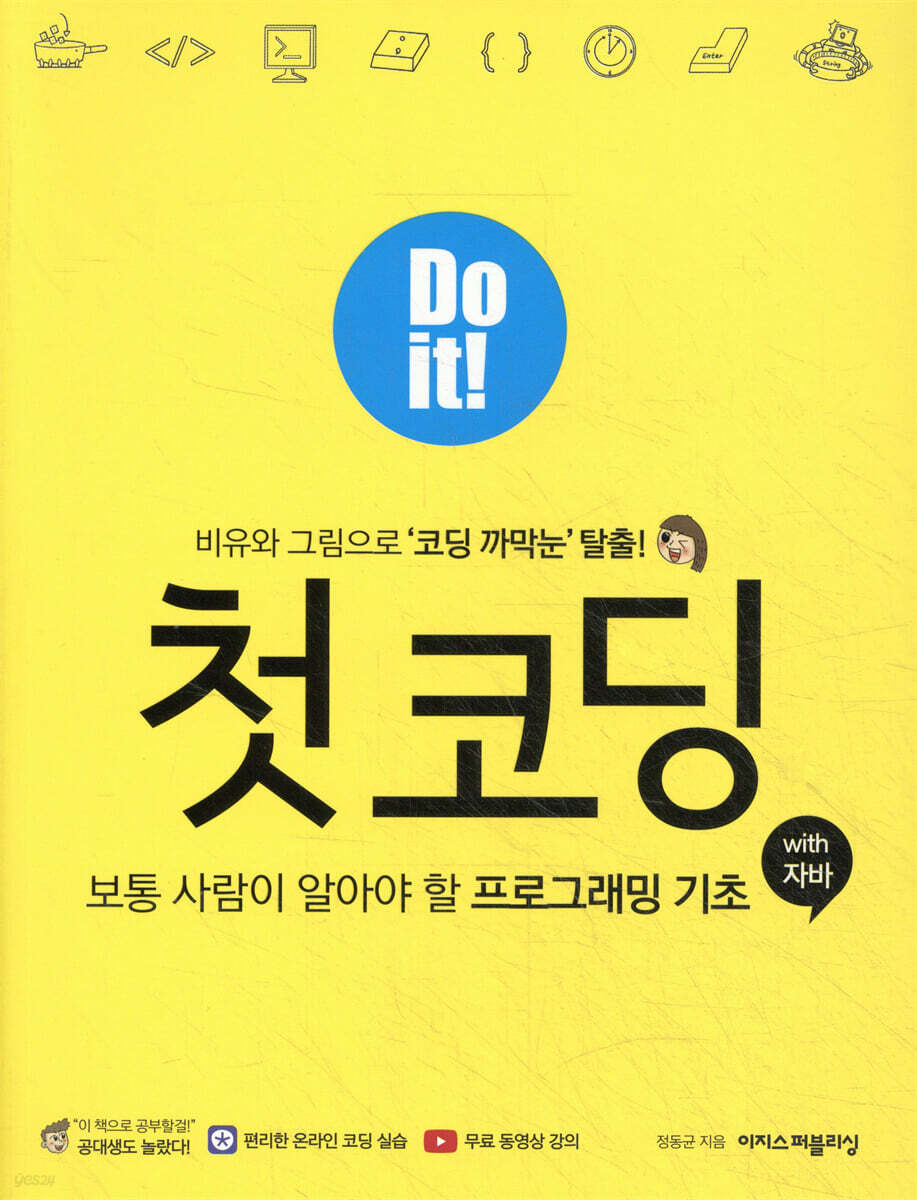
Do it! First Coding with Java
 |
Description
Book Introduction
Korea's first 'liberal arts' introductory coding book!
Escape the "coding blind spot" with 99 metaphors, illustrations, and free online practice!
This book was created for ordinary people who find coding daunting! It helps anyone, regardless of age or gender, from elementary school students to college students and seniors, become a "coder."
It is also called Korea's first "liberal arts" introductory book, as it explains 52 core programming concepts that are essential for the digital age with 99 metaphors and illustrations.
Not only that, there's no need to install programs or download example files, which are common pitfalls for coding beginners! Anyone can practice coding for free by logging into the "Ellis" platform and signing up! Check out this book, packed with free video lectures!
Escape the "coding blind spot" with 99 metaphors, illustrations, and free online practice!
This book was created for ordinary people who find coding daunting! It helps anyone, regardless of age or gender, from elementary school students to college students and seniors, become a "coder."
It is also called Korea's first "liberal arts" introductory book, as it explains 52 core programming concepts that are essential for the digital age with 99 metaphors and illustrations.
Not only that, there's no need to install programs or download example files, which are common pitfalls for coding beginners! Anyone can practice coding for free by logging into the "Ellis" platform and signing up! Check out this book, packed with free video lectures!
- You can preview some of the book's contents.
Preview
index
01 Let's go to Coding Star★!
Computer language? Similar to human language.
You have to say 01101000 to understand - Bit
Let's make a promise with a combination of 0 and 1 - Code
How to represent ABC with 0 and 1 - ASCII, Unicode
Coding Star★ A translator to help you travel - Programming Language
Types of programming languages
Programming languages speak in terms of properties
Expressing attributes with periods (.)
Coding Star★ Common Sense 01 | Decimal and Hexadecimal
Coding Star★ Common Sense 02 | 32-bit vs. 64-bit Computers
02 How do computers remember and behave?
What People and Coding Have in Common - Variables and Methods
The three spaces where computers store memories - memory
Variable ① Type of variable that resembles a bowl
Variable ② Declaring a variable
Variable ③ Freely sized! - String
Understanding how methods work
Get ready for coding practice - Just access the internet and you can start coding right away!
__[Coding Practice 01] Declaring Variables
Coding Star★ Common Sense 03 | Build, Integrated Development Environment (IDE), Software Development Kit (SDK)
03 How do computers think and make decisions?
Just plain ignorant.
But it's so fast!
Conditional sentence ① If I were a poet - if
__[Coding Practice 02] Conditional Statement if~else
Conditional statement ② When there are two conditions - AND, OR
__[Coding Practice 03] When there are two conditions
Conditional statement ③ Conditional statement within a conditional statement ― else if
__[Coding Practice 04] Conditional Statement Else If
Repeat statements ① Repeat statements that will eventually end - while, for
__[Coding Practice 05] For Loop
Loop ② Regular code in loop
Repeat statement ③ Repeat statement within a repeat statement
__[Coding Practice 06] for in a for loop
Using conditional statements and loops together
__[Coding Practice 07] Conditional statement if and loop statement for
Let me explain my code - Comments
__[Coding Practice 08] Adding Comments
04 Coding Comprehensive Gift Set, Let's Open a Class!
What is a class?
Variables I created - classes, instances
__[Coding Practice 09] Creating a Class
How to initialize an instance - Constructor
__[Coding Practice 10] Creating a Constructor
The word that an instance refers to itself - this
__[Coding Practice 11] Using this
Adding a method to a class
__[Coding Practice 12] Adding a Method
How classes are extended - inheritance, overriding
__[Coding Practice 13] Inheritance
Grouping multiple classes into a family - Packages
__[Coding Practice 14] Practicing Packages
Assigning ownership to classes - private, public
__[Coding Practice 15] Practicing Modifiers
05 You need to know this much to do real coding.
Manage similar variables at once - Arrays
__[Coding Practice 16] Finding the Mean with an Array
Turning 'anything' in the game into code - Random
__[Coding Practice 17] Playing Rock-Paper-Scissors
The Net of Circus Acrobatics - Exception Handling
__[Coding Practice 18] Exception Handling
Deliberately putting the program to sleep - sleep
__[Coding Practice 19] Slowly Representing the Multiplication Table
Pretending to do several things at once - Thread
__[Coding Practice 20] Running Race
Database Basics - SQL
A taste of graphical screen coding
[Coding Problem Solved by Hand] Answer
Computer language? Similar to human language.
You have to say 01101000 to understand - Bit
Let's make a promise with a combination of 0 and 1 - Code
How to represent ABC with 0 and 1 - ASCII, Unicode
Coding Star★ A translator to help you travel - Programming Language
Types of programming languages
Programming languages speak in terms of properties
Expressing attributes with periods (.)
Coding Star★ Common Sense 01 | Decimal and Hexadecimal
Coding Star★ Common Sense 02 | 32-bit vs. 64-bit Computers
02 How do computers remember and behave?
What People and Coding Have in Common - Variables and Methods
The three spaces where computers store memories - memory
Variable ① Type of variable that resembles a bowl
Variable ② Declaring a variable
Variable ③ Freely sized! - String
Understanding how methods work
Get ready for coding practice - Just access the internet and you can start coding right away!
__[Coding Practice 01] Declaring Variables
Coding Star★ Common Sense 03 | Build, Integrated Development Environment (IDE), Software Development Kit (SDK)
03 How do computers think and make decisions?
Just plain ignorant.
But it's so fast!
Conditional sentence ① If I were a poet - if
__[Coding Practice 02] Conditional Statement if~else
Conditional statement ② When there are two conditions - AND, OR
__[Coding Practice 03] When there are two conditions
Conditional statement ③ Conditional statement within a conditional statement ― else if
__[Coding Practice 04] Conditional Statement Else If
Repeat statements ① Repeat statements that will eventually end - while, for
__[Coding Practice 05] For Loop
Loop ② Regular code in loop
Repeat statement ③ Repeat statement within a repeat statement
__[Coding Practice 06] for in a for loop
Using conditional statements and loops together
__[Coding Practice 07] Conditional statement if and loop statement for
Let me explain my code - Comments
__[Coding Practice 08] Adding Comments
04 Coding Comprehensive Gift Set, Let's Open a Class!
What is a class?
Variables I created - classes, instances
__[Coding Practice 09] Creating a Class
How to initialize an instance - Constructor
__[Coding Practice 10] Creating a Constructor
The word that an instance refers to itself - this
__[Coding Practice 11] Using this
Adding a method to a class
__[Coding Practice 12] Adding a Method
How classes are extended - inheritance, overriding
__[Coding Practice 13] Inheritance
Grouping multiple classes into a family - Packages
__[Coding Practice 14] Practicing Packages
Assigning ownership to classes - private, public
__[Coding Practice 15] Practicing Modifiers
05 You need to know this much to do real coding.
Manage similar variables at once - Arrays
__[Coding Practice 16] Finding the Mean with an Array
Turning 'anything' in the game into code - Random
__[Coding Practice 17] Playing Rock-Paper-Scissors
The Net of Circus Acrobatics - Exception Handling
__[Coding Practice 18] Exception Handling
Deliberately putting the program to sleep - sleep
__[Coding Practice 19] Slowly Representing the Multiplication Table
Pretending to do several things at once - Thread
__[Coding Practice 20] Running Race
Database Basics - SQL
A taste of graphical screen coding
[Coding Problem Solved by Hand] Answer
Detailed image

Publisher's Review
The most basic version of the Do it! series that you can trust and watch!
This is the first book in the ambitious "Coding Star★" series from the renowned introductory book series, Do it!
[This book's target audience]
ㆍ Beginners who say, "I need to study coding..." but never get around to it
ㆍ Frustrated freshman in engineering school after reading a thick programming book
ㆍ Planners, designers, and marketers who cannot understand what developers are saying
ㆍ Job seekers who need to interview at IT-related companies
ㆍ In the era of digital revolution, leaders are at a loss.
Coding, an essential skill in the digital revolution era!
Start with the easy book, King Without a Threshold~
Computers write baseball articles, and doctors rely on artificial intelligence to help them choose treatments for their patients.
Companies are maximizing marketing effectiveness through big data analysis and are starting to include coding tests as a gateway to employment.
In this way, computer technology has permeated our lives without us even realizing it.
We are already producers and consumers of the digital world.
Reflecting this trend, countries around the world have begun teaching coding, and our country has recently incorporated coding into its regular curriculum.
Even if you don't major in computer science, you need to know how to code, and the ability to communicate with computers is starting to become fundamental.
From elementary school students to college students and seniors
Don't be intimidated! This book will help you understand the language of developers!
How should we respond to this trend? This book is written for ordinary people like you who find themselves in a situation where they suddenly need to learn coding.
Here are 52 programming concepts you need to know in the digital age, explained from a non-major's perspective.
Rather than using the language used by industry professionals, we provide easy-to-read explanations in a "liberal arts" style that anyone from elementary school students to college students and middle-aged and older adults can comfortably learn coding.
In addition, you can learn application technologies used in the field, such as classes, arrays, random numbers, and exception handling, to understand and empathize with the foundations of the digital age.
If you're a planner, designer, or marketer who works collaboratively with developers, read through Chapters 4 and 5 carefully.
After you finish the book, you'll be able to confidently nod along to the developer's words.
99 metaphors and illustrations!
Have fun learning about how computers think and behave!
But what exactly is a "liberal arts" explanation, rather than a "science and engineering" one? It refers to explaining coding concepts using simple analogies and diagrams, without any technical math or computer jargon.
We'll talk to the computer as if we were talking through a messenger, introduce 'programming languages' using analogies to human languages like Korean, English, and Japanese, and explain 'multi-threading' using analogies to games.
Would you like to hear a fun coding story that even non-majors and teenagers can read?
It's convenient! Just connect to the internet and start practicing coding!
We've even prepared video lectures, so just grab your keyboard!
"Okay! Let's start coding!" Many people eagerly started, only to give up due to the barriers of "program installation," English instructions, and complex options. As the digital world has evolved, easier ways to learn coding are also emerging.
This book also uses that method to help you learn coding very conveniently.
Simply sign up for the Ellis Coding Platform to practice the problems included in this book for free.
It's convenient because you can code right away as long as you have an internet connection, and you can even do it on your smartphone.
There are also video lectures next to the practice screen, so you don't need to look for a separate explanation link.
We've laid it out so you can see it at a glance, so just bring your keyboard!
Elice Coding Classroom [academy.elice.io → Free Course Trial → Select 'Do it! First Coding']
“Block coding books are childish, and thick programming books are difficult!”
If you learn the most popular programming language, you'll be confident in any language you encounter!
This book uses Java, a language suitable for college and middle school students to learn.
Rather than learning 'block coding' like Scratch or Entry, which elementary school students use, we learn 'text coding', which is still used in the workplace.
Moreover, it is the most popular language used in the industry, so if you learn it, you will use it for a long time.
But don't you know Java? Don't worry! This book isn't about learning Java. It's about learning the "concepts of programming" that you need to know regardless of the language you're learning.
Anyone can see it, even if they don't know Java or programming.
By starting with text coding in the most popular language, you'll feel confident when you move on to other programming languages.
It's great for studying on your own, and it's also great as a textbook!
Become a 'coder' in just 8 days!
This book provides an eight-day progress chart that is useful for both self-students and teachers.
On day 1, you learn about computer language, on day 2, you learn about variables and methods, on day 3, you learn about conditional statements, and on day 4, you learn about loops.
What we have learned so far is the basic operating principles of a computer.
On the 5th and 6th days, you will learn classes, which are the current trend in programming, and on the 7th and 8th days, you will learn applied techniques that can be used in actual coding.
Since you will learn everything from the basics to the application in a short period of time, it is suitable as a textbook for university liberal arts subjects or first-year major subjects.
"Meet intelligent readers who grow through books!"
[Do it! Study Room]: Learn, Share, and Grow Together
The Do It series will even boost your motivation to study! Join the [Do It! Study Group], where you can post and implement your study plans.
If you complete the course, you will receive a book as a gift, so you can continue to study.
Not only that, you can share knowledge and difficulties with your fellow students.
Even if you don't know it, once you start, you'll find yourself signing up again and again for the addictive Do It! Study Group! Come check it out now!
- Do it! Study Room Cafe [cafe.naver.com/doitstudyroom → 'Do it! Study Group Support & Book Gift' Menu]
This is the first book in the ambitious "Coding Star★" series from the renowned introductory book series, Do it!
[This book's target audience]
ㆍ Beginners who say, "I need to study coding..." but never get around to it
ㆍ Frustrated freshman in engineering school after reading a thick programming book
ㆍ Planners, designers, and marketers who cannot understand what developers are saying
ㆍ Job seekers who need to interview at IT-related companies
ㆍ In the era of digital revolution, leaders are at a loss.
Coding, an essential skill in the digital revolution era!
Start with the easy book, King Without a Threshold~
Computers write baseball articles, and doctors rely on artificial intelligence to help them choose treatments for their patients.
Companies are maximizing marketing effectiveness through big data analysis and are starting to include coding tests as a gateway to employment.
In this way, computer technology has permeated our lives without us even realizing it.
We are already producers and consumers of the digital world.
Reflecting this trend, countries around the world have begun teaching coding, and our country has recently incorporated coding into its regular curriculum.
Even if you don't major in computer science, you need to know how to code, and the ability to communicate with computers is starting to become fundamental.
From elementary school students to college students and seniors
Don't be intimidated! This book will help you understand the language of developers!
How should we respond to this trend? This book is written for ordinary people like you who find themselves in a situation where they suddenly need to learn coding.
Here are 52 programming concepts you need to know in the digital age, explained from a non-major's perspective.
Rather than using the language used by industry professionals, we provide easy-to-read explanations in a "liberal arts" style that anyone from elementary school students to college students and middle-aged and older adults can comfortably learn coding.
In addition, you can learn application technologies used in the field, such as classes, arrays, random numbers, and exception handling, to understand and empathize with the foundations of the digital age.
If you're a planner, designer, or marketer who works collaboratively with developers, read through Chapters 4 and 5 carefully.
After you finish the book, you'll be able to confidently nod along to the developer's words.
99 metaphors and illustrations!
Have fun learning about how computers think and behave!
But what exactly is a "liberal arts" explanation, rather than a "science and engineering" one? It refers to explaining coding concepts using simple analogies and diagrams, without any technical math or computer jargon.
We'll talk to the computer as if we were talking through a messenger, introduce 'programming languages' using analogies to human languages like Korean, English, and Japanese, and explain 'multi-threading' using analogies to games.
Would you like to hear a fun coding story that even non-majors and teenagers can read?
It's convenient! Just connect to the internet and start practicing coding!
We've even prepared video lectures, so just grab your keyboard!
"Okay! Let's start coding!" Many people eagerly started, only to give up due to the barriers of "program installation," English instructions, and complex options. As the digital world has evolved, easier ways to learn coding are also emerging.
This book also uses that method to help you learn coding very conveniently.
Simply sign up for the Ellis Coding Platform to practice the problems included in this book for free.
It's convenient because you can code right away as long as you have an internet connection, and you can even do it on your smartphone.
There are also video lectures next to the practice screen, so you don't need to look for a separate explanation link.
We've laid it out so you can see it at a glance, so just bring your keyboard!
Elice Coding Classroom [academy.elice.io → Free Course Trial → Select 'Do it! First Coding']
“Block coding books are childish, and thick programming books are difficult!”
If you learn the most popular programming language, you'll be confident in any language you encounter!
This book uses Java, a language suitable for college and middle school students to learn.
Rather than learning 'block coding' like Scratch or Entry, which elementary school students use, we learn 'text coding', which is still used in the workplace.
Moreover, it is the most popular language used in the industry, so if you learn it, you will use it for a long time.
But don't you know Java? Don't worry! This book isn't about learning Java. It's about learning the "concepts of programming" that you need to know regardless of the language you're learning.
Anyone can see it, even if they don't know Java or programming.
By starting with text coding in the most popular language, you'll feel confident when you move on to other programming languages.
It's great for studying on your own, and it's also great as a textbook!
Become a 'coder' in just 8 days!
This book provides an eight-day progress chart that is useful for both self-students and teachers.
On day 1, you learn about computer language, on day 2, you learn about variables and methods, on day 3, you learn about conditional statements, and on day 4, you learn about loops.
What we have learned so far is the basic operating principles of a computer.
On the 5th and 6th days, you will learn classes, which are the current trend in programming, and on the 7th and 8th days, you will learn applied techniques that can be used in actual coding.
Since you will learn everything from the basics to the application in a short period of time, it is suitable as a textbook for university liberal arts subjects or first-year major subjects.
"Meet intelligent readers who grow through books!"
[Do it! Study Room]: Learn, Share, and Grow Together
The Do It series will even boost your motivation to study! Join the [Do It! Study Group], where you can post and implement your study plans.
If you complete the course, you will receive a book as a gift, so you can continue to study.
Not only that, you can share knowledge and difficulties with your fellow students.
Even if you don't know it, once you start, you'll find yourself signing up again and again for the addictive Do It! Study Group! Come check it out now!
- Do it! Study Room Cafe [cafe.naver.com/doitstudyroom → 'Do it! Study Group Support & Book Gift' Menu]
GOODS SPECIFICS
- Publication date: November 20, 2019
- Page count, weight, size: 276 pages | 170*225*20mm
- ISBN13: 9791163031185
- ISBN10: 1163031186
You may also like
카테고리
korean


korean

![ELLE 엘르 A형 (여성월간) : 1월 [2026]](http://librairie.coreenne.fr/cdn/shop/files/3b70e1cf77cf67d6da56e0eb041901e8.jpg?v=1767265322&width=3840)


