

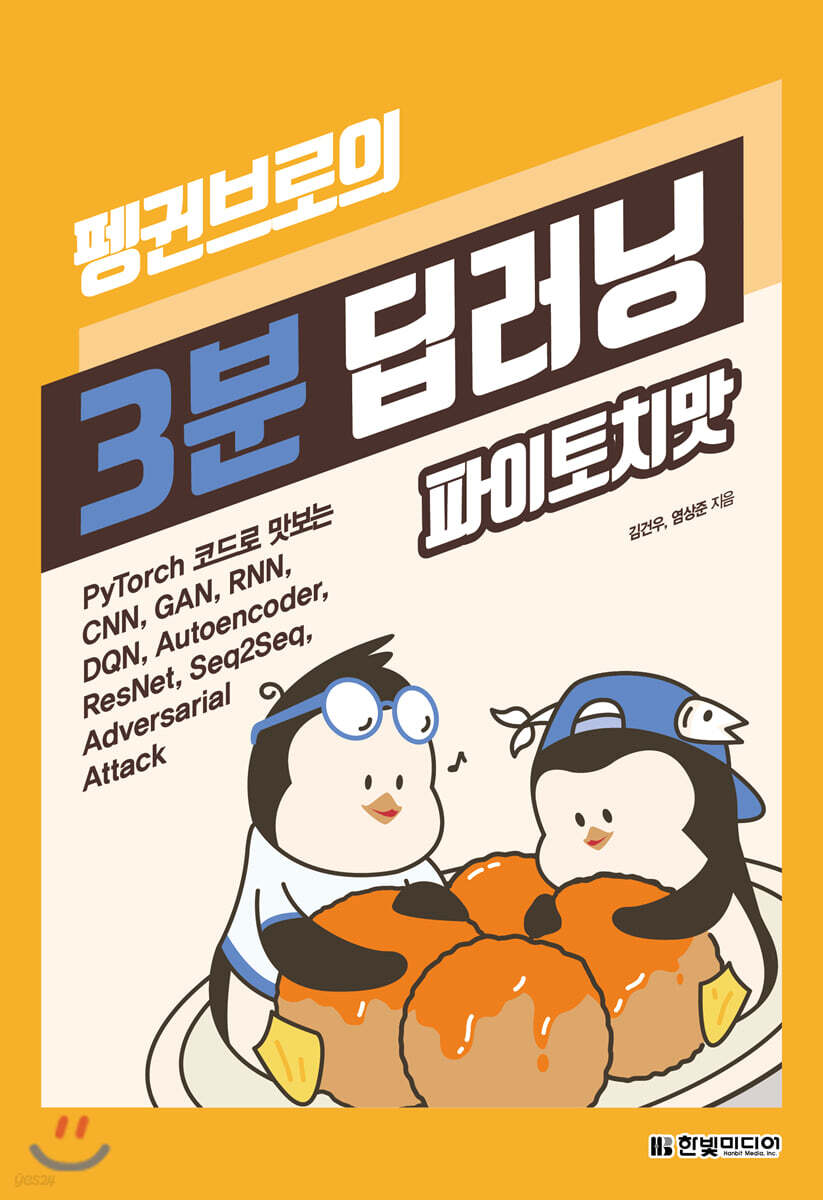
Penguin Bro's 3-Minute Deep Learning, PyTorch Flavor
 |
Description
Book Introduction
Taste the core concepts of deep learning with PyTorch code!
This book teaches you how to implement artificial intelligence with PyTorch.
We will learn about basic knowledge for beginners in artificial intelligence and artificial neural network technology, the latest method of implementing artificial intelligence, through case studies.
It directly implements supervised learning methods such as ANN, DNN, CNN, and RNN, as well as unsupervised learning methods such as AE and GAN, and reinforcement learning DQN.
We cover interesting application examples of the neural networks introduced in each chapter, such as learning how to hack by exploiting the weaknesses of deep learning.
It is designed to help you easily learn how to implement artificial intelligence by implementing examples, and the example code can be found on GitHub.
* The ‘3 minutes’ in this book does not mean ‘learn in 3 minutes.’
It means 'learning in a simple and useful way, like a 3-minute meal.'
This book teaches you how to implement artificial intelligence with PyTorch.
We will learn about basic knowledge for beginners in artificial intelligence and artificial neural network technology, the latest method of implementing artificial intelligence, through case studies.
It directly implements supervised learning methods such as ANN, DNN, CNN, and RNN, as well as unsupervised learning methods such as AE and GAN, and reinforcement learning DQN.
We cover interesting application examples of the neural networks introduced in each chapter, such as learning how to hack by exploiting the weaknesses of deep learning.
It is designed to help you easily learn how to implement artificial intelligence by implementing examples, and the example code can be found on GitHub.
* The ‘3 minutes’ in this book does not mean ‘learn in 3 minutes.’
It means 'learning in a simple and useful way, like a 3-minute meal.'
index
CHAPTER 1 Deep Learning and PyTorch
1.1 Artificial Intelligence and Machine Learning
1.2 Supervised learning, unsupervised learning, and reinforcement learning
1.3 Deep Learning and Neural Networks
1.4 Until PyTorch was developed
1.5 Why PyTorch?
1.6 In conclusion
CHAPTER 2: Getting Started with PyTorch
2.1 PyTorch Installation & Environment Configuration
2.2 Downloading and Running the PyTorch Example
2.3 Jupyter Notebook
2.4 In conclusion
CHAPTER 3: Implementing the Complete ANN Code with PyTorch
3.1 Tensors and Autograd
3.2 Image Restoration Using Gradient Descent
3.3 Implementing the Neural Network Model
3.4 In conclusion
CHAPTER 4 DNNs for Distinguishing Fashion Items
4.1 Understanding the Fashion MNIST Dataset
4.2 Classifying Fashion Items with Artificial Neural Networks
4.3 Measuring Performance
4.4 Overfitting and Dropout
4.5 In conclusion
CHAPTER 5 CNNs with Excellent Image Processing Capabilities
5.1 CNN Basics
5.2 Implementing the CNN Model
5.3 Applying ResNet to a Color Dataset
5.4 In conclusion
CHAPTER 6 Autoencoders Learning Without Human Guidance
6.1 Autoencoder Basics
6.2 Extracting Image Features with an Autoencoder
6.3 Restoring Corrupted Images with Autoencoders
6.4 In conclusion
CHAPTER 7 RNNs Processing Sequential Data
7.1 RNN Overview
7.2 Movie Review Sentiment Analysis
7.3 Seq2Seq Machine Translation
7.4 In conclusion
CHAPTER 8: Adversarial Attacks Hacking Deep Learning
8.1 What is a hostile attack?
8.2 Types of Hostile Attacks
8.3 FGSM Attack
8.4 In conclusion
CHAPTER 9 GANs that Learn Competitively
9.1 GAN Basics
9.2 Generating New Fashion Items with GANs
9.3 Controlling Generation with cGAN
9.4 In conclusion
CHAPTER 10 DQN Learning by Interacting with a Given Environment
10.1 Reinforcement Learning and DQN Basics
10.2 Mastering the Kartpole Game
10.3 In conclusion
1.1 Artificial Intelligence and Machine Learning
1.2 Supervised learning, unsupervised learning, and reinforcement learning
1.3 Deep Learning and Neural Networks
1.4 Until PyTorch was developed
1.5 Why PyTorch?
1.6 In conclusion
CHAPTER 2: Getting Started with PyTorch
2.1 PyTorch Installation & Environment Configuration
2.2 Downloading and Running the PyTorch Example
2.3 Jupyter Notebook
2.4 In conclusion
CHAPTER 3: Implementing the Complete ANN Code with PyTorch
3.1 Tensors and Autograd
3.2 Image Restoration Using Gradient Descent
3.3 Implementing the Neural Network Model
3.4 In conclusion
CHAPTER 4 DNNs for Distinguishing Fashion Items
4.1 Understanding the Fashion MNIST Dataset
4.2 Classifying Fashion Items with Artificial Neural Networks
4.3 Measuring Performance
4.4 Overfitting and Dropout
4.5 In conclusion
CHAPTER 5 CNNs with Excellent Image Processing Capabilities
5.1 CNN Basics
5.2 Implementing the CNN Model
5.3 Applying ResNet to a Color Dataset
5.4 In conclusion
CHAPTER 6 Autoencoders Learning Without Human Guidance
6.1 Autoencoder Basics
6.2 Extracting Image Features with an Autoencoder
6.3 Restoring Corrupted Images with Autoencoders
6.4 In conclusion
CHAPTER 7 RNNs Processing Sequential Data
7.1 RNN Overview
7.2 Movie Review Sentiment Analysis
7.3 Seq2Seq Machine Translation
7.4 In conclusion
CHAPTER 8: Adversarial Attacks Hacking Deep Learning
8.1 What is a hostile attack?
8.2 Types of Hostile Attacks
8.3 FGSM Attack
8.4 In conclusion
CHAPTER 9 GANs that Learn Competitively
9.1 GAN Basics
9.2 Generating New Fashion Items with GANs
9.3 Controlling Generation with cGAN
9.4 In conclusion
CHAPTER 10 DQN Learning by Interacting with a Given Environment
10.1 Reinforcement Learning and DQN Basics
10.2 Mastering the Kartpole Game
10.3 In conclusion
Detailed image

Publisher's Review
Practice over theory! [3-minute] Deep Learning Series: Learn through experience first!
What's the best way to learn a new programming language or library? [3-minute] series is easy and fun, letting you learn by typing code yourself rather than reading lengthy explanations.
I tried to make it feel like I was sitting next to the reader and quickly 'coding together' while explaining things.
Code is shown only as much as necessary to fit the flow of the explanation, with the full code presented at the end.
The theory only tells you enough to understand the big picture, and the code doesn't go into detail.
First, after you have the big picture and working code in hand, get familiar with PyTorch by referencing the PyTorch usage document and the PyTorch GitHub created by the author and tinkering with the code.
At the end of each section, the full code appears with minimal comments.
Please take a moment to review what you have learned and check if you have understood it correctly.
I've linked the location of the body text description for each code block with a number, so please use it when you don't understand a specific code.
Key Contents
- Getting started with PyTorch
- ANN implemented with PyTorch
- DNN that distinguishes fashion items
- CNN with excellent image recognition capabilities
- Autoencoders that learn without human guidance
- RNN that processes sequential data
- Adversarial attacks that hack deep learning
- GANs that learn through competition
- DQN learns by interacting with a given environment
Structure of this book
It is structured so that even those new to deep learning and PyTorch can easily learn the theory and implement it.
Deep learning is used in a wide range of fields, from language to images, and its forms vary depending on the application.
Therefore, we have prepared examples to enable implementation of as many different learning methods and deep learning models as possible.
_Chapter 1.
Deep Learning and PyTorch
Build your foundational knowledge of deep learning and learn various machine learning methods.
Learn what PyTorch is, why you need it, and how it differs from libraries like TensorFlow and Keras.
_Chapter 2.
Getting Started with PyTorch
Learn how to set up and use PyTorch.
In addition to PyTorch, you will install necessary tools as you progress through the book.
_Chapter 3.
ANN implemented with PyTorch
Learn how to implement the most basic artificial neural network using PyTorch and how to save and reuse the model.
_Chapter 4.
DNN that distinguishes fashion items
Let's use the artificial neural network we learned earlier to classify fashion items in the Fashion MNIST dataset.
_Chapter 5.
CNN with excellent image recognition capabilities
Learn about convolutional neural networks (CNNs), which boast excellent performance in image recognition.
We will also learn about and implement ResNet, which improves performance by stacking CNNs.
_Chapter 6.
Autoencoders that learn without human guidance
Learn about unsupervised learning, which extracts features in the absence of a correct answer, and learn how to understand and implement the autoencoder, a representative unsupervised learning model.
_Chapter 7.
RNNs that process sequential data
We will use recurrent neural networks (RNNs), which perform well on string, speech, and time-series data, to analyze movie review sentiment and create a simple machine translator.
_Chapter 8.
Adversarial attacks that hack deep learning
We'll explore adversarial examples, which are designed to intentionally confuse deep learning models, and explore adversarial attacks, a method for generating adversarial examples.
_Chapter 9.
GANs that learn through competition
Learn about generative adversarial networks (GANs), a unique learning structure that optimizes through competition between two models. GANs can generate new images that don't exist in the dataset.
As an example, we will train on the Fashion MNIST dataset to create new fashion items.
_Chapter 10.
We will learn about DQN (deep q-network) that grows by interacting with a given environment and implement an artificial intelligence that masters a simple game.
What's the best way to learn a new programming language or library? [3-minute] series is easy and fun, letting you learn by typing code yourself rather than reading lengthy explanations.
I tried to make it feel like I was sitting next to the reader and quickly 'coding together' while explaining things.
Code is shown only as much as necessary to fit the flow of the explanation, with the full code presented at the end.
The theory only tells you enough to understand the big picture, and the code doesn't go into detail.
First, after you have the big picture and working code in hand, get familiar with PyTorch by referencing the PyTorch usage document and the PyTorch GitHub created by the author and tinkering with the code.
At the end of each section, the full code appears with minimal comments.
Please take a moment to review what you have learned and check if you have understood it correctly.
I've linked the location of the body text description for each code block with a number, so please use it when you don't understand a specific code.
Key Contents
- Getting started with PyTorch
- ANN implemented with PyTorch
- DNN that distinguishes fashion items
- CNN with excellent image recognition capabilities
- Autoencoders that learn without human guidance
- RNN that processes sequential data
- Adversarial attacks that hack deep learning
- GANs that learn through competition
- DQN learns by interacting with a given environment
Structure of this book
It is structured so that even those new to deep learning and PyTorch can easily learn the theory and implement it.
Deep learning is used in a wide range of fields, from language to images, and its forms vary depending on the application.
Therefore, we have prepared examples to enable implementation of as many different learning methods and deep learning models as possible.
_Chapter 1.
Deep Learning and PyTorch
Build your foundational knowledge of deep learning and learn various machine learning methods.
Learn what PyTorch is, why you need it, and how it differs from libraries like TensorFlow and Keras.
_Chapter 2.
Getting Started with PyTorch
Learn how to set up and use PyTorch.
In addition to PyTorch, you will install necessary tools as you progress through the book.
_Chapter 3.
ANN implemented with PyTorch
Learn how to implement the most basic artificial neural network using PyTorch and how to save and reuse the model.
_Chapter 4.
DNN that distinguishes fashion items
Let's use the artificial neural network we learned earlier to classify fashion items in the Fashion MNIST dataset.
_Chapter 5.
CNN with excellent image recognition capabilities
Learn about convolutional neural networks (CNNs), which boast excellent performance in image recognition.
We will also learn about and implement ResNet, which improves performance by stacking CNNs.
_Chapter 6.
Autoencoders that learn without human guidance
Learn about unsupervised learning, which extracts features in the absence of a correct answer, and learn how to understand and implement the autoencoder, a representative unsupervised learning model.
_Chapter 7.
RNNs that process sequential data
We will use recurrent neural networks (RNNs), which perform well on string, speech, and time-series data, to analyze movie review sentiment and create a simple machine translator.
_Chapter 8.
Adversarial attacks that hack deep learning
We'll explore adversarial examples, which are designed to intentionally confuse deep learning models, and explore adversarial attacks, a method for generating adversarial examples.
_Chapter 9.
GANs that learn through competition
Learn about generative adversarial networks (GANs), a unique learning structure that optimizes through competition between two models. GANs can generate new images that don't exist in the dataset.
As an example, we will train on the Fashion MNIST dataset to create new fashion items.
_Chapter 10.
We will learn about DQN (deep q-network) that grows by interacting with a given environment and implement an artificial intelligence that masters a simple game.
GOODS SPECIFICS
- Date of issue: November 1, 2019
- Page count, weight, size: 344 pages | 153*223*30mm
- ISBN13: 9791162242278
- ISBN10: 1162242272
You may also like
카테고리
korean


korean

![GQ KOREA Mark (Monthly): December [2025]](http://librairie.coreenne.fr/cdn/shop/files/8ef265dbbfbf186523ed75ba7319009d.jpg?v=1765340328&width=3840)


