

Differentiation and integration again
 |
Description
Book Introduction
Let's awaken our dormant mathematical brain, starting with differentiation and integration.
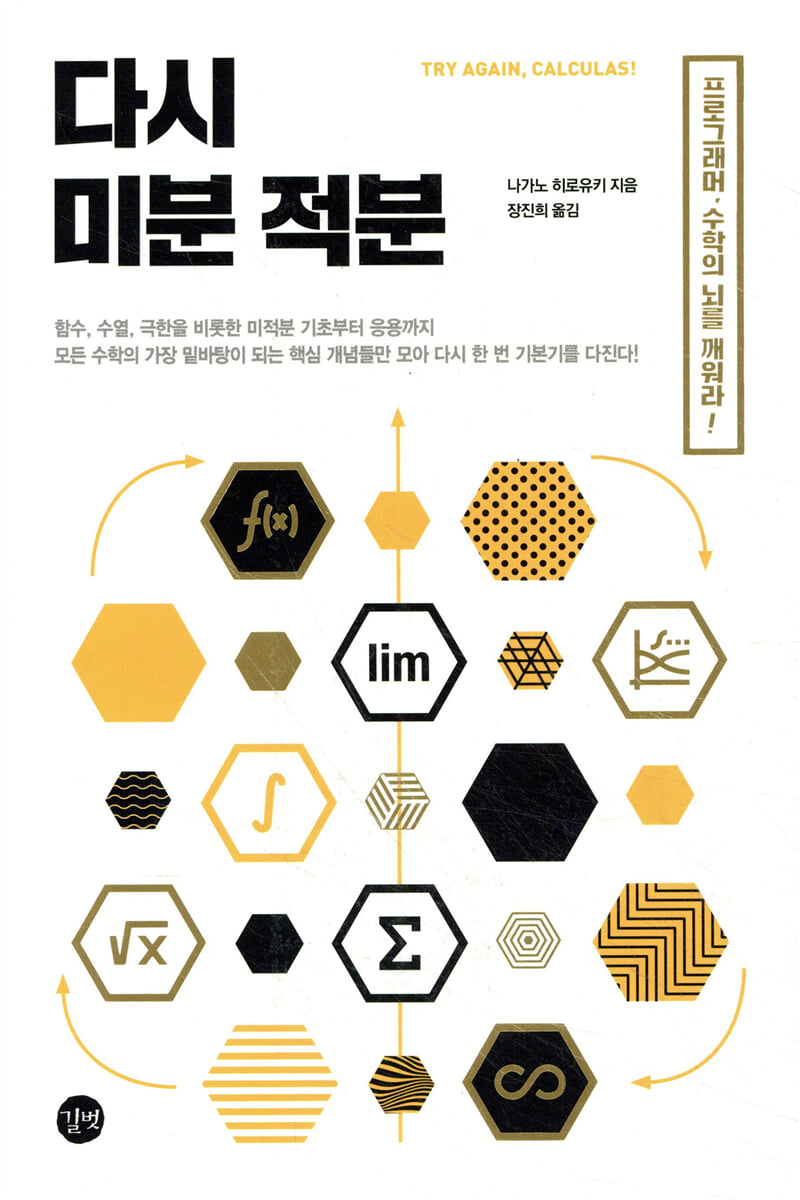
"Differential and Integral Calculus Again" is a book that covers all the concepts essential to advance to linear algebra, probability and statistics, and analysis, from functions, limits, sequences, exponents, logarithms, and trigonometric functions to calculus, all within a high school mathematics level.
Additionally, when developing formulas, it shows in detail how each formula was used without skipping any steps, and it is structured to be intuitively understandable with abundant graphs and illustrations.
"Differential and Integral Calculus Again" is a book that covers all the concepts essential to advance to linear algebra, probability and statistics, and analysis, from functions, limits, sequences, exponents, logarithms, and trigonometric functions to calculus, all within a high school mathematics level.
Additionally, when developing formulas, it shows in detail how each formula was used without skipping any steps, and it is structured to be intuitively understandable with abundant graphs and illustrations.
- You can preview some of the book's contents.
Preview
index
Chapter 1 Differentiation
01 First Steps to Functions and Graphs
02 The first step to understanding change: average rate of change
03 Sum of arithmetic sequence, sum of geometric sequence
04 Let's look very far away: the limit of a sequence
05 Let's attack 0 in the denominator: the limit of a function
06 Differential coefficient is the slope of the tangent line
07 Applications to Physics 1: Instantaneous Speed
08 Permutations, Combinations, and the Binary Theorem
09 Let's derive the differential coefficient formula ourselves!
10 Analyzing Change: Derivatives and Increment Tables
11 Differentiation and Instant Differentiation: Differentiation of Composite Functions
12 Derived by transforming the formula: Differentiation of product and quotient
13 Review at a time 1: Trigonometric ratios and trigonometric functions
14 Thinking in Sectors: Differentiation of Trigonometric Functions
15 Review at a Time 2: Powers and Exponential Functions
16 Review at a time 3: Logarithms and logarithmic functions
17 Let's differentiate logarithmic and exponential functions!
18 Application 1: Maximum and Minimum Values of Functions
19 Application 2: Approximating with a Straight Line
Chapter 2 Integration
20 What is Integral?: Fundamental Theorem of Calculus
21 Let's derive the formulas for indefinite and definite integrals.
22 Integration Techniques: Substitution Integration
23 Application of Definite Integrators 1: Finding Area
24 Application of Definite Integrators 2: Finding Volume
25 Applications to Physics 2: Differential Equations
01 First Steps to Functions and Graphs
02 The first step to understanding change: average rate of change
03 Sum of arithmetic sequence, sum of geometric sequence
04 Let's look very far away: the limit of a sequence
05 Let's attack 0 in the denominator: the limit of a function
06 Differential coefficient is the slope of the tangent line
07 Applications to Physics 1: Instantaneous Speed
08 Permutations, Combinations, and the Binary Theorem
09 Let's derive the differential coefficient formula ourselves!
10 Analyzing Change: Derivatives and Increment Tables
11 Differentiation and Instant Differentiation: Differentiation of Composite Functions
12 Derived by transforming the formula: Differentiation of product and quotient
13 Review at a time 1: Trigonometric ratios and trigonometric functions
14 Thinking in Sectors: Differentiation of Trigonometric Functions
15 Review at a Time 2: Powers and Exponential Functions
16 Review at a time 3: Logarithms and logarithmic functions
17 Let's differentiate logarithmic and exponential functions!
18 Application 1: Maximum and Minimum Values of Functions
19 Application 2: Approximating with a Straight Line
Chapter 2 Integration
20 What is Integral?: Fundamental Theorem of Calculus
21 Let's derive the formulas for indefinite and definite integrals.
22 Integration Techniques: Substitution Integration
23 Application of Definite Integrators 1: Finding Area
24 Application of Definite Integrators 2: Finding Volume
25 Applications to Physics 2: Differential Equations
Detailed image

Publisher's Review
Linear algebra, probability and statistics, and even algorithms
At its foundation are differentiation and integration!
Why differentiation and integration again?
Even the commonly known concept of 'function' is difficult to fully understand without going through calculus.
Calculus is a concept that must be known in order to advance to subjects such as linear algebra, probability and statistics, and vectors.
Algorithms also have the concept of calculus at their foundation.
Let's properly understand calculus, which is also fundamental in the fields of games, data science, and artificial intelligence.
So why this book?
This book explains everything you need to know to understand calculus, from sequences, limits, and trigonometry functions, which you need to know first to learn calculus, to calculus concepts, straight line approximations, and applications of calculus such as volume and area.
Also, rather than simply memorizing formulas and plugging them into calculations to solve problems, we explain the meaning of each formula and why it is transformed in this way without missing a single thing.
It is easier to understand because it uses formulas more actively without omitting anything, from substitution to factoring formulas.
I recommend it to the following people!
- Those who want to re-establish the basics before taking college mathematics such as linear algebra, probability and statistics, and analysis.
- For those who have forgotten high school math and want to quickly review it.
- Those who are learning differentiation and integration for the first time
At its foundation are differentiation and integration!
Why differentiation and integration again?
Even the commonly known concept of 'function' is difficult to fully understand without going through calculus.
Calculus is a concept that must be known in order to advance to subjects such as linear algebra, probability and statistics, and vectors.
Algorithms also have the concept of calculus at their foundation.
Let's properly understand calculus, which is also fundamental in the fields of games, data science, and artificial intelligence.
So why this book?
This book explains everything you need to know to understand calculus, from sequences, limits, and trigonometry functions, which you need to know first to learn calculus, to calculus concepts, straight line approximations, and applications of calculus such as volume and area.
Also, rather than simply memorizing formulas and plugging them into calculations to solve problems, we explain the meaning of each formula and why it is transformed in this way without missing a single thing.
It is easier to understand because it uses formulas more actively without omitting anything, from substitution to factoring formulas.
I recommend it to the following people!
- Those who want to re-establish the basics before taking college mathematics such as linear algebra, probability and statistics, and analysis.
- For those who have forgotten high school math and want to quickly review it.
- Those who are learning differentiation and integration for the first time
GOODS SPECIFICS
- Date of issue: July 25, 2019
- Page count, weight, size: 328 pages | 495g | 152*225*30mm
- ISBN13: 9791160508567
- ISBN10: 1160508569
You may also like
카테고리
korean


korean

![GQ KOREA Mark (Monthly): December [2025]](http://librairie.coreenne.fr/cdn/shop/files/8ef265dbbfbf186523ed75ba7319009d.jpg?v=1765340328&width=3840)


