

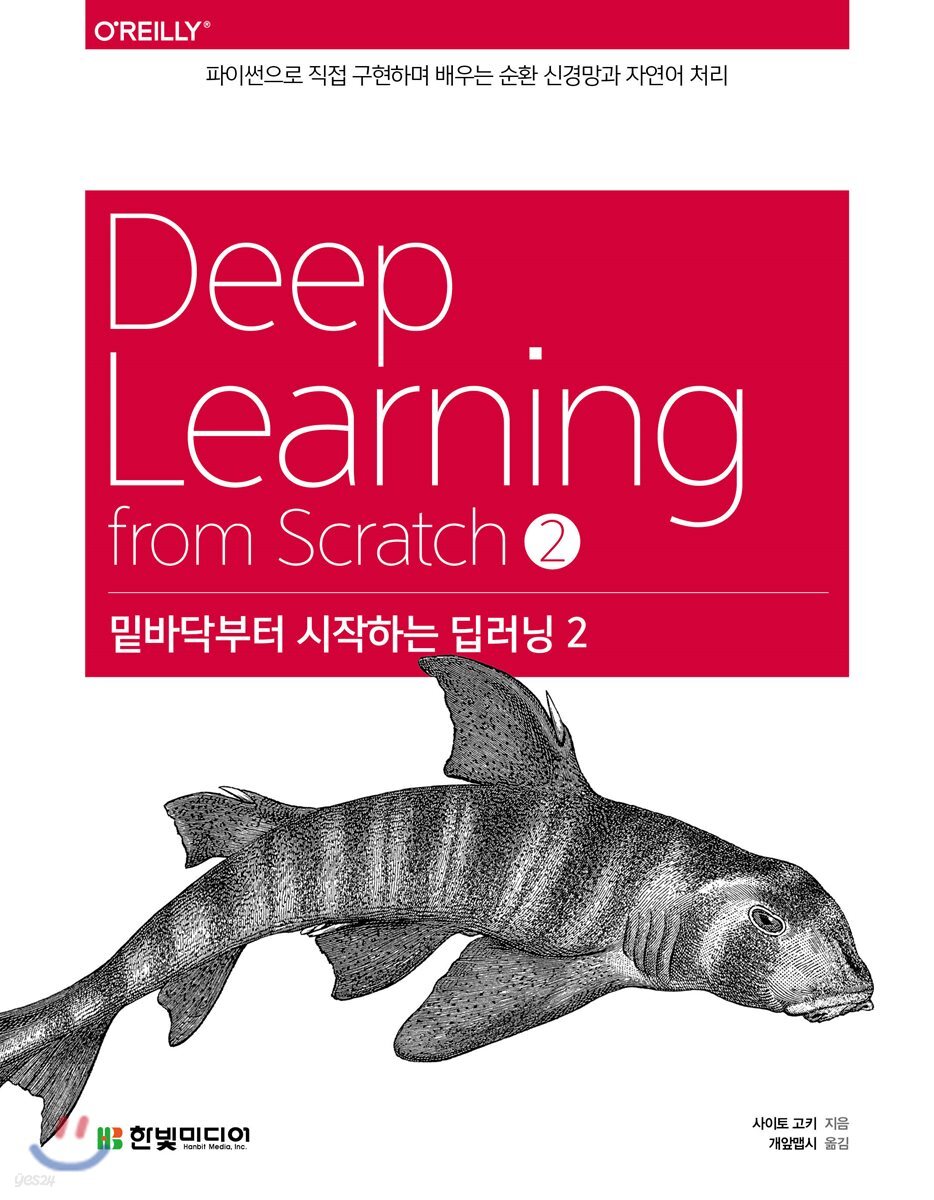
Deep Learning from Scratch 2
 |
Description
Book Introduction
A full-fledged introduction to deep learning through hands-on implementation.
This time, it's recurrent neural networks and natural language processing!
This book focuses on deep learning techniques that use recurrent neural networks (RNNs) for natural language processing and time series data processing, which were not covered in "Deep Learning from Scratch."
It is structured into 8 chapters and is designed to be read sequentially as one story.
We've included a review of neural networks, summarizing what you learned in the previous chapter, in the first chapter, so anyone with some knowledge of neural networks and Python can follow along without having to read the previous chapter.
This time, it's recurrent neural networks and natural language processing!
This book focuses on deep learning techniques that use recurrent neural networks (RNNs) for natural language processing and time series data processing, which were not covered in "Deep Learning from Scratch."
It is structured into 8 chapters and is designed to be read sequentially as one story.
We've included a review of neural networks, summarizing what you learned in the previous chapter, in the first chapter, so anyone with some knowledge of neural networks and Python can follow along without having to read the previous chapter.
- You can preview some of the book's contents.
Preview
index
CHAPTER 1 Neural Networks Review
__1.1 Math and Python Review
__1.2 Neural Network Inference
__1.3 Learning Neural Networks
__1.4 Solving problems with neural networks
__1.5 Accelerated calculations
__1.6 Summary
CHAPTER 2 Natural Language and Distributed Representation of Words
__2.1 What is natural language processing?
__2.2 Thesaurus
__2.3 Statistical-based techniques
__2.4 Improving statistical-based techniques
__2.5 Summary
CHAPTER 3 word2vec
__3.1 Inference-based techniques and neural networks
__3.2 Simple word2vec
__3.3 Preparing training data
__3.4 CBOW model implementation
__3.5 word2vec supplement
__3.6 Summary
CHAPTER 4 Improving word2vec Speed
__4.1 word2vec improvement ①
__4.2 word2vec improvement ②
__4.3 Improved word2vec learning
__4.4 word2vec remaining topics
__4.5 Summary
CHAPTER 5 Recurrent Neural Networks (RNNs)
__5.1 Probability and Language Models
__5.2 What is RNN?
__5.3 RNN Implementation
__5.4 Implementing the Time Series Data Processing Layer
__5.5 RNNLM Training and Evaluation
__5.6 Summary
CHAPTER 6 RNN with added gates
__6.1 Problems with RNNs
__6.2 Vanishing gradient and LSTM
__6.3 LSTM implementation
__6.4 Language Models Using LSTM
__6.5 Additional improvements to RNNLM
__6.6 Summary
CHAPTER 7 Sentence Generation Using RNNs
__7.1 Sentence generation using language models
__7.2 seq2seq
__7.3 seq2seq implementation
__7.4 seq2seq improvements
__7.5 Applications using seq2seq
__7.6 Summary
CHAPTER 8 Attention
__8.1 Structure of Attention
__8.2 Seq2seq Implementation with Attention
__8.3 Attention Evaluation
__8.4 The rest of the story about attention
__8.5 Attention Application
__8.6 Summary
APPENDIX A Differentiation of the sigmoid and tanh functions
__A.1 Sigmoid function
__A.2 tanh function
__A.3 Summary
APPENDIX B WordNet Preview
__B.1 Installing NLTK
__B.2 Obtaining synonyms from WordNet
__B.3 WordNet and word networks
__B.4 Semantic similarity using WordNet
APPENDIX C GRU
__C.1 GRU interface
__C.2 GRU's computational graph
__1.1 Math and Python Review
__1.2 Neural Network Inference
__1.3 Learning Neural Networks
__1.4 Solving problems with neural networks
__1.5 Accelerated calculations
__1.6 Summary
CHAPTER 2 Natural Language and Distributed Representation of Words
__2.1 What is natural language processing?
__2.2 Thesaurus
__2.3 Statistical-based techniques
__2.4 Improving statistical-based techniques
__2.5 Summary
CHAPTER 3 word2vec
__3.1 Inference-based techniques and neural networks
__3.2 Simple word2vec
__3.3 Preparing training data
__3.4 CBOW model implementation
__3.5 word2vec supplement
__3.6 Summary
CHAPTER 4 Improving word2vec Speed
__4.1 word2vec improvement ①
__4.2 word2vec improvement ②
__4.3 Improved word2vec learning
__4.4 word2vec remaining topics
__4.5 Summary
CHAPTER 5 Recurrent Neural Networks (RNNs)
__5.1 Probability and Language Models
__5.2 What is RNN?
__5.3 RNN Implementation
__5.4 Implementing the Time Series Data Processing Layer
__5.5 RNNLM Training and Evaluation
__5.6 Summary
CHAPTER 6 RNN with added gates
__6.1 Problems with RNNs
__6.2 Vanishing gradient and LSTM
__6.3 LSTM implementation
__6.4 Language Models Using LSTM
__6.5 Additional improvements to RNNLM
__6.6 Summary
CHAPTER 7 Sentence Generation Using RNNs
__7.1 Sentence generation using language models
__7.2 seq2seq
__7.3 seq2seq implementation
__7.4 seq2seq improvements
__7.5 Applications using seq2seq
__7.6 Summary
CHAPTER 8 Attention
__8.1 Structure of Attention
__8.2 Seq2seq Implementation with Attention
__8.3 Attention Evaluation
__8.4 The rest of the story about attention
__8.5 Attention Application
__8.6 Summary
APPENDIX A Differentiation of the sigmoid and tanh functions
__A.1 Sigmoid function
__A.2 tanh function
__A.3 Summary
APPENDIX B WordNet Preview
__B.1 Installing NLTK
__B.2 Obtaining synonyms from WordNet
__B.3 WordNet and word networks
__B.4 Semantic similarity using WordNet
APPENDIX C GRU
__C.1 GRU interface
__C.2 GRU's computational graph
Detailed image

Publisher's Review
★ The reputation of 『Deep Learning from Scratch』 remains intact!
This book is a sequel to Deep Learning from Scratch.
Continuing from the previous part, we continue to cover deep learning technology.
This time, we'll tackle a variety of problems using deep learning, focusing specifically on natural language processing and time-series data processing.
And just like the previous installment, we'll explore advanced technologies utilizing deep learning under the motto of "building from the ground up."
★ Focus on natural language processing and time series data processing!
In this book, you will learn essential techniques in deep learning, focusing on natural language processing and time series data processing.
Specifically, these are technologies such as word2vec and RNN, LSTM and GRU, and seq2seq and attention.
This book explains these techniques in as simple terms as possible and guides you through practical implementations to make them your own.
★ What this book covers
- Implement deep learning programs from scratch without relying on external libraries.
- As a sequel to 『Deep Learning from Scratch』, it focuses on deep learning techniques used in natural language processing and time series data processing.
- Provides a learning environment where readers can practice by actually working Python source code.
- Explain in as simple terms as possible, using lots of clear pictures.
- We use formulas, but we value explanations based on source code more than anything else.
- We value the 'why' such as 'Why is that technique superior?', 'Why does that method work?', 'Why is that a problem?', etc.
★ Recommendation
Following "Deep Learning from Scratch," this is an experiential introductory book that teaches fundamental principles by implementing widely used deep learning models.
While the previous part guided you through implementing the fundamentals of deep learning from the ground up, this part lays the foundation for building your own deep learning framework.
This is an excellent guide that covers the use of Python and NumPy.
I recommend this book to anyone studying deep learning frameworks.
Yoon Young-sun, Professor of Information and Communication Engineering, Hannam University
When diving into the field of deep learning using machine learning libraries, it can be incredibly frustrating to not be able to understand the internal structure and details of the network.
This book helps you understand networks by implementing them from the ground up, from the big picture to the details, and blows away all the frustration in one go.
Compared to books published in Korea so far that do not cover RNN or natural language processing, this book explains everything from basic natural language processing to applications and advanced processes.
Recommended for those who want to enter the field of natural language processing.
- Park Dong-ju, Master's student, Gwangju Institute of Science and Technology
From now on, the basics of natural language processing will be divided into a before and after book.
As in the previous part, I was impressed by the intuitive and logical explanation.
This book is recommended for anyone who wants to understand how natural language processing works, from beginners new to natural language processing to those who have experience using frameworks.
In particular, the part that clearly explains the pros and cons and differences between statistical-based and inference-based techniques was very helpful in understanding the content.
- Seong Min-seok, 4th year, Computer Engineering, Hongik University
You can study the basics of natural language processing using deep learning from the ground up.
As in the previous part, you can easily study the operating principles of RNN, LSTM, attention, etc. while implementing them.
I read the Japanese version first last year, and the translation is just as good as the first one.
- Kim Seon-woong, Machine Learning Engineer, Scatter Lab
This book provides an easy-to-understand explanation of the concepts of RNN-based neural networks and explains complex application models through illustrations and examples.
It will be of great help to those studying time series and those starting to study RNN.
Kim Dong-seong, Researcher at Samsung Research
By following the easily explained theories and friendly code, you can naturally understand the advancements in the field of natural language processing.
If you need a basic understanding of deep learning, I recommend starting from the beginning.
Yang Min-hyeok, Hyundai Mobis Big Data Team
I'm so excited to see Part 2 of "Deep Learning from Scratch" coming out!
This is a book that even young students like me can easily understand and follow along with natural language processing.
If you, like me, are hesitating about whether you can do it, pick up this book without hesitation.
- Kim Kyung-soo, 2nd year, Bongilcheon High School
This book is a sequel to Deep Learning from Scratch.
Continuing from the previous part, we continue to cover deep learning technology.
This time, we'll tackle a variety of problems using deep learning, focusing specifically on natural language processing and time-series data processing.
And just like the previous installment, we'll explore advanced technologies utilizing deep learning under the motto of "building from the ground up."
★ Focus on natural language processing and time series data processing!
In this book, you will learn essential techniques in deep learning, focusing on natural language processing and time series data processing.
Specifically, these are technologies such as word2vec and RNN, LSTM and GRU, and seq2seq and attention.
This book explains these techniques in as simple terms as possible and guides you through practical implementations to make them your own.
★ What this book covers
- Implement deep learning programs from scratch without relying on external libraries.
- As a sequel to 『Deep Learning from Scratch』, it focuses on deep learning techniques used in natural language processing and time series data processing.
- Provides a learning environment where readers can practice by actually working Python source code.
- Explain in as simple terms as possible, using lots of clear pictures.
- We use formulas, but we value explanations based on source code more than anything else.
- We value the 'why' such as 'Why is that technique superior?', 'Why does that method work?', 'Why is that a problem?', etc.
★ Recommendation
Following "Deep Learning from Scratch," this is an experiential introductory book that teaches fundamental principles by implementing widely used deep learning models.
While the previous part guided you through implementing the fundamentals of deep learning from the ground up, this part lays the foundation for building your own deep learning framework.
This is an excellent guide that covers the use of Python and NumPy.
I recommend this book to anyone studying deep learning frameworks.
Yoon Young-sun, Professor of Information and Communication Engineering, Hannam University
When diving into the field of deep learning using machine learning libraries, it can be incredibly frustrating to not be able to understand the internal structure and details of the network.
This book helps you understand networks by implementing them from the ground up, from the big picture to the details, and blows away all the frustration in one go.
Compared to books published in Korea so far that do not cover RNN or natural language processing, this book explains everything from basic natural language processing to applications and advanced processes.
Recommended for those who want to enter the field of natural language processing.
- Park Dong-ju, Master's student, Gwangju Institute of Science and Technology
From now on, the basics of natural language processing will be divided into a before and after book.
As in the previous part, I was impressed by the intuitive and logical explanation.
This book is recommended for anyone who wants to understand how natural language processing works, from beginners new to natural language processing to those who have experience using frameworks.
In particular, the part that clearly explains the pros and cons and differences between statistical-based and inference-based techniques was very helpful in understanding the content.
- Seong Min-seok, 4th year, Computer Engineering, Hongik University
You can study the basics of natural language processing using deep learning from the ground up.
As in the previous part, you can easily study the operating principles of RNN, LSTM, attention, etc. while implementing them.
I read the Japanese version first last year, and the translation is just as good as the first one.
- Kim Seon-woong, Machine Learning Engineer, Scatter Lab
This book provides an easy-to-understand explanation of the concepts of RNN-based neural networks and explains complex application models through illustrations and examples.
It will be of great help to those studying time series and those starting to study RNN.
Kim Dong-seong, Researcher at Samsung Research
By following the easily explained theories and friendly code, you can naturally understand the advancements in the field of natural language processing.
If you need a basic understanding of deep learning, I recommend starting from the beginning.
Yang Min-hyeok, Hyundai Mobis Big Data Team
I'm so excited to see Part 2 of "Deep Learning from Scratch" coming out!
This is a book that even young students like me can easily understand and follow along with natural language processing.
If you, like me, are hesitating about whether you can do it, pick up this book without hesitation.
- Kim Kyung-soo, 2nd year, Bongilcheon High School
GOODS SPECIFICS
- Date of issue: May 1, 2019
- Page count, weight, size: 420 pages | 750g | 183*235*30mm
- ISBN13: 9791162241745
- ISBN10: 1162241748
You may also like
카테고리
korean


korean

![GQ KOREA Mark (Monthly): December [2025]](http://librairie.coreenne.fr/cdn/shop/files/8ef265dbbfbf186523ed75ba7319009d.jpg?v=1765340328&width=3840)


