

Learning Python through Games
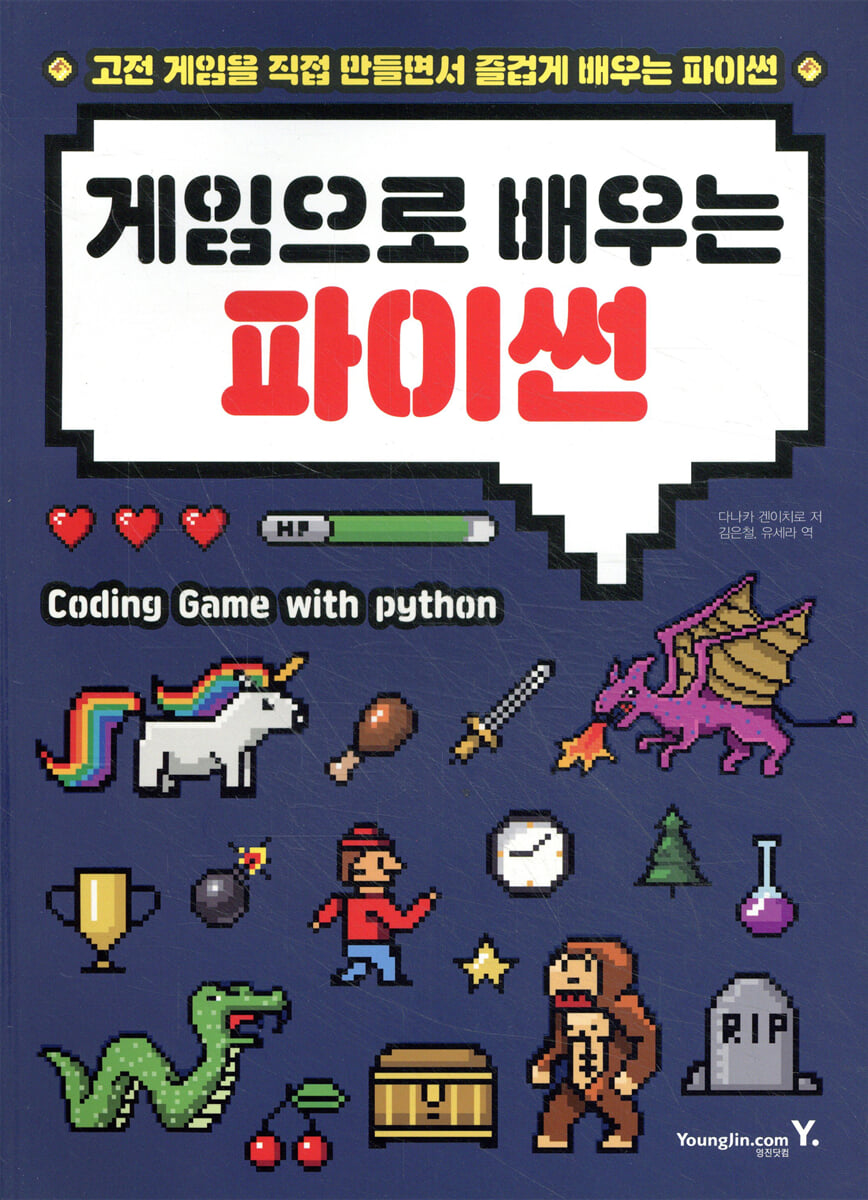 |
Description
Book Introduction
Python is attracting attention in cutting-edge fields such as machine learning and AI, and is also suitable as a basic language for learning programming principles.
In 『Learn Python through Games』, you can learn Python easily and enjoyably by creating simple games yourself.
The basics section explains basic knowledge such as Python grammar and PyGame, and the game section shows how the previously learned grammar is actually implemented through 9 example games.
We have compiled classic games we are familiar with, such as Tetris, Galaga, Block, Puzzle, and Missile, into short codes that are easy for even beginners to input.
- You can preview some of the book's contents.
Preview
index
Part 1.
Basics
Chapter 1.
Introduction to Python
1 Rich library
2 Settings
Chapter 2.
Data types and data structures
1 operation
2 variables
3 Simple method of admission
4 functions
5 data types
6 Type Conversion
7 Lists, tuples, and dictionaries
8 Convenient functions for handling lists and tuples
9 Comments
Line break of 10 rows
Chapter 3.
Control statements
1 indent
2 Conditional evaluation
3. Non-Boolean values
4 functions
5 modules
Chapter 4.
PyGame
1 Window display
2 timers
3 PyGame's documentation
4 Various drawings
Chapter 5.
Other things to know
1. Basics of Trigonometry
2 Debugging
3 ranges
Chapter 6.
object-oriented
1 Properties and Methods
2 Classes and Objects (Instances)
3. The concept of inheritance
4 Methods and Interfaces
5-class design
6 Class Definitions
7 Methods
8 Inheritance
Part 2.
Game version
Chapter 1.
Cave
1 Overview
2 global variables
3 functions
Chapter 2.
Mine Sweeper
1 Overview
2 global variables
3 functions
Chapter 3 Saturn Voyager
1 Coordinate system
2 Global variables/global code
3 functions
Chapter 4.
Snake
1 Overview (Function Version)
2 global variables
3 functions
4 Overview (Object-Oriented Version)
5 classes
Chapter 5.
Breaking blocks
1 Overview
2 global variables
3 Classes and Functions
Chapter 6.
asteroids
1 Overview
2 classes
3 functions
Chapter 7.
Missile Command
1 Overview
2 classes
3 global variables
4 Classes and Functions
Chapter 8.
Shooting
1 Overview
2 classes
3 functions
Chapter 9.
Tetris
1 Overview
2 classes
3 functions
4 global variables
Detailed image

Publisher's Review
Overview and Contents
Have fun learning Python programming while creating games.
Python is attracting attention in cutting-edge fields such as machine learning and AI, and is also suitable as a basic language for learning programming principles.
In this book, you will learn Python in an easy and fun way by creating simple games yourself.
The basics section explains basic knowledge such as Python grammar and PyGame, and the game section shows how the previously learned grammar is actually implemented through 9 example games.
We've compiled classic games we're familiar with, like Tetris, Galaga, Block, Puzzle, and Missile, into short codes that even beginners can easily input.
Part 1.
Basics
In the basics, you will learn about Python's basic grammar, including how to install Python, how to use variables, arithmetic operations, basic data structures such as lists and tuples, and control commands such as if statements, for statements, and while statements.
It also covers the basics of PyGame usage, debugging methods, trigonometry, object-oriented thinking, and class usage, all of which are essential for actual game development.
Part 2.
Game version
To become familiar with a programming language, you need to be exposed to many concrete examples.
In the game section, you will create various styles of games, such as scrolling, puzzle, pseudo-3D, block-breaking, shooting, and falling, based on what you learned in the basic section.
As you read the source code for all nine games, you'll notice a pattern.
GOODS SPECIFICS
- Date of issue: March 29, 2019
- Page count, weight, size: 280 pages | 716g | 188*257*20mm
- ISBN13: 9788931459982
- ISBN10: 893145998X
You may also like
카테고리
korean


korean


