

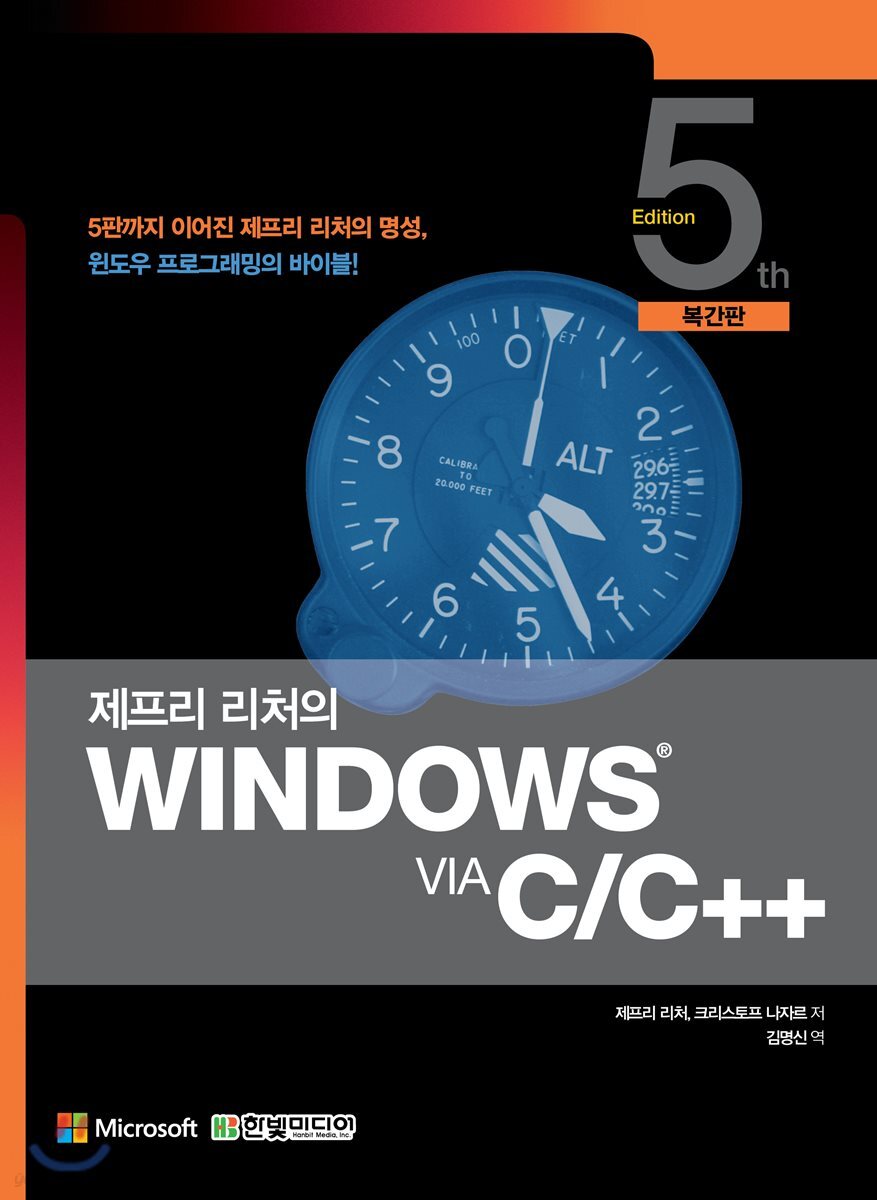
Jeffrey Richter's Windows via C/C++ (Reissue)
 |
Description
Book Introduction
To properly learn Microsoft Windows, it is important to thoroughly understand the most basic infrastructure.
Once you understand the basics, it's not difficult to gradually learn other features that make up the operating system.
So this book focuses on the most basic infrastructure of Windows and the core concepts that must be known when designing and implementing software for Windows.
This book introduces readers to various Windows features and explains how to use them using the C/C++ language.
- You can preview some of the book's contents.
Preview
index
Part 1.
Get ready
Chapter 1.
Error handling
Chapter 2 Working with Characters and Strings
Chapter 3 Kernel Objects
Part 2.
Goal Achievement
Chapter 4 Process
Chapter 5
Chapter 6: Thread Basics
Chapter 7 Thread Scheduling, Priority, and Affinity
Chapter 8 Thread Synchronization in User Mode
Chapter 9: Thread Synchronization Using Kernel Objects
Chapter 10 Synchronous and Asynchronous Device I/O
Chapter 11 Windows Thread Pool
Chapter 12 Fiber
Part 3.
Memory Management
Chapter 13: Windows Memory Structure
Chapter 14: Exploring Virtual Memory
Chapter 15: How to Use Virtual Memory in Applications
Chapter 16 Thread Stack
Chapter 17 Memory Mapped Files
Chapter 18 Heap
Part 4.
Dynamic Link Library (DLL)
Chapter 19 DLL Basics
Chapter 20: Advanced DLL Techniques
Chapter 21: Thread Local Storage (TLS)
Chapter 22: DLL Injection and API Hooking
Part 5.
Structured exception handling
Chapter 23 Termination Handler
Chapter 24 Exception Handlers and Software Exceptions
Chapter 25: Unhandled Exceptions, Vectored Exception Handling, and C++ Exceptions
Chapter 26: Error Reporting and Application Recovery
Appendix A Build Environment
Appendix B Message Cracker, Child Control Macros, and API Macros
Publisher's Review
Features and strengths of this book
-.
A revised edition after eight years, reflecting content for Windows XP, Windows Vista, and Windows Server 2008.
-.
A balanced approach to basic and applied technologies
-.
Considerations for developing applications for 64-bit Windows, guidelines and know-how for writing a single source code that can be used equally on 32-bit and 64-bit Windows.
-.
Upgraded content on core functions of the operating system, such as processes, threads, synchronization objects, and memory management.
-.
How DLLs work, detailing their operating principles, injection, how structured exception handling works, and how exceptions are handled.
-.
Includes the latest technologies, including secure string functions that are hard to find in other books, completely rewritten thread pool-related functions, and new error reporting and application recovery features introduced in Windows Vista.
The best book for Windows programmers, digging into the roots of the Windows system.
If you're a programmer developing complex applications with Visual C++, you'll find the advice in this book invaluable.
Jeffrey Richter has revised this book for the first time in eight years to reflect Windows XP, Windows Vista, and Windows Server 2008.
The in-depth and comprehensive guidance, enhanced techniques, and refined code examples included in this book will help you become a Windows application development expert.
[Main Content]
-.
Structure and implementation of applications running on 32-bit and 64-bit Windows
-.
Creating and using processes and jobs
-.
Creating, managing, synchronizing, and destroying threads
-.
Performing synchronous and asynchronous I/O using I/O completion ports
-.
Various memory management including virtual memory, memory-mapped files, and heaps.
-.
Techniques for securing physical storage of thread stacks
-.
Creating DLLs for lazy loading, API hooking, and process injection
-.
Use of structured exception handling, Windows error recovery, and application restart
"This book is not a book that can foster creativity, and it is certainly not a book that can foster craftsmanship.
This book teaches the so-called basics to developers who develop programs based on Windows.
Trending technologies have short life cycles.
New technologies that came out last year are no longer new technologies.
That's why many developers emphasize the need to constantly study.
That's partially true.
However, if the target is to learn trendy technologies as if they were a mirage, then the direction is wrong.
What is needed is a balanced approach to basic and applied technologies.
I think the reason this book has been consistently loved throughout its fifth edition is because of this sense of balance.
This is because it harmoniously combines the unchanging appearance of Windows, which has been passed down from the original Windows, with the newly added features of the new operating system.
It has been eight years since the previous edition of this book, Programming Applications for Microsoft Windows, was published.
The Windows operating system has also evolved significantly over time, and many new technologies have been incorporated.
Now is the time to upgrade what you studied eight years ago."
- From the translator's preface
GOODS SPECIFICS
- Date of issue: April 1, 2019
- Page count, weight, size: 984 pages | 1,962g | 188*257*40mm
- ISBN13: 9788979146219
- ISBN10: 8979146213
You may also like
카테고리
korean


korean


