

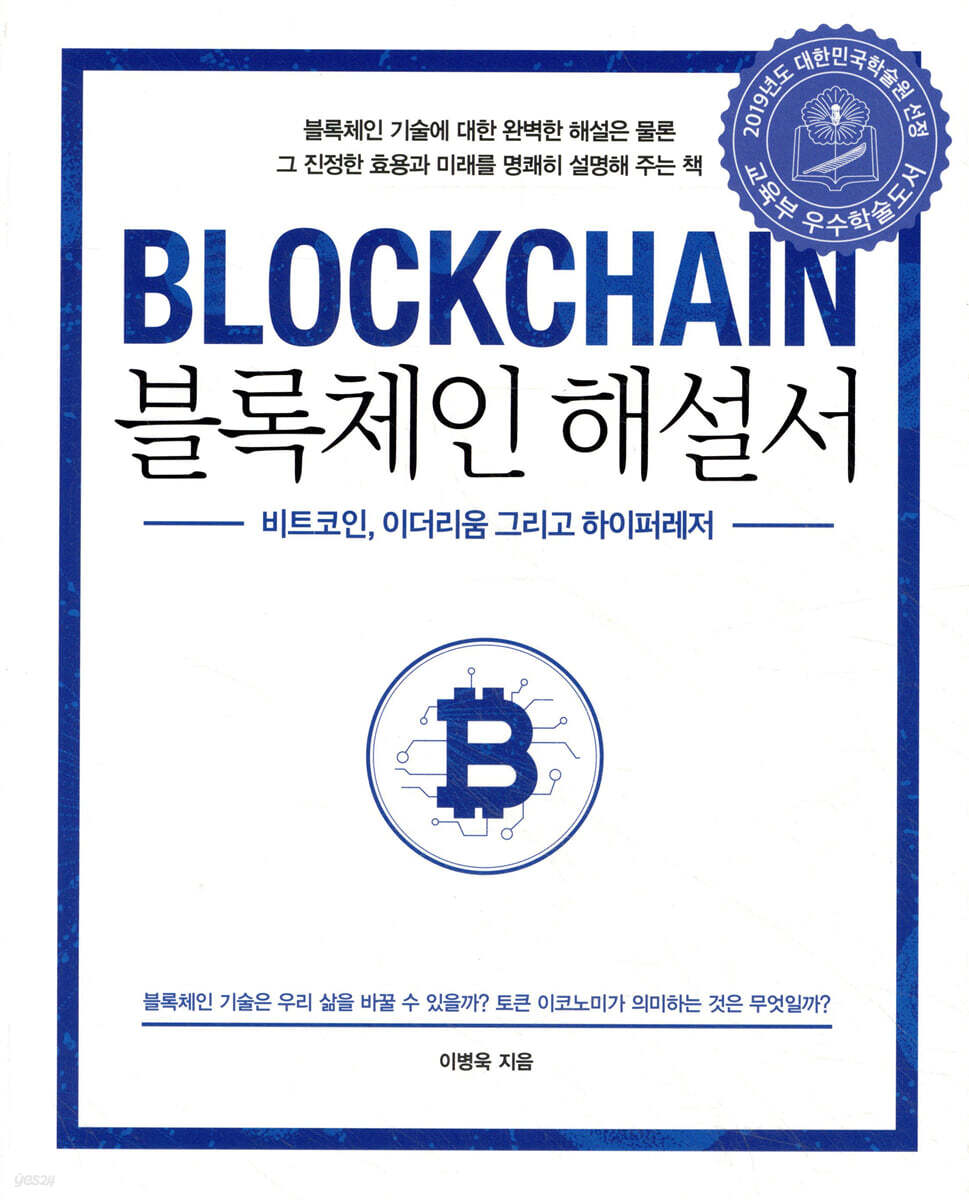
Blockchain Commentary
 |
Description
Book Introduction
This is a guide that clearly explains the true nature of blockchain technology.
It explains in detail the historical background of the creation of blockchain as well as its operating principles.
This tells us what the true utility is.
Among the numerous blockchains, the most representative ones, Bitcoin, Ethereum, and Hyperledger, are explained and compared to each other, providing clear answers about their utility and future prospects.
If you're currently involved in a blockchain project or part of a company considering implementing one, this is a must-read.
It will also provide clear answers to all readers who want to know exactly what blockchain technology is and what its future holds.
- You can preview some of the book's contents.
Preview
index
Chapter 1.
The Beginning of Confusion - Terms and Definitions
1.1 Decentralization vs. Distributed
1.1.1 Distribution of work versus overlap of work
1.1.2 Equality vs. Dominance
1.2 The Benefits of Digitalization vs. the Benefits of Blockchain
1.2.1 Examples of Misunderstanding Blockchain
1.3 Cryptocurrency, virtual currency, exchanges, etc.
1.3.1 Digital Currency vs. Cryptocurrency
1.3.2 Cryptocurrencies vs. Tokens
1.3.3 Exchanges vs. Brokers and Intermediaries
1.4 Digital Assets
1.5 Nodes, Peers, Transactions, etc.
1.6 Transactions
Chapter 2.
The basic principles of the Bitcoin blockchain
2.1 Cypherpunk
2.2 The Birth of Bitcoin - January 3, 2009
2.2.1 Bitcoin Maximum Production - 21 Million Bitcoins
2.2.2 The proper noun blockchain
2.3 Basic Operating Principles of Blockchain
2.3.1 Full Nodes and Simple Payment Verification Nodes
2.3.1.1 Full Node
2.3.1.2 Simple Payment Verification Node
2.3.2 How Blockchain Works
2.3.2.1 Delivery via broadcasting
2.3.2.2 Leader Election - Who Will Record?
2.3.2.3 Absence of Trust - Verification by All Nodes
2.3.3 Decentralized Consensus in Asynchronous Systems
2.3.3.1 The clash of different truths
2.3.3.2 Unification of Different Truths - Decentralized Consensus
2.3.3.3 Transaction Stability - Verification
2.3.4 Block Structure
2.3.4.1 Block Header
2.3.5 Transactions
2.3.5.1 UTXO
2.3.5.2 Coinbase Transactions
2.3.6 Dual Use
2.3.7 Smart Contracts
2.3.8 Bitcoin Wallet
2.3.8.1 Creating and managing private/public keys for account management
2.3.8.2 Submitting a Bitcoin transaction to the system
2.3.8.3 Bitcoin Balance Management
Chapter 3.
Bitcoin blockchain-based technology
3.1 Hash functions and asymmetric encryption techniques
3.1.1 SHA-256 and Hash Puzzles
3.1.2 Merkle tree
3.1.3 Encryption Techniques
3.1.3.1 Asymmetric encryption techniques
3.1.3.1.1 Encryption with Private Key - Digital Signature
3.1.2.1.2 Encryption with a Public Key - Confidentiality and Identity Verification
3.1.3 Electronic Signatures and Asymmetric Cryptography on Blockchain
3.2 Proof of Work and Proof of Stake
3.2.1 Proof of Work
3.2.1.1 Bitcoin's Proof of Work - Hash Puzzle
3.2.1.2 Bitcoin Hash Puzzle
3.2.1.3 Difficulty of hash puzzles
3.2.1.4 Bitcoin Difficulty Control
3.2.1.5 Irreversibility using chained hashes
3.2.2 Proof of Stake
3.2.2.1 The Nothing to Lose Dilemma
3.2.2.2 Security of Proof of Stake
3.3 Hard Forks and Soft Forks
3.3.1 Validating Previously Invalid Rules - Hard Fork
3.3.2 Invalidating previously valid rules - Soft fork
3.3.3 Segwit and Segwit2x
3.4 51% attack
3.5 The Byzantine Generals Problem and Blockchain
3.5.1 Fault-Disruption Model
3.5.2 Byzantine General Model
3.6 Blockchain and Security
3.6.1 Security Environment Surrounding Blockchain
3.6.2 Blockchain - Intrinsic Security
3.6.3 Bitcoin System - Applied Stability
3.6.3.1 Security of the Core Software System
3.6.3.2 Safety of basic design
3.6.3.2.1 Flaws in the Hash Puzzle and Difficulty Control
3.6.3.2.2 Incentive Engineering Defects
3.6.4 Bitcoin Wallet - Individual Security
3.6.4.1 Problems with the wallet software itself
3.6.4.2 Wallet User Issues
3.6.5 External environment such as brokerage firms - External safety
Chapter 4.
Ethereum blockchain
4.1 Ethereum and Accounts
4.1.2 EOA - Basic Trading Account
4.1.3 Contract Accounts and EVM
4.1.4 Gas
4.1.4.1 Meta-unit called gas
4.1.5 Ethereum's block structure
4.1.5.1 Uncle Block
4.1.5.2 Extended Merkle Tree Root Data
4.1.5.3 Gas control of the block
4.1.5.4 Log Broom
4.1.5.5 Zero-Knowledge Proofs
4.2 Ethereum Tree Structure
4.2.1 Extended Merkle Patricia Tree
4.3 Ethereum Hash Puzzle
4.3.1 Computing the Hash Puzzle
4.3.2 Ethereum Difficulty Adjustment
4.4 Ethereum and Smart Contracts
4.5 Ethereum and DApps
4.5.1 The Dilemma of DApps and Information Exposure
4.5.1.2 Authentication-based blockchain?
4.5.1.3 Hybrid System?
4.6 Sharding and Proof of Stake
Chapter 5.
Hyperledger and Blockchain
5.1 Hyperledger Fabric
5.1.1 Basic Operational Principles of Hyperledger Fabric
5.1.2 Fabric vs. Blockchain
5.2 Variant Blockchains and Insider Threats
Chapter 6.
Understanding Blockchain
6.1 Decentralization
6.1.1 Decentralized Platform without Intermediaries
6.1.2 The Cost of Decentralization
6.1.3 DAOs and the Illusion of Decentralization
6.1.4 The DAO Incident - The True Face of Decentralization
6.1.5 A synonym for decentralization is uncontrollability.
6.1.5.1 Big Miners
6.1.5.2 Cryptocurrency Foundation
6.1.5.3 Brokerage
6.2 ICO
6.3 Blockchain is not a security tool.
6.3.1 Privacy and Information Protection
6.3.2 Hash Functions and Security
6.3.3 Risk and Security
6.4 Blockchain is not a fintech tool.
6.4.1 Open Platform
6.4.2 Financial Regulatory Reform
6.4.3 Use of Personal Information - MyData
6.5 Blockchain is not a database
6.6 Blockchain and Incentive Engineering
6.7 Centralized Blockchain
6.8 Three Major Threats to Blockchain
6.8.1 Blockchain Data Size
6.8.2 System Exclusivity
6.8.3 Quantum Computers
6.8.3.1 Passwords and hashes must be decrypted
Chapter 7.
Blockchain and the Symbiotic Economy
7.1 The Rise of Token Economy
7.2 Symbiotic Economy and Blockchain
7.3 Separation of Concept and Implementation
7.3.1 Blockchain and Big Data
7.3.2 Disposable Blockchain
7.3.3 Blockchain and Universality
7.4 Blockchain and Fear Marketing
7.5 Technology vs. Content
In conclusion
Appendix 1.
Structure of a Bitcoin block
Appendix 2.
Hash puzzle concept explained
Appendix 3.
Bitcoin address
Appendix 4.
Transaction script
Detailed image

Publisher's Review
What this book covers
This book is a commentary that clearly explains what blockchain technology is and what its future holds.
To this end, we will explain in detail the historical background of the creation of blockchain as well as its operating principles.
This tells us what the true utility is.
Among the numerous blockchains, the most representative ones, Bitcoin, Ethereum, and Hyperledger, are explained and compared to each other, providing clear answers about their utility and what the future holds.
Target audience for this book
We've tried to avoid unnecessary mathematical symbols or computing jargon as much as possible, but we've focused on readers with at least a basic understanding of blockchain technology.
However, even if you don't have a background in blockchain, you will be able to understand it without difficulty if you have at least a basic understanding of computer science.
This book is particularly suitable for those considering the introduction of blockchain technology in their field, as well as those who have been longing for clear guidelines on the reality and practical utility of blockchain.
Structure of this book
Chapter 1, "The Beginning of Confusion - Defining Terms," minimizes confusion in conveying information by defining several terms.
In particular, it clearly explains the 'benefit of digitalization', which is often confused with the utility of blockchain, as well as 'digital assets' and 'decentralization'.
Chapter 2, "The Benefits of Digitization vs. the Benefits of Blockchain," explains the fundamental principles of the Bitcoin blockchain.
We begin by delving into the background of Bitcoin's creation, "cypherpunk," and privacy protection, before delving into the block creation cycle, which includes leader selection, verification, agreement, and consensus by all nodes.
Chapter 3, "Bitcoin Blockchain-Based Technologies," delves into the underlying technologies of blockchain, including hash functions, asymmetric cryptography, digital signatures, proof-of-work and proof-of-stake, hash puzzles and difficulty adjustments, and hard and soft forks.
Chapter 4, "Ethereum Blockchain," explains Ethereum and explores what an Ethereum account is, which is different from a Bitcoin address. It also delves into contract accounts, the EVM, gas, Merkle Patricia trees, Ethereum's hash puzzle and difficulty adjustment, and Ethereum's smart contracts.
Chapter 5, "Hyperledger and Blockchain," explores the principles and structure of Hyperledger, explains the basic operating principles and concepts of Hyperledger Fabric, and considers whether Hyperledger can be called a blockchain.
Chapter 6, "Understanding Blockchain," provides a comprehensive analysis of the true utility of blockchain.
Along with the concept of decentralization, it also details the true utility of blockchain, which is often misunderstood as a security tool or fintech tool.
Chapter 7, ‘Blockchain and Symbiotic Economy’, describes blockchain as a software technology that simply configures a network.
Explaining its endless possibilities from the perspective of a platform for a symbiotic economy, rather than just alcohol.
Do it.
What does it mean to separate concept and implementation, and what four combinations can be created if we do so?
Also, the key to future corporate competitiveness lies in efficiently securing appropriate data.
It explains how the concept of blockchain, rather than its technology, can be utilized.
Other blockchains
It also details how the technical and content aspects of humanity differ.
Author's Note
January 3, 2019 marks exactly 10 years since the launch of Bitcoin.
Blockchain and cryptocurrencies have created an unprecedented buzz and remain the subject of heated debate.
What benefits have people sought from blockchain technology, and how successful have they been? This book delves into the meaning and reality of blockchain and explores its future.
This is quite different from his previous work, “Bitcoin and Blockchain, the Technology Devoured by Greed” (Acorn Publishing, 2018), which mainly focused on explaining the operating principles of blockchain in an “easy and friendly” manner.
This book focuses on explaining the "substance and utility" in detail rather than providing an "easy and friendly explanation of the operating principles." To this end, it also explains the operating principles of the Bitcoin blockchain, Ethereum, and Hyperledger.
In 2016, IBM predicted that 65% of major banks worldwide would use blockchain by 2019, and CEO Ginni Romety even launched a scare marketing campaign warning that companies that do not quickly adopt blockchain will face significant losses in the future.
As Hyperledger had just launched in December 2015, led by the Linux Foundation, IBM had a fair amount of ambition to make.
And now 2019 has arrived.
But outside of experimental projects, blockchain is nowhere to be seen.
Where exactly is blockchain? What are its benefits, and what does its future hold? This book provides answers to these questions.
GOODS SPECIFICS
- Date of publication: February 28, 2019
- Page count, weight, size: 352 pages | 188*235*20mm
- ISBN13: 9791161752709
- ISBN10: 1161752706
You may also like
카테고리
korean


korean


