

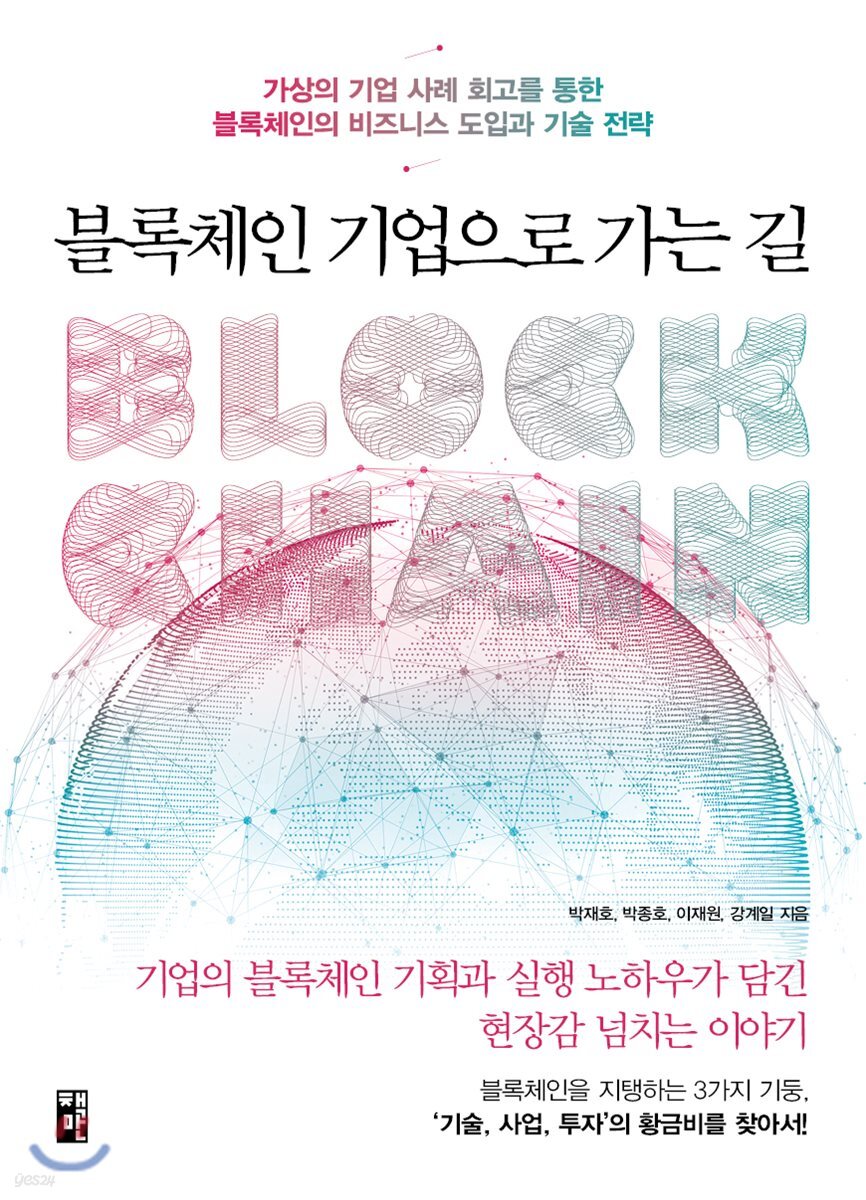
The Road to Blockchain Enterprise
 |
Description
Book Introduction
Blockchain technology is being adopted by major corporations, but how should we implement it in our own companies? As blockchain technology expands into sectors including the public sector, finance, healthcare, and manufacturing supply chain management, how should we view it from a business perspective? This book offers the answers.
This book is a virtual company's introduction to blockchain that anyone can easily and enjoyably read, even without a thorough understanding of complex formulas, security, and programming terms. It contains vivid, vivid stories of companies' blockchain planning and implementation know-how, without any exaggeration.
Additionally, the three pillars supporting blockchain—technology, business, and investment—were introduced in a balanced manner, without any bias toward any one side.
Unlike familiar concepts like AI, big data, and IoT, this book explains in detail how to actually make the technology a reality through the case of a virtual car-sharing company to help overcome the often-difficult concept of blockchain, which can feel difficult to apply to business.
- You can preview some of the book's contents.
Preview
index
Chapter 1 Nanum Corporation Board of Directors
Nanum, a car sharing service company
New 'Sharing Delivery' service launched
The Importance of Artificial Intelligence and Data
The need for blockchain adoption
Chapter 2: Does our company need blockchain?
strategy meeting
Growing corporate interest in blockchain
What is blockchain?
Blockchain, a machine that creates trust
Blockchain from a Business Perspective
Chapter 3: Let's Try Our Own Blockchain Project
Differences between tokens and coins
ICO: Crowdfunding in the Blockchain World
Differences Between Blockchain and Traditional Investments
Economic Problems to be Solved by Blockchain
Chapter 4: On-Chain vs. Off-Chain
On-chain and off-chain from an information perspective
On-chain and off-chain from an operational perspective
The Difference Between Blockchain and Distributed Databases
Oracles are a way to see outside the blockchain.
Distributed File System
Reference Architecture
Chapter 5 Mainnet Selection
Considerations for Selecting a Mainnet
Ethereum's Scaling Plan
Evaluating other mainnets besides Ethereum that support smart contracts
Chapter 6: Business Matters: Applying Blockchain to Business
Introducing Blockchain to the "Data Advertising Market" Business
Smart Contracts and Decentralization
Privacy concerns
Chapter 7: The Obstacles to Writing a White Paper: What the Heck Is a Token Economy?
Two Key Elements of White Paper Writing
What is a token economy?
Token Economy and Incentives
Marketing Uses of Token Economy
Chapter 8: Blockchain Project Funding: Starting an ICO
Marketing Process
Work allocation divided into internal and external personnel
Detailed business planning
Chapter 9 Utility Tokens vs. Security Tokens
Is it for service purposes or investment purposes?
How to convert to utility tokens?
Token Economy Redesign
Chapter 10: Reflections: Post-ICO
ICO Process Review
Hacking attempt
Community pressure related to listing
A community fake news incident occurred
Chapter 11 Market Creation
Coin price management
Measures to revitalize the market
Publisher's Review
[Features of this book]
Instead of rigidly explaining concepts and terms, we explain the key points needed to introduce blockchain into business in an easy-to-understand manner, focusing on hypothetical events that unfold in chronological order.
This article clearly outlines the key considerations for properly implementing blockchain technology, and introduces best practices and anti-patterns for each.
[For whom this book is intended]
- Executives and managers who are curious about how to apply blockchain to their business.
- Practical planners and marketers in charge of business planning and marketing
- Practical developers who want to learn about blockchain technology
[What this book covers]
- A process of applying blockchain technology to a virtual business case
- Procedures and guidelines for tokenizing existing businesses in a decentralized manner by introducing blockchain.
- Know-how required for technical decision-making, such as designing on- and off-chain architecture and selecting a mainnet.
Why token economy is important
- Precautions that are easy to overlook when writing a white paper
- Funding methods and specific marketing techniques for blockchain projects
- Understanding and application of utility tokens and security tokens
- Blockchain business project process at a glance
* TEAM PITCHFIVE
Pitch Five is a group of experts who provide not only technical support for blockchain and artificial intelligence, but also business strategy, branding, marketing, and IT consulting necessary for actual business execution.
In the era of the Fourth Industrial Revolution, a one-stop solution is needed, with experts organically connected to solve problems. The Pitch Five team provides optimal solutions, reducing the lead time and risk of adopting blockchain and artificial intelligence, enabling companies to quickly focus on their core business.
[Author's Note]
In November 2018, Naver's Japanese subsidiary Line (http://linecorp.com/) presented a roadmap for its blockchain, Linkchain.
Following the launch of Linear Network, an interchain network that connects blockchains, LINE announced plans to launch a fully public blockchain in 2019, outlining a step-by-step on-chain strategy for decentralized applications running on Link.
1.
User contribution rewards using LINK, the base coin of Linkchain.
2.
Providing in-service link payment and utility token functions
3.
Tokenization of item and content value
As the number of decentralized applications attached to the blockchain increases and cryptocurrency becomes increasingly available as a payment method instead of fiat currency, the service itself will be tokenized, creating a powerful ecosystem centered around Line. Therefore, it will be interesting to see how other service providers will respond.
Some experts see blockchain as a catalyst for disruptive technological innovation, as once a company establishes hegemony by combining existing businesses or services with blockchain, competitors are left with no viable countermeasures.
How should we respond in this rapidly changing situation?
First, we need to understand what blockchain is, then understand the areas where it can be used, and finally, determine the scope of blockchain application in our respective business sectors and the pros and cons of its adoption.
To explain this in an easily understandable way, this book adopts a unique storytelling narrative style that organizes and reflects on the process of introducing blockchain technology and investment methods, focusing on a hypothetical business. This makes it more accessible to readers than previously published, rigid blockchain books focusing on technology or cryptocurrency.
If we look at blockchain as a tool for actually running businesses on the ground, without focusing solely on the negative side effects of cryptocurrency or overly rosy projections, we might discover yet another hidden potential.
Rather than touting the concept of blockchain out of context, this book emphasizes the need to introduce it in areas where it's a natural fit, along with its superior execution capabilities from a business perspective. Despite successful ICOs, some companies have focused on fundraising rather than their business, failing to launch products that truly benefit users.
In order to use these lessons as a stepping stone, we could have organized the various reasons that led to project failures, such as lack of understanding of blockchain, lack of business experience, discord and conflict between people, service failure due to technology outsourcing, and lack of execution capabilities, and developed the content to help technology companies. However, we concluded that it would be more productive to organize the footsteps of companies that showed the possibility of success with blockchain technology and developed the content to successfully adapt to the process of technological change, and as a result, the book took its current form.
We've tried to minimize complex formulas, terminology, and difficult political and economic theories, making it easy to understand from a business (blockchain) and investment (ICO, the most widely known blockchain) perspective, so that not only executives curious about how to apply blockchain to their businesses, but also working-level staff in charge of business planning and marketing can read it together.
However, we did not forget to consider the technical staff who want to learn about blockchain technology.
By specifically highlighting several key blockchain technology points that are only briefly mentioned in other documents and books, and providing helpful information for decision-making from a practical perspective, you will be able to acquire the technical knowledge essential for developing blockchain projects.
In a world that changes rapidly every day, ICOs may be considered a passing fad, but regardless of whether they had a positive or negative impact, ICOs are worth recording as they were the protagonists (in a positive sense) or the main culprits (in a negative sense) who first made many people aware of blockchain.
All technologies are value-neutral, so they are created by people, utilized by people, and evaluated by people.
The same goes for blockchain technology.
Because we don't know how the world will change in the future, we need to carefully monitor its development direction to ensure we can actively utilize it when the time comes for blockchain to truly prove its worth.
I hope this book will be of some help in exploring the path blockchain is taking.
Blockchain is certainly an attractive topic that opens up new possibilities and is also the direction the current market demands.
However, instead of just focusing on empty rhetoric, we need to first create a proper business plan by applying the most appropriate technology to the most appropriate business field, consider the most suitable token economy and investment method for the business, create a white paper that well integrates blockchain technology and business, and successfully launch a service or product that actually works. Only then will the true value of the blockchain project be recognized by both experts and the general public.
GOODS SPECIFICS
- Date of publication: February 27, 2019
- Page count, weight, size: 228 pages | 148*205*14mm
- ISBN13: 9791189909000
- ISBN10: 1189909006
You may also like
카테고리
korean


korean


