

Pattern Recognition and Machine Learning
 |
Description
Book Introduction
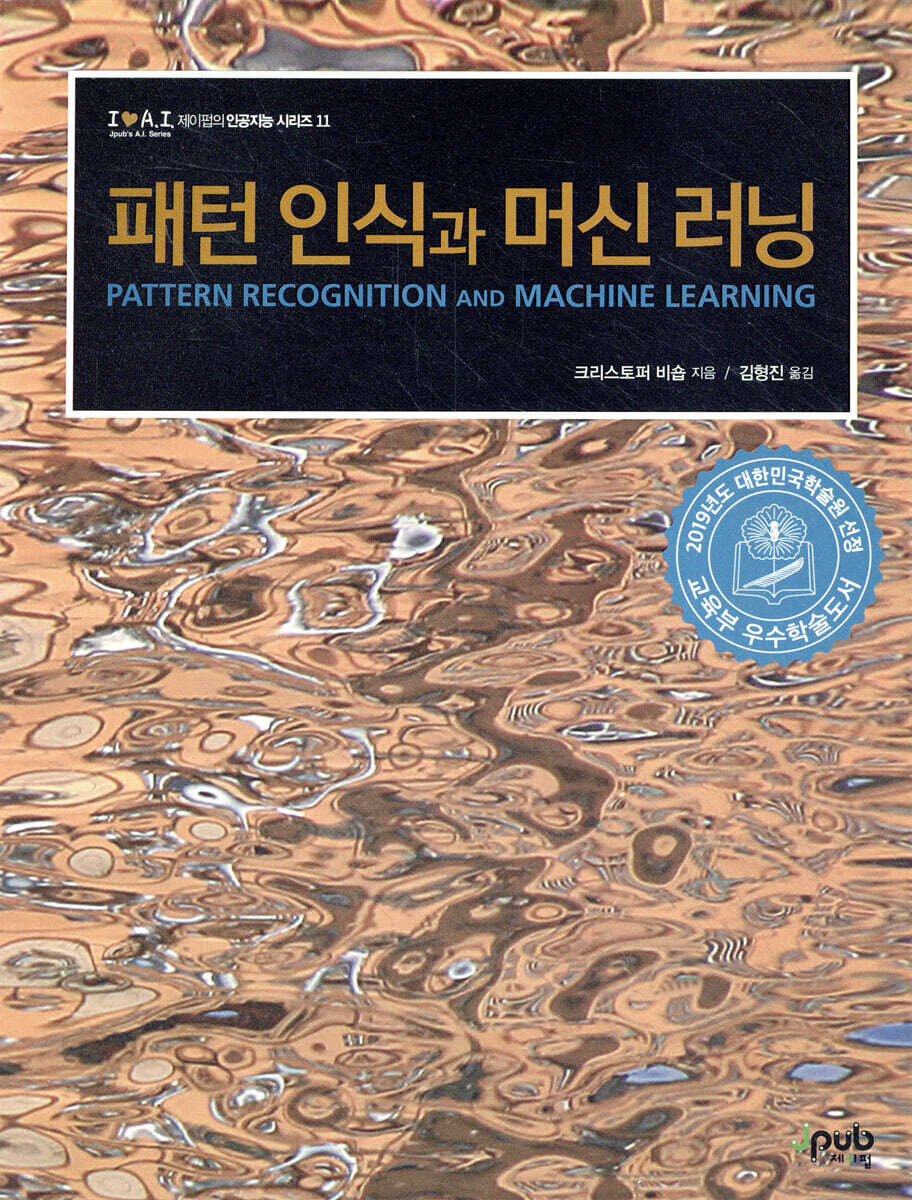
This book covers the general topics of probability/statistics-based pattern recognition and machine learning that have developed over the past several decades.
No prior knowledge of pattern recognition or machine learning is required to understand the content, but experience with multivariate calculus and basic linear algebra is recommended.
It also includes an introduction to basic probability theory, so basic knowledge of probability theory is not necessarily required.
Although primarily intended for upper-year undergraduates and first-year PhD students, it is also suitable for researchers in the field and anyone using machine learning in industry.
It is also suitable for use in courses in fields such as machine learning, statistics, computer engineering, signal processing, computer vision, data mining, and bioinformatics.
- You can preview some of the book's contents.
Preview
index
CHAPTER 1 Introduction 1
1.1 Example: Polynomial Curve Fitting _ 5
1.2 Probability Theory _ 13
1.3 Model Selection _ 36
1.4 Dimensional Curse _ 37
1.5 Decision Theory _ 42
1.6 Information Theory _ 54
CHAPTER 2 PROBABILITY DISTRIBUTIONS 75
2.1 Discrete Random Variables _ 76
2.2 Polynomial Variables _ 83
2.3 Gaussian Distribution _ 87
2.4 Exponent Family _ 126
2.5 Nonparametric Methods _ 134
CHAPTER 3 Linear Regression Models 155
3.1 Linear Basis Function Model _ 156
3.2 Bias Variance Decomposition _ 166
3.3 Bayesian Linear Regression _ 172
3.4 Bayesian Model Comparison _ 181
3.5 Evidence Approximation _ 186
CHAPTER 4 Linear Classification Models 201
4.1 Discriminant Function _ 203
4.2 Probabilistic Generative Models _ 221
4.3 Probabilistic Discriminant Model _ 229
4.4 Laplace Approximation _ 240
4.5 Bayesian Logistic Regression _ 245
CHAPTER 5 NEURAL NETWORKS 253
5.1 Feedforward Network Function _ 255
5.2 Network Training _ 261
5.3 Error Backpropagation _ 271
5.4 Hessian Matrix _ 281
5.5 Regularization in Neural Networks _ 289
5.6 Mixed Density Networks _ 306
5.7 Bayesian Neural Networks _ 312
CHAPTER 6 Kernel Methodology 327
6.1 Dual Representation _ 329
6.2 Kernel Configuration _ 330
6.3 Radial Basis Function Networks _ 336
6.4 Gaussian Processes _ 341
CHAPTER 7 Sparse Kernel Machines 363
7.1 Maximum Margin Classifier _ 364
7.2 Correlation Vector Machines _ 387
CHAPTER 8 GRAPHIC MODELS 403
8.1 Bayesian Networks _ 404
8.2 Conditional Independence _ 418
8.3 Markov Random Fields _ 431
8.4 Inference in Graphical Models _ 443
CHAPTER 9 Mixed Models and EM 477
9.1 K average clustering _ 478
9.2 Mixed Gaussians _ 485
9.3 Another Perspective on EM _ 495
9.4 General EM Algorithm _ 507
CHAPTER 10 Approximate Estimation 517
10.1 Variational Inference _ 518
10.2 Example: Variational Gaussian Mixture Distribution _ 531
10.3 Variational Linear Regression _ 545
10.4 Exponential Distributions _ 549
10.5 Regional Variation Methodology _ 552
10.6 Variational Logistic Regression _ 558
10.7 EP _ 566
CHAPTER 11 Sampling Methods 587
11.1 Basic Sampling Algorithms _ 590
11.2 Markov Chain Monte Carlo _ 603
11.3 Gibbs Sampling Method _ 608
11.4 Fragment Sampling Method _ 613
11.5 Hybrid Monte Carlo Algorithm _ 615
11.6 Partition Function Estimation _ 622
CHAPTER 12 Continuous Latent Variables 627
12.1 PCA _ 629
12.2 Probabilistic PCA _ 640
12.3 Kernel PCA _ 657
12.4 Nonlinear Latent Variable Models _ 662
CHAPTER 13 Sequential Data 677
13.1 Markov Models _ 679
13.2 Hidden Markov Models _ 682
13.3 Linear Dynamic Systems _ 710
CHAPTER 14 MODEL COMBINATIONS 729
14.1 Bayesian Model Mean _ 730
14.2 Committee Method _ 732
14.3 Boosting _ 733
14.4 Tree-Based Models _ 740
14.5 Conditional Mixture Models _ 744
Appendix A.
Dataset 757
Handwritten Numbers _ 757
Oil Flow _ 758
Old Beliefs _ 761
Synthetic Data _ 762
Appendix B.
Probability Distribution 765
Bernoulli Distribution _ 765
Beta Distribution _ 766
Binomial distribution _ 766
Dirichlet distribution _ 767
Gamma distribution _ 768
Gaussian distribution _ 768
Gaussian Gamma Distribution _ 770
Gaussian Wishart Distribution _ 770
Multinomial Distribution _ 771
Normal Distribution _ 772
Student's t distribution _ 772
Uniform Distribution _ 773
von Mises Distribution _ 773
Wishart distribution _ 774
Appendix C.
Matrix Properties 775 Basic Matrix Properties _ 775
Diagonal Sums and Determinants _ 777
Matrix Differentiation _ 778
Eigenvalue Formula _ 779
Appendix D.
Variational Calculus 783
Appendix E.
Lagrange Multiplier Method 787
Detailed image

Into the book
Finding a specific pattern in given data is sometimes a very important problem.
Humanity has been searching for answers to this question for a long time, and has often successfully found patterns.
For example, Johannes Kepler discovered Kepler's laws of planetary motion by finding patterns in the large amount of astronomical data that Tycho Brahe had observed and accumulated in the 16th century.
This law became the foundation of classical mechanics.
As another example, the discovery of regularities in atomic spectra played a crucial role in the development and confirmation of quantum physics in the early 20th century.
In this way, pattern recognition is a field that uses computer algorithms to automatically find patterns in data and use these patterns to classify data into different categories.
_1p
One limitation of the parametric approach is that it assumes that the distribution has a specific functional form.
For some applications, this assumption is not appropriate. In these cases, nonparametric density estimation methods can be used as an alternative.
In nonparametric density estimation methods, the shape of the distribution depends on the size of the data set.
These models still have parameters, but these parameters do not determine the shape of the distribution, but rather affect the complexity of the model.
Additionally, at the end of this chapter, we will look at non-parametric methods based on histograms, nearest neighbors, and kernels.
_76p
In this chapter, we looked at probability distributions that have a specific functional form.
And these distributions are governed by a small number of parameters determined by the data set.
These methods are called parametric methods of density modeling.
A major limitation of this methodology is that the chosen density function may not be an appropriate model to represent the distribution that generated the observed data.
In this case, the model's prediction performance becomes very poor.
For example, if the original distribution that created the data was a multimodal distribution, it is absolutely impossible to capture this multimodal property by using a unimodal Gaussian distribution.
134p
The overfitting problem associated with maximum likelihood methods can be avoided by marginalizing (summing or integrating) the model parameters instead of performing point estimates on the model parameters.
In this case, models can be compared directly based on the training set, eliminating the need for a validation set.
All available data can be used for training, avoiding the multiple training runs required for each model to implement cross-validation.
Additionally, multiple complexity parameters can be determined simultaneously in a single training process.
For example, in Chapter 7 we will look at relevance vector machines, which are Bayesian models with a single complexity parameter for each training data point.
_182p
The term 'neural network' originated from efforts to mathematically express information processing in biological systems (McCulloch and Pitts, 1943; Widrow and Hoff, 1960; Rosenblatt, 1962; Rumelhart et al., 1986), and has been used in a very comprehensive manner as a term to express various models.
Some of these models have been questioned for their overstated biological validity.
But from the perspective of pattern recognition applications, whether something is biologically close to reality or not is just an unnecessary additional constraint.
Therefore, this chapter will focus on the discussion of neural networks as effective statistical pattern recognition models.
In particular, we will focus on the multilayer perceptron model, which has proven to provide the most practical value among neural networks.
_254p
If we define a joint distribution for the observed variables and latent variables, the distribution of only the corresponding observed variables can be obtained through marginalization.
This allows us to express the marginal distributions for complex observed variables through joint distributions on the relatively easier-to-handle observed variable and latent variable extension space.
Therefore, by introducing latent variables, we can construct complex distributions based on simple elements.
In this chapter, we will examine mixture models that can be interpreted based on discrete latent variables.
An example of this is the Gaussian mixture model discussed in Section 2.3.9 above.
We will discuss continuous latent variables in Chapter 12.
_477p
--- From the text
Publisher's Review
Mathematical thinking for effective understanding of modern pattern recognition and machine learning concepts!
Machine learning has received more attention than ever in the past few years.
In particular, the 2016 match between AlphaGo and Lee Sedol, 9th Dan, served as a catalyst for more people to become interested in the field of artificial intelligence.
This is because the performance of various machine learning algorithms, including deep learning, has recently improved significantly.
Machine learning is not a new technology that has recently emerged.
Machine learning techniques have been used for a long time in various fields that require solving optimization problems or making predictions based on data.
Deep learning, which has recently received the most attention, is based on neural network algorithms that were first proposed several decades ago.
Neural network technology, which had been neglected by the academic world for a long time, has taken on a new form with the advancement of hardware such as GPUs, the enormous amount of data generated by companies such as Google and Facebook, and various algorithm improvements.
This book covers the general topics of probability/statistics-based pattern recognition and machine learning that have developed over the past several decades.
No prior knowledge of pattern recognition or machine learning is required to understand the content, but experience with multivariate calculus and basic linear algebra is recommended.
It also includes an introduction to basic probability theory, so basic knowledge of probability theory is not necessarily required.
Although primarily intended for upper-year undergraduates and first-year PhD students, it is also suitable for researchers in the field and anyone using machine learning in industry.
It is also suitable for use in courses in fields such as machine learning, statistics, computer engineering, signal processing, computer vision, data mining, and bioinformatics.
GOODS SPECIFICS
- Date of issue: September 10, 2018
- Page count, weight, size: 852 pages | 1,662g | 188*245*37mm
- ISBN13: 9791188621255
- ISBN10: 1188621254
You may also like
카테고리
korean


korean


