

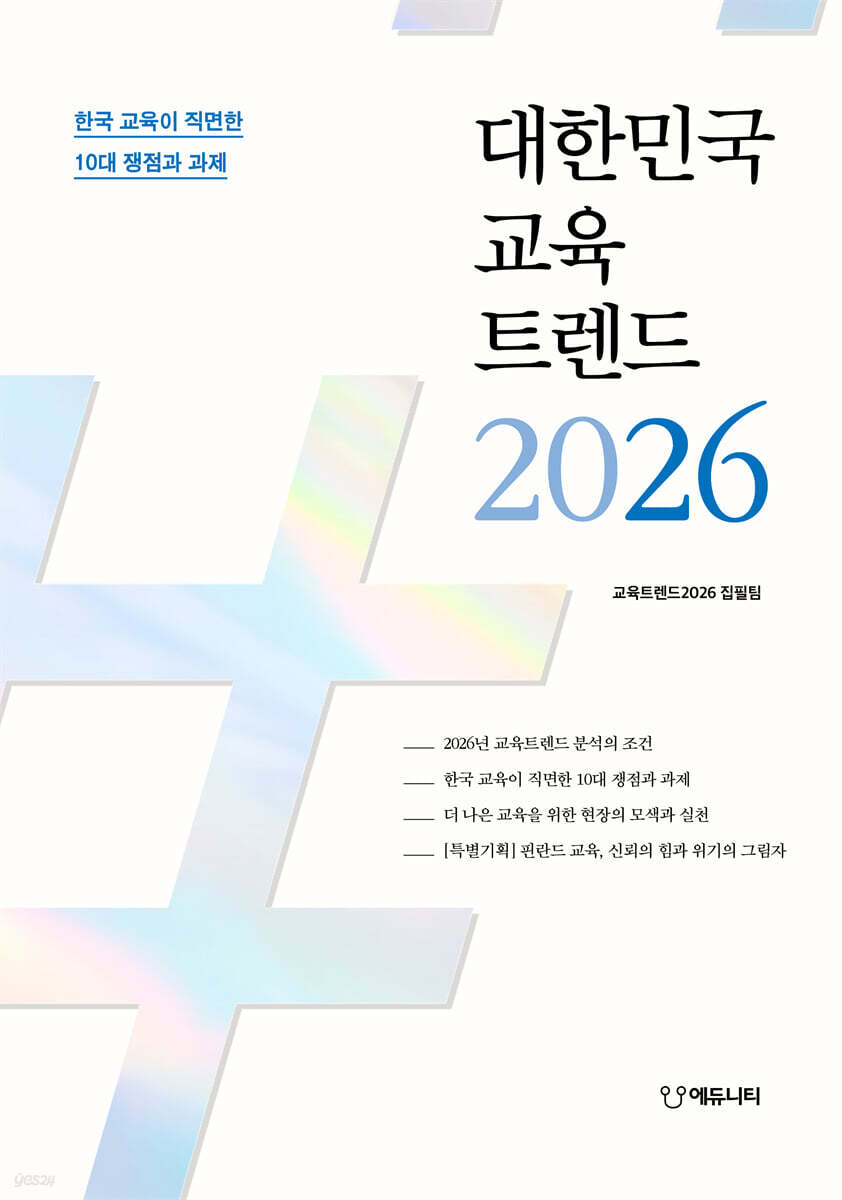
South Korea Education Trends 2026
 |
Description
Book Introduction
"South Korea Education Trends 2026" - A Map of Korean Education in 2026, Seen Through Policy and Practice
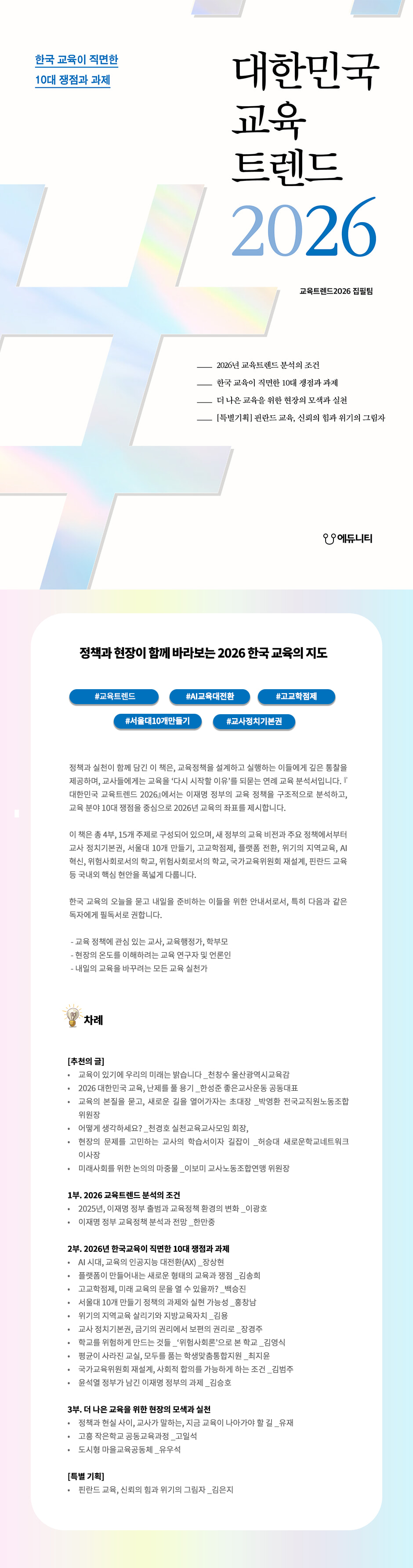
This book, which combines policy and practice, provides profound insights for those designing and implementing education policy, and is an annual educational analysis that asks teachers why they should "restart education."
"Republic of Korea Education Trends 2026" structurally analyzes the Lee Jae-myung administration's education policies and presents the 2026 educational landscape, focusing on ten key issues in the field.
This book consists of four parts and 15 topics, and covers a wide range of key domestic and international issues, including the new government's educational vision and key policies, teachers' basic political rights, the creation of 10 Seoul National University universities, the high school credit system, the transition to digital platforms, regional education in crisis, AI innovation, schools as risk societies, the redesign of the National Education Commission, and Finnish education.
As a guide for those who question the present state of Korean education and prepare for its future, this book is especially recommended for the following readers:
Teachers, educational administrators, and parents interested in education policy
Education researchers and journalists seeking to understand the temperature of the field
All educational practitioners who want to change tomorrow's education
This book, which combines policy and practice, provides profound insights for those designing and implementing education policy, and is an annual educational analysis that asks teachers why they should "restart education."
"Republic of Korea Education Trends 2026" structurally analyzes the Lee Jae-myung administration's education policies and presents the 2026 educational landscape, focusing on ten key issues in the field.
This book consists of four parts and 15 topics, and covers a wide range of key domestic and international issues, including the new government's educational vision and key policies, teachers' basic political rights, the creation of 10 Seoul National University universities, the high school credit system, the transition to digital platforms, regional education in crisis, AI innovation, schools as risk societies, the redesign of the National Education Commission, and Finnish education.
As a guide for those who question the present state of Korean education and prepare for its future, this book is especially recommended for the following readers:
Teachers, educational administrators, and parents interested in education policy
Education researchers and journalists seeking to understand the temperature of the field
All educational practitioners who want to change tomorrow's education
- You can preview some of the book's contents.
Preview
index
[Recommendation]
Our future is bright because of education. _Chun Chang-soo, Ulsan Metropolitan City Superintendent of Education
ㆍ2026 Korean Education: The Courage to Solve Challenges _ Han Seong-jun, Co-Representative of the Good Teacher Movement
An invitation to question the essence of education and open new paths _ Park Young-hwan, Chairman of the Korean Teachers and Education Workers' Union
What do you think? _Chun Kyung-ho, President of the Practical Education Teachers Association
A study guide and guide for teachers concerned with real-world problems - Heo Seung-dae, Chairman of the New School Network
ㆍA welcome gesture for discussion on the future society _ Lee Bo-mi, Chairperson of the Korean Teachers' Union Federation
Part 1.
Conditions for 2026 Education Trend Analysis
2025: The Launch of the Lee Jae-myung Administration and the Changing Education Policy Environment _Lee Gwang-ho
Analysis and Outlook of the Lee Jae-myung Administration's Education Policy _Hanmanjung
Part 2.
10 Key Issues and Challenges Facing Korean Education in 2026
The AI Era: A Great Transformation of Education (AX) _Jang Sang-hyun
New Forms of Education and Issues Created by Platforms _Kim Song-hee
Can the High School Credit System Open the Door to the Future of Education? _Baek Seung-jin
The Challenges and Feasibility of the Policy to Create 10 Seoul National University Universities _ Hong Chang-nam
Saving Local Education in Crisis and Local Education Autonomy _ Kim Yong
Teachers' Political Rights: From Taboo to Universal Rights _ Jang Kyung-ju
What Makes School Dangerous _ Schools Seen Through the Eyes of 'Risk Society Theory' _ Kim Young-sik
A Classroom Where Averages Disappear: Customized, Integrated Student Support That Embraces All _Jiyoon Choi
Redesigning the National Education Commission: Conditions for Social Consensus _Kim Beom-ju
The Lee Jae-myung administration's challenges left behind by the Yoon Seok-yeol administration _Kim Seung-ho
Part 3.
Field exploration and practice for better education
Between Policy and Reality: What Teachers Say About the Future of Education _Yoo Jae
Goheung Small School Joint Curriculum _ Go Il-seok
Urban Village Education Community _Yoo Woo-seok
[Special Feature] Finnish Education: The Power of Trust and the Shadow of Crisis _ Eunji Kim
Our future is bright because of education. _Chun Chang-soo, Ulsan Metropolitan City Superintendent of Education
ㆍ2026 Korean Education: The Courage to Solve Challenges _ Han Seong-jun, Co-Representative of the Good Teacher Movement
An invitation to question the essence of education and open new paths _ Park Young-hwan, Chairman of the Korean Teachers and Education Workers' Union
What do you think? _Chun Kyung-ho, President of the Practical Education Teachers Association
A study guide and guide for teachers concerned with real-world problems - Heo Seung-dae, Chairman of the New School Network
ㆍA welcome gesture for discussion on the future society _ Lee Bo-mi, Chairperson of the Korean Teachers' Union Federation
Part 1.
Conditions for 2026 Education Trend Analysis
2025: The Launch of the Lee Jae-myung Administration and the Changing Education Policy Environment _Lee Gwang-ho
Analysis and Outlook of the Lee Jae-myung Administration's Education Policy _Hanmanjung
Part 2.
10 Key Issues and Challenges Facing Korean Education in 2026
The AI Era: A Great Transformation of Education (AX) _Jang Sang-hyun
New Forms of Education and Issues Created by Platforms _Kim Song-hee
Can the High School Credit System Open the Door to the Future of Education? _Baek Seung-jin
The Challenges and Feasibility of the Policy to Create 10 Seoul National University Universities _ Hong Chang-nam
Saving Local Education in Crisis and Local Education Autonomy _ Kim Yong
Teachers' Political Rights: From Taboo to Universal Rights _ Jang Kyung-ju
What Makes School Dangerous _ Schools Seen Through the Eyes of 'Risk Society Theory' _ Kim Young-sik
A Classroom Where Averages Disappear: Customized, Integrated Student Support That Embraces All _Jiyoon Choi
Redesigning the National Education Commission: Conditions for Social Consensus _Kim Beom-ju
The Lee Jae-myung administration's challenges left behind by the Yoon Seok-yeol administration _Kim Seung-ho
Part 3.
Field exploration and practice for better education
Between Policy and Reality: What Teachers Say About the Future of Education _Yoo Jae
Goheung Small School Joint Curriculum _ Go Il-seok
Urban Village Education Community _Yoo Woo-seok
[Special Feature] Finnish Education: The Power of Trust and the Shadow of Crisis _ Eunji Kim
Detailed image
Into the book
The launch of the Lee Jae-myung administration is often compared to the Moon Jae-in administration.
The conditions under which the two governments were launched were similar: they were launched without a transition team following the impeachment of the former president, there were growing calls for the restoration of democracy and reform across society, and the geopolitical crisis was intensifying, including the worst inter-Korean relations.
Above all, it is also necessary to establish foreign and trade policies targeting US President Trump immediately after his inauguration.
Like the Moon Jae-in administration, the Lee Jae-myung administration was launched in a situation of serious, complex crisis.
--- p.46
In a country where all citizens can live happily while exercising their sovereignty, we must strive for education that guarantees inclusive and equitable quality education and promotes lifelong learning opportunities for all.
Education, once a sphere of hope in Korean society, has become a sphere of suffering.
The Lee Jae-myung administration's education policy must take a step forward toward "happy education for all" by addressing this educational reality.
--- p.69
Now, the educational field is moving beyond generative AI to agentic AI.
While existing reactive AI was a tool that moved according to the user's requests, agentic AI functions as an autonomous entity that sets and executes its own goals.
There are also examples of real-time analysis of students' participation and emotional changes in the classroom to suggest alternative activities, or of supporting learning design based on lifestyle patterns at home.
In the future, humanoid teaching assistants will act as both teachers' assistants and students' learning partners, and models will emerge in which avatars reflecting the learner's tendencies and goals will function as the learner's alter ego.
There will be one or more robot assistants in each classroom, and we will encounter the bizarre phenomenon of new classrooms emerging to train these robot assistants.
--- p.103
The platformization of education can be explained by the following three processes, in which economic, political, and educational dimensions are intertwined.
First, the expansion of the global EdTech market centered on profit generation; second, the discourse that 'problematizes' the limitations of traditional classroom-based teaching methods and presents digital technology as an alternative 'solution'; and third, the accompanying establishment of platforms as a core component of education.6) In order to examine this expansion of platformization, it is necessary to briefly review the history of the digitalization and datafication of education that has unfolded previously.
--- p.123
In 2025, high school education in our country reached a major turning point.
With the full implementation of the high school credit system in all high schools nationwide, students are now able to select subjects based on their career path and aptitude and earn credits by meeting achievement standards.
And by accumulating those credits, I was able to meet the graduation requirements.
This is significant in that it is not simply an institutional change that converts existing units into credits, but rather a structural reform that seeks to shift the focus of education from 'schools and teachers' to 'students and learning.'
--- p.148
The policy of "creating 10 Seoul Universities" is one of the Lee Jae-myung administration's key education policy tasks, but it should be understood as part of a comprehensive policy encompassing higher education as a whole, as it directly targets only key national universities.
Therefore, in order to correctly understand the nature and status of this policy, it is necessary to first confirm the overall plan for reforming the higher education system, that is, the plan for restructuring the higher education system.
--- p.187
The special nature of local education includes reviving education in regions that are on the verge of extinction due to population decline, but local educational autonomy to date has been remarkably incompetent in this regard.
The superintendents of education, who are the frontline leaders of local education, were not those who had a long-term sense of responsibility and devoted themselves to revitalizing local education, but rather those who helped in the superintendent election process only held their positions for about a year.
While some teachers are dedicated to saving small schools, many more are brought in by the Office of Education or to secure promotion opportunities.
For them, rural schools were merely a temporary stopover (Im Yeon-gi, 2021).
Although the Ministry of Education, the Ministry of Agriculture, Food and Rural Affairs, and other ministries provide various types of support to small rural schools, not many schools have achieved change through this support.
As a result, local educational autonomy has not been able to meaningfully change education in regions facing population decline and extinction.
--- p.218
Political rights include the right to vote, the right to hold public office, and the right to vote in national referendums.
This can be said to be a political fundamental right in a narrow sense.
In a broad sense, fundamental political rights include, in addition to the right to vote, the right to freely express political opinions, the freedom to establish and join political parties, the right to participate in election campaigns, and other political activities.1) This interpretation is also reflected in Constitutional Court decisions.2) Currently, the fundamental political rights of civil servants and teachers in South Korea are restricted to a level comparable to that of other countries.
The most important grounds for justifying this are the provisions on political neutrality in Article 7, Paragraph 2 and Article 31, Paragraph 4 of the Constitution.
--- p.231
School is not safe.
It's dangerous.
The moment they enter school, both students and teachers are overcome with anxiety.
The school space, which should be filled with the joy of learning and the rewards of teaching, feels like it is overshadowed by anxiety and danger.
Now, no one can easily say that schools are safe.
Teachers are burned out, students are isolated, and parents are anxious.
Classroom collapse, the decline of teachers' authority, psychological crises among students, the rise of students with emotional and behavioral crises, the pressure of constant school violence and competition, and the breakdown of relationships within schools are no longer the special cases of a few "problem schools," but rather the universal reality facing schools in South Korea.
How did the school end up in such danger?
--- p.256
As the number of children struggling with emotional and mental health issues increases, complex problems such as school maladjustment, academic dropout, internet and game overreliance, and school violence are emerging in the classroom.
Especially since the COVID-19 pandemic, the number of students with emotional and behavioral crises has increased rapidly, putting classrooms in a complex state of instability where a crisis could erupt at any time.
Not only do they struggle to get through each day, they also create enormous difficulties for other students and teachers in the class.
Not only does it disrupt normal classes and daily life by failing to focus during class and engaging in self-harm or verbal or physical aggression, it also threatens the safety and health of all class members.
Classrooms are becoming increasingly complex and unpredictable ecosystems, and schools are now at the forefront of the "primary mental health response system," going beyond academic and life guidance.
Recently, even the mental health of teachers has been deteriorating, and the school's worries are deepening by the day.
--- p.294
Reaching a 'social consensus' on education policy means achieving the expected goal through the policy tool of establishing a National Education Commission.
Given that there is little to indicate that the first 'implementation' was a success at this point, the National Education Commission is a vehicle for overhaul.
While the internal guidelines and practices of the National Education Commission need to be comprehensively reviewed and improved, this chapter examines whether the National Education Commission Act, which serves as the basis for the establishment and operation of this organization, is being implemented as an appropriate rule on the path toward "social consensus."
It is to review the matters that require reorganization and improvement of the current law in order to achieve the legislative purpose, that is, the intention of the legislator who enacted the law.
--- p.325
Path dependence literally means that once you enter a certain path, it is difficult to get off that path.
Even when more rational and efficient alternatives are readily available, the established system, the habits, interests, and social expectations of those accustomed to it, often block new choices. In this context, even if a new government emerges, it must pursue policies within the framework of the systems and practices established by previous administrations, along with the numerous stakeholders entangled within them. Therefore, abrupt transitions are difficult.
Ultimately, any new government must tread carefully along the existing path, and sometimes, even if it doesn't want to, it must inherit the policies of the previous government.
--- p.344
The numerous reforms carried out under the names of future education and educational transformation are, in reality, merely the same story unfolding in a different guise.
Perhaps all failed reforms are just imaginary creations, created in the mind, detached from the field and seeking self-consistency.
In the education world, the saying “the answer is in the field” is often used.
I'm not sure if the answer is really in the field, but what is clear is that only by looking deeply into the field can we clearly understand what the problem is.
As Larry Cuban said, if you don't clearly understand the problem, you'll end up trying the wrong solutions, wasting unnecessary energy and money, or building up despair that will leave you paralyzed.
--- p.370
The best way to enhance the school's educational competitiveness is to take advantage of the advantages of small schools that offer personalized education.
However, since we have often seen cases where maintaining a small student population has a negative impact on the development of learners' sociality and community, we should also actively pursue integration into schools of an appropriate size for each district in cases where the living area is the same or there are few factors of conflict in integration.
If the local residents' desire for one school per page is strong, an integrated elementary and middle school operation school, such as Jangheung Yuchi Elementary and Middle School3), which is not specified in the scope of schools under the Elementary and Secondary Education Act but is administratively feasible, is one possible alternative.
--- p.426
Sejong City, launched on July 1, 2012, is an administrative city established with the goal of balanced national development. From the initial planning stage, it aimed to be a new city model in which education, living, administration, and welfare are closely linked.
Among them, Haemil-dong, which opened in September 2020 with apartment occupancy, is a space designed jointly by Sejong City Hall, Sejong City Office of Education, Happiness Office, and LH (Korea Land and Housing Corporation), and is the first place in Sejong City to introduce the concept of a 'complex community complex'.
Apartment complexes, kindergartens, elementary schools, middle schools, and high schools are all located in one place, and a complex community center, library, gymnasium, park, and resident cultural facilities are organically placed.
This was not a simple spatial arrangement, but an intentional design that blurred the boundaries between the school and the village.
While traditional schools were isolated from the outside world with high walls and closed architecture, the school building in Haemil-dong was built with an open and low structure.
The design, in which architect Yoo Hyun-jun participated, is nicknamed the 'Smurf School' because of its friendly appearance, as if the small houses were gathered together in a village.
Children can walk straight from the classroom to the village playground, and residents can naturally pass by the school playground on their way to the library.
Physical design is becoming a catalyst for restoring community.
--- p.440
Finland has recently been facing complex domestic and international changes, including Russia's invasion of Ukraine, joining NATO, the election of a new president and the formation of a coalition government, and the rapid advancement of digital technology. As a result, Finland is redesigning its vision for society as a whole, including education.
Finnish education is considered to have maintained relatively stable political independence, but because education is closely connected to the overall social system, it cannot be completely free from change and pressure.
Declining academic achievement, declining investment in higher education, and political and economic challenges that challenge social trust are shaking the very foundations of Finnish education, the "happy nation." Now is the time to revisit Finnish education.
What is the educational goal of Finland, the "happy country," and what are the core and background of the current educational reforms? How is education changing amidst the imperfect domestic and international political and economic landscape? This article is not intended to idealize Finland as an educational model or simply emulate it.
By examining the educational direction and practical strategies that Finland seeks to maintain amidst the changing global situation, we aim to examine the implications for Korean education.
The conditions under which the two governments were launched were similar: they were launched without a transition team following the impeachment of the former president, there were growing calls for the restoration of democracy and reform across society, and the geopolitical crisis was intensifying, including the worst inter-Korean relations.
Above all, it is also necessary to establish foreign and trade policies targeting US President Trump immediately after his inauguration.
Like the Moon Jae-in administration, the Lee Jae-myung administration was launched in a situation of serious, complex crisis.
--- p.46
In a country where all citizens can live happily while exercising their sovereignty, we must strive for education that guarantees inclusive and equitable quality education and promotes lifelong learning opportunities for all.
Education, once a sphere of hope in Korean society, has become a sphere of suffering.
The Lee Jae-myung administration's education policy must take a step forward toward "happy education for all" by addressing this educational reality.
--- p.69
Now, the educational field is moving beyond generative AI to agentic AI.
While existing reactive AI was a tool that moved according to the user's requests, agentic AI functions as an autonomous entity that sets and executes its own goals.
There are also examples of real-time analysis of students' participation and emotional changes in the classroom to suggest alternative activities, or of supporting learning design based on lifestyle patterns at home.
In the future, humanoid teaching assistants will act as both teachers' assistants and students' learning partners, and models will emerge in which avatars reflecting the learner's tendencies and goals will function as the learner's alter ego.
There will be one or more robot assistants in each classroom, and we will encounter the bizarre phenomenon of new classrooms emerging to train these robot assistants.
--- p.103
The platformization of education can be explained by the following three processes, in which economic, political, and educational dimensions are intertwined.
First, the expansion of the global EdTech market centered on profit generation; second, the discourse that 'problematizes' the limitations of traditional classroom-based teaching methods and presents digital technology as an alternative 'solution'; and third, the accompanying establishment of platforms as a core component of education.6) In order to examine this expansion of platformization, it is necessary to briefly review the history of the digitalization and datafication of education that has unfolded previously.
--- p.123
In 2025, high school education in our country reached a major turning point.
With the full implementation of the high school credit system in all high schools nationwide, students are now able to select subjects based on their career path and aptitude and earn credits by meeting achievement standards.
And by accumulating those credits, I was able to meet the graduation requirements.
This is significant in that it is not simply an institutional change that converts existing units into credits, but rather a structural reform that seeks to shift the focus of education from 'schools and teachers' to 'students and learning.'
--- p.148
The policy of "creating 10 Seoul Universities" is one of the Lee Jae-myung administration's key education policy tasks, but it should be understood as part of a comprehensive policy encompassing higher education as a whole, as it directly targets only key national universities.
Therefore, in order to correctly understand the nature and status of this policy, it is necessary to first confirm the overall plan for reforming the higher education system, that is, the plan for restructuring the higher education system.
--- p.187
The special nature of local education includes reviving education in regions that are on the verge of extinction due to population decline, but local educational autonomy to date has been remarkably incompetent in this regard.
The superintendents of education, who are the frontline leaders of local education, were not those who had a long-term sense of responsibility and devoted themselves to revitalizing local education, but rather those who helped in the superintendent election process only held their positions for about a year.
While some teachers are dedicated to saving small schools, many more are brought in by the Office of Education or to secure promotion opportunities.
For them, rural schools were merely a temporary stopover (Im Yeon-gi, 2021).
Although the Ministry of Education, the Ministry of Agriculture, Food and Rural Affairs, and other ministries provide various types of support to small rural schools, not many schools have achieved change through this support.
As a result, local educational autonomy has not been able to meaningfully change education in regions facing population decline and extinction.
--- p.218
Political rights include the right to vote, the right to hold public office, and the right to vote in national referendums.
This can be said to be a political fundamental right in a narrow sense.
In a broad sense, fundamental political rights include, in addition to the right to vote, the right to freely express political opinions, the freedom to establish and join political parties, the right to participate in election campaigns, and other political activities.1) This interpretation is also reflected in Constitutional Court decisions.2) Currently, the fundamental political rights of civil servants and teachers in South Korea are restricted to a level comparable to that of other countries.
The most important grounds for justifying this are the provisions on political neutrality in Article 7, Paragraph 2 and Article 31, Paragraph 4 of the Constitution.
--- p.231
School is not safe.
It's dangerous.
The moment they enter school, both students and teachers are overcome with anxiety.
The school space, which should be filled with the joy of learning and the rewards of teaching, feels like it is overshadowed by anxiety and danger.
Now, no one can easily say that schools are safe.
Teachers are burned out, students are isolated, and parents are anxious.
Classroom collapse, the decline of teachers' authority, psychological crises among students, the rise of students with emotional and behavioral crises, the pressure of constant school violence and competition, and the breakdown of relationships within schools are no longer the special cases of a few "problem schools," but rather the universal reality facing schools in South Korea.
How did the school end up in such danger?
--- p.256
As the number of children struggling with emotional and mental health issues increases, complex problems such as school maladjustment, academic dropout, internet and game overreliance, and school violence are emerging in the classroom.
Especially since the COVID-19 pandemic, the number of students with emotional and behavioral crises has increased rapidly, putting classrooms in a complex state of instability where a crisis could erupt at any time.
Not only do they struggle to get through each day, they also create enormous difficulties for other students and teachers in the class.
Not only does it disrupt normal classes and daily life by failing to focus during class and engaging in self-harm or verbal or physical aggression, it also threatens the safety and health of all class members.
Classrooms are becoming increasingly complex and unpredictable ecosystems, and schools are now at the forefront of the "primary mental health response system," going beyond academic and life guidance.
Recently, even the mental health of teachers has been deteriorating, and the school's worries are deepening by the day.
--- p.294
Reaching a 'social consensus' on education policy means achieving the expected goal through the policy tool of establishing a National Education Commission.
Given that there is little to indicate that the first 'implementation' was a success at this point, the National Education Commission is a vehicle for overhaul.
While the internal guidelines and practices of the National Education Commission need to be comprehensively reviewed and improved, this chapter examines whether the National Education Commission Act, which serves as the basis for the establishment and operation of this organization, is being implemented as an appropriate rule on the path toward "social consensus."
It is to review the matters that require reorganization and improvement of the current law in order to achieve the legislative purpose, that is, the intention of the legislator who enacted the law.
--- p.325
Path dependence literally means that once you enter a certain path, it is difficult to get off that path.
Even when more rational and efficient alternatives are readily available, the established system, the habits, interests, and social expectations of those accustomed to it, often block new choices. In this context, even if a new government emerges, it must pursue policies within the framework of the systems and practices established by previous administrations, along with the numerous stakeholders entangled within them. Therefore, abrupt transitions are difficult.
Ultimately, any new government must tread carefully along the existing path, and sometimes, even if it doesn't want to, it must inherit the policies of the previous government.
--- p.344
The numerous reforms carried out under the names of future education and educational transformation are, in reality, merely the same story unfolding in a different guise.
Perhaps all failed reforms are just imaginary creations, created in the mind, detached from the field and seeking self-consistency.
In the education world, the saying “the answer is in the field” is often used.
I'm not sure if the answer is really in the field, but what is clear is that only by looking deeply into the field can we clearly understand what the problem is.
As Larry Cuban said, if you don't clearly understand the problem, you'll end up trying the wrong solutions, wasting unnecessary energy and money, or building up despair that will leave you paralyzed.
--- p.370
The best way to enhance the school's educational competitiveness is to take advantage of the advantages of small schools that offer personalized education.
However, since we have often seen cases where maintaining a small student population has a negative impact on the development of learners' sociality and community, we should also actively pursue integration into schools of an appropriate size for each district in cases where the living area is the same or there are few factors of conflict in integration.
If the local residents' desire for one school per page is strong, an integrated elementary and middle school operation school, such as Jangheung Yuchi Elementary and Middle School3), which is not specified in the scope of schools under the Elementary and Secondary Education Act but is administratively feasible, is one possible alternative.
--- p.426
Sejong City, launched on July 1, 2012, is an administrative city established with the goal of balanced national development. From the initial planning stage, it aimed to be a new city model in which education, living, administration, and welfare are closely linked.
Among them, Haemil-dong, which opened in September 2020 with apartment occupancy, is a space designed jointly by Sejong City Hall, Sejong City Office of Education, Happiness Office, and LH (Korea Land and Housing Corporation), and is the first place in Sejong City to introduce the concept of a 'complex community complex'.
Apartment complexes, kindergartens, elementary schools, middle schools, and high schools are all located in one place, and a complex community center, library, gymnasium, park, and resident cultural facilities are organically placed.
This was not a simple spatial arrangement, but an intentional design that blurred the boundaries between the school and the village.
While traditional schools were isolated from the outside world with high walls and closed architecture, the school building in Haemil-dong was built with an open and low structure.
The design, in which architect Yoo Hyun-jun participated, is nicknamed the 'Smurf School' because of its friendly appearance, as if the small houses were gathered together in a village.
Children can walk straight from the classroom to the village playground, and residents can naturally pass by the school playground on their way to the library.
Physical design is becoming a catalyst for restoring community.
--- p.440
Finland has recently been facing complex domestic and international changes, including Russia's invasion of Ukraine, joining NATO, the election of a new president and the formation of a coalition government, and the rapid advancement of digital technology. As a result, Finland is redesigning its vision for society as a whole, including education.
Finnish education is considered to have maintained relatively stable political independence, but because education is closely connected to the overall social system, it cannot be completely free from change and pressure.
Declining academic achievement, declining investment in higher education, and political and economic challenges that challenge social trust are shaking the very foundations of Finnish education, the "happy nation." Now is the time to revisit Finnish education.
What is the educational goal of Finland, the "happy country," and what are the core and background of the current educational reforms? How is education changing amidst the imperfect domestic and international political and economic landscape? This article is not intended to idealize Finland as an educational model or simply emulate it.
By examining the educational direction and practical strategies that Finland seeks to maintain amidst the changing global situation, we aim to examine the implications for Korean education.
--- p.463
Publisher's Review
The best educational analysis book that has been tracking the trends of education in Korea for five years.
"Education Trends in Korea 2026" is a plan that goes beyond simple critique or outlook, offering a direction for our education system amidst the wave of change it faces.
This multi-faceted structure, linking policy and practice, domestic and international, features policy designers from the Lee Jae-myung administration's State Affairs Planning Committee and practitioners in the field of education, providing a theoretical perspective on mid- to long-term education reform.
Part 1 provides an in-depth analysis of the Lee Jae-myung administration's background, national vision, and educational policy direction.
Part 2 addresses ten key issues that will shape education in 2026, including the high school credit system, AI and platform transition, regional education, teachers' basic political rights, and risk society.
Part 3 vividly captures voices and practices from the educational field, including teacher group discussions, village education communities, and small school joint curriculums.
Part 4 highlights the international case of Finland's education reform, which seeks to build social consensus even in times of crisis.
"South Korea Education Trends 2026" meticulously analyzes the structural challenges facing Korean education and the implications of this transition period, focusing on the educational vision and policies of the Lee Jae-myung administration, which was launched through an early presidential election in 2025.
Readers of this book will be able to understand the context of the following issues and explore alternatives.
- What is the Lee Jae-myung administration's national vision and growth strategy?
- What should we focus on to ensure the success of the Lee Jae-myung administration's education policy?
How can we overcome the limitations of the Yoon Seok-yeol administration's education policy?
- Creating 10 Seoul National University universities: Is this the last chance for regional universities?
- Can the regional balanced development policy (5 poles, 3 special) revitalize regional and rural education?
- Why did the National Education Commission fail, and what are the possible solutions?
- What changes will the AI revolution bring to education?
- How does platformization of education change education?
- Can the high school credit system open the door to the future of education?
- Is it possible to realize teachers' basic political rights as a universal right?
- What makes schools a 'risk society'?
- What are the causes of the increase in students at risk, and what are the solutions?
- Will the Finnish National Board of Education be abolished?
"Education Trends in Korea 2026" is a plan that goes beyond simple critique or outlook, offering a direction for our education system amidst the wave of change it faces.
This multi-faceted structure, linking policy and practice, domestic and international, features policy designers from the Lee Jae-myung administration's State Affairs Planning Committee and practitioners in the field of education, providing a theoretical perspective on mid- to long-term education reform.
Part 1 provides an in-depth analysis of the Lee Jae-myung administration's background, national vision, and educational policy direction.
Part 2 addresses ten key issues that will shape education in 2026, including the high school credit system, AI and platform transition, regional education, teachers' basic political rights, and risk society.
Part 3 vividly captures voices and practices from the educational field, including teacher group discussions, village education communities, and small school joint curriculums.
Part 4 highlights the international case of Finland's education reform, which seeks to build social consensus even in times of crisis.
"South Korea Education Trends 2026" meticulously analyzes the structural challenges facing Korean education and the implications of this transition period, focusing on the educational vision and policies of the Lee Jae-myung administration, which was launched through an early presidential election in 2025.
Readers of this book will be able to understand the context of the following issues and explore alternatives.
- What is the Lee Jae-myung administration's national vision and growth strategy?
- What should we focus on to ensure the success of the Lee Jae-myung administration's education policy?
How can we overcome the limitations of the Yoon Seok-yeol administration's education policy?
- Creating 10 Seoul National University universities: Is this the last chance for regional universities?
- Can the regional balanced development policy (5 poles, 3 special) revitalize regional and rural education?
- Why did the National Education Commission fail, and what are the possible solutions?
- What changes will the AI revolution bring to education?
- How does platformization of education change education?
- Can the high school credit system open the door to the future of education?
- Is it possible to realize teachers' basic political rights as a universal right?
- What makes schools a 'risk society'?
- What are the causes of the increase in students at risk, and what are the solutions?
- Will the Finnish National Board of Education be abolished?
GOODS SPECIFICS
- Date of issue: October 20, 2025
- Page count, weight, size: 504 pages | 966g | 165*235*31mm
- ISBN13: 9791199505506
You may also like
카테고리
korean


korean

![ELLE 엘르 스페셜 에디션 A형 : 12월 [2025]](http://librairie.coreenne.fr/cdn/shop/files/b8e27a3de6c9538896439686c6b0e8fb.jpg?v=1766436872&width=3840)


