

Mountain temple on weekends
 |
Description
Book Introduction
- A word from MD
-
A slow but profound mountain trekDesigner Yoon Seol-hee's mountain temple walk.
We introduce 7 special mountain temples that we visit every weekend.
It contains the beauty of space observed while walking through the mountains and the thoughts on life discovered within it.
The charm of old architecture conveyed through delicate lines and dots, and sensual pen drawings.
A book that provides readers tired of the hustle and bustle of the city with a slow but profound travel method.
September 2, 2025. Essay PD Lee Ju-eun
If you want to leave the tiring weekdays behind, try 'Sansa for the Weekend'
Among the 100 mountain temples visited every weekend by a designer with 10 years of experience at a large company
An essay capturing the seven most special places in delicate pen drawings.
The wisdom and deep thoughts of old architecture amidst the MZ generation's Buddhist craze
A slow but profound mountain walk unfolded through sensual pictures.
Yoon Seol-hee, the author of "Weekend Mountain Temple," has worked as a graphic designer for a large corporation for over 10 years, creating various contents in a square office and behind a monitor.
Then, I felt a thirst for 'my own space', and to find the answer, I traveled to mountain temples across the country that were open to anyone.
The author, who has visited and reported on over 100 mountain temples every weekend since 2019, explored the temples with the thought that “understanding the space I have set foot in is understanding my life,” and recorded the seven most special places with delicate pen drawings.
As the MZ generation continues to embrace Buddhism, "Weekend at the Mountain Temple" shows another side of the charm of the mountain temple as seen through the eyes of a young, talented designer and hard-working office worker.
It also offers a "slow but profound travel method" for those accustomed to quick-to-obtain but fleeting pleasures and those weary of relentless competition and anxiety, while discovering the wisdom of life and profound reflection contained in old architecture.
From Seonamsa Temple, where you can discover the diverse faces of space, to Bongeunsa Temple, where you can enjoy the tranquility in the city, the stories of seven mountain temples, told with a unique sensibility, will be a meaningful companion for those of us who need a "room of our own."
Among the 100 mountain temples visited every weekend by a designer with 10 years of experience at a large company
An essay capturing the seven most special places in delicate pen drawings.
The wisdom and deep thoughts of old architecture amidst the MZ generation's Buddhist craze
A slow but profound mountain walk unfolded through sensual pictures.
Yoon Seol-hee, the author of "Weekend Mountain Temple," has worked as a graphic designer for a large corporation for over 10 years, creating various contents in a square office and behind a monitor.
Then, I felt a thirst for 'my own space', and to find the answer, I traveled to mountain temples across the country that were open to anyone.
The author, who has visited and reported on over 100 mountain temples every weekend since 2019, explored the temples with the thought that “understanding the space I have set foot in is understanding my life,” and recorded the seven most special places with delicate pen drawings.
As the MZ generation continues to embrace Buddhism, "Weekend at the Mountain Temple" shows another side of the charm of the mountain temple as seen through the eyes of a young, talented designer and hard-working office worker.
It also offers a "slow but profound travel method" for those accustomed to quick-to-obtain but fleeting pleasures and those weary of relentless competition and anxiety, while discovering the wisdom of life and profound reflection contained in old architecture.
From Seonamsa Temple, where you can discover the diverse faces of space, to Bongeunsa Temple, where you can enjoy the tranquility in the city, the stories of seven mountain temples, told with a unique sensibility, will be a meaningful companion for those of us who need a "room of our own."
- You can preview some of the book's contents.
Preview
index
Entering _4
one.
Seonamsa Temple, Jogyesan Mountain _20
two.
Buseoksa Temple on Bonghwangsan Mountain _74
Take a break, one.
About the Mountain Temple _115
three.
Mansusan Muryangsa Temple _126
four.
Geumsansa Temple on Mt. Moak _170
Take a break, two.
Architecture of Relationships _219
five.
Ungilsan Sujongsa Temple _234
six.
Cheonbulsan Unjusa Temple _270
seven.
Bongeunsa Temple in Sudosan Mountain _310
See more, one.
Monthly Sansa _348
See more, two.
Flower Bars _352
one.
Seonamsa Temple, Jogyesan Mountain _20
two.
Buseoksa Temple on Bonghwangsan Mountain _74
Take a break, one.
About the Mountain Temple _115
three.
Mansusan Muryangsa Temple _126
four.
Geumsansa Temple on Mt. Moak _170
Take a break, two.
Architecture of Relationships _219
five.
Ungilsan Sujongsa Temple _234
six.
Cheonbulsan Unjusa Temple _270
seven.
Bongeunsa Temple in Sudosan Mountain _310
See more, one.
Monthly Sansa _348
See more, two.
Flower Bars _352
Detailed image

Into the book
I decided to get out of the small space.
I thought that broadening our understanding of space was similar to broadening our understanding of life.
--- p.8 From “Entering”
Let's take a picture of the tree trunk opposite the main gate, which looks like a couple embracing each other.
It's nothing special, but I enjoy finding things like this.
After passing through the main gate, look for the cheese-colored cat at the bell tower.
--- p.37 From “Seonamsa Temple, Jogyesan Mountain”
I guess I'm just a modern person who can't help but check social media even when I'm in the mountains.
It was definitely good, but my trip doesn't really explain it well.
It feels like it doesn't shine as much as other people's trips.
But I know enough to know that I am a person who likes to travel and discover things over a long period of time.
--- p.60 From “Seonamsa Temple, Jogyesan Mountain”
The stone walls were made using natural stones without processing them.
The small stones that fill the gaps between the stone walls are small, but they seem to play their own role, and it warms my heart.
--- p.90 From “Bongwhangsan Buseoksa Temple”
I came down from the investigation hall and leaned against the pillar of the Muryangsujeon (like the title of the book).
Beyond Anyangru, the peaks of the Sobaek Mountains appear like a painting.
The scenery is so beautiful that all the difficult process feels like a beautiful narrative for the ending.
--- p.98 From “Bongwhangsan Buseoksa Temple”
Rather than visiting the mountain temple solely as a tourist attraction, I would like to approach it as a place where I can gain enlightenment.
I hope that understanding the architecture of the space I live in will become a process of understanding myself.
--- p.123 From “Taking a Break, About the Mountain Temple”
There is an interesting wall to the right of Cheonghandang.
This wall is open so anyone can come in.
It really feels like nature flows in and becomes a garden.
The wall is open, so the mountain behind it becomes the temple's garden.
--- p.156 From “Mansusan Muryangsa Temple”
I go to temples and gain many enlightenments, but if I live according to my enlightenment, I will become a Buddha.
I am not Buddha, so I am just waiting for this enlightenment to become mine, and I am going to Geumsansa Temple, where the Buddha's relics are kept.
--- p.175 From “Moaksan Geumsansa”
Geumsansa Temple operates independently in many ways, departing from Buddhist rules and architectural styles.
If you look at it from a Buddhist perspective, it might seem arbitrary.
However, from an outsider's perspective, this unique aspect of Geumsansa Temple felt like a flexible and balanced conversation.
--- p.208 From “Moaksan Geumsansa”
They say jazz is a conversation between musicians, and I think Korean architecture is similar.
It develops and applies in various ways according to the situation, person, and nature without strict rules.
If Western architecture is a symphony with musical notation, Korean architecture can be likened to jazz and samulnori, which are improvised instruments without musical notation.
--- p.231 From “Two Rests, Architecture of Relationships”
Sujongsa Temple is located deep in the mountains, so it is difficult for many people to find, but the view from the high place is special.
It's a perspective you can get because you don't want to be loved by many people.
People who love this scenery definitely come here.
I limited my horizons for fear of looking old-fashioned in the eyes of others.
I used to think, 'What's wrong with wanting to look good and be loved more?' But I'm curious about what I can do and feel when I let go of that mindset.
--- p.259 From “Yun Gil-san’s Monk”
I recall a time when we sought liberation from the hardships of life through hope, not violence.
I felt a small, cozy happiness as I touched the stones warmed by the sun.
I wonder which stone sculptures others like best, and who they think of when they see this Buddha statue.
--- p.288 From “Cheonbulsan Unjusa”
A mountain temple with a good location and great scenery is nice, but it doesn't seem to be the only thing that's important.
If it's a location that anyone can easily find, it's more important for everyone to learn about Buddhism easily and enjoyably.
In that respect, Bongeunsa Temple was sufficient.
(…) I think that who I am who sees it is more important than what is seen.
If I know what I want, I just have to fill it.
I thought that broadening our understanding of space was similar to broadening our understanding of life.
--- p.8 From “Entering”
Let's take a picture of the tree trunk opposite the main gate, which looks like a couple embracing each other.
It's nothing special, but I enjoy finding things like this.
After passing through the main gate, look for the cheese-colored cat at the bell tower.
--- p.37 From “Seonamsa Temple, Jogyesan Mountain”
I guess I'm just a modern person who can't help but check social media even when I'm in the mountains.
It was definitely good, but my trip doesn't really explain it well.
It feels like it doesn't shine as much as other people's trips.
But I know enough to know that I am a person who likes to travel and discover things over a long period of time.
--- p.60 From “Seonamsa Temple, Jogyesan Mountain”
The stone walls were made using natural stones without processing them.
The small stones that fill the gaps between the stone walls are small, but they seem to play their own role, and it warms my heart.
--- p.90 From “Bongwhangsan Buseoksa Temple”
I came down from the investigation hall and leaned against the pillar of the Muryangsujeon (like the title of the book).
Beyond Anyangru, the peaks of the Sobaek Mountains appear like a painting.
The scenery is so beautiful that all the difficult process feels like a beautiful narrative for the ending.
--- p.98 From “Bongwhangsan Buseoksa Temple”
Rather than visiting the mountain temple solely as a tourist attraction, I would like to approach it as a place where I can gain enlightenment.
I hope that understanding the architecture of the space I live in will become a process of understanding myself.
--- p.123 From “Taking a Break, About the Mountain Temple”
There is an interesting wall to the right of Cheonghandang.
This wall is open so anyone can come in.
It really feels like nature flows in and becomes a garden.
The wall is open, so the mountain behind it becomes the temple's garden.
--- p.156 From “Mansusan Muryangsa Temple”
I go to temples and gain many enlightenments, but if I live according to my enlightenment, I will become a Buddha.
I am not Buddha, so I am just waiting for this enlightenment to become mine, and I am going to Geumsansa Temple, where the Buddha's relics are kept.
--- p.175 From “Moaksan Geumsansa”
Geumsansa Temple operates independently in many ways, departing from Buddhist rules and architectural styles.
If you look at it from a Buddhist perspective, it might seem arbitrary.
However, from an outsider's perspective, this unique aspect of Geumsansa Temple felt like a flexible and balanced conversation.
--- p.208 From “Moaksan Geumsansa”
They say jazz is a conversation between musicians, and I think Korean architecture is similar.
It develops and applies in various ways according to the situation, person, and nature without strict rules.
If Western architecture is a symphony with musical notation, Korean architecture can be likened to jazz and samulnori, which are improvised instruments without musical notation.
--- p.231 From “Two Rests, Architecture of Relationships”
Sujongsa Temple is located deep in the mountains, so it is difficult for many people to find, but the view from the high place is special.
It's a perspective you can get because you don't want to be loved by many people.
People who love this scenery definitely come here.
I limited my horizons for fear of looking old-fashioned in the eyes of others.
I used to think, 'What's wrong with wanting to look good and be loved more?' But I'm curious about what I can do and feel when I let go of that mindset.
--- p.259 From “Yun Gil-san’s Monk”
I recall a time when we sought liberation from the hardships of life through hope, not violence.
I felt a small, cozy happiness as I touched the stones warmed by the sun.
I wonder which stone sculptures others like best, and who they think of when they see this Buddha statue.
--- p.288 From “Cheonbulsan Unjusa”
A mountain temple with a good location and great scenery is nice, but it doesn't seem to be the only thing that's important.
If it's a location that anyone can easily find, it's more important for everyone to learn about Buddhism easily and enjoyably.
In that respect, Bongeunsa Temple was sufficient.
(…) I think that who I am who sees it is more important than what is seen.
If I know what I want, I just have to fill it.
--- p.334 From “Bongeunsa Temple in Sudosan Mountain”
Publisher's Review
MZ generation designers with sensuous pen drawings
Stories of 7 Mountain Temples, Captured Like a Stroll
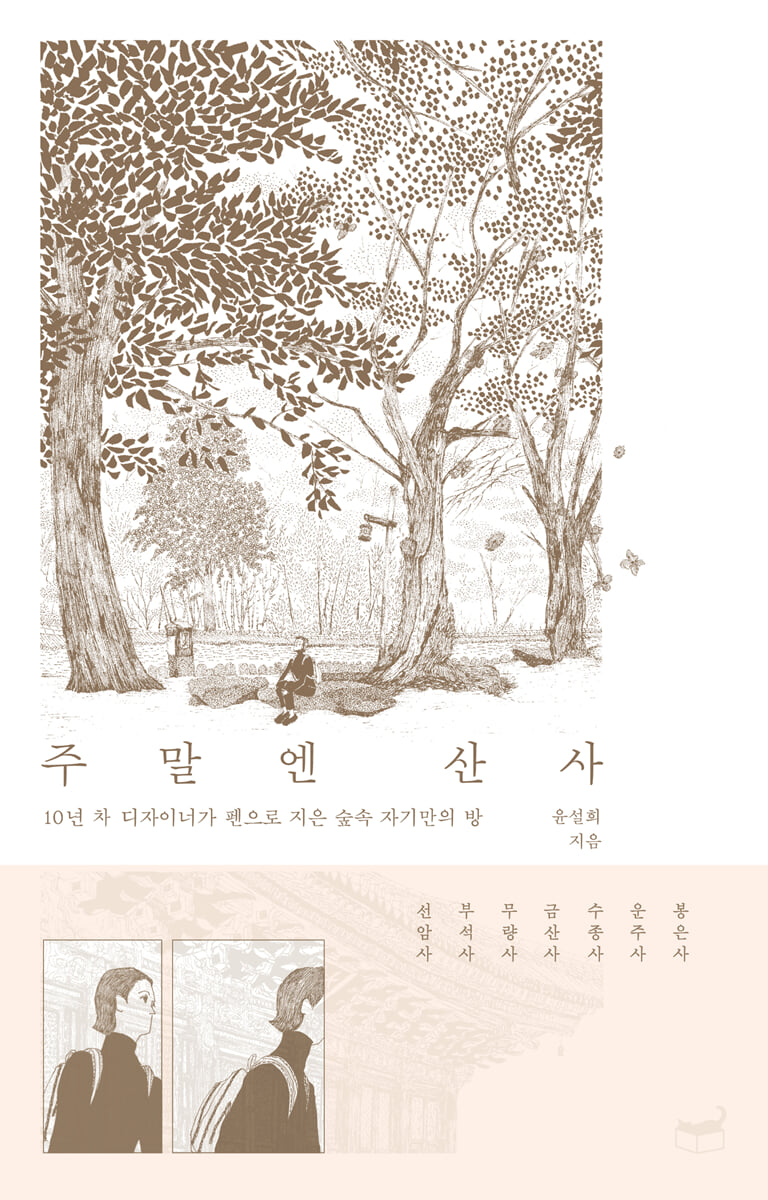
Artist Seolhee Yoon, who has been working as a graphic designer at Samsung Electronics for over 10 years, has captured the stories of 7 of the most special mountain temples among the 100 or so temples she visited across the country over the past five years since 2019, through her sensuous pen drawings.
The delicate yet solid pen drawings are reminiscent of beautiful ink paintings and hold our gaze for a long time.
As we admire the tranquil scenery of the mountain temple, densely filled with delicate lines and dots, we find ourselves walking through the main gate and into the mountain temple.
From Seonamsa Temple in Suncheon, South Jeolla Province, a UNESCO World Heritage Site where you can discover the diverse faces of space, to Buseoksa Temple in Yeongju, North Gyeongsang Province, one of CNN's "33 Most Beautiful Temples in Korea," to Bongeunsa Temple in Seoul, a mountain temple in the heart of the city.
The stories of the seven mountain temples, told in an easy and friendly manner through unique illustrations and the unique perspective of a talented designer, give the impression of an honest conversation about the feelings that compelled them to visit the mountain temples while taking a walk together.
Moreover, the temple's architecture and easy-to-understand explanations of Buddhist terminology, meticulously placed throughout, allow anyone to enjoy the temple's beauty and meaning, even if they don't know much about architecture or are not religious.
A designer with 10 years of experience at a large company
Why I left the confines of a square space and went to a mountain temple
Author Yoon Seol-hee visited over 100 mountain temples over the course of five years to explore Korean ancient architecture and her own personal space.
I visited the impressive mountain temples several times to look deeper into them, and I also visited foreign mountain temples to personally confirm the unique identity of Korean architecture.
The reason he became obsessed with exploring space was because he wanted to build his own home, away from the small, square spaces in the city, such as studio apartments, cafes, and offices.
In order to build my own space where I could fully dedicate my life, I had to first understand the space I was in and myself. The author meticulously walked through mountain temples across the country with the idea that “broadening my understanding of space is similar to broadening my understanding of life.”
"Weekend Mountain Temple," written by a writer with 10 years of experience in the office, chronicles his journey of self-discovery by visiting historic spaces in the forest every weekend for several years. This book will breathe life into us, weary of weekdays in the city, by offering the comfort of a quiet space and the vitality that only weekends can provide.
“Where I really need to stay is….”
Old architecture and deep thoughts
Comfort and enlightenment for the MZ generation
《Weekend at the Mountain Temple》 offers the comfort and enlightenment that can only be found in a temple in the forest.
The old architecture and deep thoughts of over 1000 years ago make me recognize myself as a finite and small being and focus on the present 'me'.
This is also why Buddhism is attracting attention from the MZ generation recently.
For those accustomed to quick, fleeting pleasures, and weary of relentless competition and anxiety, the easily achievable Buddhist values in daily life can serve as a guide to living a life that allows them to focus entirely on themselves.
The majestic scenery of the Sobaek Mountains at Bulguksa Temple, which can only be enjoyed by climbing long stairs and leaning against the pillars; the flexibility of Geumsansa Temple, which harmoniously embraces nature and indigenous beliefs; and the thousand Buddhas and thousand pagodas of Unjusa Temple, which, although crude and unfinished, reveal their uniqueness through their earnest style and diversity.
The author seeks answers to the essential questions of life that the Zen questions and answers he encounter in each mountain temple reveal.
As we read "Weekend at the Mountain Temple," we too will feel the space in our hearts in the mountain temple in the book and think about our own space where our lives can be placed.
Perhaps, each person's own room, which cannot be found in the wide and busy city center, may be there.
Stories of 7 Mountain Temples, Captured Like a Stroll
Artist Seolhee Yoon, who has been working as a graphic designer at Samsung Electronics for over 10 years, has captured the stories of 7 of the most special mountain temples among the 100 or so temples she visited across the country over the past five years since 2019, through her sensuous pen drawings.
The delicate yet solid pen drawings are reminiscent of beautiful ink paintings and hold our gaze for a long time.
As we admire the tranquil scenery of the mountain temple, densely filled with delicate lines and dots, we find ourselves walking through the main gate and into the mountain temple.
From Seonamsa Temple in Suncheon, South Jeolla Province, a UNESCO World Heritage Site where you can discover the diverse faces of space, to Buseoksa Temple in Yeongju, North Gyeongsang Province, one of CNN's "33 Most Beautiful Temples in Korea," to Bongeunsa Temple in Seoul, a mountain temple in the heart of the city.
The stories of the seven mountain temples, told in an easy and friendly manner through unique illustrations and the unique perspective of a talented designer, give the impression of an honest conversation about the feelings that compelled them to visit the mountain temples while taking a walk together.
Moreover, the temple's architecture and easy-to-understand explanations of Buddhist terminology, meticulously placed throughout, allow anyone to enjoy the temple's beauty and meaning, even if they don't know much about architecture or are not religious.
A designer with 10 years of experience at a large company
Why I left the confines of a square space and went to a mountain temple
Author Yoon Seol-hee visited over 100 mountain temples over the course of five years to explore Korean ancient architecture and her own personal space.
I visited the impressive mountain temples several times to look deeper into them, and I also visited foreign mountain temples to personally confirm the unique identity of Korean architecture.
The reason he became obsessed with exploring space was because he wanted to build his own home, away from the small, square spaces in the city, such as studio apartments, cafes, and offices.
In order to build my own space where I could fully dedicate my life, I had to first understand the space I was in and myself. The author meticulously walked through mountain temples across the country with the idea that “broadening my understanding of space is similar to broadening my understanding of life.”
"Weekend Mountain Temple," written by a writer with 10 years of experience in the office, chronicles his journey of self-discovery by visiting historic spaces in the forest every weekend for several years. This book will breathe life into us, weary of weekdays in the city, by offering the comfort of a quiet space and the vitality that only weekends can provide.
“Where I really need to stay is….”
Old architecture and deep thoughts
Comfort and enlightenment for the MZ generation
《Weekend at the Mountain Temple》 offers the comfort and enlightenment that can only be found in a temple in the forest.
The old architecture and deep thoughts of over 1000 years ago make me recognize myself as a finite and small being and focus on the present 'me'.
This is also why Buddhism is attracting attention from the MZ generation recently.
For those accustomed to quick, fleeting pleasures, and weary of relentless competition and anxiety, the easily achievable Buddhist values in daily life can serve as a guide to living a life that allows them to focus entirely on themselves.
The majestic scenery of the Sobaek Mountains at Bulguksa Temple, which can only be enjoyed by climbing long stairs and leaning against the pillars; the flexibility of Geumsansa Temple, which harmoniously embraces nature and indigenous beliefs; and the thousand Buddhas and thousand pagodas of Unjusa Temple, which, although crude and unfinished, reveal their uniqueness through their earnest style and diversity.
The author seeks answers to the essential questions of life that the Zen questions and answers he encounter in each mountain temple reveal.
As we read "Weekend at the Mountain Temple," we too will feel the space in our hearts in the mountain temple in the book and think about our own space where our lives can be placed.
Perhaps, each person's own room, which cannot be found in the wide and busy city center, may be there.
GOODS SPECIFICS
- Date of issue: September 1, 2025
- Page count, weight, size: 360 pages | 506g | 128*200*23mm
- ISBN13: 9791170873754
- ISBN10: 1170873758
You may also like
카테고리
korean


korean

![ELLE 엘르 스페셜 에디션 A형 : 12월 [2025]](http://librairie.coreenne.fr/cdn/shop/files/b8e27a3de6c9538896439686c6b0e8fb.jpg?v=1766436872&width=3840)


