

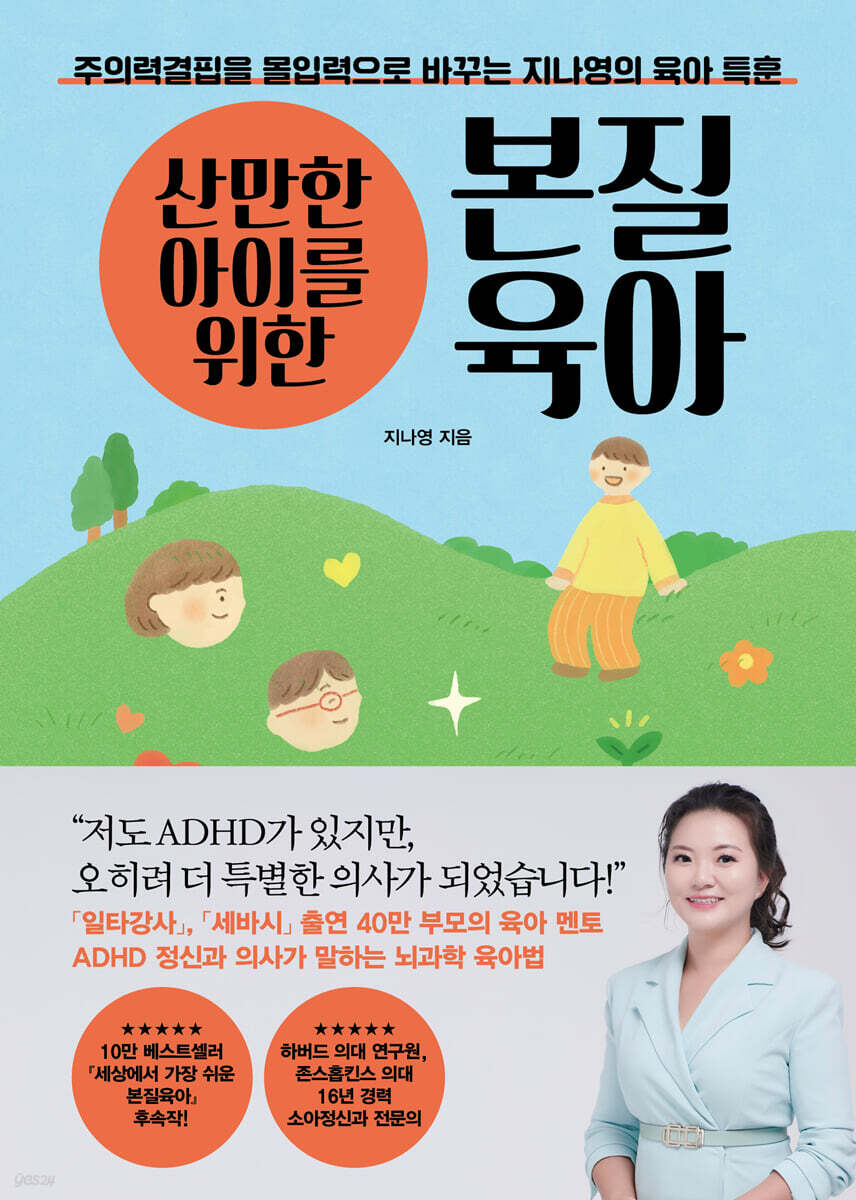
Essential Parenting for Distracted Children
 |
Description
Book Introduction
“The one and only book that summarizes everything about ADHD!”
Professor Jinah Young, with 20 years of experience in child psychiatry, shares her thoughts.
Parenting Special Training: Turning Attention Deficit into Engagement
"Essential Parenting for Distractible Children" is a special brain science parenting book by Professor Jinah Young, which teaches children who are easily distracted to become "designers of concentration."
“Distractibility is not a defect to be fixed, but a possibility to be designed,” says author Gina Young, a pediatric psychiatrist with 20 years of experience and a person with ADHD herself.
It understands a child's lack of attention, impulsivity, and planning ability not as a simple disciplinary issue, but as a difference in the way the brain processes and responds to information, and presents specific ways to transform this into practical strategies in everyday life.
While the previous work, "The Easiest Essential Parenting in the World," which received the love of 100,000 readers, dealt with "parents' attitudes and relationships," this book expands its scope to "the brain and behavioral mechanisms of distracted children" based on that philosophy.
Beyond the principles of discipline and emotional regulation, we dissect the core mechanisms of ADHD, namely, 'attention control-reward system-arousal management', from a neuroscientific perspective.
In other words, it is a practical guidebook that answers the question, “How can I make my child focus?” rather than “Why can’t my child focus?”
Based on numerous cases experienced in the clinic and at home, the author presents solutions for specific situations such as homework, organization, school attendance, and game time.
Immediately applicable routines such as 'timer training', 'reward table design', 'visual reminders', and the 'empathy → rule → alternative' conversation method are organized in language that parents can easily reach.
This is not an approach that aims to correct a child's 'attention deficit' in a short period of time, but rather guides them through a process of training the circuit of concentration and developing the muscles of immersion.
The latter half of the book also features a dedicated chapter on "Parental Resilience." It addresses the frustration, burnout, and self-blame experienced by parents raising children with ADHD, offering practical ways to recover through meditation, self-compassion, and community.
Ultimately, this book is a roadmap for change that breaks the vicious cycle of “distracted child - anxious parent” and transforms children’s strengths into immersion and parents’ anxiety into trust.
Professor Jinah Young, with 20 years of experience in child psychiatry, shares her thoughts.
Parenting Special Training: Turning Attention Deficit into Engagement
"Essential Parenting for Distractible Children" is a special brain science parenting book by Professor Jinah Young, which teaches children who are easily distracted to become "designers of concentration."
“Distractibility is not a defect to be fixed, but a possibility to be designed,” says author Gina Young, a pediatric psychiatrist with 20 years of experience and a person with ADHD herself.
It understands a child's lack of attention, impulsivity, and planning ability not as a simple disciplinary issue, but as a difference in the way the brain processes and responds to information, and presents specific ways to transform this into practical strategies in everyday life.
While the previous work, "The Easiest Essential Parenting in the World," which received the love of 100,000 readers, dealt with "parents' attitudes and relationships," this book expands its scope to "the brain and behavioral mechanisms of distracted children" based on that philosophy.
Beyond the principles of discipline and emotional regulation, we dissect the core mechanisms of ADHD, namely, 'attention control-reward system-arousal management', from a neuroscientific perspective.
In other words, it is a practical guidebook that answers the question, “How can I make my child focus?” rather than “Why can’t my child focus?”
Based on numerous cases experienced in the clinic and at home, the author presents solutions for specific situations such as homework, organization, school attendance, and game time.
Immediately applicable routines such as 'timer training', 'reward table design', 'visual reminders', and the 'empathy → rule → alternative' conversation method are organized in language that parents can easily reach.
This is not an approach that aims to correct a child's 'attention deficit' in a short period of time, but rather guides them through a process of training the circuit of concentration and developing the muscles of immersion.
The latter half of the book also features a dedicated chapter on "Parental Resilience." It addresses the frustration, burnout, and self-blame experienced by parents raising children with ADHD, offering practical ways to recover through meditation, self-compassion, and community.
Ultimately, this book is a roadmap for change that breaks the vicious cycle of “distracted child - anxious parent” and transforms children’s strengths into immersion and parents’ anxiety into trust.
- You can preview some of the book's contents.
Preview
index
Prologue: The Distracted Child: A Possibility, Not a Stigma
PART 1: The Truth You Didn't Know About ADHD
Does my child have ADHD?
The ADHD brain is different
Causes of ADHD: Genetics or Environment?
How does the ADHD brain work?
PART 2: Understanding Brain Science Reveals the Solution
Execution function
I can't even do easy things properly
Essential Parenting Plus Children's Routine Table
I can't keep my belongings organized and they just fall into disarray.
Why do I have no sense of time?
I'm nervous because I'm not careful.
Essential Parenting Plus Reward System
Attention control
Why am I so distracted?
Why am I so out of it?
Why do I always end up in Samcheonpo?
Arousal control
I'm worried because I'm too lazy
It feels like my body has a motor attached to it.
Compensation processing
I don't even touch things I'm not interested in.
PART 3 How to treat ADHD after diagnosis?
What to do first after being diagnosed with ADHD
What are non-pharmacological treatments?
Essential Parenting Plus: Resources to Help You Raise a Child with ADHD
Drug Treatment: What You Need to Know
PART 4: How to Develop Potential in Distracted Children
Unleash your child's potential
Protecting the Self-Esteem of a Distracted Child
Situational Discipline for Distractable Children
Essential Parenting Plus Basic Principles of Discipline
PART 5 Parents Need Care Too
Raising a distracted child
Epilogue: So that every child can shine
PART 1: The Truth You Didn't Know About ADHD
Does my child have ADHD?
The ADHD brain is different
Causes of ADHD: Genetics or Environment?
How does the ADHD brain work?
PART 2: Understanding Brain Science Reveals the Solution
Execution function
I can't even do easy things properly
Essential Parenting Plus Children's Routine Table
I can't keep my belongings organized and they just fall into disarray.
Why do I have no sense of time?
I'm nervous because I'm not careful.
Essential Parenting Plus Reward System
Attention control
Why am I so distracted?
Why am I so out of it?
Why do I always end up in Samcheonpo?
Arousal control
I'm worried because I'm too lazy
It feels like my body has a motor attached to it.
Compensation processing
I don't even touch things I'm not interested in.
PART 3 How to treat ADHD after diagnosis?
What to do first after being diagnosed with ADHD
What are non-pharmacological treatments?
Essential Parenting Plus: Resources to Help You Raise a Child with ADHD
Drug Treatment: What You Need to Know
PART 4: How to Develop Potential in Distracted Children
Unleash your child's potential
Protecting the Self-Esteem of a Distracted Child
Situational Discipline for Distractable Children
Essential Parenting Plus Basic Principles of Discipline
PART 5 Parents Need Care Too
Raising a distracted child
Epilogue: So that every child can shine
Detailed image
.jpg)
Into the book
ADHD, which sometimes makes things difficult for those around me, has been with me my entire life.
At the same time, ADHD is also an area that I have specialized in as a psychiatrist for over 20 years.
Sixteen of those years were spent treating and researching developmental disorders, including ADHD, at Johns Hopkins University School of Medicine.
This book contains in-depth case studies of children I have treated, as well as my own experiences with ADHD.
As an expert and a stakeholder, I have made the most of my strengths in being able to unravel this colorful life from a first-person perspective.
--- p.9
“When children are young, especially boys, they are very active and playful.
“No problem.”
“It’s because you didn’t discipline them well. If you just teach them good habits, everything will be fixed.”
"Is that something to take? Teach me better."
When parents who are doing their best hear things like this, they feel wronged and upset.
Even though there are clear difficulties, when people around you deny it, you start to wonder, 'What did I do wrong?'
Grandparents who only see the child for a short time or parents who spend little time with the child may not realize the severity of the symptoms.
If you view ADHD solely as a disciplinary issue, you may miss the moment when treatment is truly needed.
--- p.29
But the ADHD brain's attention is like a broken spotlight.
The main character is talking, but the camera is pointing at the wrong place or moving back and forth without focus.
The reason we are so distracted is because we lack the selective attention to focus on what's important and filter out what's unnecessary.
The ability to shift attention as needed is also unstable, either switching too quickly or remaining fixed when a switch is needed.
Then, hyperconcentration, where concentration becomes excessively fixed, may occur.
--- p.114
The key is to ensure that your child is not ashamed of himself and maintains healthy self-esteem.
“There’s nothing wrong with anything else.
Give them the message, “You will be awesome in your own way.”
And make sure your child feels confident that “Mom and Dad always love me unconditionally.”
A parent's unconditional love becomes a strong shield that helps a child overcome the wounds he or she receives from the world.
--- p.190
Raising a child with ADHD presents a whole new level of challenge than typical parenting.
It is often said that it takes as much energy to raise ten other children.
Instead of blaming yourself, saying, “Why is my child like this?” or “Why can’t I discipline my child as well as other moms (and dads)?”, try accepting, “We are on a special journey.”
This will give you the strength to go a long way without getting tired.
No matter what people who don't know your situation say, remember that you are a good enough parent, struggling every day and doing your best.
At the same time, ADHD is also an area that I have specialized in as a psychiatrist for over 20 years.
Sixteen of those years were spent treating and researching developmental disorders, including ADHD, at Johns Hopkins University School of Medicine.
This book contains in-depth case studies of children I have treated, as well as my own experiences with ADHD.
As an expert and a stakeholder, I have made the most of my strengths in being able to unravel this colorful life from a first-person perspective.
--- p.9
“When children are young, especially boys, they are very active and playful.
“No problem.”
“It’s because you didn’t discipline them well. If you just teach them good habits, everything will be fixed.”
"Is that something to take? Teach me better."
When parents who are doing their best hear things like this, they feel wronged and upset.
Even though there are clear difficulties, when people around you deny it, you start to wonder, 'What did I do wrong?'
Grandparents who only see the child for a short time or parents who spend little time with the child may not realize the severity of the symptoms.
If you view ADHD solely as a disciplinary issue, you may miss the moment when treatment is truly needed.
--- p.29
But the ADHD brain's attention is like a broken spotlight.
The main character is talking, but the camera is pointing at the wrong place or moving back and forth without focus.
The reason we are so distracted is because we lack the selective attention to focus on what's important and filter out what's unnecessary.
The ability to shift attention as needed is also unstable, either switching too quickly or remaining fixed when a switch is needed.
Then, hyperconcentration, where concentration becomes excessively fixed, may occur.
--- p.114
The key is to ensure that your child is not ashamed of himself and maintains healthy self-esteem.
“There’s nothing wrong with anything else.
Give them the message, “You will be awesome in your own way.”
And make sure your child feels confident that “Mom and Dad always love me unconditionally.”
A parent's unconditional love becomes a strong shield that helps a child overcome the wounds he or she receives from the world.
--- p.190
Raising a child with ADHD presents a whole new level of challenge than typical parenting.
It is often said that it takes as much energy to raise ten other children.
Instead of blaming yourself, saying, “Why is my child like this?” or “Why can’t I discipline my child as well as other moms (and dads)?”, try accepting, “We are on a special journey.”
This will give you the strength to go a long way without getting tired.
No matter what people who don't know your situation say, remember that you are a good enough parent, struggling every day and doing your best.
--- p.265
Publisher's Review
“I also have ADHD, but it makes me an even more special doctor!
Appearances on "Daily Instructor" and "Sebashi": Parenting Mentors for 400,000 Parents
Neuroscience Parenting Tips from an ADHD Psychiatrist
Many parents today feel anxious about their children's 'distractions'.
Is it a disease that I can't focus, am I falling behind, or am I raising my child wrong?
However, the author points out that this anxiety is the starting point of a vicious cycle that makes children more difficult and exhausts parents themselves.
"Essential Parenting for Distracted Children" interprets this anxiety through the language of brain science and presents a new parenting method that begins with "understanding, not correction."
The author, Jinna Young, is a child psychiatrist who has studied and treated ADHD and is herself a sufferer of ADHD.
Based on 20 years of clinical experience at Johns Hopkins and the Kennedy Krieger Institute, I present practical strategies based on the scientific evidence that “the brains of distracted children have different reward circuits.”
For example, by adding time limits and competitive elements to boring tasks, we can stimulate the reward circuit, and by using spatial structuring, checklists, and timers to reduce attentional shifts.
The key is design, not discipline; structuring, not commanding.
“The whole world is in the eyes of a distracted child!”
The most scientific and warm solution for parents of distracted children!
Another strength of the book is its relevance to everyday life.
"Essential Parenting for Distracted Children" is not a theoretical book, but a practical parenting book drawn from real-life situations in the clinic and at home.
It shows what to do and how to do it in situations that parents encounter every day, such as 'when running around in a restaurant', 'when playing at the playground', and 'when homework is put off or not organized'.
The author says that true discipline is not simply correcting behavior, but also addressing the emotions (boredom, anxiety, frustration, etc.) behind that behavior.
Acknowledge the child's emotions and provide specific guidance on 'how to understand emotions but correct behavior' through a consistent disciplinary structure that goes from empathy → rules → alternatives.
Meanwhile, at the end of each chapter, a routine table, reward system, and dialogue script are included, so you can put the lessons into practice the moment you close the book.
So readers learn “how to change a day, not a child,” and gain something they can do right now.
Above all, this book focuses not only on children's recovery but also on the recovery of their parents. Parents of children with ADHD can easily burn out amidst comparisons and self-blame.
The author introduces the concept of 'self-compassion' and emphasizes that parents' self-care is directly linked to their children's growth.
We help parents heal their hearts and design sustainable parenting routines through meditation, emotional journaling, and community utilization.
Finally, the author suggests that we view distraction not as a flaw, but as the brain's way of navigating the world.
Distracted children have an "exploratory brain" that sees the world more broadly and reacts sensitively to new stimuli.
The important thing is not to suppress that energy, but to create an environment where it can be transformed into immersion and creativity.
This book presents that very moment of transition.
By understanding your child, your relationship changes, and by changing your relationship, growth begins.
Readers who read this book will come away with a complete understanding of their child, one that allows them to look at him with understanding rather than anxiety, and with trust rather than control.
Appearances on "Daily Instructor" and "Sebashi": Parenting Mentors for 400,000 Parents
Neuroscience Parenting Tips from an ADHD Psychiatrist
Many parents today feel anxious about their children's 'distractions'.
Is it a disease that I can't focus, am I falling behind, or am I raising my child wrong?
However, the author points out that this anxiety is the starting point of a vicious cycle that makes children more difficult and exhausts parents themselves.
"Essential Parenting for Distracted Children" interprets this anxiety through the language of brain science and presents a new parenting method that begins with "understanding, not correction."
The author, Jinna Young, is a child psychiatrist who has studied and treated ADHD and is herself a sufferer of ADHD.
Based on 20 years of clinical experience at Johns Hopkins and the Kennedy Krieger Institute, I present practical strategies based on the scientific evidence that “the brains of distracted children have different reward circuits.”
For example, by adding time limits and competitive elements to boring tasks, we can stimulate the reward circuit, and by using spatial structuring, checklists, and timers to reduce attentional shifts.
The key is design, not discipline; structuring, not commanding.
“The whole world is in the eyes of a distracted child!”
The most scientific and warm solution for parents of distracted children!
Another strength of the book is its relevance to everyday life.
"Essential Parenting for Distracted Children" is not a theoretical book, but a practical parenting book drawn from real-life situations in the clinic and at home.
It shows what to do and how to do it in situations that parents encounter every day, such as 'when running around in a restaurant', 'when playing at the playground', and 'when homework is put off or not organized'.
The author says that true discipline is not simply correcting behavior, but also addressing the emotions (boredom, anxiety, frustration, etc.) behind that behavior.
Acknowledge the child's emotions and provide specific guidance on 'how to understand emotions but correct behavior' through a consistent disciplinary structure that goes from empathy → rules → alternatives.
Meanwhile, at the end of each chapter, a routine table, reward system, and dialogue script are included, so you can put the lessons into practice the moment you close the book.
So readers learn “how to change a day, not a child,” and gain something they can do right now.
Above all, this book focuses not only on children's recovery but also on the recovery of their parents. Parents of children with ADHD can easily burn out amidst comparisons and self-blame.
The author introduces the concept of 'self-compassion' and emphasizes that parents' self-care is directly linked to their children's growth.
We help parents heal their hearts and design sustainable parenting routines through meditation, emotional journaling, and community utilization.
Finally, the author suggests that we view distraction not as a flaw, but as the brain's way of navigating the world.
Distracted children have an "exploratory brain" that sees the world more broadly and reacts sensitively to new stimuli.
The important thing is not to suppress that energy, but to create an environment where it can be transformed into immersion and creativity.
This book presents that very moment of transition.
By understanding your child, your relationship changes, and by changing your relationship, growth begins.
Readers who read this book will come away with a complete understanding of their child, one that allows them to look at him with understanding rather than anxiety, and with trust rather than control.
GOODS SPECIFICS
- Date of issue: October 22, 2025
- Page count, weight, size: 276 pages | 404g | 150*210*17mm
- ISBN13: 9791173575259
- ISBN10: 1173575251
You may also like
카테고리
korean


korean

![ELLE 엘르 스페셜 에디션 A형 : 12월 [2025]](http://librairie.coreenne.fr/cdn/shop/files/b8e27a3de6c9538896439686c6b0e8fb.jpg?v=1766436872&width=3840)


