

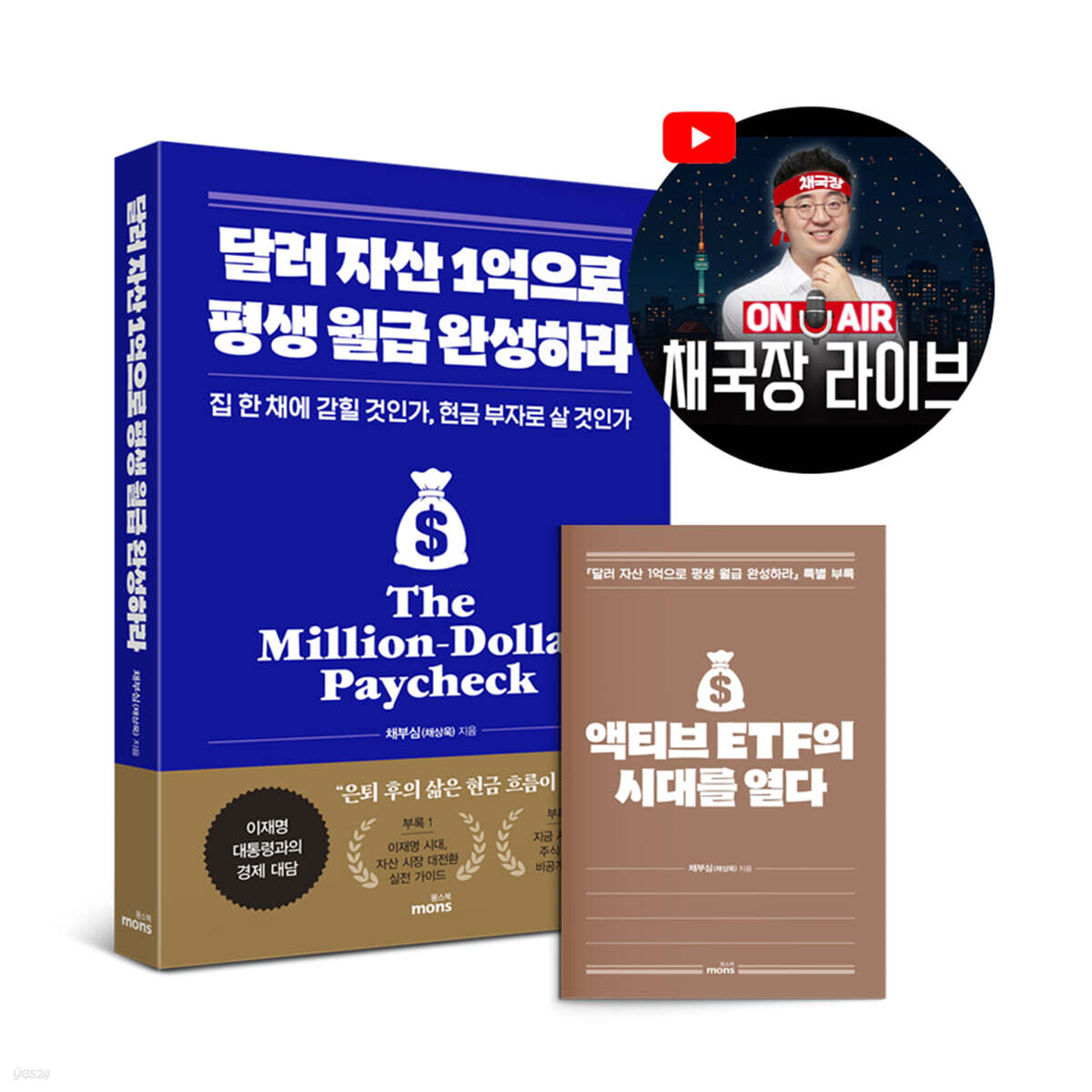
Earn a Lifetime Salary with 100 Million Dollar Assets (2026 Investment Strategy Special Edition)
 |
Description
Book Introduction
“The Republic of Korea is a society where the entire population is obsessed with financial investment.
Instead of excessive investment, with 100 million in dollar assets
“Let time make money roll in”
Economic Dialogue with President Lee Jae-myung
Appendix 1.
A Practical Guide to the Asset Market Transformation in the Lee Jae-myung Era
Appendix 2.
What Stocks Should You Buy Now? Private ETF Lecture
This book is not a trading technique book aimed at short-term profits.
It covers how to align your time and income with assets that can generate long-term compounding effects.
We cover a variety of asset classes, including stocks, real estate, pensions, and digital assets, but our core question is "How to create sustainable cash flow?"
- In the text
Break free from the "over-investment" mindset and invest in a strategy that puts time on your side.
South Korea is one of the world's most "over-investment-obsessed" societies.
It's common for people to wake up in the morning and check the U.S. stock market, watch stock and real estate-related YouTube videos on their way to work, and seek out investment lectures on the weekends.
We live in an era where even the owner of a local hotteok shop talks about Tesla stock and leveraged ETFs.
Author Chae Bu-sim (Chae Sang-wook) has observed this phenomenon more closely than anyone else while analyzing the real estate and stock markets for 20 years.
He asks:
"Is this excessive investment truly improving our lives?" Many find themselves emotionally swayed by daily asset price fluctuations, and the time and energy poured into investing studies is encroaching on their work and family lives.
This book presents 'time and welfare' as the answer.
The key is not to trade for short-term price differences, but to create a structure in which assets grow on their own over the long term.
While we cover a variety of asset classes, including stocks, ETFs, pensions, and digital assets, our core focus is on creating sustainable cash flow.
The author offers concrete ways to reduce the time spent investing and help your assets grow while maintaining a work-life balance.
This approach isn't just a simple investment guide; it's also a "mental safety net" that helps those suffering from financial burnout recover and find long-term financial stability.
Instead of excessive investment, with 100 million in dollar assets
“Let time make money roll in”
Economic Dialogue with President Lee Jae-myung
Appendix 1.
A Practical Guide to the Asset Market Transformation in the Lee Jae-myung Era
Appendix 2.
What Stocks Should You Buy Now? Private ETF Lecture
This book is not a trading technique book aimed at short-term profits.
It covers how to align your time and income with assets that can generate long-term compounding effects.
We cover a variety of asset classes, including stocks, real estate, pensions, and digital assets, but our core question is "How to create sustainable cash flow?"
- In the text
Break free from the "over-investment" mindset and invest in a strategy that puts time on your side.
South Korea is one of the world's most "over-investment-obsessed" societies.
It's common for people to wake up in the morning and check the U.S. stock market, watch stock and real estate-related YouTube videos on their way to work, and seek out investment lectures on the weekends.
We live in an era where even the owner of a local hotteok shop talks about Tesla stock and leveraged ETFs.
Author Chae Bu-sim (Chae Sang-wook) has observed this phenomenon more closely than anyone else while analyzing the real estate and stock markets for 20 years.
He asks:
"Is this excessive investment truly improving our lives?" Many find themselves emotionally swayed by daily asset price fluctuations, and the time and energy poured into investing studies is encroaching on their work and family lives.
This book presents 'time and welfare' as the answer.
The key is not to trade for short-term price differences, but to create a structure in which assets grow on their own over the long term.
While we cover a variety of asset classes, including stocks, ETFs, pensions, and digital assets, our core focus is on creating sustainable cash flow.
The author offers concrete ways to reduce the time spent investing and help your assets grow while maintaining a work-life balance.
This approach isn't just a simple investment guide; it's also a "mental safety net" that helps those suffering from financial burnout recover and find long-term financial stability.
- You can preview some of the book's contents.
Preview
index
Prologue 04
Chapter 1.
Korea is a society obsessed with financial investment.
01 Is investing a second career for Koreans? 014
02 Why You Should Still Invest This Way 031
03. 540 million won in assets needed for retirement? 039
04 People who say they are rich even with 300 million won, but not rich even with 3 billion won 049
05 Citizens of low-growth countries need to change their investment perspectives. 057
06 Why You Should Start Investing in Foreign Currency Assets for the Long Term Now 064
Chapter 2.
Buy dollar assets
01 Buying 'Assets' with 'Money' 072
02 Asset Investment Methods in a Low-Growth Era 082
03 Boost Your Income with High-Dividend ETFs and Stocks 086
04 If you're headed in the right direction, you're halfway there. Focus on your monthly income. 098
05 Dividend Investment Proposal for Debt Review 103
06 ETF Investment Guide 111
Chapter 3.
Complete your retirement planning by investing in overseas ETFs.
01 Investing in stocks with US index ETFs is also sufficient 118
02 Comparison of S&P 500-Based Index ETFs 124
03 Comparison of NASDAQ-Based Index ETFs 128
04 Reasons You Should Never Invest in Leveraged ETFs 133
05 The Concept of "Target-Date Funds" and Life Cycle Investment Methods 141
Chapter 4.
Is it better not to invest in stocks?
01 Investment, Risk, and Return 150
02 Studying Stocks Doesn't Increase Investment Returns 160
03 To Hold or to Cut Losses, That Is the Question 167
04 Organize your interests by personality, not industry. 177
05. Buy only stocks of companies with sustainable growth and sleep. If you buy anything else, you'll be in big trouble. 185
Chapter 5.
Real estate, what should I do?
In dollar terms, the Korean real estate market has fallen by -40% over the past three years.
02 The Concept of Housing Costs and Housing Price Outlook 200
03 Why Growth Stock Investment and Apartment Investment Are the Same 206
04 Reasons Why You Shouldn't Invest in Small Gap Stocks 210
05 Should I move, buy, rent, or invest in stocks? 215
Chapter 6.
Pension Strategy
01 Understanding the Pension System 222
02 Is it better to pay the National Pension or not? 227
03 Manage your retirement pension 232
04 Don't Save for Pension 243
Chapter 7.
Peak Out Korea: Survival Strategy
01 Peak Out is Coming 252
02 Is investing in foreign currency assets treasonous? 257
03 Pension peak-out is just around the corner 262
04 Are we prepared if Japan's Lost 30 Years unfold in Korea? 266
Appendix 272: A Practical Guide to the Asset Market Transformation in the Lee Jae-myung Era
Chapter 1.
Korea is a society obsessed with financial investment.
01 Is investing a second career for Koreans? 014
02 Why You Should Still Invest This Way 031
03. 540 million won in assets needed for retirement? 039
04 People who say they are rich even with 300 million won, but not rich even with 3 billion won 049
05 Citizens of low-growth countries need to change their investment perspectives. 057
06 Why You Should Start Investing in Foreign Currency Assets for the Long Term Now 064
Chapter 2.
Buy dollar assets
01 Buying 'Assets' with 'Money' 072
02 Asset Investment Methods in a Low-Growth Era 082
03 Boost Your Income with High-Dividend ETFs and Stocks 086
04 If you're headed in the right direction, you're halfway there. Focus on your monthly income. 098
05 Dividend Investment Proposal for Debt Review 103
06 ETF Investment Guide 111
Chapter 3.
Complete your retirement planning by investing in overseas ETFs.
01 Investing in stocks with US index ETFs is also sufficient 118
02 Comparison of S&P 500-Based Index ETFs 124
03 Comparison of NASDAQ-Based Index ETFs 128
04 Reasons You Should Never Invest in Leveraged ETFs 133
05 The Concept of "Target-Date Funds" and Life Cycle Investment Methods 141
Chapter 4.
Is it better not to invest in stocks?
01 Investment, Risk, and Return 150
02 Studying Stocks Doesn't Increase Investment Returns 160
03 To Hold or to Cut Losses, That Is the Question 167
04 Organize your interests by personality, not industry. 177
05. Buy only stocks of companies with sustainable growth and sleep. If you buy anything else, you'll be in big trouble. 185
Chapter 5.
Real estate, what should I do?
In dollar terms, the Korean real estate market has fallen by -40% over the past three years.
02 The Concept of Housing Costs and Housing Price Outlook 200
03 Why Growth Stock Investment and Apartment Investment Are the Same 206
04 Reasons Why You Shouldn't Invest in Small Gap Stocks 210
05 Should I move, buy, rent, or invest in stocks? 215
Chapter 6.
Pension Strategy
01 Understanding the Pension System 222
02 Is it better to pay the National Pension or not? 227
03 Manage your retirement pension 232
04 Don't Save for Pension 243
Chapter 7.
Peak Out Korea: Survival Strategy
01 Peak Out is Coming 252
02 Is investing in foreign currency assets treasonous? 257
03 Pension peak-out is just around the corner 262
04 Are we prepared if Japan's Lost 30 Years unfold in Korea? 266
Appendix 272: A Practical Guide to the Asset Market Transformation in the Lee Jae-myung Era
Detailed image

Into the book
To relieve the burnout that comes from a life overly focused on financial investment, to break free from the daily grind of money and completely resolve this issue, you must break free from the inertial financial habits you've been following.
Perhaps, what you, the readers, have been doing so far is not preparing well for old age, but rather, you may have lived a life so harshly in your 30s to 50s that you missed out on many aspects of life or overworked your body, which could make old age more difficult by getting sick later in life.
---From "Is investing a second career for Koreans?"
I want to point out that when people talk about investing, they focus only on building "assets" and don't pay much attention to cash flow.
However, if capital is needed to purchase products and services in capitalism, and if our lives are determined by which of those products and services we buy and sell, then rather than living a life where we buy assets but cannot buy anything else, we should pursue a balanced approach to both to live a fun and happy life.
---From "Why You Should Still Do This Kind of Investment"
What's missing from this discourse on the wealthy is 'time', and if we can properly establish the concept of time, we won't have to worry so much about preparing for old age or life after retirement.
Rather, I think that someone who saved 100 million won in their 30s is richer than someone who saved 1 billion won in their 60s.
This is partly because he actually has a lot of time on his hands, and who knows what the future might hold if he uses that same time more effectively.
---“People who are rich even with 300 million won, but not rich even with 3 billion won”
But now, it goes beyond this and invests in foreign currency assets (assets based on foreign currency including the dollar).
Therefore, it is time to have a distribution strategy between ‘dollar assets’ (sometimes referred to as ‘dollar assets’) and won assets.
Because the value of the won is melting away steeply every year.
While the 2024 benchmark may not apply to everyone, there has been a 12% currency devaluation in the past year alone.
The exchange rate has risen.
And when compared to the 2020s, it is seen that the exchange rate has been maintained in the 1,100 to 1,400 won range, so the fact that there is an exchange rate change of about 30% over four years means a huge decline in the value of the currency.
---From "Citizens of low-growth countries need to change their perspective on investment"
You can go abroad and work to earn foreign currency, but there is already a system in the market that allows you to enjoy foreign growth by simply sending money abroad.
Whether it's stocks, real estate, or virtual assets, all we have to do is send capital to foreign countries' growth instead of Korea's and enjoy it like picking and eating fruit.
This must be implemented unconditionally starting in 2025, when the nominal growth rate has declined.
As each year passes, the amount of money that can be sent abroad decreases or becomes more necessary.
---From "Why You Should Start Investing in Foreign Currency Assets for the Long Term Right Now"
Typically, during growth periods, people spend more money and companies earn more money, so asset values rise quickly.
Investments at this time are investments that rely on the increase in asset value, and the general investment theory is to consider 'sales capital gains' as important.
On the other hand, during a period of low growth, asset prices do not rise significantly because the pace of money creation slows and people reduce their consumption.
So, in times like these, it becomes more important to invest in assets that provide a steady cash flow rather than buying assets and waiting for prices to rise.
---From "Asset Investment Methods in the Low-Growth Era"
However, from the perspective of Korean investors who need to invest in overseas indices, there are actually two types of overseas index ETFs.
The first is the overseas (US) index ETF, which is a form of directly purchasing ETFs by opening a direct stock account and using the overseas stock purchase function.
The second is an ETF listed on the Korean stock market that closely tracks U.S. index ETFs, tailored to the convenience of Koreans.
Let's call this a replication ETF.
So, which one should you buy: an overseas ETF or a replica ETF?
---From "Investing in stocks is sufficient with US index ETFs"
However, U.S. stocks have achieved a long-term average asset value increase of 10% over the past 50 years.
It's worth considering the power of investing in these American stocks.
If you retire with 10% of your assets invested in long-term averages, you can live comfortably in your old age, mowing the lawn, drinking beer, and watching baseball without worrying about living expenses.
---From "Investment, Risk, and Return"
However, the idea that studying business will help you do well in stocks is similar to the idea that studying economics will help you understand the market.
Investment is investment, economy is economy, and business is business.
So, leave behind all those who gaslight you by telling you that you need to meticulously study individual companies, industries, and technology trends to invest in individual stocks. They won't help you in life.
---From "Studying Stocks Does Not Increase Investment Returns"
Then, the question that might arise is, “If you don’t own a home in the top 20% of Seoul’s housing market, is it better to sell it and invest in other assets (stocks or dividend stocks)?”
My answer is, of course, “Yes.”
To put it extremely, it is because they think, 'If you have money, you have a lot of houses.'
---From "The Concept of Housing Costs and Housing Price Outlook"
Basically, if you're in your 40s, consider a DC-type retirement pension. A DC-type investment management system allows individuals to manage their investments and receive full benefits from their investments.
Of course, it is not wrong to challenge for a high salary in your 40s and to maximize DB-type profits through job changes, etc.
In institutions such as public institutions where annual salaries are determined by grade level, it is also appropriate to base it on DB.
However, DBs are not properly managed by companies in the first place, and in fact, they are left in deposits and left unattended, which does not even increase with the inflation rate and actually ends up losing the principal.
---From "Manage the Retirement Pension"
Ultimately, it may be advantageous for Korea to accumulate overseas won assets and later liquidate the won carry.
Of course, it would be best if the money stayed in Korea, but if the low birth rate leads to a peak, it would be better to send the money overseas and enjoy growth.
Of course, domestic assets should not be given a 0% weighting, and a balance must be maintained.
Perhaps, what you, the readers, have been doing so far is not preparing well for old age, but rather, you may have lived a life so harshly in your 30s to 50s that you missed out on many aspects of life or overworked your body, which could make old age more difficult by getting sick later in life.
---From "Is investing a second career for Koreans?"
I want to point out that when people talk about investing, they focus only on building "assets" and don't pay much attention to cash flow.
However, if capital is needed to purchase products and services in capitalism, and if our lives are determined by which of those products and services we buy and sell, then rather than living a life where we buy assets but cannot buy anything else, we should pursue a balanced approach to both to live a fun and happy life.
---From "Why You Should Still Do This Kind of Investment"
What's missing from this discourse on the wealthy is 'time', and if we can properly establish the concept of time, we won't have to worry so much about preparing for old age or life after retirement.
Rather, I think that someone who saved 100 million won in their 30s is richer than someone who saved 1 billion won in their 60s.
This is partly because he actually has a lot of time on his hands, and who knows what the future might hold if he uses that same time more effectively.
---“People who are rich even with 300 million won, but not rich even with 3 billion won”
But now, it goes beyond this and invests in foreign currency assets (assets based on foreign currency including the dollar).
Therefore, it is time to have a distribution strategy between ‘dollar assets’ (sometimes referred to as ‘dollar assets’) and won assets.
Because the value of the won is melting away steeply every year.
While the 2024 benchmark may not apply to everyone, there has been a 12% currency devaluation in the past year alone.
The exchange rate has risen.
And when compared to the 2020s, it is seen that the exchange rate has been maintained in the 1,100 to 1,400 won range, so the fact that there is an exchange rate change of about 30% over four years means a huge decline in the value of the currency.
---From "Citizens of low-growth countries need to change their perspective on investment"
You can go abroad and work to earn foreign currency, but there is already a system in the market that allows you to enjoy foreign growth by simply sending money abroad.
Whether it's stocks, real estate, or virtual assets, all we have to do is send capital to foreign countries' growth instead of Korea's and enjoy it like picking and eating fruit.
This must be implemented unconditionally starting in 2025, when the nominal growth rate has declined.
As each year passes, the amount of money that can be sent abroad decreases or becomes more necessary.
---From "Why You Should Start Investing in Foreign Currency Assets for the Long Term Right Now"
Typically, during growth periods, people spend more money and companies earn more money, so asset values rise quickly.
Investments at this time are investments that rely on the increase in asset value, and the general investment theory is to consider 'sales capital gains' as important.
On the other hand, during a period of low growth, asset prices do not rise significantly because the pace of money creation slows and people reduce their consumption.
So, in times like these, it becomes more important to invest in assets that provide a steady cash flow rather than buying assets and waiting for prices to rise.
---From "Asset Investment Methods in the Low-Growth Era"
However, from the perspective of Korean investors who need to invest in overseas indices, there are actually two types of overseas index ETFs.
The first is the overseas (US) index ETF, which is a form of directly purchasing ETFs by opening a direct stock account and using the overseas stock purchase function.
The second is an ETF listed on the Korean stock market that closely tracks U.S. index ETFs, tailored to the convenience of Koreans.
Let's call this a replication ETF.
So, which one should you buy: an overseas ETF or a replica ETF?
---From "Investing in stocks is sufficient with US index ETFs"
However, U.S. stocks have achieved a long-term average asset value increase of 10% over the past 50 years.
It's worth considering the power of investing in these American stocks.
If you retire with 10% of your assets invested in long-term averages, you can live comfortably in your old age, mowing the lawn, drinking beer, and watching baseball without worrying about living expenses.
---From "Investment, Risk, and Return"
However, the idea that studying business will help you do well in stocks is similar to the idea that studying economics will help you understand the market.
Investment is investment, economy is economy, and business is business.
So, leave behind all those who gaslight you by telling you that you need to meticulously study individual companies, industries, and technology trends to invest in individual stocks. They won't help you in life.
---From "Studying Stocks Does Not Increase Investment Returns"
Then, the question that might arise is, “If you don’t own a home in the top 20% of Seoul’s housing market, is it better to sell it and invest in other assets (stocks or dividend stocks)?”
My answer is, of course, “Yes.”
To put it extremely, it is because they think, 'If you have money, you have a lot of houses.'
---From "The Concept of Housing Costs and Housing Price Outlook"
Basically, if you're in your 40s, consider a DC-type retirement pension. A DC-type investment management system allows individuals to manage their investments and receive full benefits from their investments.
Of course, it is not wrong to challenge for a high salary in your 40s and to maximize DB-type profits through job changes, etc.
In institutions such as public institutions where annual salaries are determined by grade level, it is also appropriate to base it on DB.
However, DBs are not properly managed by companies in the first place, and in fact, they are left in deposits and left unattended, which does not even increase with the inflation rate and actually ends up losing the principal.
---From "Manage the Retirement Pension"
Ultimately, it may be advantageous for Korea to accumulate overseas won assets and later liquidate the won carry.
Of course, it would be best if the money stayed in Korea, but if the low birth rate leads to a peak, it would be better to send the money overseas and enjoy growth.
Of course, domestic assets should not be given a 0% weighting, and a balance must be maintained.
---From "Is Foreign Asset Investment an Act of Treason?"
Publisher's Review
Would you rather be trapped in one house or live a cash-rich life?
Koreans' asset structure is heavily concentrated in real estate.
However, real estate prices in Korea are high even by world standards, and housing in the metropolitan area in particular has become so expensive that it takes a lifetime's worth of savings to buy one.
In this reality, many people are overly obsessed with 'house prices' and pour all their assets into a single apartment.
But the authors warn that this approach could put your life in jeopardy after retirement.
The house you live in is merely an asset on paper, not a 'cash flow' that can be used for living expenses.
If your income decreases after retirement, you will eventually have to sell the house or take out a mortgage, which is far from a secure retirement.
This book breaks free from the trap of "all-in on real estate," and presents practical investment strategies that will provide monthly living expenses after retirement, rather than investing in an expensive home.
The goal is not simply to become rich, but to become cash-rich, able to spend money at any time, thereby achieving both financial freedom and stability in life.
A lifetime salary system that creates "100 million dollar assets"
Many people tie up their entire assets in their homes, but real estate is not a "cash-flowing asset" that can support retirement living expenses.
The author points out this structural limitation and proposes alternatives, such as investing in global ETFs and dollar assets. The "100 million won in dollar assets" suggested in the book is not simply a target amount.
This is a realistic standard calculated by calculating the living expenses required after retirement, expected rate of return, and investment period.
For example, if you hold 100 million won in dollar assets at age 45 and manage it for 20 years at an annual rate of return of 8%, you will have approximately 540 million won by age 65.
This is a scale that can stably provide living expenses of around 3 million won per month.
In other words, it is not important to need more than 1 billion won right now, but to create an asset structure that can be called upon when needed by utilizing the power of time and compound interest.
The author calls this the "lifetime salary system."
It presents examples of stocks and portfolios that can actually be managed, such as ETFs based on the US S&P 500 and Nasdaq indices, and dividend ETFs, and helps readers implement them on their own.
There are three advantages to this system.
First, you can diversify and protect your assets by taking advantage of exchange rates and global market growth.
Second, cash flow through dividends and distributions is steady.
Third, because it is a long-term investment structure, it is not affected by daily price fluctuations.
Practical know-how from a 20-year veteran economic expert in debt assessment
The author, Chae Bu-sim (real name Chae Sang-wook), is an economic expert who has been analyzing the real estate and stock markets for 20 years while working as an analyst at a construction company and securities firm.
He has been ranked first in the Best Analyst category of the Korea Economic Daily Research Center for three consecutive years and has been selected as the Best Analyst of the Maeil Business Newspaper for nine consecutive years.
He currently runs the YouTube channel 'Chaebusim (Chae Sang-wook's Real Estate Errand Center)', where he produces content to help individual investors navigate complex market situations.
The book contains real-world investment cases, portfolio construction processes, and know-how in managing variables such as taxes, exchange rates, and prices.
In particular, topics like "target-date funds," life-cycle investment strategies, and how to utilize dollar assets alongside pensions and retirement annuities after retirement are difficult to obtain unless you're a professional in the field. The author emphasizes:
“Preparing for retirement doesn’t have to be complicated.
Anyone can do it if they make time their ally and design a compounding structure.” This book is a “customized roadmap” that helps investors from beginners to intermediate level create an action plan tailored to their individual circumstances.
For readers who want to maintain a steady cash flow after retirement and those who dream of long-term wealth by avoiding "over-investment" spending, this book will serve as a solid guide.
Koreans' asset structure is heavily concentrated in real estate.
However, real estate prices in Korea are high even by world standards, and housing in the metropolitan area in particular has become so expensive that it takes a lifetime's worth of savings to buy one.
In this reality, many people are overly obsessed with 'house prices' and pour all their assets into a single apartment.
But the authors warn that this approach could put your life in jeopardy after retirement.
The house you live in is merely an asset on paper, not a 'cash flow' that can be used for living expenses.
If your income decreases after retirement, you will eventually have to sell the house or take out a mortgage, which is far from a secure retirement.
This book breaks free from the trap of "all-in on real estate," and presents practical investment strategies that will provide monthly living expenses after retirement, rather than investing in an expensive home.
The goal is not simply to become rich, but to become cash-rich, able to spend money at any time, thereby achieving both financial freedom and stability in life.
A lifetime salary system that creates "100 million dollar assets"
Many people tie up their entire assets in their homes, but real estate is not a "cash-flowing asset" that can support retirement living expenses.
The author points out this structural limitation and proposes alternatives, such as investing in global ETFs and dollar assets. The "100 million won in dollar assets" suggested in the book is not simply a target amount.
This is a realistic standard calculated by calculating the living expenses required after retirement, expected rate of return, and investment period.
For example, if you hold 100 million won in dollar assets at age 45 and manage it for 20 years at an annual rate of return of 8%, you will have approximately 540 million won by age 65.
This is a scale that can stably provide living expenses of around 3 million won per month.
In other words, it is not important to need more than 1 billion won right now, but to create an asset structure that can be called upon when needed by utilizing the power of time and compound interest.
The author calls this the "lifetime salary system."
It presents examples of stocks and portfolios that can actually be managed, such as ETFs based on the US S&P 500 and Nasdaq indices, and dividend ETFs, and helps readers implement them on their own.
There are three advantages to this system.
First, you can diversify and protect your assets by taking advantage of exchange rates and global market growth.
Second, cash flow through dividends and distributions is steady.
Third, because it is a long-term investment structure, it is not affected by daily price fluctuations.
Practical know-how from a 20-year veteran economic expert in debt assessment
The author, Chae Bu-sim (real name Chae Sang-wook), is an economic expert who has been analyzing the real estate and stock markets for 20 years while working as an analyst at a construction company and securities firm.
He has been ranked first in the Best Analyst category of the Korea Economic Daily Research Center for three consecutive years and has been selected as the Best Analyst of the Maeil Business Newspaper for nine consecutive years.
He currently runs the YouTube channel 'Chaebusim (Chae Sang-wook's Real Estate Errand Center)', where he produces content to help individual investors navigate complex market situations.
The book contains real-world investment cases, portfolio construction processes, and know-how in managing variables such as taxes, exchange rates, and prices.
In particular, topics like "target-date funds," life-cycle investment strategies, and how to utilize dollar assets alongside pensions and retirement annuities after retirement are difficult to obtain unless you're a professional in the field. The author emphasizes:
“Preparing for retirement doesn’t have to be complicated.
Anyone can do it if they make time their ally and design a compounding structure.” This book is a “customized roadmap” that helps investors from beginners to intermediate level create an action plan tailored to their individual circumstances.
For readers who want to maintain a steady cash flow after retirement and those who dream of long-term wealth by avoiding "over-investment" spending, this book will serve as a solid guide.
GOODS SPECIFICS
- Date of issue: August 25, 2025
- Page count, weight, size: 296 pages | 400g | 140*210*18mm
- ISBN13: 9791199229976
- ISBN10: 1199229970
You may also like
카테고리
korean


korean

![ELLE 엘르 스페셜 에디션 A형 : 12월 [2025]](http://librairie.coreenne.fr/cdn/shop/files/b8e27a3de6c9538896439686c6b0e8fb.jpg?v=1766436872&width=3840)


