

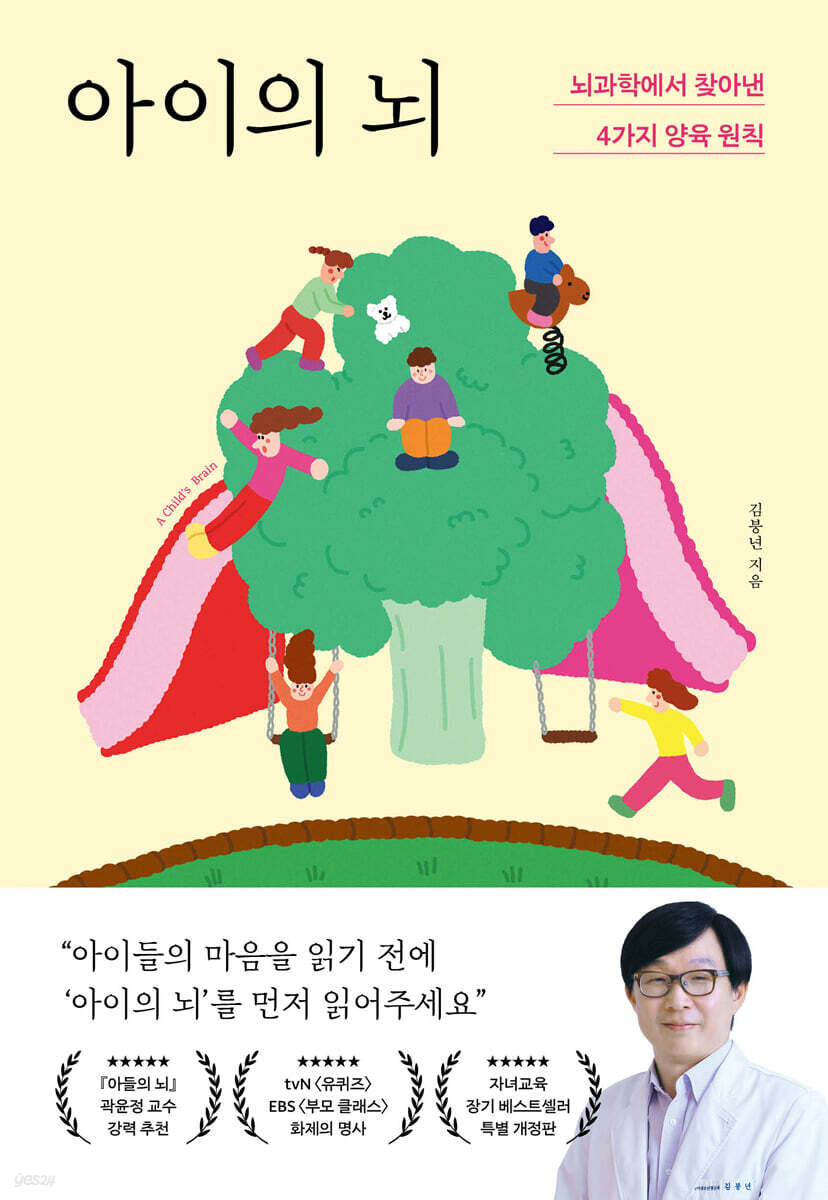
child's brain
 |
Description
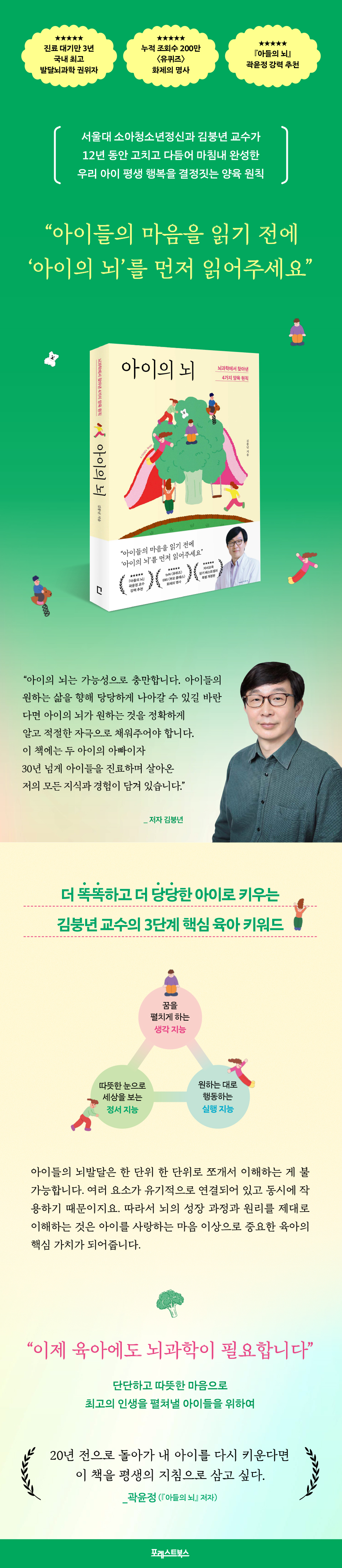
Book Introduction
* Waiting for treatment for 3 years!
* The best doctor in the Department of Child and Adolescent Psychiatry at Seoul National University
* Professor Kwak Yun-jeong strongly recommends 『The Son's Brain』
* tvN [You Quiz] EBS [Parents Class] Hot Topic
"Now, even parenting needs brain science."
The country's top developmental neuroscientist tells you
4 Parenting Principles for Raising Smarter, More Confident Children
“If I could go back 20 years and raise my child again,
“I want to use this book as a lifelong guide.” _ Kwak Yun-jeong (author of “The Son’s Brain”)
Waiting for treatment for 3 years.
The child and adolescent psychiatrist most sought after by parents in Korea.
The highest authority in developmental brain science in Korea.
All of this is an introduction to Professor Kim Boong-nyeon of the Department of Child and Adolescent Psychiatry at Seoul National University.
Having provided excellent solutions to countless children and parents struggling with emotional and behavioral issues for over 30 years, he has now published a new book, "The Child's Brain," introducing four parenting principles discovered in brain science after 12 years of careful revision and refinement.
Humans are born with only about 30% of their brain function.
It is said that it only has the ability to sustain life.
A child's brain grows explosively until the age of 12, the so-called critical period, when connections between neurons are activated, and the areas where these connections are activated vary with age.
Until the age of 3, development takes place in the parietal lobe, temporal lobe, occipital lobe, and limbic system, and these areas primarily control the emotional and sensory areas.
In other words, it is impossible to develop areas such as logic, reason, rational thinking, and learning before the age of three.
Instead, during this period, the development of sensory functions that are satisfied through stimulation of the five senses and the development of emotions that are formed through sympathy and attachment are very important.
This book contains practical and specific parenting guidelines that can help children develop their thinking, empathy, and executive abilities during the critical period of brain development.
Professor Kim Boong-nyeon offers heartfelt advice, sometimes sharp, sometimes warm, drawing on the insight of a scholar who has worked as a developmental neuroscientist for over 30 years and the experience of a father raising two children.
There is no parent who does not want to raise their child well.
Just as Professor Kwak Yun-jeong praised the book, saying, “If I could go back 20 years and raise my child again, I would use this book as a lifelong guide,” this book will serve as a solid foundation for children to confidently move forward toward the lives they desire.
* The best doctor in the Department of Child and Adolescent Psychiatry at Seoul National University
* Professor Kwak Yun-jeong strongly recommends 『The Son's Brain』
* tvN [You Quiz] EBS [Parents Class] Hot Topic
"Now, even parenting needs brain science."
The country's top developmental neuroscientist tells you
4 Parenting Principles for Raising Smarter, More Confident Children
“If I could go back 20 years and raise my child again,
“I want to use this book as a lifelong guide.” _ Kwak Yun-jeong (author of “The Son’s Brain”)
Waiting for treatment for 3 years.
The child and adolescent psychiatrist most sought after by parents in Korea.
The highest authority in developmental brain science in Korea.
All of this is an introduction to Professor Kim Boong-nyeon of the Department of Child and Adolescent Psychiatry at Seoul National University.
Having provided excellent solutions to countless children and parents struggling with emotional and behavioral issues for over 30 years, he has now published a new book, "The Child's Brain," introducing four parenting principles discovered in brain science after 12 years of careful revision and refinement.
Humans are born with only about 30% of their brain function.
It is said that it only has the ability to sustain life.
A child's brain grows explosively until the age of 12, the so-called critical period, when connections between neurons are activated, and the areas where these connections are activated vary with age.
Until the age of 3, development takes place in the parietal lobe, temporal lobe, occipital lobe, and limbic system, and these areas primarily control the emotional and sensory areas.
In other words, it is impossible to develop areas such as logic, reason, rational thinking, and learning before the age of three.
Instead, during this period, the development of sensory functions that are satisfied through stimulation of the five senses and the development of emotions that are formed through sympathy and attachment are very important.
This book contains practical and specific parenting guidelines that can help children develop their thinking, empathy, and executive abilities during the critical period of brain development.
Professor Kim Boong-nyeon offers heartfelt advice, sometimes sharp, sometimes warm, drawing on the insight of a scholar who has worked as a developmental neuroscientist for over 30 years and the experience of a father raising two children.
There is no parent who does not want to raise their child well.
Just as Professor Kwak Yun-jeong praised the book, saying, “If I could go back 20 years and raise my child again, I would use this book as a lifelong guide,” this book will serve as a solid foundation for children to confidently move forward toward the lives they desire.
- You can preview some of the book's contents.
Preview
index
Introduction
To raise a child who is strong and warm on the inside
Part 1: Why Brain Science Matters in Parenting
01 The ever-changing brain of a child
02 Is it genetic or environmental?
03 Are smart children happier?
04 Dopamine, the brain's lifeblood
05 Serotonin, the brain's resting place
06 Adrenaline, the brain's alarm system
07 What Happens When You Don't Sleep
08 I don't usually eat breakfast.
09 Surprising Habits That Strengthen Your Brain
Part 2.
Thinking intelligence that broadens your perspective on the world
10 Secrets of Children Who Finally Accomplish It
11 The brain does not work by force.
12. Does my absent-minded child have ADHD?
13 The Joy of Immersion
14 Imagination Changes Brain Maps
15 Self-Esteem Boosting Wizards
16 The effects of reading books that stimulate the prefrontal cortex
Part 3: Emotional Intelligence: Seeing Others with Warm Eyes
17. Getting along is also a skill.
18 Empathy grows on love.
19 Reasons We Are Attracted to Goodness
20 Children Whose Happiness Is Mortgaged
21 I think I got bitten by a black bulldog
22 Skinship that strengthens the happiness muscles
23 The safety fence called school
Part 4: Executive Intelligence That Enables You to Act as You Set Your Mind
24 A society that encourages competition
25 A child who knows how to wait leads the world.
26 The Child Who Dreams VS The Child Who Makes His Dreams Come True
27 The Art of Praise
28 For a child with too many worries and anxieties
29 Willpower Circuits that Drive Out Negative Memories
To raise a child who is strong and warm on the inside
Part 1: Why Brain Science Matters in Parenting
01 The ever-changing brain of a child
02 Is it genetic or environmental?
03 Are smart children happier?
04 Dopamine, the brain's lifeblood
05 Serotonin, the brain's resting place
06 Adrenaline, the brain's alarm system
07 What Happens When You Don't Sleep
08 I don't usually eat breakfast.
09 Surprising Habits That Strengthen Your Brain
Part 2.
Thinking intelligence that broadens your perspective on the world
10 Secrets of Children Who Finally Accomplish It
11 The brain does not work by force.
12. Does my absent-minded child have ADHD?
13 The Joy of Immersion
14 Imagination Changes Brain Maps
15 Self-Esteem Boosting Wizards
16 The effects of reading books that stimulate the prefrontal cortex
Part 3: Emotional Intelligence: Seeing Others with Warm Eyes
17. Getting along is also a skill.
18 Empathy grows on love.
19 Reasons We Are Attracted to Goodness
20 Children Whose Happiness Is Mortgaged
21 I think I got bitten by a black bulldog
22 Skinship that strengthens the happiness muscles
23 The safety fence called school
Part 4: Executive Intelligence That Enables You to Act as You Set Your Mind
24 A society that encourages competition
25 A child who knows how to wait leads the world.
26 The Child Who Dreams VS The Child Who Makes His Dreams Come True
27 The Art of Praise
28 For a child with too many worries and anxieties
29 Willpower Circuits that Drive Out Negative Memories
Detailed image
Into the book
Parents pass on a genetic framework to their children, but ultimately, how this genetic framework is expressed depends on the environment in which the child lives, and the experiences they have play a decisive role.
This is also the difference between animals and humans.
--- p..21
An important element of happiness necessarily includes ‘peace of mind’ or ‘a sense of stability in daily life.’
To achieve this, we must achieve a state of moderation, where emotions and reason are precisely balanced.
Therefore, in order to develop children's brains into happy brains, we must help the cingulate cortex, which controls both rational and emotional functions, develop well.
--- p..29~30
There is another important reason why it is important to develop the serotonin neural network during childhood.
This is to ensure that you can have a healthy and stable adolescence.
Adolescence is a difficult time.
It's hard because my mood changes several times a day, it's hard because it feels like people around me are only looking at me, and it's hard because of the entrance exams and the difficult studying.
But the serotonin neural network can help these adolescents.
In the polar opposites of adolescence, the brains of adolescents who must cope with the raging waves of sex hormones are only equipped with a serotonin network that can act as a safety net.
--- p..40
It has long been known that creativity comes from the 'resting brain'.
In particular, it has been revealed that creative thoughts come out more often when alpha waves, which are the most active brain waves during resting periods, are dominant.
When these alpha waves are dominant, our body also relaxes, and the stress hormone cortisol also decreases.
--- p..78
Happiness sprouts through relationships.
As the human brain has evolved, the area responsible for interpersonal relationships has also developed to a surprising degree.
One of them is the ability to empathize.
Even now, the ability to build relationships based on empathy will become very important in the future.
Empathy is the foundation of meaningful relationships.
Let's look at children who make good friends and maintain those relationships for a long time.
You can see that they are all children with empathetic ears who listen well to what others say.
--- p..126
Research has consistently shown that physical contact plays a positive role in various areas of development in children and adolescents.
This research suggests that physical contact can help with early social development, stress management, and an optimistic outlook on life.
It has also been argued that physical contact during childhood is closely related to dating and marriage in adulthood.
Children who receive a lot of warm physical contact from their parents grow up to be people who can share more active love with friends, lovers, spouses, etc.
In other words, it is said that the ability to love is formed through experiences of physical contact during childhood.
--- p..159~160
From a neuroscientific perspective, worrying is one of the good functions of the frontal lobe.
The frontal lobe plays a crucial role in planning, prioritizing tasks, executing them, and preparing for the future.
In other words, worry is a key function that prepares us for problems that may occur in the future.
But problems arise when we worry too much.
Our brain is more sensitive to negative things than positive things.
When something good happens, it just makes you feel good for a moment and then it just passes by.
Small emotions create happiness, but in fact, our brains are structured to be insensitive to feeling such subtle happiness.
This is also the difference between animals and humans.
--- p..21
An important element of happiness necessarily includes ‘peace of mind’ or ‘a sense of stability in daily life.’
To achieve this, we must achieve a state of moderation, where emotions and reason are precisely balanced.
Therefore, in order to develop children's brains into happy brains, we must help the cingulate cortex, which controls both rational and emotional functions, develop well.
--- p..29~30
There is another important reason why it is important to develop the serotonin neural network during childhood.
This is to ensure that you can have a healthy and stable adolescence.
Adolescence is a difficult time.
It's hard because my mood changes several times a day, it's hard because it feels like people around me are only looking at me, and it's hard because of the entrance exams and the difficult studying.
But the serotonin neural network can help these adolescents.
In the polar opposites of adolescence, the brains of adolescents who must cope with the raging waves of sex hormones are only equipped with a serotonin network that can act as a safety net.
--- p..40
It has long been known that creativity comes from the 'resting brain'.
In particular, it has been revealed that creative thoughts come out more often when alpha waves, which are the most active brain waves during resting periods, are dominant.
When these alpha waves are dominant, our body also relaxes, and the stress hormone cortisol also decreases.
--- p..78
Happiness sprouts through relationships.
As the human brain has evolved, the area responsible for interpersonal relationships has also developed to a surprising degree.
One of them is the ability to empathize.
Even now, the ability to build relationships based on empathy will become very important in the future.
Empathy is the foundation of meaningful relationships.
Let's look at children who make good friends and maintain those relationships for a long time.
You can see that they are all children with empathetic ears who listen well to what others say.
--- p..126
Research has consistently shown that physical contact plays a positive role in various areas of development in children and adolescents.
This research suggests that physical contact can help with early social development, stress management, and an optimistic outlook on life.
It has also been argued that physical contact during childhood is closely related to dating and marriage in adulthood.
Children who receive a lot of warm physical contact from their parents grow up to be people who can share more active love with friends, lovers, spouses, etc.
In other words, it is said that the ability to love is formed through experiences of physical contact during childhood.
--- p..159~160
From a neuroscientific perspective, worrying is one of the good functions of the frontal lobe.
The frontal lobe plays a crucial role in planning, prioritizing tasks, executing them, and preparing for the future.
In other words, worry is a key function that prepares us for problems that may occur in the future.
But problems arise when we worry too much.
Our brain is more sensitive to negative things than positive things.
When something good happens, it just makes you feel good for a moment and then it just passes by.
Small emotions create happiness, but in fact, our brains are structured to be insensitive to feeling such subtle happiness.
--- p..212
Publisher's Review
“What on earth are you thinking?”
vs
“Why is Mom only like this to me?”
The power of brain science to reduce misunderstandings and conflicts and foster understanding and respect.
When raising a child, there are times when you think, “I don’t know what’s going on in my child’s head.”
It seems like other kids are doing well, but my child is falling behind, so I feel anxious and even worried that there might be a problem.
The same goes for children.
“Why is Mom always like this to me?”, “What did I do wrong?” are always on my lips.
I feel wronged and upset because my parents don't seem to understand my feelings.
At the center of all these conflicts is the 'brain'.
This is because the abilities that are essential for human life, such as thinking, empathy, and action, are not formed at birth, but rather grow in accordance with the brain development process.
Therefore, properly understanding the brain's growth process and principles becomes a core value of parenting that is more important than loving a child.
Professor Kim Boong-nyeon of the Department of Child and Adolescent Psychiatry at Seoul National University, who is considered one of the leading parenting mentors in Korea through broadcast programs such as tvN's [You Quiz on the Block] and EBS's [Parent Class], as well as through YouTube and lectures, firmly states, "Children's brains want different parenting and education."
If parents do not properly understand the brain, which is the core center of thought and action, the love and attention they send to their children may end up as greed and hurt.
Good parenting is not about giving your child what you want, but about providing them with exactly and unwaveringly what they need.
“Before reading the minds of children
“Please read the child’s brain”
Away from unconditional love and sacrifice
A book that presents clear parenting principles!
After their children are hurt by bad parenting, parents say this:
“I did it because I loved my child too much,” “I just wanted the child to do well.” However, parenting that is driven by emotions and desires without clear principles and standards only leaves scars on both parents and children.
So then, what exactly is proper parenting?
Professor Kim Boong-nyeon, one of Korea's top child and adolescent psychiatrists and a father of two, answers the question of how to become a good parent this way.
“Treat your children as honored guests.” This short sentence holds so much meaning.
Consideration comes first.
If you are an honored guest, you tend to base your judgment on the other person, not yourself.
It means that I don't force what I like or what I want, but rather think about what the other person wants.
Next is respect.
It means that I have to acknowledge that I am not a being that I can control and look at that person as the person he is.
And he emphasizes that in order to have this kind of parenting attitude, we must study the 'child's brain'.
“Critical periods for children’s brain development vary depending on the area.
“In order for children to grow up with a smart brain and warm emotions, it is very important for parents to provide an appropriate nurturing environment for their children’s brain development during this period.”
If you want your child to be smarter, think more freely, and act more confidently, you need to establish clear parenting principles based on scientifically proven brain development processes, not unconditional love and sacrifice.
What parents need to read is not the heart, but the child's brain.
vs
“Why is Mom only like this to me?”
The power of brain science to reduce misunderstandings and conflicts and foster understanding and respect.
When raising a child, there are times when you think, “I don’t know what’s going on in my child’s head.”
It seems like other kids are doing well, but my child is falling behind, so I feel anxious and even worried that there might be a problem.
The same goes for children.
“Why is Mom always like this to me?”, “What did I do wrong?” are always on my lips.
I feel wronged and upset because my parents don't seem to understand my feelings.
At the center of all these conflicts is the 'brain'.
This is because the abilities that are essential for human life, such as thinking, empathy, and action, are not formed at birth, but rather grow in accordance with the brain development process.
Therefore, properly understanding the brain's growth process and principles becomes a core value of parenting that is more important than loving a child.
Professor Kim Boong-nyeon of the Department of Child and Adolescent Psychiatry at Seoul National University, who is considered one of the leading parenting mentors in Korea through broadcast programs such as tvN's [You Quiz on the Block] and EBS's [Parent Class], as well as through YouTube and lectures, firmly states, "Children's brains want different parenting and education."
If parents do not properly understand the brain, which is the core center of thought and action, the love and attention they send to their children may end up as greed and hurt.
Good parenting is not about giving your child what you want, but about providing them with exactly and unwaveringly what they need.
“Before reading the minds of children
“Please read the child’s brain”
Away from unconditional love and sacrifice
A book that presents clear parenting principles!
After their children are hurt by bad parenting, parents say this:
“I did it because I loved my child too much,” “I just wanted the child to do well.” However, parenting that is driven by emotions and desires without clear principles and standards only leaves scars on both parents and children.
So then, what exactly is proper parenting?
Professor Kim Boong-nyeon, one of Korea's top child and adolescent psychiatrists and a father of two, answers the question of how to become a good parent this way.
“Treat your children as honored guests.” This short sentence holds so much meaning.
Consideration comes first.
If you are an honored guest, you tend to base your judgment on the other person, not yourself.
It means that I don't force what I like or what I want, but rather think about what the other person wants.
Next is respect.
It means that I have to acknowledge that I am not a being that I can control and look at that person as the person he is.
And he emphasizes that in order to have this kind of parenting attitude, we must study the 'child's brain'.
“Critical periods for children’s brain development vary depending on the area.
“In order for children to grow up with a smart brain and warm emotions, it is very important for parents to provide an appropriate nurturing environment for their children’s brain development during this period.”
If you want your child to be smarter, think more freely, and act more confidently, you need to establish clear parenting principles based on scientifically proven brain development processes, not unconditional love and sacrifice.
What parents need to read is not the heart, but the child's brain.
GOODS SPECIFICS
- Date of issue: December 11, 2024
- Page count, weight, size: 228 pages | 320g | 145*210*20mm
- ISBN13: 9791193506981
- ISBN10: 1193506980
You may also like
카테고리
korean


korean

![ELLE 엘르 스페셜 에디션 A형 : 12월 [2025]](http://librairie.coreenne.fr/cdn/shop/files/b8e27a3de6c9538896439686c6b0e8fb.jpg?v=1766436872&width=3840)


