

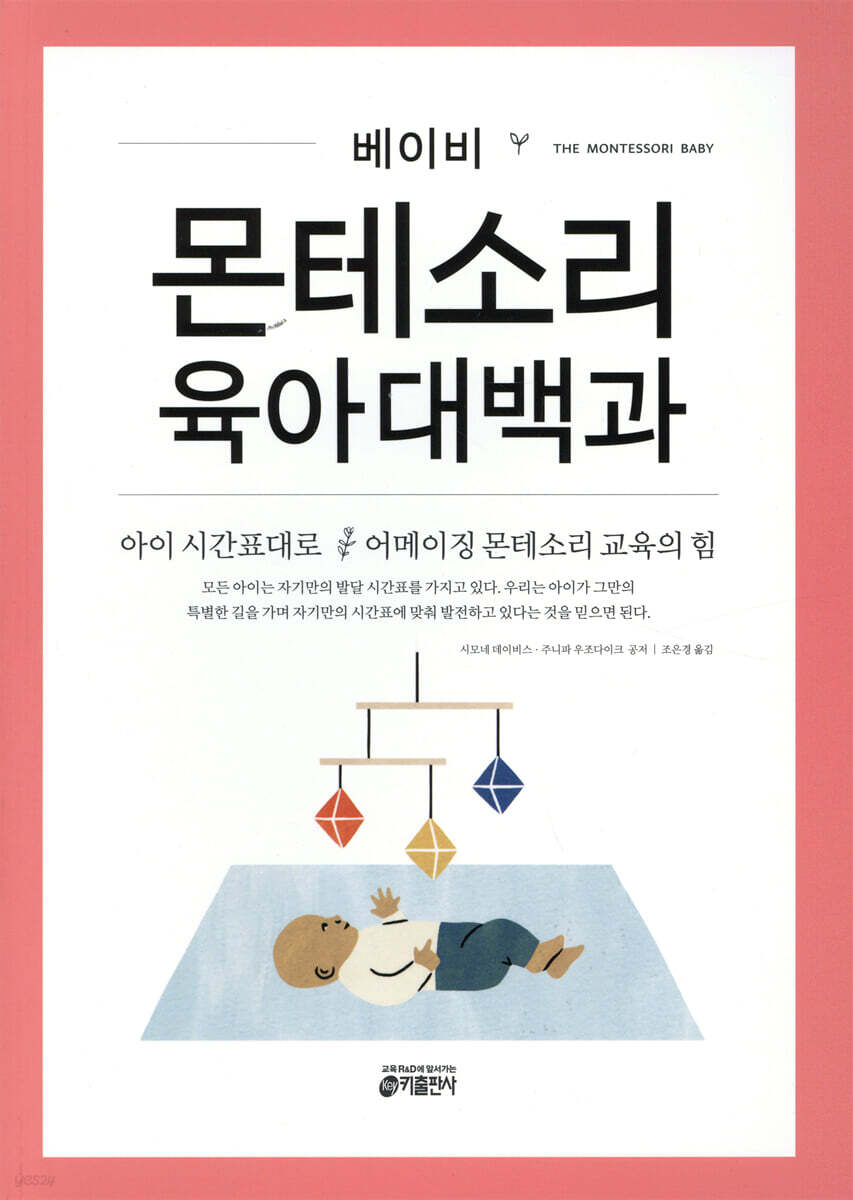
Baby Montessori Parenting Encyclopedia
 |
Description
Book Introduction
Amazon bestseller, translated and published in over 28 countries worldwide
A new book from the author of 『Encyclopedia of Montessori Parenting for Infants and Toddlers』!
A baby's life from birth to the first year through the Montessori lens
Montessori parenting based on love, respect, and observation!
Based on the principles developed by Dr. Maria Montessori, this book shows you how to raise your baby from birth to the first year with love, respect, and remarkable calm and insight.
Co-authored by Simone Davis and Junifa Uzodike, authors of the bestselling Montessori Parenting Guide, this book is filled with practical ideas for understanding what's really happening to your baby and how adults can provide thoughtful, thoughtful support to help them learn and develop.
A new book from the author of 『Encyclopedia of Montessori Parenting for Infants and Toddlers』!
A baby's life from birth to the first year through the Montessori lens
Montessori parenting based on love, respect, and observation!
Based on the principles developed by Dr. Maria Montessori, this book shows you how to raise your baby from birth to the first year with love, respect, and remarkable calm and insight.
Co-authored by Simone Davis and Junifa Uzodike, authors of the bestselling Montessori Parenting Guide, this book is filled with practical ideas for understanding what's really happening to your baby and how adults can provide thoughtful, thoughtful support to help them learn and develop.
- You can preview some of the book's contents.
Preview
index
CHAPTER 1.
Daily life with a baby
Let's change our perspective on babies.
Our Montessori Story
Why we love babies
What we need to know about babies
What Babies Really Tell Us
How to Use This Book
CHAPTER 2.
Montessori principles for babies
Montessori education for babies?
A Brief History of Montessori
What is Montessori?
Some important Montessori principles
- Absorbent spirit
- Human tendencies
- Sensitive period
- Observation
- Prepared environment
CHAPTER 3.
From conception to 6 weeks after birth
Conception
pregnancy
childbirth
Symbiosis: The first six to eight weeks with your baby
- Tactile experience
- Auditory experience
- Visual experience
The Voice of a Newborn: An Interview with Karin Slava
CHAPTER 4.
Interior design of a house with a baby
Decorating your space in Montessori style
Babies don't need much.
Create a space where you can say “yes”
Observe, save, and take out alternately
Decoration by space
Questions about floor beds
Tips for Tricky Situations
- If you have older siblings
- narrow space
-Cleaning up clutter
Preparing the Home Environment for Infants and Toddlers
Benefits of Decorating Your Home Montessori Style
A Montessori Home from the Perspective of 16-Month-Old Baby Jack
home visits
CHAPTER 5.
Parenting the Montessori Way
Trust
Accept
Respect
Set boundaries gently but firmly
Helping you focus
Freedom of activity
Secure attachment
When the baby cries
Become your baby's guide
Establishing a framework for your baby's perspective on the world
Take it slow
A simple checklist to help you connect with your baby
CHAPTER 6.
Montessori Activities for Babies
PART 1.
Introduction to the activity
How to Support Your Baby's Development
- Our role is not to entertain the baby, but to prepare the environment.
- How to help your baby when he or she is struggling or stuck somewhere
Additional Things to Know About Activities for Babies
PART 2.
Language activities
three months from birth
three to six months
six to nine months
Nine to twelve months
After twelve months
Important stages of language development during the first year of life
bilingual
PART 3.
movement activities
three months from birth
Grasping and movement development
three to six months
six to nine months
Nine to twelve months
gross motor development
PART 4.
Other activities
music
Outdoor
Movements in the first year of life
CHAPTER 7.
Practical Parenting
PART 1.
Daily life
The rhythm of daily life
consciousness
eating
sleep
PART 2.
physical care
Dressing up
changing diapers
Bathing
Traveling by car
Baby Maggie
Teething period
Using a rubber nipple
Share
Colic and reflexes
Video exposure
PART 3.
General Questions
Hitting/Throwing/Biting/Pushing
When your baby won't let go/separation anxiety
When touching an object and putting it in your mouth
When I have to finish work
Montessori activities at a low cost
PART 4.
Other circumstances
siblings
twins
premature infant
If you become an adoptive parent
physical disabilities or neurological differences
CHAPTER 8.
Prescription for Parents
Our Role as Adults
Taking care of ourselves
- Intellectual preparation
- Physical preparation
- Emotional and spiritual preparation
- Self-belief and forgiveness
49 Ideas to Stay Calm
Do your best
CHAPTER 9.
co-parenting
We do not walk this path alone.
When a single parent or a separated couple raises a child together
Sharing a parenting philosophy
Things to Consider When Finding a Daycare Center or Caregiver
When you are separated from your baby
A letter from a baby
CHAPTER 10.
After infancy
Infancy
Until becoming an adult
Four stages of development
The Road to Peace
Montessori families around the world
India/Uganda: Forest Montessori
UK: Montessori Chapters
USA: Real-Life Montessori
Togo: Raising Giannis
Spain: Montessori Learning with the Heart
Nigeria: Duoma Montessori and Fruitful Orchard Montessori Schools
Netherlands: Jacaranda Tree Montessori and Montessori Notebook
supplement
Key things to check and prepare for each month
List of Montessori Activities for Babies
Primitive reflection
References
Online resources
Junipa's Solú Observation Diary: From Birth to Week 15
How to Choose Montessori Materials and Furniture
How to Make a Grab Activity Tool
How to Make Montessori Mobiles, Including a Dancer Mobile
How to create an object persistence box
How to Make a Patchwork Ball
How to make toponcino
Daily life with a baby
Let's change our perspective on babies.
Our Montessori Story
Why we love babies
What we need to know about babies
What Babies Really Tell Us
How to Use This Book
CHAPTER 2.
Montessori principles for babies
Montessori education for babies?
A Brief History of Montessori
What is Montessori?
Some important Montessori principles
- Absorbent spirit
- Human tendencies
- Sensitive period
- Observation
- Prepared environment
CHAPTER 3.
From conception to 6 weeks after birth
Conception
pregnancy
childbirth
Symbiosis: The first six to eight weeks with your baby
- Tactile experience
- Auditory experience
- Visual experience
The Voice of a Newborn: An Interview with Karin Slava
CHAPTER 4.
Interior design of a house with a baby
Decorating your space in Montessori style
Babies don't need much.
Create a space where you can say “yes”
Observe, save, and take out alternately
Decoration by space
Questions about floor beds
Tips for Tricky Situations
- If you have older siblings
- narrow space
-Cleaning up clutter
Preparing the Home Environment for Infants and Toddlers
Benefits of Decorating Your Home Montessori Style
A Montessori Home from the Perspective of 16-Month-Old Baby Jack
home visits
CHAPTER 5.
Parenting the Montessori Way
Trust
Accept
Respect
Set boundaries gently but firmly
Helping you focus
Freedom of activity
Secure attachment
When the baby cries
Become your baby's guide
Establishing a framework for your baby's perspective on the world
Take it slow
A simple checklist to help you connect with your baby
CHAPTER 6.
Montessori Activities for Babies
PART 1.
Introduction to the activity
How to Support Your Baby's Development
- Our role is not to entertain the baby, but to prepare the environment.
- How to help your baby when he or she is struggling or stuck somewhere
Additional Things to Know About Activities for Babies
PART 2.
Language activities
three months from birth
three to six months
six to nine months
Nine to twelve months
After twelve months
Important stages of language development during the first year of life
bilingual
PART 3.
movement activities
three months from birth
Grasping and movement development
three to six months
six to nine months
Nine to twelve months
gross motor development
PART 4.
Other activities
music
Outdoor
Movements in the first year of life
CHAPTER 7.
Practical Parenting
PART 1.
Daily life
The rhythm of daily life
consciousness
eating
sleep
PART 2.
physical care
Dressing up
changing diapers
Bathing
Traveling by car
Baby Maggie
Teething period
Using a rubber nipple
Share
Colic and reflexes
Video exposure
PART 3.
General Questions
Hitting/Throwing/Biting/Pushing
When your baby won't let go/separation anxiety
When touching an object and putting it in your mouth
When I have to finish work
Montessori activities at a low cost
PART 4.
Other circumstances
siblings
twins
premature infant
If you become an adoptive parent
physical disabilities or neurological differences
CHAPTER 8.
Prescription for Parents
Our Role as Adults
Taking care of ourselves
- Intellectual preparation
- Physical preparation
- Emotional and spiritual preparation
- Self-belief and forgiveness
49 Ideas to Stay Calm
Do your best
CHAPTER 9.
co-parenting
We do not walk this path alone.
When a single parent or a separated couple raises a child together
Sharing a parenting philosophy
Things to Consider When Finding a Daycare Center or Caregiver
When you are separated from your baby
A letter from a baby
CHAPTER 10.
After infancy
Infancy
Until becoming an adult
Four stages of development
The Road to Peace
Montessori families around the world
India/Uganda: Forest Montessori
UK: Montessori Chapters
USA: Real-Life Montessori
Togo: Raising Giannis
Spain: Montessori Learning with the Heart
Nigeria: Duoma Montessori and Fruitful Orchard Montessori Schools
Netherlands: Jacaranda Tree Montessori and Montessori Notebook
supplement
Key things to check and prepare for each month
List of Montessori Activities for Babies
Primitive reflection
References
Online resources
Junipa's Solú Observation Diary: From Birth to Week 15
How to Choose Montessori Materials and Furniture
How to Make a Grab Activity Tool
How to Make Montessori Mobiles, Including a Dancer Mobile
How to create an object persistence box
How to Make a Patchwork Ball
How to make toponcino
Detailed image

Into the book
We know that a variety of families will encounter this book.
In the past, Montessori held a fairly traditional viewpoint that selected the mother as the primary caregiver and nurturer.
However, these traditional concepts do not reflect the diverse families of today.
Any family can raise children the Montessori way, regardless of who takes on the primary caregiving role, as long as equal partners co-parent.
Mothers who choose not to breastfeed, mothers who cannot breastfeed, parents who adopted their children rather than giving birth themselves, parents who adopted their babies shortly after birth, and parents who must go to work soon after the baby is born can all raise their children using the Montessori method.
This book promises to provide everyone with the tools to apply Montessori principles, and to help you apply them in a way that suits your family's circumstances.
---P.44
The foundation of Montessori parenting is respect.
Respect children as they are and the countless future possibilities they hold.
There are many ways to respect your baby from birth.
---P.109
Praising your baby is a hard habit to break.
It's hard not to praise it.
When a baby does something, I feel like I have to acknowledge it in some way and say something.
So, in many cases, we show that recognition by praising them, which teaches them to expect us to feel the same way about their efforts.
Montessori wants the child to develop his or her own sense of self rather than being accustomed to or expecting external praise or evaluation.
So, rather than praising them, let's just say "good job" or applaud.
---P.113
If you know your baby is focused, don't disturb them.
Not trying to help or being proud.
They don't even fix it.
I just smile to myself and watch from a distance, enjoying what the baby has accomplished and the process.
During development, concentration can be very easily broken.
It breaks so easily that if your baby experiences this break in concentration a few times, it will be a problem.
You may not want to try.
It's truly beautiful to see a baby completely absorbed in something and focused.
---P.118
A key way to give your baby freedom is to give him or her the freedom to move from the moment he or she is born.
This is a topic that has been covered a lot, but it cannot be emphasized enough.
There are many benefits to having freedom of movement.
The benefits are too numerous to list, including increased gross motor skills, fine motor skills, increased body awareness, self-confidence, motivation, and the ability to quickly learn problem-solving skills.
---P.119
The activities covered in this chapter are organized by month, but this is only a guideline.
Every baby will develop at his or her own pace and on his or her own unique timetable.
That's okay though.
We want to support our babies to progress at their own pace.
Rather than speeding up or slowing down your personal process, you want to match it to your baby's own pace.
---P.132
You don't have to show your baby what to do.
Our role is to create an environment where babies can play, provide toys and teaching aids, and then allow babies to play with them at ideal times.
If your baby is practicing a skill they can do using a particular object, they are doing something they should do naturally.
Babies have these times of exploration when they are fully in control.
Babies can choose when, how, and what they want to do.
By taking control, babies can experience the effects of their actions and choices.
It is important for babies to experience this control as part of their daily lives.
In this way, the baby builds confidence in himself and his abilities.
We build and maintain this trust as we grow into adults, and we rely on it when we face challenges.
---P.134
The best solution we can offer is to return to the fundamental principle of observation.
Observation is the most fundamental principle that guides us at every stage of caring for and working with newborns, babies, toddlers, and children.
Every child is special.
Let's observe the baby like a scientist.
Observe how long it takes you to fall asleep, what you eat, what you look like when you wake up, and why you wake up.
Armed with this information about our children, we can help them develop a positive relationship with sleep and make simple adjustments when necessary.
---P.215
One of the many wonderful things Montessori teaches parents is that adults are not seen as the ones who give children all the knowledge or ideas.
Children are not empty vessels to be filled.
Dr. Montessori believed that children have the potential to learn almost anything if given the right environment.
This relieves parents of the responsibility to know everything and be everything for their children.
In the past, Montessori held a fairly traditional viewpoint that selected the mother as the primary caregiver and nurturer.
However, these traditional concepts do not reflect the diverse families of today.
Any family can raise children the Montessori way, regardless of who takes on the primary caregiving role, as long as equal partners co-parent.
Mothers who choose not to breastfeed, mothers who cannot breastfeed, parents who adopted their children rather than giving birth themselves, parents who adopted their babies shortly after birth, and parents who must go to work soon after the baby is born can all raise their children using the Montessori method.
This book promises to provide everyone with the tools to apply Montessori principles, and to help you apply them in a way that suits your family's circumstances.
---P.44
The foundation of Montessori parenting is respect.
Respect children as they are and the countless future possibilities they hold.
There are many ways to respect your baby from birth.
---P.109
Praising your baby is a hard habit to break.
It's hard not to praise it.
When a baby does something, I feel like I have to acknowledge it in some way and say something.
So, in many cases, we show that recognition by praising them, which teaches them to expect us to feel the same way about their efforts.
Montessori wants the child to develop his or her own sense of self rather than being accustomed to or expecting external praise or evaluation.
So, rather than praising them, let's just say "good job" or applaud.
---P.113
If you know your baby is focused, don't disturb them.
Not trying to help or being proud.
They don't even fix it.
I just smile to myself and watch from a distance, enjoying what the baby has accomplished and the process.
During development, concentration can be very easily broken.
It breaks so easily that if your baby experiences this break in concentration a few times, it will be a problem.
You may not want to try.
It's truly beautiful to see a baby completely absorbed in something and focused.
---P.118
A key way to give your baby freedom is to give him or her the freedom to move from the moment he or she is born.
This is a topic that has been covered a lot, but it cannot be emphasized enough.
There are many benefits to having freedom of movement.
The benefits are too numerous to list, including increased gross motor skills, fine motor skills, increased body awareness, self-confidence, motivation, and the ability to quickly learn problem-solving skills.
---P.119
The activities covered in this chapter are organized by month, but this is only a guideline.
Every baby will develop at his or her own pace and on his or her own unique timetable.
That's okay though.
We want to support our babies to progress at their own pace.
Rather than speeding up or slowing down your personal process, you want to match it to your baby's own pace.
---P.132
You don't have to show your baby what to do.
Our role is to create an environment where babies can play, provide toys and teaching aids, and then allow babies to play with them at ideal times.
If your baby is practicing a skill they can do using a particular object, they are doing something they should do naturally.
Babies have these times of exploration when they are fully in control.
Babies can choose when, how, and what they want to do.
By taking control, babies can experience the effects of their actions and choices.
It is important for babies to experience this control as part of their daily lives.
In this way, the baby builds confidence in himself and his abilities.
We build and maintain this trust as we grow into adults, and we rely on it when we face challenges.
---P.134
The best solution we can offer is to return to the fundamental principle of observation.
Observation is the most fundamental principle that guides us at every stage of caring for and working with newborns, babies, toddlers, and children.
Every child is special.
Let's observe the baby like a scientist.
Observe how long it takes you to fall asleep, what you eat, what you look like when you wake up, and why you wake up.
Armed with this information about our children, we can help them develop a positive relationship with sleep and make simple adjustments when necessary.
---P.215
One of the many wonderful things Montessori teaches parents is that adults are not seen as the ones who give children all the knowledge or ideas.
Children are not empty vessels to be filled.
Dr. Montessori believed that children have the potential to learn almost anything if given the right environment.
This relieves parents of the responsibility to know everything and be everything for their children.
---P.258
Publisher's Review
Amazon bestseller, translated and published in over 28 countries worldwide
A new book from the author of 『Encyclopedia of Montessori Parenting for Infants and Toddlers』!
Based on the principles developed by Dr. Maria Montessori, this book shows you how to raise your baby from birth to the first year with love, respect, and remarkable calm and insight.
Co-authored by Simone Davis and Junifa Uzodike, authors of the bestselling Montessori Parenting Guide, this book is filled with practical ideas for understanding what's really happening to your baby and how adults can provide thoughtful, thoughtful support to help them learn and develop.
A baby's life from birth to the first year through the Montessori lens
Montessori parenting based on love, respect, and observation!
This book, which looks at a child's life from birth to the first year through the lens of Montessori, teaches new parents how to raise their children with love and respect, and how to enjoy peace.
It teaches us how to slow down to match our baby's breathing and how to help our baby build trust in their surroundings and in their relationship with us.
It teaches us step by step how to become a skilled observer and understand what our babies are telling us.
Like the 『Encyclopedia of Montessori Parenting for Infants and Toddlers』, which has been loved by many people, this book is also a great pleasure to read.
Beautiful, colorful illustrations and a bright, cheerful design enhance the book's jargon-free, easy-to-understand, non-judgmental, non-prescriptive tone.
Overall, it talks about how to be a calm and planned parent.
Additionally, the publisher offers a variety of online resources, including Montessori mobile templates, for free through its website.
Supervised by Jeong I-bi, a trainer for ages 0-3, certified by the Association Montessori Internationale (AMI)!
YouTube channel 'Bessa TV, Parenting with Science and Facts' recommends Bessa!
Reviewer's note
All the contents of this book are covered in the Association Montessori Internationale (AMI) 0-3 Years Diploma Course, and some contents corresponding to 0-1 years of age are selected from that course.
This is a summary of the AMI 0-3 Year Old Diploma course, which introduces the authors' experiences and cases so that they can be easily practiced at home, and can be considered a reference book for home use.
I am so grateful to be able to share the specific, practical content of AMI Montessori education with Korean parents and children through this book.
I sincerely hope that the true message of Montessori education will be conveyed so that Montessori education can be practiced by children anytime, anywhere, without the need for expensive Montessori teaching aids.
_Jeong I-bi.
Certified trainer for ages 0-3, Montessori Center Korea Director
A new book from the author of 『Encyclopedia of Montessori Parenting for Infants and Toddlers』!
Based on the principles developed by Dr. Maria Montessori, this book shows you how to raise your baby from birth to the first year with love, respect, and remarkable calm and insight.
Co-authored by Simone Davis and Junifa Uzodike, authors of the bestselling Montessori Parenting Guide, this book is filled with practical ideas for understanding what's really happening to your baby and how adults can provide thoughtful, thoughtful support to help them learn and develop.
A baby's life from birth to the first year through the Montessori lens
Montessori parenting based on love, respect, and observation!
This book, which looks at a child's life from birth to the first year through the lens of Montessori, teaches new parents how to raise their children with love and respect, and how to enjoy peace.
It teaches us how to slow down to match our baby's breathing and how to help our baby build trust in their surroundings and in their relationship with us.
It teaches us step by step how to become a skilled observer and understand what our babies are telling us.
Like the 『Encyclopedia of Montessori Parenting for Infants and Toddlers』, which has been loved by many people, this book is also a great pleasure to read.
Beautiful, colorful illustrations and a bright, cheerful design enhance the book's jargon-free, easy-to-understand, non-judgmental, non-prescriptive tone.
Overall, it talks about how to be a calm and planned parent.
Additionally, the publisher offers a variety of online resources, including Montessori mobile templates, for free through its website.
Supervised by Jeong I-bi, a trainer for ages 0-3, certified by the Association Montessori Internationale (AMI)!
YouTube channel 'Bessa TV, Parenting with Science and Facts' recommends Bessa!
Reviewer's note
All the contents of this book are covered in the Association Montessori Internationale (AMI) 0-3 Years Diploma Course, and some contents corresponding to 0-1 years of age are selected from that course.
This is a summary of the AMI 0-3 Year Old Diploma course, which introduces the authors' experiences and cases so that they can be easily practiced at home, and can be considered a reference book for home use.
I am so grateful to be able to share the specific, practical content of AMI Montessori education with Korean parents and children through this book.
I sincerely hope that the true message of Montessori education will be conveyed so that Montessori education can be practiced by children anytime, anywhere, without the need for expensive Montessori teaching aids.
_Jeong I-bi.
Certified trainer for ages 0-3, Montessori Center Korea Director
GOODS SPECIFICS
- Publication date: July 9, 2021
- Page count, weight, size: 328 pages | 716g | 168*238*20mm
- ISBN13: 9791165260859
- ISBN10: 1165260859
You may also like
카테고리
korean


korean

![ELLE 엘르 A형 (여성월간) : 1월 [2026]](http://librairie.coreenne.fr/cdn/shop/files/3b70e1cf77cf67d6da56e0eb041901e8.jpg?v=1767265322&width=3840)


