

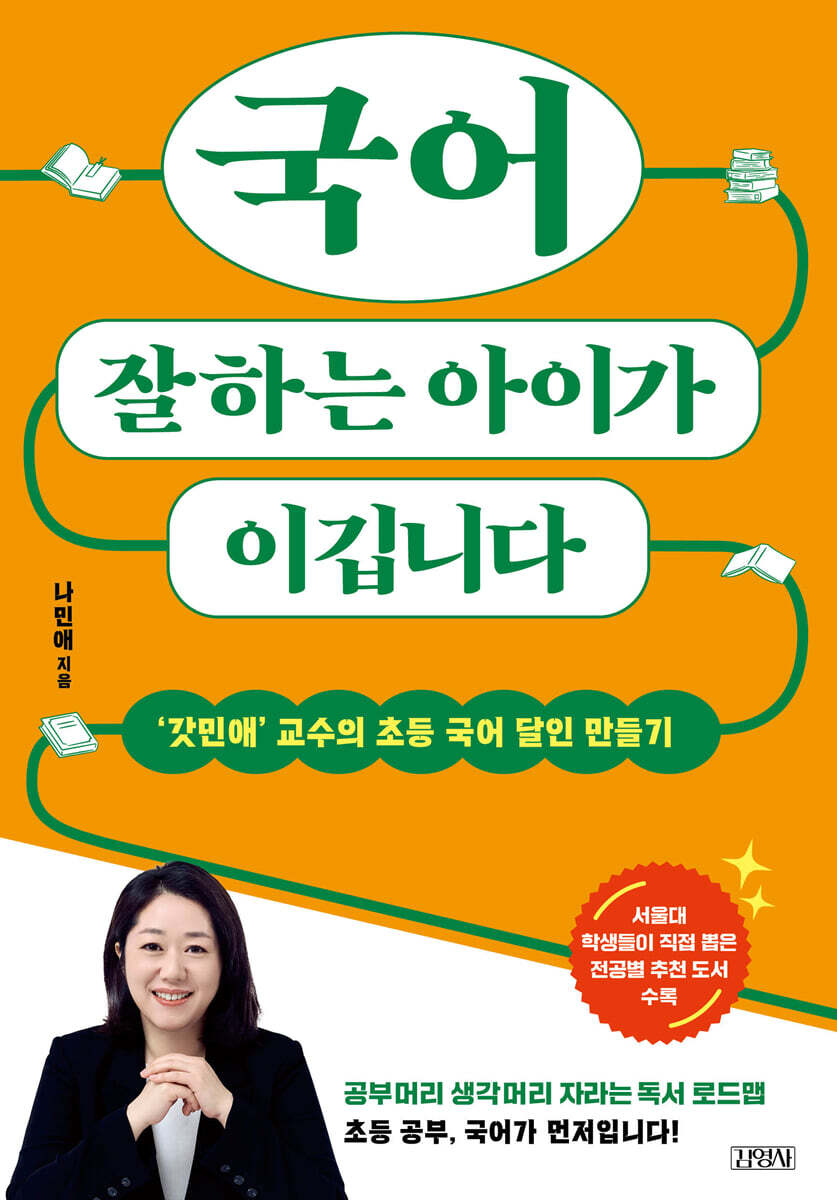
The child who is good at Korean wins.
 |
Description
Book Introduction
In elementary school, Korean comes first! Professor Na Min-ae, the most popular writing teacher at Seoul National University A 12-year Korean language mastery project from elementary school to high school Includes recommended books by major, selected directly by Seoul National University students. Elementary Korean: Where should you start? Before you rush to expensive academies or books that are considered good, let's revisit the fundamentals of reading! Professor Na Min-ae, who has been in charge of Seoul National University students' writing for 12 years, provides helpful and clear answers to parents' concerns about Korean language learning in "Children Who Are Good at Korean Win." It's packed with reading strategies to win the college entrance exam, Korean language study methods for Seoul National University students, and even guides for each school age. Let's make our children masters of the Korean language more enjoyable and easier. |
- You can preview some of the book's contents.
Preview
index
Preface┃To all parents who run with their children
Chapter 1.
What and how did Seoul National University students read?
When: I read a lot since elementary school.
Why: I read it because it's fun
How to: Read when you're bored
Don't miss out on the golden age of middle school
Read strategically in high school
Read more_Don't cross that river
Chapter 2.
Korean Language Mastery Project Starting at Home
Trends: Understand them, but don't follow them.
The fundamentals of reading are even more important in the age of artificial intelligence.
Make the most of your Korean language academy
As Chinese character education decreases, children who know Chinese characters will win.
Educational comics, should I read them or not?
Successful Reading Strategies When You Can't Read Extensively
Read More_Are E-Books and Web Novels Effective?
Chapter 3.
The Key to Mastering Korean: Building Vocabulary
Conditions for reading to improve vocabulary
Focus on invisible words, abstract words, and conceptual words
Swapping words
Using symbols and metaphors
Read more_When and how should we approach poetry?
Chapter 4.
A step-by-step Korean language roadmap from elementary to high school
Preschool: Playing with Books
Lower Elementary School: Falling in Love with Picture Books
Elementary and Middle Grades: A Crucial Moment in Reading Life
Upper Elementary School: Entering the World of Sublime Reading
Middle School Students: Reading Skills Are Determined
High School Students: A Thorough Reading Strategy is Everything
Read More_Why Reading Books is Better Than Newspaper Articles
Appendix┃Recommended Middle and High School Books Selected by Seoul National University Students
Chapter 1.
What and how did Seoul National University students read?
When: I read a lot since elementary school.
Why: I read it because it's fun
How to: Read when you're bored
Don't miss out on the golden age of middle school
Read strategically in high school
Read more_Don't cross that river
Chapter 2.
Korean Language Mastery Project Starting at Home
Trends: Understand them, but don't follow them.
The fundamentals of reading are even more important in the age of artificial intelligence.
Make the most of your Korean language academy
As Chinese character education decreases, children who know Chinese characters will win.
Educational comics, should I read them or not?
Successful Reading Strategies When You Can't Read Extensively
Read More_Are E-Books and Web Novels Effective?
Chapter 3.
The Key to Mastering Korean: Building Vocabulary
Conditions for reading to improve vocabulary
Focus on invisible words, abstract words, and conceptual words
Swapping words
Using symbols and metaphors
Read more_When and how should we approach poetry?
Chapter 4.
A step-by-step Korean language roadmap from elementary to high school
Preschool: Playing with Books
Lower Elementary School: Falling in Love with Picture Books
Elementary and Middle Grades: A Crucial Moment in Reading Life
Upper Elementary School: Entering the World of Sublime Reading
Middle School Students: Reading Skills Are Determined
High School Students: A Thorough Reading Strategy is Everything
Read More_Why Reading Books is Better Than Newspaper Articles
Appendix┃Recommended Middle and High School Books Selected by Seoul National University Students
Detailed image

Into the book
A whopping 69% of Seoul National University freshmen responded that they read a lot of books in elementary school.
The saying that reading a lot of books makes you good at studying applies to seven out of ten people.
This is precisely why, no matter how much the college entrance exam system changes, you must never let go of books, books, books.
Especially, elementary school mothers should close their ears to the 'Kardera Communication' next door, close their eyes to the changing college entrance exam system, and first pick up a book.
--- p.17
A much more important question than knowing when to go to academy is 'when to quit'.
There comes a time when you must quit school.
You shouldn't be afraid to leave the academy just because it's hard to get into it.
So when should I quit school?
--- p.79
Chinese character proficiency is essential for developing a sense for words, that is, vocabulary inference skills.
Just like mathematical operations, Chinese characters must be studied consistently, and the focus should be on their application rather than the Chinese characters themselves.
So, it is a good idea to start studying Chinese characters around the third grade of elementary school, when the number of words you need to know increases rapidly.
--- p.88
There is a way to overcome your picky reading habits.
The idea is to create a compromise stage and gradually move to a book of short stories.
You can use a 'book of lines with comic points'.
From the easy 'Bad Guys' to the slightly more difficult 'Codename' series, there are quite a few if you look for them.
Don't be obsessed with luxury.
This is when you should use funny books, adventure books, hero books, etc.
--- p.105
If your child isn't a bookworm, a balanced reading strategy will work well.
Let's check out the three essential nutrients in reading below.
1.
Are you reading a book about classical culture?
2.
Are you reading a book set in the 'grandmother's generation'?
3.
Is there a good balance between 'story books' and 'knowledge books'?
--- p.113
To increase your vocabulary in a short period of time, you need to focus on reading thin books and practice 'reading them carefully' and 'reading them multiple times.'
In particular, you need to 'read multiple times' to sufficiently learn unfamiliar words.
If you read 10 books last month but only 1 this month, your mom will get impatient.
There is absolutely no need for that.
From a child's perspective, reading one book 10 times is not much different from reading 10 books.
--- p.142
If a child has difficulty developing advanced vocabulary on his or her own, the mother should help.
It is necessary to try a kind of 'advanced vocabulary foundation' in daily life.
Rather than teaching abstract and conceptual words one by one, it is best to have children learn them through the ‘mother’s language’ that comes out of their mother’s mouth on a regular basis.
The saying that reading a lot of books makes you good at studying applies to seven out of ten people.
This is precisely why, no matter how much the college entrance exam system changes, you must never let go of books, books, books.
Especially, elementary school mothers should close their ears to the 'Kardera Communication' next door, close their eyes to the changing college entrance exam system, and first pick up a book.
--- p.17
A much more important question than knowing when to go to academy is 'when to quit'.
There comes a time when you must quit school.
You shouldn't be afraid to leave the academy just because it's hard to get into it.
So when should I quit school?
--- p.79
Chinese character proficiency is essential for developing a sense for words, that is, vocabulary inference skills.
Just like mathematical operations, Chinese characters must be studied consistently, and the focus should be on their application rather than the Chinese characters themselves.
So, it is a good idea to start studying Chinese characters around the third grade of elementary school, when the number of words you need to know increases rapidly.
--- p.88
There is a way to overcome your picky reading habits.
The idea is to create a compromise stage and gradually move to a book of short stories.
You can use a 'book of lines with comic points'.
From the easy 'Bad Guys' to the slightly more difficult 'Codename' series, there are quite a few if you look for them.
Don't be obsessed with luxury.
This is when you should use funny books, adventure books, hero books, etc.
--- p.105
If your child isn't a bookworm, a balanced reading strategy will work well.
Let's check out the three essential nutrients in reading below.
1.
Are you reading a book about classical culture?
2.
Are you reading a book set in the 'grandmother's generation'?
3.
Is there a good balance between 'story books' and 'knowledge books'?
--- p.113
To increase your vocabulary in a short period of time, you need to focus on reading thin books and practice 'reading them carefully' and 'reading them multiple times.'
In particular, you need to 'read multiple times' to sufficiently learn unfamiliar words.
If you read 10 books last month but only 1 this month, your mom will get impatient.
There is absolutely no need for that.
From a child's perspective, reading one book 10 times is not much different from reading 10 books.
--- p.142
If a child has difficulty developing advanced vocabulary on his or her own, the mother should help.
It is necessary to try a kind of 'advanced vocabulary foundation' in daily life.
Rather than teaching abstract and conceptual words one by one, it is best to have children learn them through the ‘mother’s language’ that comes out of their mother’s mouth on a regular basis.
--- p.158
Publisher's Review
In elementary school, Korean comes first!
Professor Na Min-ae, the most popular writing teacher at Seoul National University
A 12-year Korean language mastery project from elementary school to high school
“My child even ‘skips’ YouTube.”
“I only read comics and don’t read other books.”
“I can’t read Korean, let alone other subjects.”
Literacy is a problem at school, at home, and in academies.
People around me are fueling my anxiety by saying that future college entrance exams will be determined by Korean language skills and that everyone reads this much before entering elementary school.
However, Korean is a subject that requires a longer-term perspective than immediate performance assessments and entrance exams.
Korean language skills are the foundation for all subjects, and the skills accumulated in elementary school determine lifelong thinking and communication skills.
Elementary Korean: Where should you start? Before you rush to expensive academies or books that are considered good, let's revisit the fundamentals of reading! Professor Na Min-ae, better known as "God Min-ae," who has been in charge of Seoul National University students' writing for 12 years, provides helpful and clear answers to parents' concerns about Korean language learning in "Children Who Are Good at Korean Win."
As the daughter of a poet, a critic, and a professor of writing with the highest lecture evaluation, this author has read and written more than anyone else, and this is the know-how for studying Korean that she has seen, heard, and practiced while raising two children.
Based on the principle that “there is a way for every child to study Korean more enjoyably and easily,” this book is packed with reading strategies to win college entrance exams, Korean study methods of Seoul National University students, and even guides for each school age.
"Children who are good at Korean win" will provide a clear reading roadmap for parents of elementary school students who are anxious about the Korean language, which has no answers.
Studying Korean: Academy and pre-learning aren't the answer.
“Ultimately, whether it’s reading, writing, school Korean, or the CSAT, it’s best to prepare on your own.”
Professor Na Min-ae keeps a close eye on the latest educational trends.
I do not deny the necessity of academies.
However, I do not follow trends and I only send them to academies for a short time.
Korean cannot be learned in a hurry.
There is no set answer.
But you can do it without expensive books or academies.
Is that really true? "Kids Who Are Good at Korean Win" includes the results of a survey on the reading habits of Seoul National University freshmen, conducted by Professor Na Min-ae herself.
The factors that made the best students were surprisingly simple.
A child who is exposed to a lot of books reads a lot.
Although Korean language academies were not mandatory, reading was almost mandatory during elementary school.
I read books because I had a 'time of solitude' without school or play, and until middle school, I read freely without any particular strategy.
What is important to remember is that 70% of students who did not readily answer yes when asked if they studied a lot answered yes when asked if they read a lot of books in elementary school.
Reading that is faithful to the basics is what led children to prestigious universities.
Even in an age where artificial intelligence writes, Korean is still necessary, and it lasts a lifetime.
“Reading skills are important not only for high scores and college admissions, but also for lifelong reading and the reading of one’s life.”
In an era where ChatGPTs write better than humans, is it really necessary to study Korean? Yes.
You have to keep doing it, starting from a young age.
Being able to read well is a lifelong skill.
If you have a basic understanding of Korean, you can read and understand any subject matter. The comprehension and analytical skills essential for the CSAT are developed through reading, and the Korean language skills you build in elementary school will be used throughout your life, beyond the 12 years of elementary, middle, and high school.
So, parents who are quick on their feet think beyond college entrance exams, starting from elementary school.
We're already busy trying to improve our immediate grades, so why should we be preparing for what's to come years from now? I'm not suggesting we do advanced learning.
The idea is to establish and follow a consistent educational policy from elementary school.
Let's not forget.
As a child's Korean language studies continue, parents must set standards and guide their children.
And the most important thing is reading.
Let's start reading fundamentally, building up from the basics step by step, while remembering the saying, "A mother's Korean language skills are her child's Korean language skills."
"The Child Who Is Good at Korean Wins" will become a milestone that will change your child's life amidst the confusion of college entrance exams.
A child who is good at Korean can win in college entrance exams, school grades, and life.
How to study Korean now and for life
Need more detailed guidance on studying Korean? Korean language proficiency comes from a solid vocabulary.
In "Kids Who Are Good at Korean Win," we introduce conversational techniques that naturally increase vocabulary at home, symbols and metaphors that foster imagination, and vocabulary that is easy to miss but good to know.
Parents and children can improve their vocabulary levels together.
It is also packed with practical tips.
It provides clear and detailed answers to the questions that elementary school parents are most curious about, such as whether it is okay to read educational comics, whether children should study Chinese characters if they are not taught at school, what is the appropriate level of reading for my child, and whether it is okay for working parents to not have time to read with their children.
For parents who are curious about a longer-term study method, we have also included a roadmap for studying Korean at a glance in the last chapter.
Before school, books are not read to children, but rather played with like toys.
By the time they enter elementary school, they are being read picture books, and by middle school, they are tackling the mountain of "long books" of over 100 pages.
In upper elementary school, spelling is important, in middle school, speed reading is important, and in high school, careful strategic reading is everything.
As an appendix, we have included recommended middle and high school books selected by Seoul National University students to help you explore your career path.
There is a more enjoyable and easier way for every child to become a Korean language master.
"The child who is good at Korean wins" will help you find that way.
Professor Na Min-ae, the most popular writing teacher at Seoul National University
A 12-year Korean language mastery project from elementary school to high school
“My child even ‘skips’ YouTube.”
“I only read comics and don’t read other books.”
“I can’t read Korean, let alone other subjects.”
Literacy is a problem at school, at home, and in academies.
People around me are fueling my anxiety by saying that future college entrance exams will be determined by Korean language skills and that everyone reads this much before entering elementary school.
However, Korean is a subject that requires a longer-term perspective than immediate performance assessments and entrance exams.
Korean language skills are the foundation for all subjects, and the skills accumulated in elementary school determine lifelong thinking and communication skills.
Elementary Korean: Where should you start? Before you rush to expensive academies or books that are considered good, let's revisit the fundamentals of reading! Professor Na Min-ae, better known as "God Min-ae," who has been in charge of Seoul National University students' writing for 12 years, provides helpful and clear answers to parents' concerns about Korean language learning in "Children Who Are Good at Korean Win."
As the daughter of a poet, a critic, and a professor of writing with the highest lecture evaluation, this author has read and written more than anyone else, and this is the know-how for studying Korean that she has seen, heard, and practiced while raising two children.
Based on the principle that “there is a way for every child to study Korean more enjoyably and easily,” this book is packed with reading strategies to win college entrance exams, Korean study methods of Seoul National University students, and even guides for each school age.
"Children who are good at Korean win" will provide a clear reading roadmap for parents of elementary school students who are anxious about the Korean language, which has no answers.
Studying Korean: Academy and pre-learning aren't the answer.
“Ultimately, whether it’s reading, writing, school Korean, or the CSAT, it’s best to prepare on your own.”
Professor Na Min-ae keeps a close eye on the latest educational trends.
I do not deny the necessity of academies.
However, I do not follow trends and I only send them to academies for a short time.
Korean cannot be learned in a hurry.
There is no set answer.
But you can do it without expensive books or academies.
Is that really true? "Kids Who Are Good at Korean Win" includes the results of a survey on the reading habits of Seoul National University freshmen, conducted by Professor Na Min-ae herself.
The factors that made the best students were surprisingly simple.
A child who is exposed to a lot of books reads a lot.
Although Korean language academies were not mandatory, reading was almost mandatory during elementary school.
I read books because I had a 'time of solitude' without school or play, and until middle school, I read freely without any particular strategy.
What is important to remember is that 70% of students who did not readily answer yes when asked if they studied a lot answered yes when asked if they read a lot of books in elementary school.
Reading that is faithful to the basics is what led children to prestigious universities.
Even in an age where artificial intelligence writes, Korean is still necessary, and it lasts a lifetime.
“Reading skills are important not only for high scores and college admissions, but also for lifelong reading and the reading of one’s life.”
In an era where ChatGPTs write better than humans, is it really necessary to study Korean? Yes.
You have to keep doing it, starting from a young age.
Being able to read well is a lifelong skill.
If you have a basic understanding of Korean, you can read and understand any subject matter. The comprehension and analytical skills essential for the CSAT are developed through reading, and the Korean language skills you build in elementary school will be used throughout your life, beyond the 12 years of elementary, middle, and high school.
So, parents who are quick on their feet think beyond college entrance exams, starting from elementary school.
We're already busy trying to improve our immediate grades, so why should we be preparing for what's to come years from now? I'm not suggesting we do advanced learning.
The idea is to establish and follow a consistent educational policy from elementary school.
Let's not forget.
As a child's Korean language studies continue, parents must set standards and guide their children.
And the most important thing is reading.
Let's start reading fundamentally, building up from the basics step by step, while remembering the saying, "A mother's Korean language skills are her child's Korean language skills."
"The Child Who Is Good at Korean Wins" will become a milestone that will change your child's life amidst the confusion of college entrance exams.
A child who is good at Korean can win in college entrance exams, school grades, and life.
How to study Korean now and for life
Need more detailed guidance on studying Korean? Korean language proficiency comes from a solid vocabulary.
In "Kids Who Are Good at Korean Win," we introduce conversational techniques that naturally increase vocabulary at home, symbols and metaphors that foster imagination, and vocabulary that is easy to miss but good to know.
Parents and children can improve their vocabulary levels together.
It is also packed with practical tips.
It provides clear and detailed answers to the questions that elementary school parents are most curious about, such as whether it is okay to read educational comics, whether children should study Chinese characters if they are not taught at school, what is the appropriate level of reading for my child, and whether it is okay for working parents to not have time to read with their children.
For parents who are curious about a longer-term study method, we have also included a roadmap for studying Korean at a glance in the last chapter.
Before school, books are not read to children, but rather played with like toys.
By the time they enter elementary school, they are being read picture books, and by middle school, they are tackling the mountain of "long books" of over 100 pages.
In upper elementary school, spelling is important, in middle school, speed reading is important, and in high school, careful strategic reading is everything.
As an appendix, we have included recommended middle and high school books selected by Seoul National University students to help you explore your career path.
There is a more enjoyable and easier way for every child to become a Korean language master.
"The child who is good at Korean wins" will help you find that way.
GOODS SPECIFICS
- Date of issue: March 15, 2024
- Page count, weight, size: 276 pages | 432g | 150*215*15mm
- ISBN13: 9788934965404
- ISBN10: 8934965401
You may also like
카테고리
korean


korean

![GQ KOREA Mark (Monthly): December [2025]](http://librairie.coreenne.fr/cdn/shop/files/8ef265dbbfbf186523ed75ba7319009d.jpg?v=1765340328&width=3840)


