

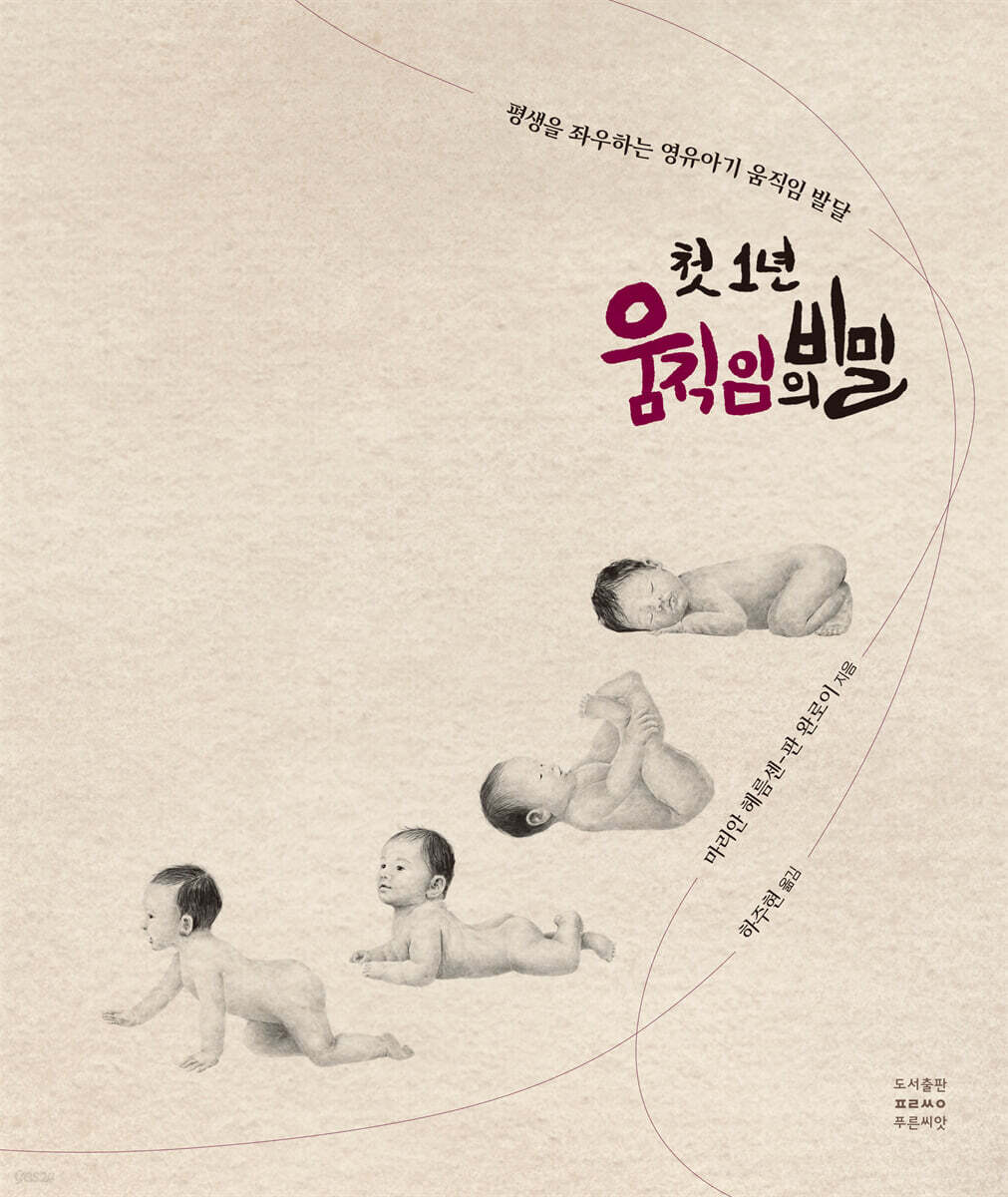
The Secret of the First Year of Movement
 |
Description
Book Introduction
Movement development in the first year of life is very important in a person's life. This book was created at the request of numerous parents and colleagues, based on the author's experience working with over 3,000 infants and toddlers over 50 years as a pediatric physical therapist. This book explains the processes through which babies grow and develop, and why it is important to help them develop motor skills properly. In particular, the postures and movements of babies are captured in photos and explained in detail and clearly to caregivers. The movements presented in this book will help children and adults who struggle with learning and movement find fundamental solutions. |
- You can preview some of the book's contents.
Preview
index
Acknowledgements
Introduction
Muscle Balance and the Four Body Types
Control of flexor and extensor muscles
Four body axes
Development of horizontal and vertical axes
Development of two diagonal axes
Baby's development and movements by stage
newborn baby
Up to 3 months after birth
Up to 3 to 6 months
6 to 9 months
9 to 18 months
Deep and joint compression massage to help develop movement
It's not okay
Walk on your butt
The original reflection remains
Revisit Baby Products
Conclusion
References
With the release of the Korean version
Introduction
Muscle Balance and the Four Body Types
Control of flexor and extensor muscles
Four body axes
Development of horizontal and vertical axes
Development of two diagonal axes
Baby's development and movements by stage
newborn baby
Up to 3 months after birth
Up to 3 to 6 months
6 to 9 months
9 to 18 months
Deep and joint compression massage to help develop movement
It's not okay
Walk on your butt
The original reflection remains
Revisit Baby Products
Conclusion
References
With the release of the Korean version
Into the book
This book explains which movements babies perform spontaneously at different stages of development and how we, as caregivers, can help them develop these movements at the appropriate stage.
Children who skip or miss out on appropriate motor development milestones are more likely to later experience problems related to those areas, such as balance issues, poor posture, and learning disabilities.
I hope this book will give people a little insight into the processes that babies go through as they grow and develop, and why it's important to help them develop motor skills appropriately and correctly.
Baby's growth
It's like the process of petals opening from a flower bud.
They bloom one by one.
We are pulling and spreading the petals prematurely as we please.
Behaviors that hinder natural growth
The flower will become distorted, losing its original beauty.
--- From the "Introductory Note"
Caregivers need to be able to distinguish whether a baby has lost muscle balance or has not yet reached that stage.
Children who pass developmental milestones with outside help, such as those who are frequently forced to sit up before they can sit up on their own, are at greater risk for developing poor muscle balance.
Muscle imbalances also tend to run in families.
If a parent or family member has muscle imbalances, their child is more likely to have the same problem.
Factors such as a history of illness or Down syndrome can also contribute to muscle imbalances.
Parents may not be able to tell if their baby's muscle control is developing properly.
Fortunately, despite parental errors, most children naturally achieve proper muscle balance.
However, if we properly understand the developmental process of babies, we can properly facilitate and support that natural process.
By following the simple and clear guidelines presented in this book, you can help your baby develop proper muscle balance.
Don't forget.
Developmental milestones aren't meant to be taught! You have to let your baby grow at his or her own pace.
--- From "Muscle Balance and the Four Axes of the Body"
As babies learn to move in a spontaneous and orderly manner, they gradually suppress their primitive reflexes.
It's the process of learning to chew before swallowing, learning to put your hands together to play with a toy, and learning to lift your feet while lying on your back.
This natural process happens naturally in normally developing babies without any special instruction.
Babies who have well-developed voluntary and natural movements are better able to control their primitive reflexes.
In other words, primitive reflexes can be well integrated into brain function.
Primitive reflexes do not disappear, but are always present beneath the surface and reappear in emergency situations, such as when exposed to heat or when the airway is blocked.
If your baby has developed smoothly, that is, has gone through all the movements in the correct sequence without skipping any steps, most of the reflexes will have been integrated by the time he or she performs the lizard crawl.
However, children who do not have sufficient fundamental motor development and thus do not properly integrate primitive reflexes are likely to have difficulties now or later in life.
--- From "The Primitive Reflection Remains"
For the brain to function properly, the baby needs to be in an upright position.
In the supine position, consciousness is not fully awakened. (The baby in the photos on pages 60 and 61 is awakened in this sense.)
Babies' brains are ready to learn) and are passive when lying half-reclined on their backs.
There is nothing you can do but lie around....The semi-reclining position is 'not at all' beneficial for infants and children of any age.
It is best to avoid it as much as possible unless absolutely necessary.
---- From "It's Not Okay"
When I wrote and published the manuscript in 2003, I never dreamed that this little book would spread so far around the world.
For over 20 years, thousands of babies and parents/caregivers have found their way to healthy parenting with the information contained in this book.
I am truly delighted and grateful to hear that this book has been translated into Korean and is now available to Korean readers.
This book was translated by someone who works with children in support classes, so I believe it will be well-used by Korean parents to help them fully understand the content and properly support their children's growth and development.
I would like to thank my colleague and close friend, Ingen Schneider, for introducing this book to the translator.
I would also like to express my gratitude to Blue Seed Publishing for their hard work in publishing this book.
Children who skip or miss out on appropriate motor development milestones are more likely to later experience problems related to those areas, such as balance issues, poor posture, and learning disabilities.
I hope this book will give people a little insight into the processes that babies go through as they grow and develop, and why it's important to help them develop motor skills appropriately and correctly.
Baby's growth
It's like the process of petals opening from a flower bud.
They bloom one by one.
We are pulling and spreading the petals prematurely as we please.
Behaviors that hinder natural growth
The flower will become distorted, losing its original beauty.
--- From the "Introductory Note"
Caregivers need to be able to distinguish whether a baby has lost muscle balance or has not yet reached that stage.
Children who pass developmental milestones with outside help, such as those who are frequently forced to sit up before they can sit up on their own, are at greater risk for developing poor muscle balance.
Muscle imbalances also tend to run in families.
If a parent or family member has muscle imbalances, their child is more likely to have the same problem.
Factors such as a history of illness or Down syndrome can also contribute to muscle imbalances.
Parents may not be able to tell if their baby's muscle control is developing properly.
Fortunately, despite parental errors, most children naturally achieve proper muscle balance.
However, if we properly understand the developmental process of babies, we can properly facilitate and support that natural process.
By following the simple and clear guidelines presented in this book, you can help your baby develop proper muscle balance.
Don't forget.
Developmental milestones aren't meant to be taught! You have to let your baby grow at his or her own pace.
--- From "Muscle Balance and the Four Axes of the Body"
As babies learn to move in a spontaneous and orderly manner, they gradually suppress their primitive reflexes.
It's the process of learning to chew before swallowing, learning to put your hands together to play with a toy, and learning to lift your feet while lying on your back.
This natural process happens naturally in normally developing babies without any special instruction.
Babies who have well-developed voluntary and natural movements are better able to control their primitive reflexes.
In other words, primitive reflexes can be well integrated into brain function.
Primitive reflexes do not disappear, but are always present beneath the surface and reappear in emergency situations, such as when exposed to heat or when the airway is blocked.
If your baby has developed smoothly, that is, has gone through all the movements in the correct sequence without skipping any steps, most of the reflexes will have been integrated by the time he or she performs the lizard crawl.
However, children who do not have sufficient fundamental motor development and thus do not properly integrate primitive reflexes are likely to have difficulties now or later in life.
--- From "The Primitive Reflection Remains"
For the brain to function properly, the baby needs to be in an upright position.
In the supine position, consciousness is not fully awakened. (The baby in the photos on pages 60 and 61 is awakened in this sense.)
Babies' brains are ready to learn) and are passive when lying half-reclined on their backs.
There is nothing you can do but lie around....The semi-reclining position is 'not at all' beneficial for infants and children of any age.
It is best to avoid it as much as possible unless absolutely necessary.
---- From "It's Not Okay"
When I wrote and published the manuscript in 2003, I never dreamed that this little book would spread so far around the world.
For over 20 years, thousands of babies and parents/caregivers have found their way to healthy parenting with the information contained in this book.
I am truly delighted and grateful to hear that this book has been translated into Korean and is now available to Korean readers.
This book was translated by someone who works with children in support classes, so I believe it will be well-used by Korean parents to help them fully understand the content and properly support their children's growth and development.
I would like to thank my colleague and close friend, Ingen Schneider, for introducing this book to the translator.
I would also like to express my gratitude to Blue Seed Publishing for their hard work in publishing this book.
--- From "On the Release of the Korean Version"
GOODS SPECIFICS
- Date of issue: January 15, 2024
- Page count, weight, size: 120 pages | 286g | 188*223*10mm
- ISBN13: 9791186202753
You may also like
카테고리
korean


korean

![GQ KOREA Mark (Monthly): December [2025]](http://librairie.coreenne.fr/cdn/shop/files/8ef265dbbfbf186523ed75ba7319009d.jpg?v=1765340328&width=3840)


