

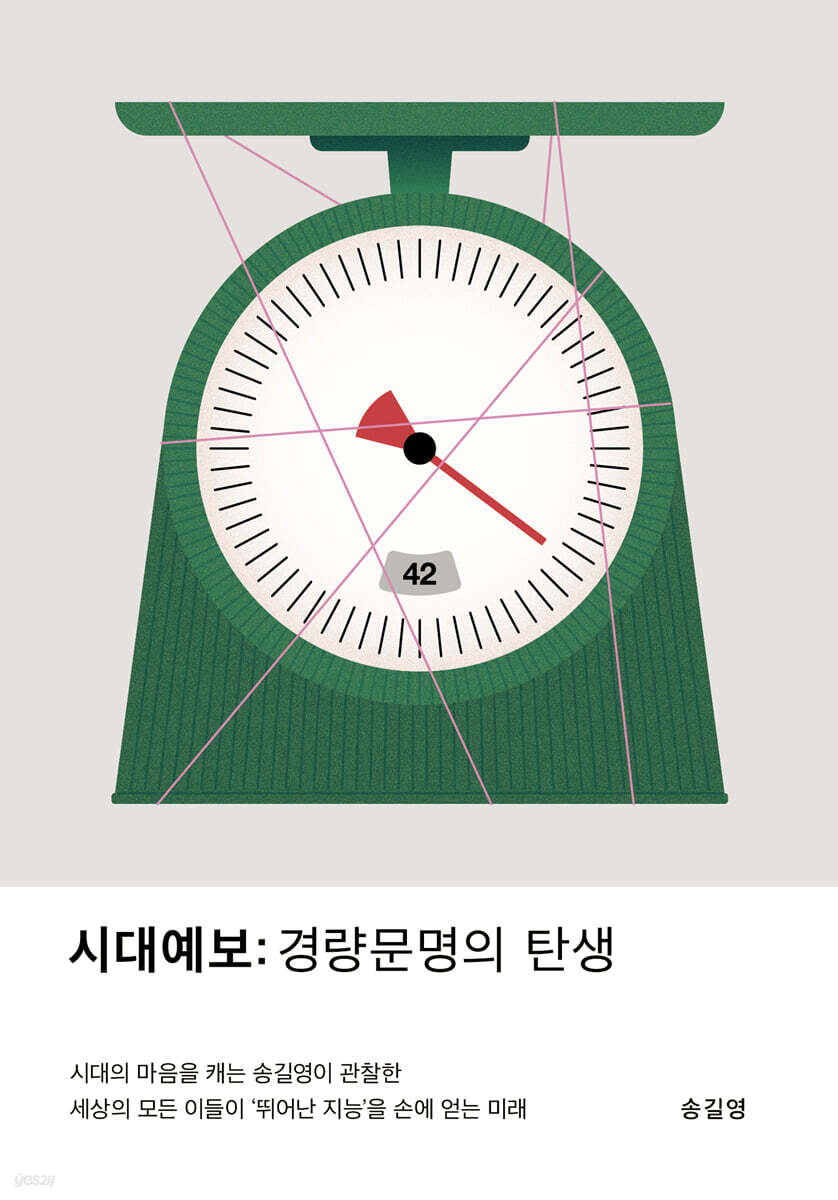
Forecast of the Times: The Birth of a Lightweight Civilization
 |
Description
Book Introduction
- A word from MD
-
We declare the birth of a 'light civilization'.Mind Minor Song Gil-young's third era forecast.
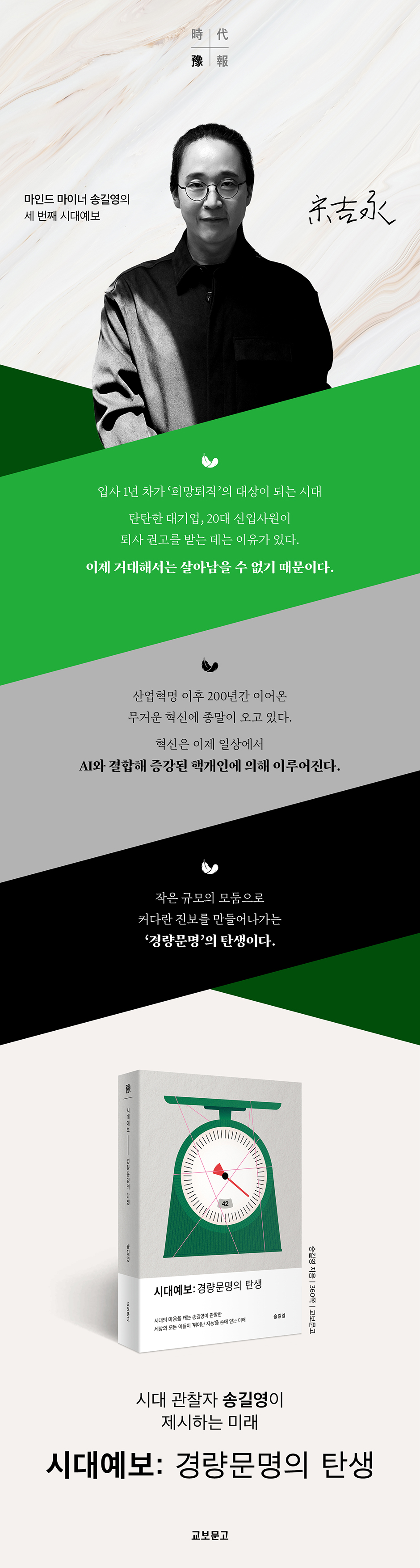
We keenly observe the lightweighting of organizations occurring throughout our society, and declare the end of the heavy civilization that has lasted for 200 years and the transition to a 'light civilization.'
Mass no longer guarantees our safety.
Now, adapting lightly and quickly is a condition for survival.
September 16, 2025. Economics and Management PD Oh Da-eun
Hugeness no longer guarantees safety.
Only organizations and individuals that are light and adapt quickly will survive.
We declare the birth of a ‘light civilization.’
One of the hot topics in our society today is ‘voluntary retirement.’
Just a few years ago, voluntary retirement was an emergency measure used by companies facing a liquidity crisis to resolve their problems in the short term.
However, in recent years, news of 'voluntary retirement' from large corporations has been heard almost every day, almost like a permanent system.
The target was also expanded from those in their 50s who have worked for more than 10 years to those in their 20s who have worked for one year.
At this point, it is not simply a matter of securing liquidity.
A massive change is taking place in our society that will alter the very meaning and structure of the organization itself.
Author Song Gil-young, who has been introducing changes in our society by focusing on individuals with innovative keywords such as “nuclear individual” and “name-calling society,” has returned with his third “Sidae Yebo.”
This time, we declare the "birth of a lightweight civilization," and introduce the changes taking place in every "organizational" unit of our society with a sharp eye and delicate expression.
Only organizations and individuals that are light and adapt quickly will survive.
We declare the birth of a ‘light civilization.’
One of the hot topics in our society today is ‘voluntary retirement.’
Just a few years ago, voluntary retirement was an emergency measure used by companies facing a liquidity crisis to resolve their problems in the short term.
However, in recent years, news of 'voluntary retirement' from large corporations has been heard almost every day, almost like a permanent system.
The target was also expanded from those in their 50s who have worked for more than 10 years to those in their 20s who have worked for one year.
At this point, it is not simply a matter of securing liquidity.
A massive change is taking place in our society that will alter the very meaning and structure of the organization itself.
Author Song Gil-young, who has been introducing changes in our society by focusing on individuals with innovative keywords such as “nuclear individual” and “name-calling society,” has returned with his third “Sidae Yebo.”
This time, we declare the "birth of a lightweight civilization," and introduce the changes taking place in every "organizational" unit of our society with a sharp eye and delicate expression.
- You can preview some of the book's contents.
Preview
index
Prologue: The Inescapable Lightness of Civilization
Chapter 1: The Emergence of Lightweight Civilization
Everyone had their own plans
The Great Demon - If you're huge, you die
Diligent intelligence and transcendent intelligence
Cluster, a vessel containing lightweight civilization
Lightening the Collaboration
Chapter 2: Aspects of Lightweight Civilization
The Rise of Agents, the Fall of Agencies
The Media Industry's Transformation: The End of Mass Media, Each Person's Fandom
Brands in the Age of Light Civilization - A Competition of Beauty and Beauty
Still, things that don't change
Chapter 3: The Law of Lightweight Organization
The Virtues of a New Leader - The Greatest Showman
The New Organizational Standard - {Human, Artificial} Intelligence
The New Role of Organizational Culture: 'Entertainment'
Betrayal of Study, Redefinition of Learning
Chapter 4: Lightweight Civilization Korea
The K of Envy - The World's Eyes on Korea
Local becomes global
New K - From Parts to Brands
Expanding K - New Koreans
Chapter 5.
The End of a Heavy World, the Beginning of a Light World
Clash of Civilizations
Things that cannot be changed, things that do not change
Delicacy, a weapon against machines
New rules for lightweight civilization
Epilogue _ To you who is about to take your first flight
source
Reference books
Chapter 1: The Emergence of Lightweight Civilization
Everyone had their own plans
The Great Demon - If you're huge, you die
Diligent intelligence and transcendent intelligence
Cluster, a vessel containing lightweight civilization
Lightening the Collaboration
Chapter 2: Aspects of Lightweight Civilization
The Rise of Agents, the Fall of Agencies
The Media Industry's Transformation: The End of Mass Media, Each Person's Fandom
Brands in the Age of Light Civilization - A Competition of Beauty and Beauty
Still, things that don't change
Chapter 3: The Law of Lightweight Organization
The Virtues of a New Leader - The Greatest Showman
The New Organizational Standard - {Human, Artificial} Intelligence
The New Role of Organizational Culture: 'Entertainment'
Betrayal of Study, Redefinition of Learning
Chapter 4: Lightweight Civilization Korea
The K of Envy - The World's Eyes on Korea
Local becomes global
New K - From Parts to Brands
Expanding K - New Koreans
Chapter 5.
The End of a Heavy World, the Beginning of a Light World
Clash of Civilizations
Things that cannot be changed, things that do not change
Delicacy, a weapon against machines
New rules for lightweight civilization
Epilogue _ To you who is about to take your first flight
source
Reference books
Detailed image
Into the book
The heavy civilization in which everyone lived together and produced in a community-centered manner is now fading away.
A new era of civilization has begun, where each individual's wisdom combines with their own artificial intelligence, and even small groups can make great progress.
Above all, the blueprints for numerous organizations that would share in the benefits of that civilization are just beginning to be drawn.
We declare the birth of a light, fast, yet profound civilization, a 'light civilization.'
---From the "Prologue"
Even if you don't have a physical network or live in a place with limited infrastructure, a lightweight civilization will arrive simultaneously for everyone with a smartphone.
A signal of hope is being sent out that everyone can embrace the opportunity together at the center of change.
The era of 'fast changers' rather than 'fast followers' has begun.
In a lightweight civilization, anyone, anywhere can become a starting point for change.
---From "Chapter 1 - The Emergence of Light Civilization"
The experiences of past eras have established 'acceleration' as a virtue in the minds of people in this society.
But humans began to feel overwhelmed by the fast pace of AI, which worked tirelessly.
Even Koreans, who go to work as the bell rings at dawn, work two jobs until late at night, and export the word "hurry, hurry" to the world, cannot keep up with this speed.
The people of this land, who have maintained their competitiveness by sleeping less and working harder than others, are now beginning to feel helpless.
---From "Chapter 2 - Aspects of Light Civilization"
A lightweight civilization is one in which a small number of members are augmented to achieve self-sufficiency.
In a light-civilized organization armed with intelligence and transparency, there can be no shadows, so we implement a system where everyone discloses and takes responsibility for their own results.
As a culture evolves where a small number of people with a sense of problem and professionalism voluntarily achieve extreme efficiency, the heavy-handed system of surveillance and management becomes no longer effective.
---From "Chapter 3 - The Law of Lightweight Organization"
K's transformation from a component-centric to a brand-centric approach required a long period of thought, a symbol placed on the product, and a unique narrative.
Now, the subject of the brand is diversifying from the state to the corporation, and from the corporation to the individual.
The biggest wave of change will come from the new collaborative methods of lightweight civilization, characterized by lighter production and closer communication.
---From "Chapter 4 - Lightweight Civilization Korea"
Lightweight isn't just a matter of weight.
It is a restructuring of the value system and a revolution in the way we relate to one another.
Above all, it is designed for sustainability.
A life of greater connection while possessing less, a life of less complexity but deeper order, and above all, an attitude of expecting less from one another and caring more for one another—this is the language of a lightweight civilization.
Man-made technology makes structures lighter, and human wisdom adds meaning.
In this way, we are moving beyond the heavy burdens of the world and toward a lighter civilization.
---From "Chapter 5 - The End of the Heavy World, the Beginning of the Light World"
Meals provided on long-haul flights are prepared based on the 'arrival time', not the departure point.
Even though it was late at night at the departure point, breakfast was served, and even though I was tired, they offered me coffee.
People on the plane are adjusting against their present senses to match the time of their destination, which has not yet arrived.
The same goes for those who will live in a lightweight civilization.
Members of the new civilization cultivate their bodies and minds not for where they stand now, but for where they will reach in the future.
The fatigue of the present is an effort to adjust one's life to the rhythm of the future.
The flight of a light civilization is not simply a matter of connecting points, but rather an adaptation to a new sense of time.
A new era of civilization has begun, where each individual's wisdom combines with their own artificial intelligence, and even small groups can make great progress.
Above all, the blueprints for numerous organizations that would share in the benefits of that civilization are just beginning to be drawn.
We declare the birth of a light, fast, yet profound civilization, a 'light civilization.'
---From the "Prologue"
Even if you don't have a physical network or live in a place with limited infrastructure, a lightweight civilization will arrive simultaneously for everyone with a smartphone.
A signal of hope is being sent out that everyone can embrace the opportunity together at the center of change.
The era of 'fast changers' rather than 'fast followers' has begun.
In a lightweight civilization, anyone, anywhere can become a starting point for change.
---From "Chapter 1 - The Emergence of Light Civilization"
The experiences of past eras have established 'acceleration' as a virtue in the minds of people in this society.
But humans began to feel overwhelmed by the fast pace of AI, which worked tirelessly.
Even Koreans, who go to work as the bell rings at dawn, work two jobs until late at night, and export the word "hurry, hurry" to the world, cannot keep up with this speed.
The people of this land, who have maintained their competitiveness by sleeping less and working harder than others, are now beginning to feel helpless.
---From "Chapter 2 - Aspects of Light Civilization"
A lightweight civilization is one in which a small number of members are augmented to achieve self-sufficiency.
In a light-civilized organization armed with intelligence and transparency, there can be no shadows, so we implement a system where everyone discloses and takes responsibility for their own results.
As a culture evolves where a small number of people with a sense of problem and professionalism voluntarily achieve extreme efficiency, the heavy-handed system of surveillance and management becomes no longer effective.
---From "Chapter 3 - The Law of Lightweight Organization"
K's transformation from a component-centric to a brand-centric approach required a long period of thought, a symbol placed on the product, and a unique narrative.
Now, the subject of the brand is diversifying from the state to the corporation, and from the corporation to the individual.
The biggest wave of change will come from the new collaborative methods of lightweight civilization, characterized by lighter production and closer communication.
---From "Chapter 4 - Lightweight Civilization Korea"
Lightweight isn't just a matter of weight.
It is a restructuring of the value system and a revolution in the way we relate to one another.
Above all, it is designed for sustainability.
A life of greater connection while possessing less, a life of less complexity but deeper order, and above all, an attitude of expecting less from one another and caring more for one another—this is the language of a lightweight civilization.
Man-made technology makes structures lighter, and human wisdom adds meaning.
In this way, we are moving beyond the heavy burdens of the world and toward a lighter civilization.
---From "Chapter 5 - The End of the Heavy World, the Beginning of the Light World"
Meals provided on long-haul flights are prepared based on the 'arrival time', not the departure point.
Even though it was late at night at the departure point, breakfast was served, and even though I was tired, they offered me coffee.
People on the plane are adjusting against their present senses to match the time of their destination, which has not yet arrived.
The same goes for those who will live in a lightweight civilization.
Members of the new civilization cultivate their bodies and minds not for where they stand now, but for where they will reach in the future.
The fatigue of the present is an effort to adjust one's life to the rhythm of the future.
The flight of a light civilization is not simply a matter of connecting points, but rather an adaptation to a new sense of time.
---From the "Epilogue"
Publisher's Review
Companies are cutting staff, but they're not outsourcing work.
The end of a heavy civilization that lasted for 200 years
Song Gil-young, a writer who captures the spirit of the times, has broadly examined the social phenomena of intellectualization and aging in his two volumes of "Sidae Yebo" and predicted changes in attitudes toward life, the decline of lifelong employment, and the emergence of lightweight organizations due to organizational minimization and fluidity.
The phenomenon of organizations shrinking and individuals growing larger is reshaping the future more rapidly and dramatically with the introduction of artificial intelligence.
There's a flood of articles claiming that the pace of technological change is beginning to outpace Moore's Law.
The accelerating pace of social change is becoming increasingly difficult to keep up with.
Since the Industrial Revolution, humanity has ushered in an era of mass production, providing an abundance of necessary goods through division of labor.
As technology developed, the specialization in the fields that handled it deepened, and as experts were deployed at each stage of development, organizations became larger and heavier.
The larger the organization, the more advantageous it was in competition.
This is the image of the heavyweight civilization that dominated our society for 200 years after the Industrial Revolution.
But heavy and massive civilizations are inevitably slow.
It's difficult to keep up with the pace of change driven by artificial intelligence.
In the new era, survival is no longer determined by economies of scale, but by the ability to respond immediately to change.
To do that, it needs to be even lighter.
The void left by the disappearance of greatness is filled by artificial intelligence with two attributes: 'diligent intelligence' and 'huge intelligence'.
With the advancement of artificial intelligence, we are entering a new era of 'light civilization.'
The society we meet now, the society we meet briefly, the society we meet again
Exploring the posture required for a light-hearted civilized person
The new keyword "light civilization" proposed by author Song Gil-young clearly defines the enormous changes in organizations and individuals that humanity will bring as it encounters artificial intelligence.
He particularly notes the paradigm shift that has transformed the way we collaborate.
These two axes of paradigm shift, ‘generalization of intelligence’ and ‘lightening of cooperation,’ become a pair that responds and amplifies each other, rapidly changing the world.
The widespread adoption of artificial intelligence will enable individuals to perform many tasks previously outsourced to external parties. These augmented individuals will work and achieve results through horizontal collaboration, where individuals can develop and achieve synergy, rather than relying on one another as subordinates.
It is a lightweight form of cooperation.
Light collaborations are characterized by the ability to quickly come together and disperse as needed.
The civilization of farming season sharing, where everyone lived together and produced communally, is now fading away.
A new era of civilization is now beginning, where each individual's wisdom combines with their own artificial intelligence, and even small groups can make great progress.
In a lightweight civilization, size no longer guarantees safety.
Artificial intelligence assists individual cores, and cooperation deepens in smaller units.
We own less, we are more connected, we depend less, and we care for each other more.
Heavy orders are dismantled, and slow organizations fall.
At this time, we must keep in mind that what determines survival is not size, but the ability to respond immediately to change.
Only those who first understand this civilization can survive in the next era.
The end of a heavy civilization that lasted for 200 years
Song Gil-young, a writer who captures the spirit of the times, has broadly examined the social phenomena of intellectualization and aging in his two volumes of "Sidae Yebo" and predicted changes in attitudes toward life, the decline of lifelong employment, and the emergence of lightweight organizations due to organizational minimization and fluidity.
The phenomenon of organizations shrinking and individuals growing larger is reshaping the future more rapidly and dramatically with the introduction of artificial intelligence.
There's a flood of articles claiming that the pace of technological change is beginning to outpace Moore's Law.
The accelerating pace of social change is becoming increasingly difficult to keep up with.
Since the Industrial Revolution, humanity has ushered in an era of mass production, providing an abundance of necessary goods through division of labor.
As technology developed, the specialization in the fields that handled it deepened, and as experts were deployed at each stage of development, organizations became larger and heavier.
The larger the organization, the more advantageous it was in competition.
This is the image of the heavyweight civilization that dominated our society for 200 years after the Industrial Revolution.
But heavy and massive civilizations are inevitably slow.
It's difficult to keep up with the pace of change driven by artificial intelligence.
In the new era, survival is no longer determined by economies of scale, but by the ability to respond immediately to change.
To do that, it needs to be even lighter.
The void left by the disappearance of greatness is filled by artificial intelligence with two attributes: 'diligent intelligence' and 'huge intelligence'.
With the advancement of artificial intelligence, we are entering a new era of 'light civilization.'
The society we meet now, the society we meet briefly, the society we meet again
Exploring the posture required for a light-hearted civilized person
The new keyword "light civilization" proposed by author Song Gil-young clearly defines the enormous changes in organizations and individuals that humanity will bring as it encounters artificial intelligence.
He particularly notes the paradigm shift that has transformed the way we collaborate.
These two axes of paradigm shift, ‘generalization of intelligence’ and ‘lightening of cooperation,’ become a pair that responds and amplifies each other, rapidly changing the world.
The widespread adoption of artificial intelligence will enable individuals to perform many tasks previously outsourced to external parties. These augmented individuals will work and achieve results through horizontal collaboration, where individuals can develop and achieve synergy, rather than relying on one another as subordinates.
It is a lightweight form of cooperation.
Light collaborations are characterized by the ability to quickly come together and disperse as needed.
The civilization of farming season sharing, where everyone lived together and produced communally, is now fading away.
A new era of civilization is now beginning, where each individual's wisdom combines with their own artificial intelligence, and even small groups can make great progress.
In a lightweight civilization, size no longer guarantees safety.
Artificial intelligence assists individual cores, and cooperation deepens in smaller units.
We own less, we are more connected, we depend less, and we care for each other more.
Heavy orders are dismantled, and slow organizations fall.
At this time, we must keep in mind that what determines survival is not size, but the ability to respond immediately to change.
Only those who first understand this civilization can survive in the next era.
GOODS SPECIFICS
- Date of issue: September 11, 2025
- Format: Hardcover book binding method guide
- Page count, weight, size: 360 pages | 448g | 130*188*25mm
- ISBN13: 9791170613114
- ISBN10: 117061311X
You may also like
카테고리
korean


korean

![ELLE 엘르 스페셜 에디션 A형 : 12월 [2025]](http://librairie.coreenne.fr/cdn/shop/files/b8e27a3de6c9538896439686c6b0e8fb.jpg?v=1766436872&width=3840)


