

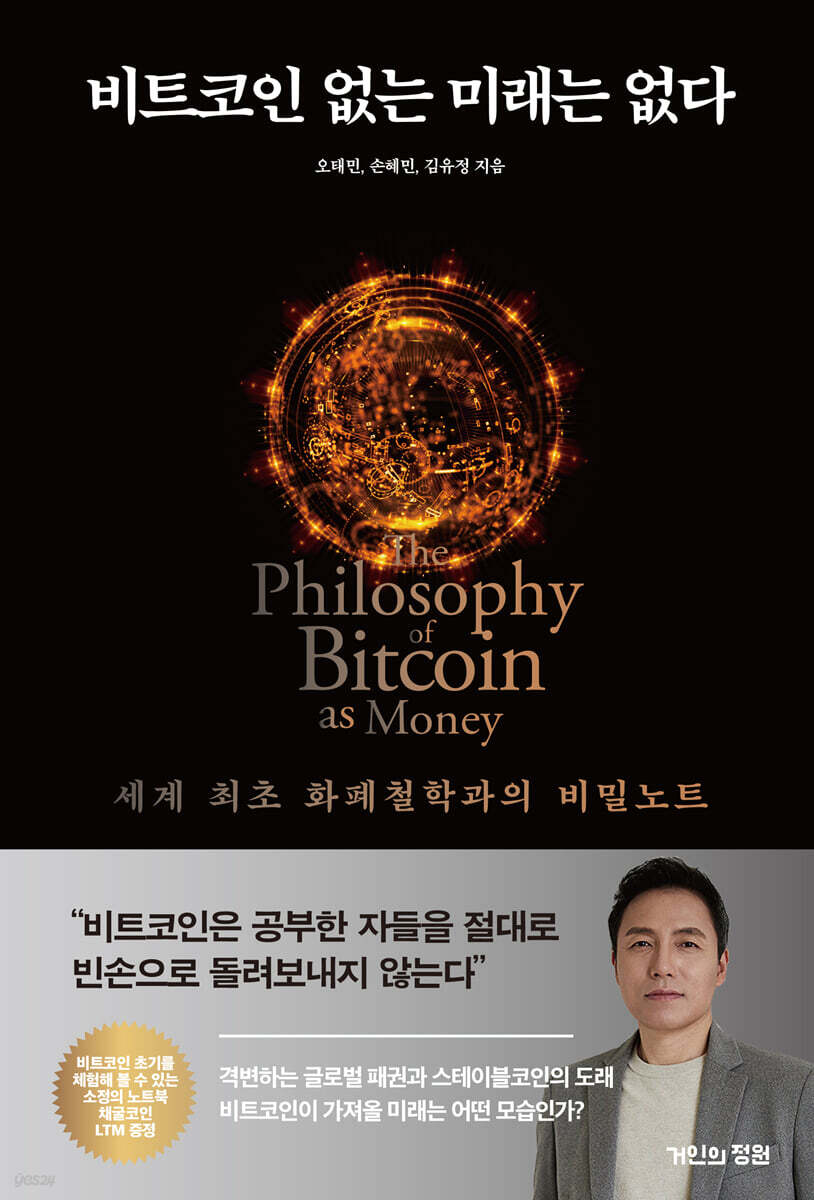
There is no future without Bitcoin.
 |
Description
Book Introduction
Bitcoin never sends those who study it away empty-handed.
The Shifting Global Hegemony and the Advent of Stablecoins
What does the future hold for Bitcoin?
Many people try to define Bitcoin simply as digital currency or blockchain technology.
However, Bitcoin cannot be simply described as a new means of payment, store of value, or technological device.
Bitcoin is a "civilizational event" that raises questions about the very nature of human society: the state and the individual, institutions and systems, cooperation and authority.
Civilization operates through an invisible order called 'trust'.
Currency is just paper, but the moment you believe it is 'money', it moves the empire.
The law is just a letter, but the moment we believe it is 'justice', it can function as violence.
The state is not a physical entity, but the moment people show reverence for it, it can become a war machine that orders murder.
At this point, Bitcoin and the emerging stablecoins are shaking the very foundations of civilization.
Can trust truly exist only within institutions and authority?
Humans have always invented a third party to guarantee trust.
They believed in the king, who was the representative of God, and in the 'structure' in which the central bank issued currency using the country as collateral.
But now that laws reproduce inequality, a financial system that conceals risk triggers financial crises, and "delegated trust" is shaken, what does Bitcoin, which exists independently of a central authority, mean to us? This book, written based on a heated debate between professors and students of the Bitcoin Philosophy of Money department at Hanyang University's College of Humanities, goes beyond Bitcoin as a new asset and explores the philosophical foundations of trust and order, leading us to a true understanding of Bitcoin.
This will provide us with a high-level insight into the new international order to come.
The Shifting Global Hegemony and the Advent of Stablecoins
What does the future hold for Bitcoin?
Many people try to define Bitcoin simply as digital currency or blockchain technology.
However, Bitcoin cannot be simply described as a new means of payment, store of value, or technological device.
Bitcoin is a "civilizational event" that raises questions about the very nature of human society: the state and the individual, institutions and systems, cooperation and authority.
Civilization operates through an invisible order called 'trust'.
Currency is just paper, but the moment you believe it is 'money', it moves the empire.
The law is just a letter, but the moment we believe it is 'justice', it can function as violence.
The state is not a physical entity, but the moment people show reverence for it, it can become a war machine that orders murder.
At this point, Bitcoin and the emerging stablecoins are shaking the very foundations of civilization.
Can trust truly exist only within institutions and authority?
Humans have always invented a third party to guarantee trust.
They believed in the king, who was the representative of God, and in the 'structure' in which the central bank issued currency using the country as collateral.
But now that laws reproduce inequality, a financial system that conceals risk triggers financial crises, and "delegated trust" is shaken, what does Bitcoin, which exists independently of a central authority, mean to us? This book, written based on a heated debate between professors and students of the Bitcoin Philosophy of Money department at Hanyang University's College of Humanities, goes beyond Bitcoin as a new asset and explores the philosophical foundations of trust and order, leading us to a true understanding of Bitcoin.
This will provide us with a high-level insight into the new international order to come.
- You can preview some of the book's contents.
Preview
index
introduction
Chapter 1.
A new norm called Bitcoin
· Definition: Bitcoin is a philosophical event.
The Limits of Justice and the Platypus | Bitcoin: The One That Disarms Justice
· Substance: What is the essence of money?
Reality Without Reality | Scarcity, Trust, and Historical Lessons from the Monetary Phenomena
· Value: To whom and under what conditions does it arise?
Gold as a Condensation of Labor Time and Productivity | Bitcoin and Marginal Cost: Labor Value Embodied in Energy | For Whom and In What Context Does Value Work?
· Norm: Norms that transcend national boundaries
Bitcoin as a Self-Generating Norm | Bitcoin is a nut
[One Step Further 1] Legal Systems That Transcend National Borders
[One Step Further 2] Dual Sovereignty
[One Step Further 3] The Humiliation at Canossa (1077)
[One Step Further 4] A Laboratory of Dual Sovereignty: The Self-Governing Order of Utah and the Mormon Community
[One Step Further 5] Stocks and Bitcoin: Asset Bubbles and Information Asymmetry
Chapter 2.
dollar
· Dollar hegemony
The Bretton Woods System | Petrodollar | The Rise of the Eurodollar Market and the Restructuring of Global Capital Flows
· The globalization of the dollar crisis
The Great Inflation and the Volcker Shock | South America's "Lost Decade" | The Plaza Accord and Japan's Bubble Economy | The Structure and Persistence of the "Externalization of the Dollar Problem"
· Geopolitical solutions to the dollar system
Détente and Goldilocks with China | The Myth of "Finance Democratization"
· 2008 financial crisis
The System's Illusion: Lehman's Collapse | The Paradox of Dollar Hegemony and the Deepening of the Asymmetric Financial Order
· China's expanding self-consciousness and challenge to order
The Rise of China, the Problem Solver, and the Shift to Nationalism | The Belt and Road Initiative and the Experiment in Financial Sovereignty | The Collapse of Civilizational Alternatives and the Prelude to a New Cold War
[One Step Further 1] Does History Repeat Itself? The Spanish Empire's Default and the Future of the United States
[One Step Further 2] The Failure of Mathematics and Human Nature: The Blind Faith in Financial Engineering and the Shadow of the Derivatives Era
[One Step Further 3] Selection Pressure and the Evolution of Human Populations
[One Step Further 4] China's Trilemma
[One Step Further 5] China's Digital Currency Strategy
Chapter 3.
US Treasury bonds that support the world
· The Pyramid of Trust and the Birth of National Bonds
The Trust Pyramid of Modern Finance | Collateral Transformation and the Evolution of Currency
· The myth of risk-free assets and the art of liquidity
The Structure of the Modern Financial System | Types of Government Bonds by Maturity | Collateralized Transactions and the Art of Liquidity: Repo | The Transition of Financial Standards: From LIBOR to SOFR | The Paradox of Trust: Promises Strengthened in a Crisis
· Structural cracks and new collateral experiments
The Double Side of Repo Trading: Leverage and the Liquidity Crisis | The Erosion of Structural Confidence in Government Bonds | A New Collateral Experiment: Bitcoin and the Potential of Decentralized Trust
[One Step Further 1] Repos are also used when purchasing a car on installment in Korea.
[One Step Further 2] Bitcoin as a Strategic Reserve Asset: A New Debt Management Scenario for the United States
Chapter 4.
The De-dollarization Movement and the US Counterattack
· Weaponization of the dollar and the financial sanctions system
The Dollar's Empowerment and Financial Sanctions | SWIFT: From Neutral Infrastructure to Geopolitical Weapon
· Paradoxical reaction and de-dollarization practices
The Spread of Dollar Risk Perception | Backlash to Sanctions: The Rise of a De-dollarization Order
· The Counterattack of the Digital Dollar Hegemony
The Technological Evolution and Global Spread of Stablecoins | Digital Dollar Strategies and the Institutionalization of Stablecoins
[One Step Further 1] SWIFT Message Security and Examples of Cross-Border Currency Messages
[One Step Further 2] The SWIFT Network and Money as Secure Messages
[One Step Further 3] The Epic of the Suffering and Glory of Tedder
[One Step Further 4] Crypto and Money Laundering: The Clash of Digital Anonymity and Regulatory Power
[One Step Further 5] Quantitative Easing, Inflation, and Stablecoins
Chapter 5.
The patchwork of the world system
The Illusion of a Single Order and the Reality of World Order 228
A World Order of Balance of Power | The Empty System: An Experiment in Order Without Hegemony
· The Philosophy of Balance and the Origins of the American Order
Redesigning America: Institutionalizing the 1945 Order | Institutionalized Hegemony: The Dual Design of Economics and Security | Conditions for Stability: Nuclear Deterrence and Interdependence
· The fatigue of a generous empire
The Rise of Europe's "No" to America | Discontent with European Free Riders and the Rise of Trump | The Coming of a World Without Empires?
[One Step Further 1] Lessons from the Euro Experiment and Dollarization
Chapter 6.
neutral currency
The paradox of reserve currencies and the failure of institutionalization
The Triffin Dilemma and the Structural Contradiction of Dollar Hegemony | The Birth of the SDR | The Limits of a Designed Neutral Currency
· The evolution of spontaneous order and post-territorial currencies
The Origins of the Eurodollar and the Financial Order of Regulatory Evasion | Shadow Currencies and "Governance Without Domination"
· Bitcoin and Stablecoins: Neutrality Created by Technology
Turning Points After the Eurodollar: Bitcoin's Technological Imagination | The Rise of the Digital Eurodollar: The Structure and Genealogy of Stablecoins | Stablecoins as Geopolitical Strategic Assets | The New Balance of Power in the Bitcoin Era
[One Step Further 1] The Fate of the Reserve Currency Nation: Solving the Triffin Dilemma with Formulas
[One Step Further 2] The Conflict Between Mercantilism and Economic Rationality
Chapter 7.
Programmable Money
· Bitcoin's Ledger Revolution: Can Technology Become Order?
The Ledger Revolution and the Transformation of Trust Structures | Technology-Enabled Norms, Trust Without Trust
· Automation of contracts and restructuring of systems
The Birth of Ethereum and Smart Contracts | The Ethereum Ecosystem as an Institution | The Challenges of Speed-Driven Blockchain 3.0
· Financial experiments that rewrite the structure of trust
Automated Contracts: Redesigning Insurance | Oracle and the Infrastructure of Trust
Multi-chain and tokenized world
Bitcoin Maximalism vs.
Multichain | Atomic Swaps: A Key Link in the Multichain Ecosystem | Tokenization of All Assets: Larry Fink's Vision | Hernando De Soto's Insights and Tokenization: Reviving 'Dead Capital' in Developing Countries | Atomic Swaps for Dollar Stablecoins: A Catalyst for a New Financial Order
· Bitcoin's Philosophy: Reorganizing Order
The Birth of Collateral Reimagined Through Technology | Bitcoin is an Ecosystem Beyond Bitcoin
[One Step Further 1] The Blockchain Trilemma and Choosing Each Blockchain
[One Step Further 2] A Philosophy of Simplicity and Stability: Why Bitcoin is Robust Despite Its 'Fragility'
References
Chapter 1.
A new norm called Bitcoin
· Definition: Bitcoin is a philosophical event.
The Limits of Justice and the Platypus | Bitcoin: The One That Disarms Justice
· Substance: What is the essence of money?
Reality Without Reality | Scarcity, Trust, and Historical Lessons from the Monetary Phenomena
· Value: To whom and under what conditions does it arise?
Gold as a Condensation of Labor Time and Productivity | Bitcoin and Marginal Cost: Labor Value Embodied in Energy | For Whom and In What Context Does Value Work?
· Norm: Norms that transcend national boundaries
Bitcoin as a Self-Generating Norm | Bitcoin is a nut
[One Step Further 1] Legal Systems That Transcend National Borders
[One Step Further 2] Dual Sovereignty
[One Step Further 3] The Humiliation at Canossa (1077)
[One Step Further 4] A Laboratory of Dual Sovereignty: The Self-Governing Order of Utah and the Mormon Community
[One Step Further 5] Stocks and Bitcoin: Asset Bubbles and Information Asymmetry
Chapter 2.
dollar
· Dollar hegemony
The Bretton Woods System | Petrodollar | The Rise of the Eurodollar Market and the Restructuring of Global Capital Flows
· The globalization of the dollar crisis
The Great Inflation and the Volcker Shock | South America's "Lost Decade" | The Plaza Accord and Japan's Bubble Economy | The Structure and Persistence of the "Externalization of the Dollar Problem"
· Geopolitical solutions to the dollar system
Détente and Goldilocks with China | The Myth of "Finance Democratization"
· 2008 financial crisis
The System's Illusion: Lehman's Collapse | The Paradox of Dollar Hegemony and the Deepening of the Asymmetric Financial Order
· China's expanding self-consciousness and challenge to order
The Rise of China, the Problem Solver, and the Shift to Nationalism | The Belt and Road Initiative and the Experiment in Financial Sovereignty | The Collapse of Civilizational Alternatives and the Prelude to a New Cold War
[One Step Further 1] Does History Repeat Itself? The Spanish Empire's Default and the Future of the United States
[One Step Further 2] The Failure of Mathematics and Human Nature: The Blind Faith in Financial Engineering and the Shadow of the Derivatives Era
[One Step Further 3] Selection Pressure and the Evolution of Human Populations
[One Step Further 4] China's Trilemma
[One Step Further 5] China's Digital Currency Strategy
Chapter 3.
US Treasury bonds that support the world
· The Pyramid of Trust and the Birth of National Bonds
The Trust Pyramid of Modern Finance | Collateral Transformation and the Evolution of Currency
· The myth of risk-free assets and the art of liquidity
The Structure of the Modern Financial System | Types of Government Bonds by Maturity | Collateralized Transactions and the Art of Liquidity: Repo | The Transition of Financial Standards: From LIBOR to SOFR | The Paradox of Trust: Promises Strengthened in a Crisis
· Structural cracks and new collateral experiments
The Double Side of Repo Trading: Leverage and the Liquidity Crisis | The Erosion of Structural Confidence in Government Bonds | A New Collateral Experiment: Bitcoin and the Potential of Decentralized Trust
[One Step Further 1] Repos are also used when purchasing a car on installment in Korea.
[One Step Further 2] Bitcoin as a Strategic Reserve Asset: A New Debt Management Scenario for the United States
Chapter 4.
The De-dollarization Movement and the US Counterattack
· Weaponization of the dollar and the financial sanctions system
The Dollar's Empowerment and Financial Sanctions | SWIFT: From Neutral Infrastructure to Geopolitical Weapon
· Paradoxical reaction and de-dollarization practices
The Spread of Dollar Risk Perception | Backlash to Sanctions: The Rise of a De-dollarization Order
· The Counterattack of the Digital Dollar Hegemony
The Technological Evolution and Global Spread of Stablecoins | Digital Dollar Strategies and the Institutionalization of Stablecoins
[One Step Further 1] SWIFT Message Security and Examples of Cross-Border Currency Messages
[One Step Further 2] The SWIFT Network and Money as Secure Messages
[One Step Further 3] The Epic of the Suffering and Glory of Tedder
[One Step Further 4] Crypto and Money Laundering: The Clash of Digital Anonymity and Regulatory Power
[One Step Further 5] Quantitative Easing, Inflation, and Stablecoins
Chapter 5.
The patchwork of the world system
The Illusion of a Single Order and the Reality of World Order 228
A World Order of Balance of Power | The Empty System: An Experiment in Order Without Hegemony
· The Philosophy of Balance and the Origins of the American Order
Redesigning America: Institutionalizing the 1945 Order | Institutionalized Hegemony: The Dual Design of Economics and Security | Conditions for Stability: Nuclear Deterrence and Interdependence
· The fatigue of a generous empire
The Rise of Europe's "No" to America | Discontent with European Free Riders and the Rise of Trump | The Coming of a World Without Empires?
[One Step Further 1] Lessons from the Euro Experiment and Dollarization
Chapter 6.
neutral currency
The paradox of reserve currencies and the failure of institutionalization
The Triffin Dilemma and the Structural Contradiction of Dollar Hegemony | The Birth of the SDR | The Limits of a Designed Neutral Currency
· The evolution of spontaneous order and post-territorial currencies
The Origins of the Eurodollar and the Financial Order of Regulatory Evasion | Shadow Currencies and "Governance Without Domination"
· Bitcoin and Stablecoins: Neutrality Created by Technology
Turning Points After the Eurodollar: Bitcoin's Technological Imagination | The Rise of the Digital Eurodollar: The Structure and Genealogy of Stablecoins | Stablecoins as Geopolitical Strategic Assets | The New Balance of Power in the Bitcoin Era
[One Step Further 1] The Fate of the Reserve Currency Nation: Solving the Triffin Dilemma with Formulas
[One Step Further 2] The Conflict Between Mercantilism and Economic Rationality
Chapter 7.
Programmable Money
· Bitcoin's Ledger Revolution: Can Technology Become Order?
The Ledger Revolution and the Transformation of Trust Structures | Technology-Enabled Norms, Trust Without Trust
· Automation of contracts and restructuring of systems
The Birth of Ethereum and Smart Contracts | The Ethereum Ecosystem as an Institution | The Challenges of Speed-Driven Blockchain 3.0
· Financial experiments that rewrite the structure of trust
Automated Contracts: Redesigning Insurance | Oracle and the Infrastructure of Trust
Multi-chain and tokenized world
Bitcoin Maximalism vs.
Multichain | Atomic Swaps: A Key Link in the Multichain Ecosystem | Tokenization of All Assets: Larry Fink's Vision | Hernando De Soto's Insights and Tokenization: Reviving 'Dead Capital' in Developing Countries | Atomic Swaps for Dollar Stablecoins: A Catalyst for a New Financial Order
· Bitcoin's Philosophy: Reorganizing Order
The Birth of Collateral Reimagined Through Technology | Bitcoin is an Ecosystem Beyond Bitcoin
[One Step Further 1] The Blockchain Trilemma and Choosing Each Blockchain
[One Step Further 2] A Philosophy of Simplicity and Stability: Why Bitcoin is Robust Despite Its 'Fragility'
References
Detailed image

Into the book
These facts demand that we broaden the horizon of our value judgments.
Bitcoin may be an imperfect or even dangerous tool from the perspective of the overall public good, but for oppressed individuals, it offers a viable means of opening up the possibility of freedom and survival.
It is not a utility granted by central power, but a practical value discovered by those who have been pushed to the periphery.
This value may not be 'legitimate', but it may be 'justifiable' enough.
At this point we are faced with an important philosophical dilemma.
When we judge value, what are the criteria? And in what spatiotemporal context are those criteria placed?
--- p.43, from “For whom and in what context does value work?”
The United States printed dollars to import Chinese products, and China, in return, invested the dollars it earned in U.S. Treasury bonds, thereby supporting the U.S. budget deficit and consumption.
This has created a mutually dependent cycle in which America's excessive consumption justifies China's excessive savings, and China's foreign exchange reserves, in turn, strengthen America's financial infrastructure.
As a result, China has become America's largest creditor, creating a strange power dynamic that underpins American consumption.
--- p.92, from “Détente and Goldilocks with China”
The 2008 financial crisis wasn't just the collapse of the real estate bubble.
It was an explosion of self-deception inherent in the structure of the dollar-based monetary system, which had expanded through credit creation.
Excessive liquidity, complex derivatives, externalized risks, and unregulated shadow banking.
All of this was intertwined in one mechanism.
This was also the moment when the structural contradiction predicted by the Triffin dilemma, namely the distortion that inevitably arises under the condition that the reserve currency country's deficit is responsible for global liquidity, was realized.
The United States ran budget deficits and debt to supply dollars to the world, and those dollars flowed into the real estate market and financial products, creating a massive credit pyramid.
As a result, a seemingly robust system collapsed in an instant due to a single breach of trust.
--- p.97, from “The Illusion Created by the System, the Collapse of Lehman Brothers”
The status of a reserve currency in the international monetary order offers clear advantages.
Having a national currency serve as the standard for international trade and financial transactions carries with it more than just symbolic advantage; it also carries real power.
Reserve currency countries enjoy three benefits: stable foreign exchange demand, low funding rates, and priority access to global financial markets.
But these privileges are never given for free.
Rather, it imposes a double challenge that entails structural tension.
This challenge of maintaining national monetary order while meeting global liquidity needs is fundamentally conflicting.
The 'Triffin Dilemma' conceptualizes this structural contradiction.
--- p.265, from “The Triffin Dilemma and the Structural Contradiction of the Dollar Hegemony”
In particular, the dollar stablecoin, like the Eurodollar, is based on the dollar but operates outside the United States.
Many stablecoin issuers operate in jurisdictions outside the United States, and while they are backed by U.S. Treasury securities or bank deposits, their legal responsibilities are decentralized.
Like the Eurodollar, this provides a structure that expands the international standing of the US dollar while also expanding the scope of the dollar system without the burden of monetary sovereignty.
The dollar stablecoin is itself a digital Eurodollar, a new form of shadow currency that reinforces the US-centric order without being issued by the United States.
Bitcoin may be an imperfect or even dangerous tool from the perspective of the overall public good, but for oppressed individuals, it offers a viable means of opening up the possibility of freedom and survival.
It is not a utility granted by central power, but a practical value discovered by those who have been pushed to the periphery.
This value may not be 'legitimate', but it may be 'justifiable' enough.
At this point we are faced with an important philosophical dilemma.
When we judge value, what are the criteria? And in what spatiotemporal context are those criteria placed?
--- p.43, from “For whom and in what context does value work?”
The United States printed dollars to import Chinese products, and China, in return, invested the dollars it earned in U.S. Treasury bonds, thereby supporting the U.S. budget deficit and consumption.
This has created a mutually dependent cycle in which America's excessive consumption justifies China's excessive savings, and China's foreign exchange reserves, in turn, strengthen America's financial infrastructure.
As a result, China has become America's largest creditor, creating a strange power dynamic that underpins American consumption.
--- p.92, from “Détente and Goldilocks with China”
The 2008 financial crisis wasn't just the collapse of the real estate bubble.
It was an explosion of self-deception inherent in the structure of the dollar-based monetary system, which had expanded through credit creation.
Excessive liquidity, complex derivatives, externalized risks, and unregulated shadow banking.
All of this was intertwined in one mechanism.
This was also the moment when the structural contradiction predicted by the Triffin dilemma, namely the distortion that inevitably arises under the condition that the reserve currency country's deficit is responsible for global liquidity, was realized.
The United States ran budget deficits and debt to supply dollars to the world, and those dollars flowed into the real estate market and financial products, creating a massive credit pyramid.
As a result, a seemingly robust system collapsed in an instant due to a single breach of trust.
--- p.97, from “The Illusion Created by the System, the Collapse of Lehman Brothers”
The status of a reserve currency in the international monetary order offers clear advantages.
Having a national currency serve as the standard for international trade and financial transactions carries with it more than just symbolic advantage; it also carries real power.
Reserve currency countries enjoy three benefits: stable foreign exchange demand, low funding rates, and priority access to global financial markets.
But these privileges are never given for free.
Rather, it imposes a double challenge that entails structural tension.
This challenge of maintaining national monetary order while meeting global liquidity needs is fundamentally conflicting.
The 'Triffin Dilemma' conceptualizes this structural contradiction.
--- p.265, from “The Triffin Dilemma and the Structural Contradiction of the Dollar Hegemony”
In particular, the dollar stablecoin, like the Eurodollar, is based on the dollar but operates outside the United States.
Many stablecoin issuers operate in jurisdictions outside the United States, and while they are backed by U.S. Treasury securities or bank deposits, their legal responsibilities are decentralized.
Like the Eurodollar, this provides a structure that expands the international standing of the US dollar while also expanding the scope of the dollar system without the burden of monetary sovereignty.
The dollar stablecoin is itself a digital Eurodollar, a new form of shadow currency that reinforces the US-centric order without being issued by the United States.
--- p.284, from “The Rise of the Digital Eurodollar: The Structure and Genealogy of Stablecoins”
Publisher's Review
Will Bitcoin Become the New Standard for International Order?
The essence of civilization: state and individual, institution and system, cooperation and authority
Bitcoin viewed through the lens of the history of the financial system and international order!
Bitcoin, a currency that builds trust in a new way
The essence of money is not a physical thing.
A 'ledger' is reliable information that can be recorded, guaranteed, and maintained in a state that allows for exchange.
Anything from shells to banknotes to digital information can function as currency if society recognizes it as a medium of exchange.
In other words, money is a 'symbolic entity' based on social trust.
Bitcoin is the most extreme example of this.
Unlike gold, Bitcoin lacks physical collateral and is not dependent on a governmental authority, but it builds trust through its decentralized technology and consensus mechanism, allowing it to function as a medium of exchange.
The question we must consider here is: Can Bitcoin truly establish itself as a new international order?
The reason we must ask such ultimate questions is because the questions Bitcoin poses to us are not simple.
Bitcoin has proven that spontaneous order can emerge outside of the state.
Bitcoin asks:
"What kind of structure do we believe in and live by, and by whom, when, and in what way was that belief given?" This question ultimately leads to the question of the essence of civilization: "Why did humans create nations and why do we live according to law?"
By understanding Bitcoin through the lens of its history—understanding nations, individuals, institutions, and systems—and the way they operate, we can more clearly see how Bitcoin will reshape the world.
This is why we need to explore Bitcoin not simply as a new asset, but from a humanistic perspective.
This book guides readers into the essence of Bitcoin by examining how the essence of currency and civilization is realized in reality, drawing on actual history.
The crisis of the US and the dollar that supported global finance
If the financial system is built on trust, and Bitcoin is a currency built on trust established outside of the state, then by understanding the structure that has sustained global finance to date, we can more clearly predict the future.
This book illuminates the history of the United States' hegemony through the dollar and traces the "trust structure" upon which the global economy has been sustained to this day.
Today, U.S. Treasury bonds are a core structure that underpins the modern financial system.
Banks, insurance companies, pension funds, and even central banks around the world use U.S. Treasury bonds as collateral assets, offering liquidity, safety, and stability.
We examine the collapse and repercussions of the Bretton Woods system, which pegged the price of gold to the dollar, and the implications of the petrodollar system, which effectively used oil as physical collateral by forcing oil to be traded exclusively in dollars.
It also examines the bizarre international order in which the United States issued dollars to import Chinese products, and China invested the dollars earned in return in U.S. Treasury bonds, thereby making China the largest creditor to the United States and supporting American consumption.
Furthermore, it traces the changes in the global economy following the 2008 financial crisis, when the deficits of key currency countries became responsible for global liquidity.
By examining a series of historical events, readers will gain insight into how the modern financial system operates and what role Bitcoin will play in the global economy.
Digital Dollar Hegemony: Stablecoins Will Become a New Testing Ground
Today, the dollar is perceived as a "political currency" whose value fluctuates depending on U.S. policy.
Emerging economies seeking asset diversification, neutral countries pursuing neutral diplomacy, and even multinational corporations and financial institutions are gradually developing strategies to reduce their dependence on the dollar.
In that respect, the US's aggressive stance on Bitcoin and stablecoins seems ironic.
In a digital world that strives for decentralization, the paradoxical fact that the majority of stablecoins are dollar-backed hints at the United States' puzzling behavior.
Stablecoins are a new "testing ground for order" that addresses needs not met by the current financial system.
Stablecoins function as "central-less money" in places where institutional structures are unstable or nonexistent, where currency values can plummet, and where global remittance costs are excessively high.
It is at this very point that the United States is attempting to adopt a new hegemonic strategy called digital dollarization by embracing and institutionalizing this trend.
These movements go beyond simple technology adoption or regulatory overhaul.
It can be seen as part of the competition over future global currency hegemony.
Will the United States, still holding the dollar and positioned as the hegemon, be able to maintain this status in the future? What impact will Bitcoin, which emerged by poking holes in the existing system's instability, have on the global economy? This book will provide answers to countless questions in this rapidly changing era.
The essence of civilization: state and individual, institution and system, cooperation and authority
Bitcoin viewed through the lens of the history of the financial system and international order!
Bitcoin, a currency that builds trust in a new way
The essence of money is not a physical thing.
A 'ledger' is reliable information that can be recorded, guaranteed, and maintained in a state that allows for exchange.
Anything from shells to banknotes to digital information can function as currency if society recognizes it as a medium of exchange.
In other words, money is a 'symbolic entity' based on social trust.
Bitcoin is the most extreme example of this.
Unlike gold, Bitcoin lacks physical collateral and is not dependent on a governmental authority, but it builds trust through its decentralized technology and consensus mechanism, allowing it to function as a medium of exchange.
The question we must consider here is: Can Bitcoin truly establish itself as a new international order?
The reason we must ask such ultimate questions is because the questions Bitcoin poses to us are not simple.
Bitcoin has proven that spontaneous order can emerge outside of the state.
Bitcoin asks:
"What kind of structure do we believe in and live by, and by whom, when, and in what way was that belief given?" This question ultimately leads to the question of the essence of civilization: "Why did humans create nations and why do we live according to law?"
By understanding Bitcoin through the lens of its history—understanding nations, individuals, institutions, and systems—and the way they operate, we can more clearly see how Bitcoin will reshape the world.
This is why we need to explore Bitcoin not simply as a new asset, but from a humanistic perspective.
This book guides readers into the essence of Bitcoin by examining how the essence of currency and civilization is realized in reality, drawing on actual history.
The crisis of the US and the dollar that supported global finance
If the financial system is built on trust, and Bitcoin is a currency built on trust established outside of the state, then by understanding the structure that has sustained global finance to date, we can more clearly predict the future.
This book illuminates the history of the United States' hegemony through the dollar and traces the "trust structure" upon which the global economy has been sustained to this day.
Today, U.S. Treasury bonds are a core structure that underpins the modern financial system.
Banks, insurance companies, pension funds, and even central banks around the world use U.S. Treasury bonds as collateral assets, offering liquidity, safety, and stability.
We examine the collapse and repercussions of the Bretton Woods system, which pegged the price of gold to the dollar, and the implications of the petrodollar system, which effectively used oil as physical collateral by forcing oil to be traded exclusively in dollars.
It also examines the bizarre international order in which the United States issued dollars to import Chinese products, and China invested the dollars earned in return in U.S. Treasury bonds, thereby making China the largest creditor to the United States and supporting American consumption.
Furthermore, it traces the changes in the global economy following the 2008 financial crisis, when the deficits of key currency countries became responsible for global liquidity.
By examining a series of historical events, readers will gain insight into how the modern financial system operates and what role Bitcoin will play in the global economy.
Digital Dollar Hegemony: Stablecoins Will Become a New Testing Ground
Today, the dollar is perceived as a "political currency" whose value fluctuates depending on U.S. policy.
Emerging economies seeking asset diversification, neutral countries pursuing neutral diplomacy, and even multinational corporations and financial institutions are gradually developing strategies to reduce their dependence on the dollar.
In that respect, the US's aggressive stance on Bitcoin and stablecoins seems ironic.
In a digital world that strives for decentralization, the paradoxical fact that the majority of stablecoins are dollar-backed hints at the United States' puzzling behavior.
Stablecoins are a new "testing ground for order" that addresses needs not met by the current financial system.
Stablecoins function as "central-less money" in places where institutional structures are unstable or nonexistent, where currency values can plummet, and where global remittance costs are excessively high.
It is at this very point that the United States is attempting to adopt a new hegemonic strategy called digital dollarization by embracing and institutionalizing this trend.
These movements go beyond simple technology adoption or regulatory overhaul.
It can be seen as part of the competition over future global currency hegemony.
Will the United States, still holding the dollar and positioned as the hegemon, be able to maintain this status in the future? What impact will Bitcoin, which emerged by poking holes in the existing system's instability, have on the global economy? This book will provide answers to countless questions in this rapidly changing era.
GOODS SPECIFICS
- Date of issue: September 19, 2025
- Page count, weight, size: 368 pages | 664g | 152*225*23mm
- ISBN13: 9791193869338
- ISBN10: 1193869331
You may also like
카테고리
korean


korean

![ELLE 엘르 스페셜 에디션 A형 : 12월 [2025]](http://librairie.coreenne.fr/cdn/shop/files/b8e27a3de6c9538896439686c6b0e8fb.jpg?v=1766436872&width=3840)


