

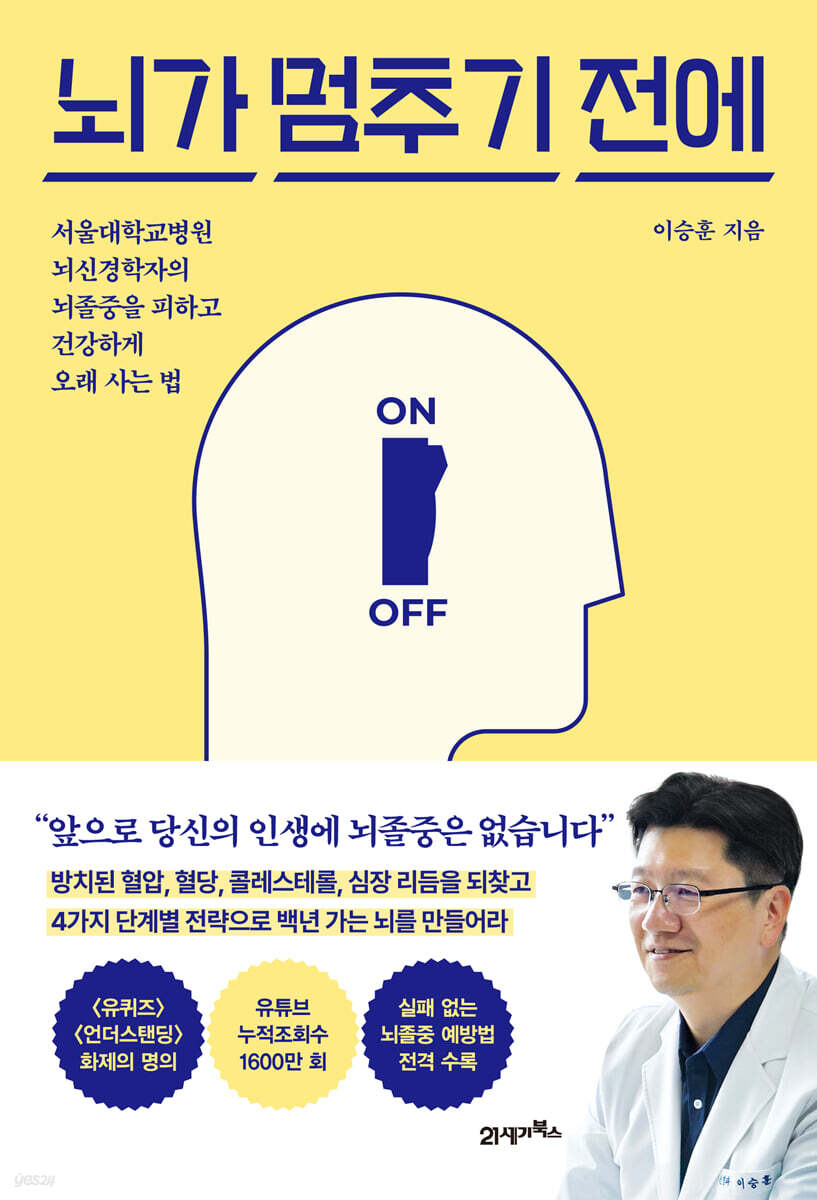
Before my brain stops
 |
Description
Book Introduction
“No more strokes in your life.”
Escape from the accumulation of bad lifestyle habits and neglect of chronic diseases
Professor Lee Seung-hoon of Seoul National University Hospital, the 'national brain health doctor'
The most reliable brain health practice
Have you recently experienced extreme stress or overwork? If you have any of the risk factors for brain health, recent stress or overwork may have triggered a brain attack that caused your brain to shut down.
People in their 30s and 40s who don't usually pay much attention to their health, people over 50 who are already halfway through their lives and need to build up health capital, people who have been diagnosed with high blood pressure or diabetes but are putting off treatment, people who drink and smoke frequently, people who are caught in a vicious cycle of late-night snacking and obesity, and people with a family history of cardiovascular disease or stroke should definitely pay attention to the new book, "Before the Brain Stops" by Professor Seung-Hoon Lee of the Department of Neurology at Seoul National University Hospital.
Because with just the "very little effort" suggested in this book, anyone can learn how to prevent stroke for life and maintain brain health before it's too late.
Professor Seung-Hoon Lee, a stroke specialist who appeared on tvN's "You Quiz on the Block" and became a hot topic as the "person you most want to meet," has been researching neurological diseases, especially stroke, for decades and has treated thousands of stroke patients in his clinic.
He says he has always wondered, “Why is it so common when it is such an easily preventable disease?”
Why do over 100,000 people suffer a stroke every year, one every 12 minutes? How can we maintain brain health and live long, healthy lives? Professor Seung-Hoon Lee, a "national brain health doctor" who has cared for stroke patients for 30 years, is heartbroken by the reality that a single stroke can derail an entire life. He has written this book, incorporating his clinical experience and research findings into a book that's as accessible as possible.
This book contains the author's sincere desire to eliminate strokes from our lives forever, along with a comprehensive "Stroke Prevention Method" that everyone can apply to themselves without fail.
This book, which will free us from the vague fear of stroke, is not just a simple medical guide.
Before your brain stops, this is the most reliable guide to not stopping living.
Escape from the accumulation of bad lifestyle habits and neglect of chronic diseases
Professor Lee Seung-hoon of Seoul National University Hospital, the 'national brain health doctor'
The most reliable brain health practice
Have you recently experienced extreme stress or overwork? If you have any of the risk factors for brain health, recent stress or overwork may have triggered a brain attack that caused your brain to shut down.
People in their 30s and 40s who don't usually pay much attention to their health, people over 50 who are already halfway through their lives and need to build up health capital, people who have been diagnosed with high blood pressure or diabetes but are putting off treatment, people who drink and smoke frequently, people who are caught in a vicious cycle of late-night snacking and obesity, and people with a family history of cardiovascular disease or stroke should definitely pay attention to the new book, "Before the Brain Stops" by Professor Seung-Hoon Lee of the Department of Neurology at Seoul National University Hospital.
Because with just the "very little effort" suggested in this book, anyone can learn how to prevent stroke for life and maintain brain health before it's too late.
Professor Seung-Hoon Lee, a stroke specialist who appeared on tvN's "You Quiz on the Block" and became a hot topic as the "person you most want to meet," has been researching neurological diseases, especially stroke, for decades and has treated thousands of stroke patients in his clinic.
He says he has always wondered, “Why is it so common when it is such an easily preventable disease?”
Why do over 100,000 people suffer a stroke every year, one every 12 minutes? How can we maintain brain health and live long, healthy lives? Professor Seung-Hoon Lee, a "national brain health doctor" who has cared for stroke patients for 30 years, is heartbroken by the reality that a single stroke can derail an entire life. He has written this book, incorporating his clinical experience and research findings into a book that's as accessible as possible.
This book contains the author's sincere desire to eliminate strokes from our lives forever, along with a comprehensive "Stroke Prevention Method" that everyone can apply to themselves without fail.
This book, which will free us from the vague fear of stroke, is not just a simple medical guide.
Before your brain stops, this is the most reliable guide to not stopping living.
- You can preview some of the book's contents.
Preview
index
As we go into it, we have a completely wrong understanding of stroke.
Chapter 1: One day, the brain suddenly attacks.
- Misconceptions and truths about stroke
One person suffers a stroke every 12 minutes.
It's very deadly, but prevention is simple.
You should study your brain at least once in your life.
Understanding the Brain: What Makes Us Human
Understanding the Brain's Blood Vessels: What Makes Your Brain Stop
Not all strokes are the same
Cerebral infarction: A disease caused by blood not flowing to the place where it should flow.
Cerebral hemorrhage: A disease caused by blood flowing to a place where it should not flow.
*Key Summary & Practice Guidelines*
Chapter 2: Stroke is a lifestyle disease and complication.
- Five major risk factors and chronic diseases
Hypertension: The Most Secretive and Common Habit That Destroys Your Brain
Diabetes: Beware the Poison Hidden Behind Sweetness
Hyperlipidemia: Fatty blood blocks the path to the brain.
Smoking: A Bad Habit That Burns Brain Blood Vessels
Drinking: A glass of comfort numbs the brain
Obesity and Metabolic Syndrome: Visceral Fat, a Time Bomb
Atrial Fibrillation: The Deadly Risk of Heart Irregularities
*Key Summary & Practice Guidelines*
Chapter 3: Stroke is arguably the most preventable disease.
- Stroke prevention practices by stage of occurrence
Stage and situation models of stroke onset
Stage 0: Not safe even if you have no symptoms
*Key Summary & Practice Guidelines*
Step 1: High blood pressure and diabetes are warning signs.
*Key Summary & Practice Guidelines*
Stage 2: The Silent Destroyer, Atherosclerosis Begins
*Key Summary & Practice Guidelines*
Step 3: If it has already occurred, prevent it from happening again.
Chapter 4: Time Decides the Fate of the Brain
Between Recovery and Relapse: A Survival Manual
Symptoms: Read the signals your brain sends.
Diagnosis: Understanding the Reality of the War in the Brain
Treatment: Waking Up Isn't the End
Rehabilitation: Time to Reconnect with Your Brain
Preventing Relapse: The Second Time is More Deadly
*Key Summary & Practice Guidelines*
As you go, there will be no more strokes in your life.
Chapter 1: One day, the brain suddenly attacks.
- Misconceptions and truths about stroke
One person suffers a stroke every 12 minutes.
It's very deadly, but prevention is simple.
You should study your brain at least once in your life.
Understanding the Brain: What Makes Us Human
Understanding the Brain's Blood Vessels: What Makes Your Brain Stop
Not all strokes are the same
Cerebral infarction: A disease caused by blood not flowing to the place where it should flow.
Cerebral hemorrhage: A disease caused by blood flowing to a place where it should not flow.
*Key Summary & Practice Guidelines*
Chapter 2: Stroke is a lifestyle disease and complication.
- Five major risk factors and chronic diseases
Hypertension: The Most Secretive and Common Habit That Destroys Your Brain
Diabetes: Beware the Poison Hidden Behind Sweetness
Hyperlipidemia: Fatty blood blocks the path to the brain.
Smoking: A Bad Habit That Burns Brain Blood Vessels
Drinking: A glass of comfort numbs the brain
Obesity and Metabolic Syndrome: Visceral Fat, a Time Bomb
Atrial Fibrillation: The Deadly Risk of Heart Irregularities
*Key Summary & Practice Guidelines*
Chapter 3: Stroke is arguably the most preventable disease.
- Stroke prevention practices by stage of occurrence
Stage and situation models of stroke onset
Stage 0: Not safe even if you have no symptoms
*Key Summary & Practice Guidelines*
Step 1: High blood pressure and diabetes are warning signs.
*Key Summary & Practice Guidelines*
Stage 2: The Silent Destroyer, Atherosclerosis Begins
*Key Summary & Practice Guidelines*
Step 3: If it has already occurred, prevent it from happening again.
Chapter 4: Time Decides the Fate of the Brain
Between Recovery and Relapse: A Survival Manual
Symptoms: Read the signals your brain sends.
Diagnosis: Understanding the Reality of the War in the Brain
Treatment: Waking Up Isn't the End
Rehabilitation: Time to Reconnect with Your Brain
Preventing Relapse: The Second Time is More Deadly
*Key Summary & Practice Guidelines*
As you go, there will be no more strokes in your life.
Detailed image

Into the book
Stroke is a representative disease that has caused numerous deaths and disabilities worldwide since ancient times, resulting in enormous costs for families and society.
From the perspective of the general public, it is not uncommon to witness an adult in the family suddenly collapse, so it is understandable to be extremely afraid of this disease.
But as a stroke expert, I can confidently say that few diseases are as easily preventable as this one.
--- p.5, from “Introduction | We are completely wrong about stroke”
When a patient is brought to the emergency room and a stroke is suspected, the stroke 'emergency process' is usually activated.
This refers to the regulations for the treatment process that prioritizes the resources and manpower of the emergency room for the initial diagnosis and treatment of stroke patients.
This process is basically commonly applied in almost all developed countries and domestic stroke centers.
The reason this process is commonly implemented around the world is because stroke is a disease that acutely attacks the brain, and 'time is brain.'
--- pp.49-50, from "Chapter 1 | Suddenly Attacking the Brain One Day"
Diabetes, which is mentioned as a risk factor for stroke, mostly refers to type 2 diabetes.
A particular problem with type 2 diabetes is that, like high blood pressure, it is often asymptomatic in its early stages.
Many patients are often diagnosed with diabetes only after they have developed complications, making early detection and management more challenging.
The number of diabetes patients is steadily increasing worldwide, and the rate of increase in our country is even more serious.
Diabetes, along with high blood pressure, are two major chronic diseases that impose a huge burden not only on individual health but also on social costs.
--- p.101, from “Chapter 2 | Stroke is a lifestyle disease and complication”
Recently, the incidence of stroke among young people under the age of 40 to 45 has been increasing compared to the past.
What's even more surprising is that these are not special cases with a genetic predisposition.
A significant number of these are typical strokes caused by arteriosclerosis.
While the average age of stroke in the elderly was 65 in the past, the age of onset is gradually decreasing to around 73, what does it mean that typical atherosclerosis is increasing in younger stroke cases? The only explanation is that it's a result of the worsening of lifestyle habits in people in their 20s and 40s, such as excessive drinking, smoking, obesity, and lack of exercise.
Therefore, you should not be overly reassured just because you are under 50 years old.
--- p.171, from “Chapter 3 | Stroke is arguably the easiest disease to prevent”
The term "mini-stroke" is sometimes used to describe the precursor symptoms of a stroke, but this is not an accurate academic term.
The correct scientific term for aura is 'transient ischemic attack', but since the name is complicated, it is better to use it as aura.
A warning sign of a stroke occurs when a stroke begins with a blockage caused by a blood clot, but luckily the clot breaks up or dissolves, allowing blood flow to improve.
In other words, since it is a symptom that occurred after a stroke and then resolved, it cannot be different from the symptoms of a stroke.
Common warning signs include paralysis of the limbs, speech/language disorders, visual impairment, and balance disorders, as mentioned above.
However, if these symptoms improve within 30 minutes, it is called a warning symptom rather than a stroke.
The scientific definition of a transient ischemic attack is one that recovers within 24 hours, but it usually doesn't last longer than 30 to 60 minutes.
--- pp.221-222, from “Chapter 4 | Time Decides the Fate of the Brain”
This book has tried to strip away as much academic knowledge as possible and provide easy-to-understand basic tips for stroke prevention.
Of course, there are some parts that are difficult for the general public to understand, such as mechanisms of action and proteins, but I hope you understand that this is because I really hate mentioning knowledge without basis, and it is to differentiate it from other health books.
In this book, I introduce my knowledge and views on the health and happiness of each and every one of us, especially on the prevention and treatment of stroke.
Stroke is a disease that is largely preventable and, if it does occur, is largely treatable.
From the perspective of the general public, it is not uncommon to witness an adult in the family suddenly collapse, so it is understandable to be extremely afraid of this disease.
But as a stroke expert, I can confidently say that few diseases are as easily preventable as this one.
--- p.5, from “Introduction | We are completely wrong about stroke”
When a patient is brought to the emergency room and a stroke is suspected, the stroke 'emergency process' is usually activated.
This refers to the regulations for the treatment process that prioritizes the resources and manpower of the emergency room for the initial diagnosis and treatment of stroke patients.
This process is basically commonly applied in almost all developed countries and domestic stroke centers.
The reason this process is commonly implemented around the world is because stroke is a disease that acutely attacks the brain, and 'time is brain.'
--- pp.49-50, from "Chapter 1 | Suddenly Attacking the Brain One Day"
Diabetes, which is mentioned as a risk factor for stroke, mostly refers to type 2 diabetes.
A particular problem with type 2 diabetes is that, like high blood pressure, it is often asymptomatic in its early stages.
Many patients are often diagnosed with diabetes only after they have developed complications, making early detection and management more challenging.
The number of diabetes patients is steadily increasing worldwide, and the rate of increase in our country is even more serious.
Diabetes, along with high blood pressure, are two major chronic diseases that impose a huge burden not only on individual health but also on social costs.
--- p.101, from “Chapter 2 | Stroke is a lifestyle disease and complication”
Recently, the incidence of stroke among young people under the age of 40 to 45 has been increasing compared to the past.
What's even more surprising is that these are not special cases with a genetic predisposition.
A significant number of these are typical strokes caused by arteriosclerosis.
While the average age of stroke in the elderly was 65 in the past, the age of onset is gradually decreasing to around 73, what does it mean that typical atherosclerosis is increasing in younger stroke cases? The only explanation is that it's a result of the worsening of lifestyle habits in people in their 20s and 40s, such as excessive drinking, smoking, obesity, and lack of exercise.
Therefore, you should not be overly reassured just because you are under 50 years old.
--- p.171, from “Chapter 3 | Stroke is arguably the easiest disease to prevent”
The term "mini-stroke" is sometimes used to describe the precursor symptoms of a stroke, but this is not an accurate academic term.
The correct scientific term for aura is 'transient ischemic attack', but since the name is complicated, it is better to use it as aura.
A warning sign of a stroke occurs when a stroke begins with a blockage caused by a blood clot, but luckily the clot breaks up or dissolves, allowing blood flow to improve.
In other words, since it is a symptom that occurred after a stroke and then resolved, it cannot be different from the symptoms of a stroke.
Common warning signs include paralysis of the limbs, speech/language disorders, visual impairment, and balance disorders, as mentioned above.
However, if these symptoms improve within 30 minutes, it is called a warning symptom rather than a stroke.
The scientific definition of a transient ischemic attack is one that recovers within 24 hours, but it usually doesn't last longer than 30 to 60 minutes.
--- pp.221-222, from “Chapter 4 | Time Decides the Fate of the Brain”
This book has tried to strip away as much academic knowledge as possible and provide easy-to-understand basic tips for stroke prevention.
Of course, there are some parts that are difficult for the general public to understand, such as mechanisms of action and proteins, but I hope you understand that this is because I really hate mentioning knowledge without basis, and it is to differentiate it from other health books.
In this book, I introduce my knowledge and views on the health and happiness of each and every one of us, especially on the prevention and treatment of stroke.
Stroke is a disease that is largely preventable and, if it does occur, is largely treatable.
--- pp.266-267, from "Going Out | No More Stroke in Your Life"
Publisher's Review
"It's safe to say that stroke is the most preventable disease."
tvN's "You Quiz on the Block" and YouTube's "Understanding" are the hottest topics
How to avoid stroke and live a long and healthy life, according to a neuroscientist at Seoul National University Hospital.
When we hear the word 'stroke', we often think of it as a disease that comes without warning and changes our lives completely.
However, depending on one's attitude toward life and the effort one makes, stroke is something that anyone can avoid for the rest of their life.
Professor Seung-Hoon Lee, a neurologist at Seoul National University Hospital, asserts that although stroke is the disease that many people fear the most, “it is actually the disease that is easiest to prevent.”
He argues that while stroke is commonly perceived as a 'sudden and irresistible disease' that strikes mainly in old age, along with cancer and dementia, this is not the case.
The author says that we reach the point where our 'brain stops working' only when we are exposed to small habits in our lives for a long time that we ignore even though we know they are obviously harmful, such as high blood pressure, diabetes, obesity, smoking, lack of exercise, and drinking.
Stroke occurs as a result of accumulated lifestyle habits and vascular problems over years or even decades, and is therefore a disease that can be completely prevented by early identification and management of risk factors.
Professor Seung-Hoon Lee, who has both medical expertise and clinical experience, says that he began communicating with the public through lectures and broadcasts such as tvN's "You Quiz on the Block" by chance, which gave him a deep understanding of how many people are afraid of stroke.
The reason we have a vague fear of stroke is because we haven't been properly informed about the facts.
To this end, the author has devised a four-step preventive guideline that anyone can easily understand and included it in this book.
His goal is clear.
The goal of this book is to inform people that strokes can be prevented throughout life with minimal medical guidance and a little effort to modify daily lifestyle habits, and to help even just one reader avoid stroke and maintain their health through this book.
Restore neglected blood pressure, blood sugar, cholesterol, and heart rhythm
Build a brain that will last a century with a 4-step strategy!
This book is organized into four chapters to help readers systematically understand and prevent stroke.
Chapter 1, “One Day, Suddenly, the Brain is Attacked,” deals with the misconceptions and truths about stroke.
Starting with the structure and principles of the brain and cerebrovascular system, which are the basis for understanding stroke, we will correct unscientific misconceptions about stroke.
Furthermore, it scientifically and easily explains how the brain is damaged when a stroke occurs and why one side of the body suddenly becomes paralyzed or unable to speak.
Chapter 2, “Stroke is a Lifestyle Disease and Complication,” highlights the five major risk factors and chronic diseases that cause stroke.
It focuses on risk factors for stroke, including high blood pressure, diabetes, hyperlipidemia, smoking, drinking, obesity, aging, and atrial fibrillation.
It repeatedly emphasizes that these are not simply bad habits, but rather 'red flags' that are like loading a bullet into a gun that will hit our brain, and explains how bad lifestyle habits and chronic diseases affect and affect the blood vessels in the brain.
Chapter 3, “Stroke is the most preventable disease,” is a key part that contains preventative measures for each stage of stroke.
The author divides readers into four stages, from stage 0 (healthy) to stage 3 (already experienced a stroke), and guides them through practice methods tailored to each stage.
This step-by-step prevention strategy, which anyone can follow even without medical knowledge, is the core of this book.
In addition to improving lifestyle habits, it also provides specific health checkup guidelines and medications required for each stage, helping readers make their own decisions and choices.
The final chapter, "Time Decides the Fate of the Brain," offers a survival manual for those who have actually suffered a stroke and are struggling between recovery and recurrence.
It is organized so that you can see everything at a glance, from first aid, treatment, rehabilitation, and relapse prevention.
In particular, it emphasizes the importance of early response by emphasizing the proposition that 'time is the brain' and further provides practical methods for people who have suffered a stroke to recover.
In this way, as readers read each chapter, they go beyond simply learning information and gain concrete strategies that lead to behavioral change.
“The goal of this book is to help you overcome stroke in your lifetime.
“It’s about telling you how to avoid getting caught.”
You will definitely eliminate stroke from your life.
A book filled with Professor Lee Seung-hoon's sincerity
"Before Your Brain Stops" is a rare health book that explains complex medical information in a way that even the general public can easily understand.
While existing health books either rely on fragmented prescriptions centered on specific foods or folk remedies, or, conversely, focus solely on academic depth, making them seem like a barrier to general readers, this book delicately explores the middle ground.
For each chapter and major part, we provide a brief table containing key summaries and actionable guidelines to help readers understand, and we provide clear, step-by-step action guidelines to give readers the will to take action.
Above all, the strength of this book is that it provides a clear answer to the question 'why.'
The author provides reasons based on scientific knowledge and long-term clinical data to answer questions such as, "Why is high blood pressure dangerous?", "Why is stroke preventable?", and "Why should we take action now?"
The message that stroke can happen to anyone, but at the same time, it is a disease that anyone can prevent, gives readers a clear sense of hope and relief.
The author's message is concise.
'Once the brain stops, it cannot be brought back.
But preventing that pause is simpler than you think. This book, which presents practical strategies for preventing stroke and changing lifestyle and behavior, is a 'brain health guide' that contains the author's 30 years of know-how to save even just one life, and a 'life guide' that you should keep by your side and refer to throughout your life.
This book will be the starting point for your decision to no longer let illness 'choose me.'
tvN's "You Quiz on the Block" and YouTube's "Understanding" are the hottest topics
How to avoid stroke and live a long and healthy life, according to a neuroscientist at Seoul National University Hospital.
When we hear the word 'stroke', we often think of it as a disease that comes without warning and changes our lives completely.
However, depending on one's attitude toward life and the effort one makes, stroke is something that anyone can avoid for the rest of their life.
Professor Seung-Hoon Lee, a neurologist at Seoul National University Hospital, asserts that although stroke is the disease that many people fear the most, “it is actually the disease that is easiest to prevent.”
He argues that while stroke is commonly perceived as a 'sudden and irresistible disease' that strikes mainly in old age, along with cancer and dementia, this is not the case.
The author says that we reach the point where our 'brain stops working' only when we are exposed to small habits in our lives for a long time that we ignore even though we know they are obviously harmful, such as high blood pressure, diabetes, obesity, smoking, lack of exercise, and drinking.
Stroke occurs as a result of accumulated lifestyle habits and vascular problems over years or even decades, and is therefore a disease that can be completely prevented by early identification and management of risk factors.
Professor Seung-Hoon Lee, who has both medical expertise and clinical experience, says that he began communicating with the public through lectures and broadcasts such as tvN's "You Quiz on the Block" by chance, which gave him a deep understanding of how many people are afraid of stroke.
The reason we have a vague fear of stroke is because we haven't been properly informed about the facts.
To this end, the author has devised a four-step preventive guideline that anyone can easily understand and included it in this book.
His goal is clear.
The goal of this book is to inform people that strokes can be prevented throughout life with minimal medical guidance and a little effort to modify daily lifestyle habits, and to help even just one reader avoid stroke and maintain their health through this book.
Restore neglected blood pressure, blood sugar, cholesterol, and heart rhythm
Build a brain that will last a century with a 4-step strategy!
This book is organized into four chapters to help readers systematically understand and prevent stroke.
Chapter 1, “One Day, Suddenly, the Brain is Attacked,” deals with the misconceptions and truths about stroke.
Starting with the structure and principles of the brain and cerebrovascular system, which are the basis for understanding stroke, we will correct unscientific misconceptions about stroke.
Furthermore, it scientifically and easily explains how the brain is damaged when a stroke occurs and why one side of the body suddenly becomes paralyzed or unable to speak.
Chapter 2, “Stroke is a Lifestyle Disease and Complication,” highlights the five major risk factors and chronic diseases that cause stroke.
It focuses on risk factors for stroke, including high blood pressure, diabetes, hyperlipidemia, smoking, drinking, obesity, aging, and atrial fibrillation.
It repeatedly emphasizes that these are not simply bad habits, but rather 'red flags' that are like loading a bullet into a gun that will hit our brain, and explains how bad lifestyle habits and chronic diseases affect and affect the blood vessels in the brain.
Chapter 3, “Stroke is the most preventable disease,” is a key part that contains preventative measures for each stage of stroke.
The author divides readers into four stages, from stage 0 (healthy) to stage 3 (already experienced a stroke), and guides them through practice methods tailored to each stage.
This step-by-step prevention strategy, which anyone can follow even without medical knowledge, is the core of this book.
In addition to improving lifestyle habits, it also provides specific health checkup guidelines and medications required for each stage, helping readers make their own decisions and choices.
The final chapter, "Time Decides the Fate of the Brain," offers a survival manual for those who have actually suffered a stroke and are struggling between recovery and recurrence.
It is organized so that you can see everything at a glance, from first aid, treatment, rehabilitation, and relapse prevention.
In particular, it emphasizes the importance of early response by emphasizing the proposition that 'time is the brain' and further provides practical methods for people who have suffered a stroke to recover.
In this way, as readers read each chapter, they go beyond simply learning information and gain concrete strategies that lead to behavioral change.
“The goal of this book is to help you overcome stroke in your lifetime.
“It’s about telling you how to avoid getting caught.”
You will definitely eliminate stroke from your life.
A book filled with Professor Lee Seung-hoon's sincerity
"Before Your Brain Stops" is a rare health book that explains complex medical information in a way that even the general public can easily understand.
While existing health books either rely on fragmented prescriptions centered on specific foods or folk remedies, or, conversely, focus solely on academic depth, making them seem like a barrier to general readers, this book delicately explores the middle ground.
For each chapter and major part, we provide a brief table containing key summaries and actionable guidelines to help readers understand, and we provide clear, step-by-step action guidelines to give readers the will to take action.
Above all, the strength of this book is that it provides a clear answer to the question 'why.'
The author provides reasons based on scientific knowledge and long-term clinical data to answer questions such as, "Why is high blood pressure dangerous?", "Why is stroke preventable?", and "Why should we take action now?"
The message that stroke can happen to anyone, but at the same time, it is a disease that anyone can prevent, gives readers a clear sense of hope and relief.
The author's message is concise.
'Once the brain stops, it cannot be brought back.
But preventing that pause is simpler than you think. This book, which presents practical strategies for preventing stroke and changing lifestyle and behavior, is a 'brain health guide' that contains the author's 30 years of know-how to save even just one life, and a 'life guide' that you should keep by your side and refer to throughout your life.
This book will be the starting point for your decision to no longer let illness 'choose me.'
GOODS SPECIFICS
- Date of issue: July 2, 2025
- Page count, weight, size: 268 pages | 408g | 143*210*17mm
- ISBN13: 9791173573699
- ISBN10: 1173573690
You may also like
카테고리
korean


korean

![ELLE 엘르 스페셜 에디션 A형 : 12월 [2025]](http://librairie.coreenne.fr/cdn/shop/files/b8e27a3de6c9538896439686c6b0e8fb.jpg?v=1766436872&width=3840)


