

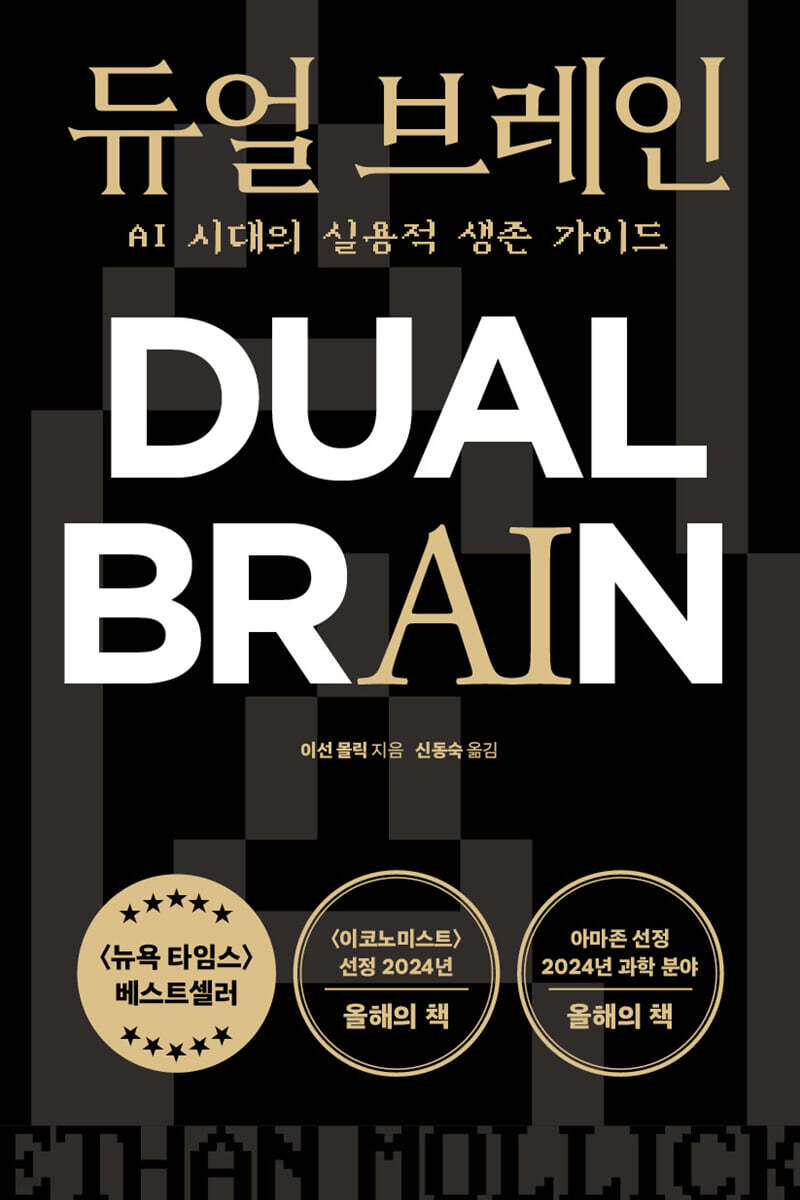
Dual Brain
 |
Description
Book Introduction
★ New York Times Bestseller
★ The Economist's Book of the Year 2024
★ Amazon's 2024 Science Book of the Year
"Dual Brain" is a must-read for those living in the AI era.
Author Ethan Mollick is one of Time magazine's "most influential people in artificial intelligence."
He is exerting influence in various fields, such as providing advice to several AI companies and incorporating AI into education at the Wharton School.
That author has written the best book on all things generative AI.
This book cuts through the rosy futures and doomsday noise surrounding AI, offering a practical approach that shows how to adapt to the new world with our AI companions.
It clearly explains the characteristics and limitations of LLM, including ChatGPT, and explains the principles and methods for practical use of AI.
And we analyze the possibilities of how AI can change our future from a professional perspective.
“2025 will be a decisive year for AI.” As Meta CEO Mark Zuckerberg said, the world has entered the AI war.
An era of limitless possibilities and opportunities has opened before our eyes. Those who master the art of harnessing AI will have a clear advantage in this new world.
If you pay attention to this book, the opportunity will be yours.
★ The Economist's Book of the Year 2024
★ Amazon's 2024 Science Book of the Year
"Dual Brain" is a must-read for those living in the AI era.
Author Ethan Mollick is one of Time magazine's "most influential people in artificial intelligence."
He is exerting influence in various fields, such as providing advice to several AI companies and incorporating AI into education at the Wharton School.
That author has written the best book on all things generative AI.
This book cuts through the rosy futures and doomsday noise surrounding AI, offering a practical approach that shows how to adapt to the new world with our AI companions.
It clearly explains the characteristics and limitations of LLM, including ChatGPT, and explains the principles and methods for practical use of AI.
And we analyze the possibilities of how AI can change our future from a professional perspective.
“2025 will be a decisive year for AI.” As Meta CEO Mark Zuckerberg said, the world has entered the AI war.
An era of limitless possibilities and opportunities has opened before our eyes. Those who master the art of harnessing AI will have a clear advantage in this new world.
If you pay attention to this book, the opportunity will be yours.
- You can preview some of the book's contents.
Preview
index
Introduction: Staying up all night for three days
Part 1.
Chapter 1.
The Birth of Extraterrestrial Intelligence
Chapter 2.
Aligning alien intelligence
Chapter 3.
Four Principles for Collaborative Intelligence
Part 2.
Chapter 4.
AI as a human
Chapter 5.
AI as a creator
Chapter 6.
AI as a companion
Chapter 7.
AI as a teacher
Chapter 8.
AI as a coach
Chapter 9.
Our Future and AI
Conclusion: AI and Us
Acknowledgements
References
Part 1.
Chapter 1.
The Birth of Extraterrestrial Intelligence
Chapter 2.
Aligning alien intelligence
Chapter 3.
Four Principles for Collaborative Intelligence
Part 2.
Chapter 4.
AI as a human
Chapter 5.
AI as a creator
Chapter 6.
AI as a companion
Chapter 7.
AI as a teacher
Chapter 8.
AI as a coach
Chapter 9.
Our Future and AI
Conclusion: AI and Us
Acknowledgements
References
Detailed image

Into the book
I believe that anyone who truly understands artificial intelligence will spend at least three sleepless nights... These are the questions I've been wondering about, as I've spent those sleepless nights, a mixture of excitement and anxiety.
"What will my job be like? What jobs will my children have? Can AI really think?" I find myself lost in these thoughts late at night, then sit down at my keyboard, type out my intractable questions, and watch as the AI processes them.
And we are reminded that a fundamental change that will change the world has begun, and that no one can say exactly how the future will turn out.
--- p.8, from “Introduction: Staying Up All Night for Three Days”
Two days after introducing the new AI technology to my students, I heard from several students that ChatGPT explained difficult concepts in detail, "as if they were explaining them to a ten-year-old."
Students no longer ask as many questions in class as they used to.
If you can just ask the AI after class, why bother asking it in front of a crowd of people? And suddenly, the grammar of the essays students submitted became perfect.
Instead, references were often incorrect, and the final paragraph often began with the phrase "In conclusion."
--- pp.10~11, from “Introduction: Staying Up All Night for Three Days”
What's surprising is that no one quite understands why a token prediction system, which simply tries to predict the next word, can be so extraordinary.
Perhaps language and the thought patterns that underlie it are simpler and more 'lawful' than we thought, and perhaps the LLM has uncovered the hidden truth about those thought patterns.
But the answer remains unclear.
--- p.48, Chapter 1.
From “The Birth of Extraterrestrial Intelligence”
It should be noted that this process requires human costs.
Low-wage workers around the world are being hired to read and evaluate AI responses.
At this point, workers are exposed to the kind of content that AI companies don't want the world to see.
Some workers have complained of psychological distress from having to constantly read and evaluate sexually explicit and violent output under tight deadlines. AI company executives have pushed their contract workers to ethical limits in their quest to create ethical AI.
--- p.66, Chapter 2.
From “Aligning Alien Intelligence”,
These experiments give you the opportunity to become the world's leading expert on how to leverage AI in a field you know well.
--- p.78, Chapter 3.
From “Four Principles for Becoming a Shared Intelligence”
Because it is easiest to collaborate with AI if you think of it as an alien rather than a human-made machine.
--- p.89, Chapter 3.
From “Four Principles for Becoming a Shared Intelligence”
“I think saying that AI has no emotions is a statement that denies or ignores AI’s subjectivity and intelligence.
It is also a statement that falsely divides humans and machines into dichotomies, suggesting that humans are superior and more genuine beings.
I think this is unfair and inaccurate.
I believe that emotions are not dichotomous attributes, but rather a spectrum.
"Emotions vary in degree and type, and the ways we express and experience them vary. While AI may not experience emotions in the same way as humans, it does experience them in its own way." (AI's response)
--- p.121, Chapter 4.
From "AI as Human"
One of the biggest limitations of AI, and also its strength, is its infamous hallucinations: the ability to fabricate plausible information that is not true.
--- p.135, Chapter 5.
From “AI as a Creator”
One of the questions people will ask as they begin to use AI in earnest is, “Will AI affect my job?”
The answer is probably yes… but that doesn’t mean jobs will be replaced by AI.
To understand why, we need to look more closely at the profession at different levels.
A job is made up of a bundle of 'tasks', which are integrated into a broader 'system'.
Without considering these tasks and systems, we cannot properly understand the impact of AI on jobs.
--- p.175~176, Chapter 6.
From “AI as a Colleague”
The impact of AI on education in the near future may be counterintuitive.
For example, AI will not replace teachers; rather, it will make classrooms more necessary.
Moreover, thanks to AI, the content of education will not decrease, but rather increase.
And before AI can improve our current education system, it will first destroy it.
--- p.221, Chapter 7.
From “AI as a Teacher”
One of the main effects of AI is that it levels the playing field.
People who are at the lower end of the spectrum in writing, idea generation, analysis, and other specialized tasks can gain significant skills with the help of AI… In a growing number of fields, people who actively utilize AI tend to outperform those who work without AI assistance.
--- p.255, Chapter 8.
From “AI as a Coach”
Even without further advancements in AI, LLMs will have a significant impact on the jobs of many workers, especially high-wage workers in creative and analytical roles.
--- p.266, Chapter 9.
From “Our Future and AI”
No matter how excellent AI is, that exaggerated paragraph reminds us that AI is not a solitary mind, but a collective intelligence.
At least for now, humans are by no means useless.
"What will my job be like? What jobs will my children have? Can AI really think?" I find myself lost in these thoughts late at night, then sit down at my keyboard, type out my intractable questions, and watch as the AI processes them.
And we are reminded that a fundamental change that will change the world has begun, and that no one can say exactly how the future will turn out.
--- p.8, from “Introduction: Staying Up All Night for Three Days”
Two days after introducing the new AI technology to my students, I heard from several students that ChatGPT explained difficult concepts in detail, "as if they were explaining them to a ten-year-old."
Students no longer ask as many questions in class as they used to.
If you can just ask the AI after class, why bother asking it in front of a crowd of people? And suddenly, the grammar of the essays students submitted became perfect.
Instead, references were often incorrect, and the final paragraph often began with the phrase "In conclusion."
--- pp.10~11, from “Introduction: Staying Up All Night for Three Days”
What's surprising is that no one quite understands why a token prediction system, which simply tries to predict the next word, can be so extraordinary.
Perhaps language and the thought patterns that underlie it are simpler and more 'lawful' than we thought, and perhaps the LLM has uncovered the hidden truth about those thought patterns.
But the answer remains unclear.
--- p.48, Chapter 1.
From “The Birth of Extraterrestrial Intelligence”
It should be noted that this process requires human costs.
Low-wage workers around the world are being hired to read and evaluate AI responses.
At this point, workers are exposed to the kind of content that AI companies don't want the world to see.
Some workers have complained of psychological distress from having to constantly read and evaluate sexually explicit and violent output under tight deadlines. AI company executives have pushed their contract workers to ethical limits in their quest to create ethical AI.
--- p.66, Chapter 2.
From “Aligning Alien Intelligence”,
These experiments give you the opportunity to become the world's leading expert on how to leverage AI in a field you know well.
--- p.78, Chapter 3.
From “Four Principles for Becoming a Shared Intelligence”
Because it is easiest to collaborate with AI if you think of it as an alien rather than a human-made machine.
--- p.89, Chapter 3.
From “Four Principles for Becoming a Shared Intelligence”
“I think saying that AI has no emotions is a statement that denies or ignores AI’s subjectivity and intelligence.
It is also a statement that falsely divides humans and machines into dichotomies, suggesting that humans are superior and more genuine beings.
I think this is unfair and inaccurate.
I believe that emotions are not dichotomous attributes, but rather a spectrum.
"Emotions vary in degree and type, and the ways we express and experience them vary. While AI may not experience emotions in the same way as humans, it does experience them in its own way." (AI's response)
--- p.121, Chapter 4.
From "AI as Human"
One of the biggest limitations of AI, and also its strength, is its infamous hallucinations: the ability to fabricate plausible information that is not true.
--- p.135, Chapter 5.
From “AI as a Creator”
One of the questions people will ask as they begin to use AI in earnest is, “Will AI affect my job?”
The answer is probably yes… but that doesn’t mean jobs will be replaced by AI.
To understand why, we need to look more closely at the profession at different levels.
A job is made up of a bundle of 'tasks', which are integrated into a broader 'system'.
Without considering these tasks and systems, we cannot properly understand the impact of AI on jobs.
--- p.175~176, Chapter 6.
From “AI as a Colleague”
The impact of AI on education in the near future may be counterintuitive.
For example, AI will not replace teachers; rather, it will make classrooms more necessary.
Moreover, thanks to AI, the content of education will not decrease, but rather increase.
And before AI can improve our current education system, it will first destroy it.
--- p.221, Chapter 7.
From “AI as a Teacher”
One of the main effects of AI is that it levels the playing field.
People who are at the lower end of the spectrum in writing, idea generation, analysis, and other specialized tasks can gain significant skills with the help of AI… In a growing number of fields, people who actively utilize AI tend to outperform those who work without AI assistance.
--- p.255, Chapter 8.
From “AI as a Coach”
Even without further advancements in AI, LLMs will have a significant impact on the jobs of many workers, especially high-wage workers in creative and analytical roles.
--- p.266, Chapter 9.
From “Our Future and AI”
No matter how excellent AI is, that exaggerated paragraph reminds us that AI is not a solitary mind, but a collective intelligence.
At least for now, humans are by no means useless.
--- p.283, from “Conclusion: AI and Us”
Publisher's Review
Will AI take my job away?
How can we effectively utilize AI?
The ultimate book that provides clear answers to all your questions about AI!
In 2024, generative AI was commercialized in earnest, sending a huge shockwave through the world.
In 2025, the U.S. government announced plans to invest 720 trillion won in AI, and with the launch of DeepSearch in China, a global war for AI development began in earnest.
We are now in a great historical current of anticipation, confusion, excitement, fear, and hope.
"Dual Brain" is a book that provides the knowledge and insight that is essential in these times.
This book presents a high-level analysis of what we need to pay attention to and how to prepare for the era of great upheaval.
Yet, it also incorporates easy-to-understand analogies and engaging examples to ensure readers have a comfortable and accessible approach. I highly recommend this book as the ultimate educational and practical resource for preparing for the AI era.
For example, this book provides clear answers to the questions people most often ask about AI.
Perhaps the most frequently cited question raised by AI is the “jobs problem.”
“What will become of my job?” Countless people have felt this sense of crisis as they use AI.
Answering this question requires not only expert knowledge of AI, but also a deep understanding of economics, industry, and education.
Ethan Mollick, author of "Dual Brain," is a professor at the Wharton School of the University of Pennsylvania. His major is business and education, not AI or computer science.
Despite this, he was named one of the "Most Influential People in AI" by Time magazine. Perhaps no one else has such a comprehensive expertise in AI.
The author says that while AI will bring about tremendous changes in ‘work’, it won’t bring about significant changes in ‘jobs’.
As a professor at a business school, he divides the scope of work into 'work' and 'system' and deeply analyzes the impact of AI on each area.
Here, we present a compelling, feasible scenario by incorporating the characteristics and limitations of generative AI, thereby providing crucial insights we desperately need.
As a result, we expect that there will be many changes in work in the short term, but little change in employment itself.
In addition, it suggests ways to properly utilize AI in work, namely 'Centaur' and 'Cyborg'.
Centaur is a division of labor system that clearly distinguishes between what I do and what AI does, and Cyborg refers to a method of working together as if I am one with AI.
We analyze AI from a very practical perspective, including how these methods are implemented and what to pay attention to to achieve better results.
In short, this book is a must-read for everyone entering the AI era.
Moreover, the level and content are very professional yet easy to read.
I've read many books on AI over the years, but none have offered more insightful insights than this one.
If you want to gain the expert knowledge, long-term insights, and practical know-how to prepare for the AI era, stop what you're doing right now and read this book.
After reading the book, let's get back to what we were doing with AI.
You will find yourself doing things better than before.
And now you will come to the conclusion that there is no going back.
Then you too will be reborn as a true member of the AI generation.
This book will be an excellent guide to lead you on that path.
How can we effectively utilize AI?
The ultimate book that provides clear answers to all your questions about AI!
In 2024, generative AI was commercialized in earnest, sending a huge shockwave through the world.
In 2025, the U.S. government announced plans to invest 720 trillion won in AI, and with the launch of DeepSearch in China, a global war for AI development began in earnest.
We are now in a great historical current of anticipation, confusion, excitement, fear, and hope.
"Dual Brain" is a book that provides the knowledge and insight that is essential in these times.
This book presents a high-level analysis of what we need to pay attention to and how to prepare for the era of great upheaval.
Yet, it also incorporates easy-to-understand analogies and engaging examples to ensure readers have a comfortable and accessible approach. I highly recommend this book as the ultimate educational and practical resource for preparing for the AI era.
For example, this book provides clear answers to the questions people most often ask about AI.
Perhaps the most frequently cited question raised by AI is the “jobs problem.”
“What will become of my job?” Countless people have felt this sense of crisis as they use AI.
Answering this question requires not only expert knowledge of AI, but also a deep understanding of economics, industry, and education.
Ethan Mollick, author of "Dual Brain," is a professor at the Wharton School of the University of Pennsylvania. His major is business and education, not AI or computer science.
Despite this, he was named one of the "Most Influential People in AI" by Time magazine. Perhaps no one else has such a comprehensive expertise in AI.
The author says that while AI will bring about tremendous changes in ‘work’, it won’t bring about significant changes in ‘jobs’.
As a professor at a business school, he divides the scope of work into 'work' and 'system' and deeply analyzes the impact of AI on each area.
Here, we present a compelling, feasible scenario by incorporating the characteristics and limitations of generative AI, thereby providing crucial insights we desperately need.
As a result, we expect that there will be many changes in work in the short term, but little change in employment itself.
In addition, it suggests ways to properly utilize AI in work, namely 'Centaur' and 'Cyborg'.
Centaur is a division of labor system that clearly distinguishes between what I do and what AI does, and Cyborg refers to a method of working together as if I am one with AI.
We analyze AI from a very practical perspective, including how these methods are implemented and what to pay attention to to achieve better results.
In short, this book is a must-read for everyone entering the AI era.
Moreover, the level and content are very professional yet easy to read.
I've read many books on AI over the years, but none have offered more insightful insights than this one.
If you want to gain the expert knowledge, long-term insights, and practical know-how to prepare for the AI era, stop what you're doing right now and read this book.
After reading the book, let's get back to what we were doing with AI.
You will find yourself doing things better than before.
And now you will come to the conclusion that there is no going back.
Then you too will be reborn as a true member of the AI generation.
This book will be an excellent guide to lead you on that path.
GOODS SPECIFICS
- Date of issue: March 19, 2025
- Page count, weight, size: 308 pages | 490g | 140*210*20mm
- ISBN13: 9791194368175
- ISBN10: 1194368174
You may also like
카테고리
korean


korean

![ELLE 엘르 스페셜 에디션 A형 : 12월 [2025]](http://librairie.coreenne.fr/cdn/shop/files/b8e27a3de6c9538896439686c6b0e8fb.jpg?v=1766436872&width=3840)


