

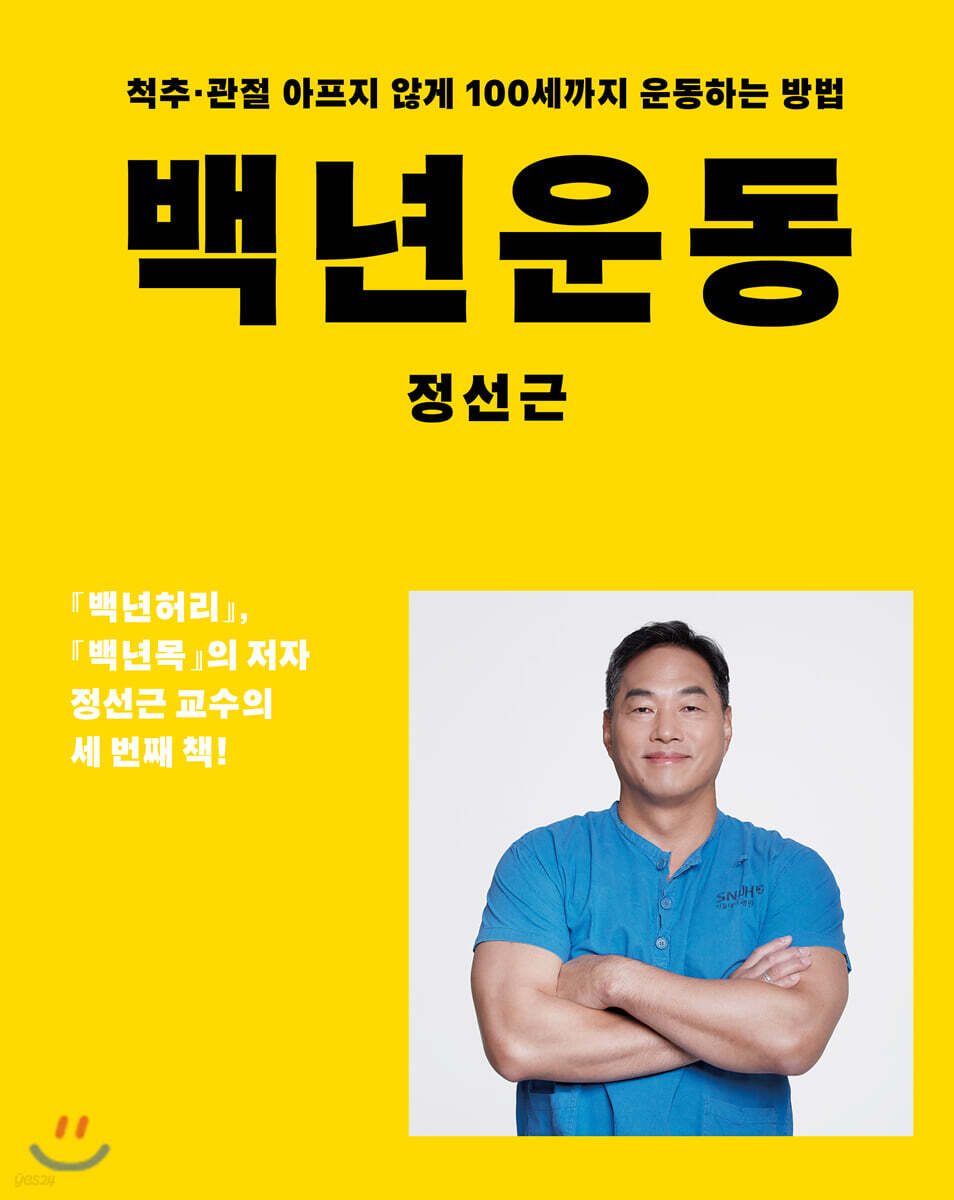
Centennial Movement
 |
Description
Book Introduction
- A word from MD
- Exercise is necessary to maintain a healthy body.
However, the spine and joints that become weaker while exercising are a dilemma and concern for all those who exercise.
This book provides specific, step-by-step guidance on how to exercise while protecting the soft tissues that support the muscles and bones. As the title suggests, it suggests how to live a healthy life to 100 years old through safe exercise.
- Health PD Lee Ju-eun
Professor Jeong Seon-geun of the Department of Rehabilitation Medicine at Seoul National University College of Medicine offers medical advice to those who wish to live a healthy and wonderful life to the age of 100 in his new book, "The 100-Year Movement."
Professor Jeong's best-selling books in the health field, '100-Year Back' and '100-Year Neck', published a few years ago, are books that presented a new treatment method for lumbar and cervical disc diseases to the public, while his new book, '100-Year Exercise', is a book that presents an exercise method that allows you to exercise safely while protecting your joints and spine.
It is a well-known fact that exercise is good for the body.
How good exercise is for our bodies can be easily seen from the fact that 'over 30 trillion cells in the entire body are activated simultaneously with just one stimulus called exercise.'
However, as good as exercise is, exercise is the best medicine, but the biggest enemy of exercise is pain in the spine and joints.
The key is how to resolve this dilemma: if you exercise, you get sick, and if you don't exercise, you get weak.
People face an exercise dilemma when they have back or joint pain or when they start to age after middle age.
Even if you want to exercise for your health, you may be worried that exercising too hastily could worsen your body's recovery or lead to injury, which can leave you stuck in a quandary.
To solve the concerns of such people, the author suggests a method based on clinical experience and research.
The author says that if you know how to exercise consistently while protecting the soft tissues (cartilage, tendons, and ligaments) that are torn and pushed between strong muscles and bones, you won't have to fall into the dilemma of 'should people who have experienced spinal or joint injuries exercise or not?' or 'should you exercise or not as you get older?'
The specific, step-by-step exercises presented in the book to protect soft tissues are exercises that effectively protect the spine and joints, and are one of the core contents of this book.
First, it is about accurately understanding the condition of your spine and joints and finding the right exercise for your body. Second, it is about being able to exercise consistently without injury using the right exercise method for your body. That is the 100-year exercise.
Professor Jeong's best-selling books in the health field, '100-Year Back' and '100-Year Neck', published a few years ago, are books that presented a new treatment method for lumbar and cervical disc diseases to the public, while his new book, '100-Year Exercise', is a book that presents an exercise method that allows you to exercise safely while protecting your joints and spine.
It is a well-known fact that exercise is good for the body.
How good exercise is for our bodies can be easily seen from the fact that 'over 30 trillion cells in the entire body are activated simultaneously with just one stimulus called exercise.'
However, as good as exercise is, exercise is the best medicine, but the biggest enemy of exercise is pain in the spine and joints.
The key is how to resolve this dilemma: if you exercise, you get sick, and if you don't exercise, you get weak.
People face an exercise dilemma when they have back or joint pain or when they start to age after middle age.
Even if you want to exercise for your health, you may be worried that exercising too hastily could worsen your body's recovery or lead to injury, which can leave you stuck in a quandary.
To solve the concerns of such people, the author suggests a method based on clinical experience and research.
The author says that if you know how to exercise consistently while protecting the soft tissues (cartilage, tendons, and ligaments) that are torn and pushed between strong muscles and bones, you won't have to fall into the dilemma of 'should people who have experienced spinal or joint injuries exercise or not?' or 'should you exercise or not as you get older?'
The specific, step-by-step exercises presented in the book to protect soft tissues are exercises that effectively protect the spine and joints, and are one of the core contents of this book.
First, it is about accurately understanding the condition of your spine and joints and finding the right exercise for your body. Second, it is about being able to exercise consistently without injury using the right exercise method for your body. That is the 100-year exercise.
- You can preview some of the book's contents.
Preview
index
prolog
Part 1: Exercise, the Best Medicine, and the Dilemma
Chapter 1: Lack of physical activity is poison, exercise is the antidote
Chapter 2: Aerobic Exercise for a Longer Life, Anaerobic Exercise for a Better Life
Chapter 3: The Dilemma of the Centenarian Movement
Part 2: Aerobic Exercises Good for Your Spine and Joints
Chapter 4: A Closer Look at the Yun Oxygen Movement
Chapter 5: Finding the Right Cardio Exercise for Your Body
Chapter 6: Walking, the best medicine from God
Part 3 Strengthening Exercises for the Spine and Joints
Chapter 7: A Closer Look at Strength Training
Chapter 8 #1 Buttocks: Strengthen and enjoy the most delicious pleasure with these muscles.
Chapter 9, 2nd Place: The Strong Back of a Centenarian
Chapter 10, Number 3 Quadriceps Femoris: Guardian of the Knee Joint
Chapter 11, 4th place, posterior calf muscle: 2, heart
Chapter 12, Section 5: Muscles around the scapula: Bodyguards of the shoulder joint
Chapter 13, Number 6 Core Muscles: The Center of Our Body
Chapter 14, Number 7, Pectoralis Major: The Dream of Younger Brothers
Chapter 15, Number 8: Shoulder Muscles: The Pride of a Strong Man
Chapter 16, Number 9, Arm Muscles: Muscles Essential to Homo Sapiens
Chapter 17, Number 10: Hamstrings: A Sportsman's Essential
Chapter 18: Forearm and Ankle Muscles: Tennis Elbow, Golfer's Elbow, and Ankle Sprains
Part 4: The Centennial Exercise That Fits My Body
Chapter 19: 20 Best Value Strength Training Exercises
Chapter 20: Follow the Centennial Exercises That Fit Your Body
Epilogue
References
Part 1: Exercise, the Best Medicine, and the Dilemma
Chapter 1: Lack of physical activity is poison, exercise is the antidote
Chapter 2: Aerobic Exercise for a Longer Life, Anaerobic Exercise for a Better Life
Chapter 3: The Dilemma of the Centenarian Movement
Part 2: Aerobic Exercises Good for Your Spine and Joints
Chapter 4: A Closer Look at the Yun Oxygen Movement
Chapter 5: Finding the Right Cardio Exercise for Your Body
Chapter 6: Walking, the best medicine from God
Part 3 Strengthening Exercises for the Spine and Joints
Chapter 7: A Closer Look at Strength Training
Chapter 8 #1 Buttocks: Strengthen and enjoy the most delicious pleasure with these muscles.
Chapter 9, 2nd Place: The Strong Back of a Centenarian
Chapter 10, Number 3 Quadriceps Femoris: Guardian of the Knee Joint
Chapter 11, 4th place, posterior calf muscle: 2, heart
Chapter 12, Section 5: Muscles around the scapula: Bodyguards of the shoulder joint
Chapter 13, Number 6 Core Muscles: The Center of Our Body
Chapter 14, Number 7, Pectoralis Major: The Dream of Younger Brothers
Chapter 15, Number 8: Shoulder Muscles: The Pride of a Strong Man
Chapter 16, Number 9, Arm Muscles: Muscles Essential to Homo Sapiens
Chapter 17, Number 10: Hamstrings: A Sportsman's Essential
Chapter 18: Forearm and Ankle Muscles: Tennis Elbow, Golfer's Elbow, and Ankle Sprains
Part 4: The Centennial Exercise That Fits My Body
Chapter 19: 20 Best Value Strength Training Exercises
Chapter 20: Follow the Centennial Exercises That Fit Your Body
Epilogue
References
Into the book
The poison of lack of physical activity can be treated with the antidote called exercise.
Eight hours of sitting can be detoxified with 60-75 minutes of moderate intensity exercise!
---From "How to detoxify the poison of lack of physical activity?"
With just one stimulus called exercise, over 30 trillion cells in the entire body are activated simultaneously.
---From "The Principle of Overload - The Best Gift Exercise Gives"
When doing aerobic exercise for the same amount of time, people with more muscle mass burn more body fat than people with less muscle mass.
---From "Strength training and a slim body - Expanding the incinerator in a waste incinerator"
Regular strength training increases blood testosterone levels, boosting a man's confidence.
---From "The Effects of Strength Training That Aerobic Exercise Can't Match"
To live youthfully until the age of 100, consistent exercise is the best medicine, but the biggest enemy of consistent exercise is pain in the spine and joints.
The key is how to resolve this dilemma: if you exercise, you get sick, and if you don't exercise, you get weak.
---From "The Dilemma of the 100-Year-Old Movement"
Once you know how to exercise consistently while protecting the soft tissues (cartilage, tendons, and ligaments) that are torn and strained between strong muscles and bones, the dilemma of "whether or not to exercise as you age" will no longer be a problem.
---From "The Protagonist of the Dilemma - The Soft Tissue That Receives Power"
To find the right exercise for your body, you need to know what your spine and joints can handle, and the exact level of stress and impact of the exercise you want to do.
On top of that knowledge base, it would be icing on the cake if you understood the God-given warning system called 'pain'.
---From "Chapter 3, The Dilemma of the 100-Year-Old Movement"
If a sore back is like a newborn baby, then the back that has had surgery can be thought of as a fetus in the womb.
You need to be much more strict about maintaining lumbar lordosis and maintaining spinal hygiene.
---From "When Your Waist Meets Exercise 2"
There is no such thing as a back that gets better with exercise.
Exercise is about making your body healthy.
Your back will improve with good posture
---From "When Your Waist Meets Exercise 3"
Knowing the exact condition of your spine and joints and finding the right exercise for your body is the 100-year exercise.
---From "The Dilemma of the 100-Year-Old Movement"
If you want to live long, walk a lot.
There is no greater benefit than extending your lifespan through walking.
---From "The Mountain Spirit Appearing at Harvard University"
Let the vertical line from the ear hole (the center of gravity of the head) pass through the anus (the center of the pelvis).
---From "Correct Walking Posture"
A deep conflict begins over whether to go with high-weight, low-rep training, which increases the weight but reduces the number of repetitions, or low-weight, high-rep training, which reduces the weight and increases the number of repetitions.
---From "Inverse Relationship Between Weight and Number of Times"
The safest exercise to strengthen your hip muscles is the seated leg spread (hip abduction).
You can exercise your glutes at high intensity without putting any strain on your lower back.
---「Chapter 8, No. 1 Buttock Muscles: The Muscles That Get the Most Savory Fun by Strengthening Them」
The safest latissimus dorsi exercises for people with back and joint problems are downward or horizontal pulls.
For those with weak backs, we recommend pulling downwards, and for those with weak shoulders, we recommend pulling horizontally.
---From "Chapter 9, 2nd Place, Back Muscles: The Strong Back of a Centenarian's Youth"
For people with knee pain, walking and leg extensions are good exercises.
---From "Chapter 10, Number 3, Quadriceps Femoris: Guardian of the Knee Joint"
The four basic bodyweight exercises you can do anytime, anywhere—hip-pull squats, pull-ups, heel raises, and combined push-ups—are a godsend.
Eight hours of sitting can be detoxified with 60-75 minutes of moderate intensity exercise!
---From "How to detoxify the poison of lack of physical activity?"
With just one stimulus called exercise, over 30 trillion cells in the entire body are activated simultaneously.
---From "The Principle of Overload - The Best Gift Exercise Gives"
When doing aerobic exercise for the same amount of time, people with more muscle mass burn more body fat than people with less muscle mass.
---From "Strength training and a slim body - Expanding the incinerator in a waste incinerator"
Regular strength training increases blood testosterone levels, boosting a man's confidence.
---From "The Effects of Strength Training That Aerobic Exercise Can't Match"
To live youthfully until the age of 100, consistent exercise is the best medicine, but the biggest enemy of consistent exercise is pain in the spine and joints.
The key is how to resolve this dilemma: if you exercise, you get sick, and if you don't exercise, you get weak.
---From "The Dilemma of the 100-Year-Old Movement"
Once you know how to exercise consistently while protecting the soft tissues (cartilage, tendons, and ligaments) that are torn and strained between strong muscles and bones, the dilemma of "whether or not to exercise as you age" will no longer be a problem.
---From "The Protagonist of the Dilemma - The Soft Tissue That Receives Power"
To find the right exercise for your body, you need to know what your spine and joints can handle, and the exact level of stress and impact of the exercise you want to do.
On top of that knowledge base, it would be icing on the cake if you understood the God-given warning system called 'pain'.
---From "Chapter 3, The Dilemma of the 100-Year-Old Movement"
If a sore back is like a newborn baby, then the back that has had surgery can be thought of as a fetus in the womb.
You need to be much more strict about maintaining lumbar lordosis and maintaining spinal hygiene.
---From "When Your Waist Meets Exercise 2"
There is no such thing as a back that gets better with exercise.
Exercise is about making your body healthy.
Your back will improve with good posture
---From "When Your Waist Meets Exercise 3"
Knowing the exact condition of your spine and joints and finding the right exercise for your body is the 100-year exercise.
---From "The Dilemma of the 100-Year-Old Movement"
If you want to live long, walk a lot.
There is no greater benefit than extending your lifespan through walking.
---From "The Mountain Spirit Appearing at Harvard University"
Let the vertical line from the ear hole (the center of gravity of the head) pass through the anus (the center of the pelvis).
---From "Correct Walking Posture"
A deep conflict begins over whether to go with high-weight, low-rep training, which increases the weight but reduces the number of repetitions, or low-weight, high-rep training, which reduces the weight and increases the number of repetitions.
---From "Inverse Relationship Between Weight and Number of Times"
The safest exercise to strengthen your hip muscles is the seated leg spread (hip abduction).
You can exercise your glutes at high intensity without putting any strain on your lower back.
---「Chapter 8, No. 1 Buttock Muscles: The Muscles That Get the Most Savory Fun by Strengthening Them」
The safest latissimus dorsi exercises for people with back and joint problems are downward or horizontal pulls.
For those with weak backs, we recommend pulling downwards, and for those with weak shoulders, we recommend pulling horizontally.
---From "Chapter 9, 2nd Place, Back Muscles: The Strong Back of a Centenarian's Youth"
For people with knee pain, walking and leg extensions are good exercises.
---From "Chapter 10, Number 3, Quadriceps Femoris: Guardian of the Knee Joint"
The four basic bodyweight exercises you can do anytime, anywhere—hip-pull squats, pull-ups, heel raises, and combined push-ups—are a godsend.
---From "20 Strength Training Exercises Recommended for Cost-Effectiveness in Chapter 19"
Publisher's Review
In Part 1, 'Exercise, the Best Medicine, and the Dilemma,' the author covers the introductory content of exercise and the dilemma that inevitably arises when longevity and exercise meet.
We examined the scientifically proven effects of exercise and compared aerobic and anaerobic exercise, the two major types of exercise for building a healthy body, in terms of principles and effectiveness.
It explains, through real-life examples, the embarrassing problems that arise in the spine and joints when exercising to live youthfully until 100, and the process of overcoming them.
Part 2, 'Aerobic Exercises Good for the Spine and Joints', presents the basic methods of aerobic exercise in an easy-to-understand manner and covers in detail the good and bad effects of various aerobic exercises on the spine and joints.
It describes in detail the specific methods of walking, the pinnacle of aerobic exercise, and explains the effects of walking, the correct method, and how to interpret and deal with pain in the spine and joints that occurs when walking.
Part 3, "Strength Training for the Spine and Joints," provides step-by-step instructions on how to perform strength training while reducing the strain on the spine and joints, along with the latest research results.
To live to be 100 years old with a strong spine and joints, the author introduces 10 muscles in order of importance (which the author calls 'cost-effectiveness'), and shows in detail the movements of muscle strengthening exercises listed in order of safety, taking into account the relationship between each muscle, spine, and joints.
In Part 4, 'The 100-Year Exercise That's Perfect for My Body', we've carefully selected 20 recommended strength training movements that reduce the burden on the spine and joints and maximize the effect of strengthening muscles.
There are nine bodyweight exercises and eleven machine exercises.
By combining 20 selected strength training movements and aerobic exercises, we present the best exercise methods for various situations, from young people to the elderly, and from those with back pain to those with shoulder pain.
This is the most suitable exercise prescription for various situations that may arise while living to the age of 100.
It is the Centennial Movement.
The three key points the author highlights in the epilogue are ones that anyone who wants to exercise until they are 100 should take to heart.
1.
Start with low exercise intensity and increase slowly.
If you have ever experienced back or joint pain, increase very slowly.
2.
When exercising, you don't necessarily have to use the full range of motion.
This means that you don't have to use the full range of motion of your joints.
3.
If you get sick while exercising, avoid it like you would avoid a rain shower.
The way to avoid this is to lower the intensity of your exercise and move on to a safer exercise method.
We examined the scientifically proven effects of exercise and compared aerobic and anaerobic exercise, the two major types of exercise for building a healthy body, in terms of principles and effectiveness.
It explains, through real-life examples, the embarrassing problems that arise in the spine and joints when exercising to live youthfully until 100, and the process of overcoming them.
Part 2, 'Aerobic Exercises Good for the Spine and Joints', presents the basic methods of aerobic exercise in an easy-to-understand manner and covers in detail the good and bad effects of various aerobic exercises on the spine and joints.
It describes in detail the specific methods of walking, the pinnacle of aerobic exercise, and explains the effects of walking, the correct method, and how to interpret and deal with pain in the spine and joints that occurs when walking.
Part 3, "Strength Training for the Spine and Joints," provides step-by-step instructions on how to perform strength training while reducing the strain on the spine and joints, along with the latest research results.
To live to be 100 years old with a strong spine and joints, the author introduces 10 muscles in order of importance (which the author calls 'cost-effectiveness'), and shows in detail the movements of muscle strengthening exercises listed in order of safety, taking into account the relationship between each muscle, spine, and joints.
In Part 4, 'The 100-Year Exercise That's Perfect for My Body', we've carefully selected 20 recommended strength training movements that reduce the burden on the spine and joints and maximize the effect of strengthening muscles.
There are nine bodyweight exercises and eleven machine exercises.
By combining 20 selected strength training movements and aerobic exercises, we present the best exercise methods for various situations, from young people to the elderly, and from those with back pain to those with shoulder pain.
This is the most suitable exercise prescription for various situations that may arise while living to the age of 100.
It is the Centennial Movement.
The three key points the author highlights in the epilogue are ones that anyone who wants to exercise until they are 100 should take to heart.
1.
Start with low exercise intensity and increase slowly.
If you have ever experienced back or joint pain, increase very slowly.
2.
When exercising, you don't necessarily have to use the full range of motion.
This means that you don't have to use the full range of motion of your joints.
3.
If you get sick while exercising, avoid it like you would avoid a rain shower.
The way to avoid this is to lower the intensity of your exercise and move on to a safer exercise method.
GOODS SPECIFICS
- Publication date: November 11, 2019
- Page count, weight, size: 484 pages | 774g | 175*220*30mm
- ISBN13: 9791196834005
- ISBN10: 1196834008
You may also like
카테고리
korean


korean

![ELLE 엘르 스페셜 에디션 A형 : 12월 [2025]](http://librairie.coreenne.fr/cdn/shop/files/b8e27a3de6c9538896439686c6b0e8fb.jpg?v=1766436872&width=3840)


