

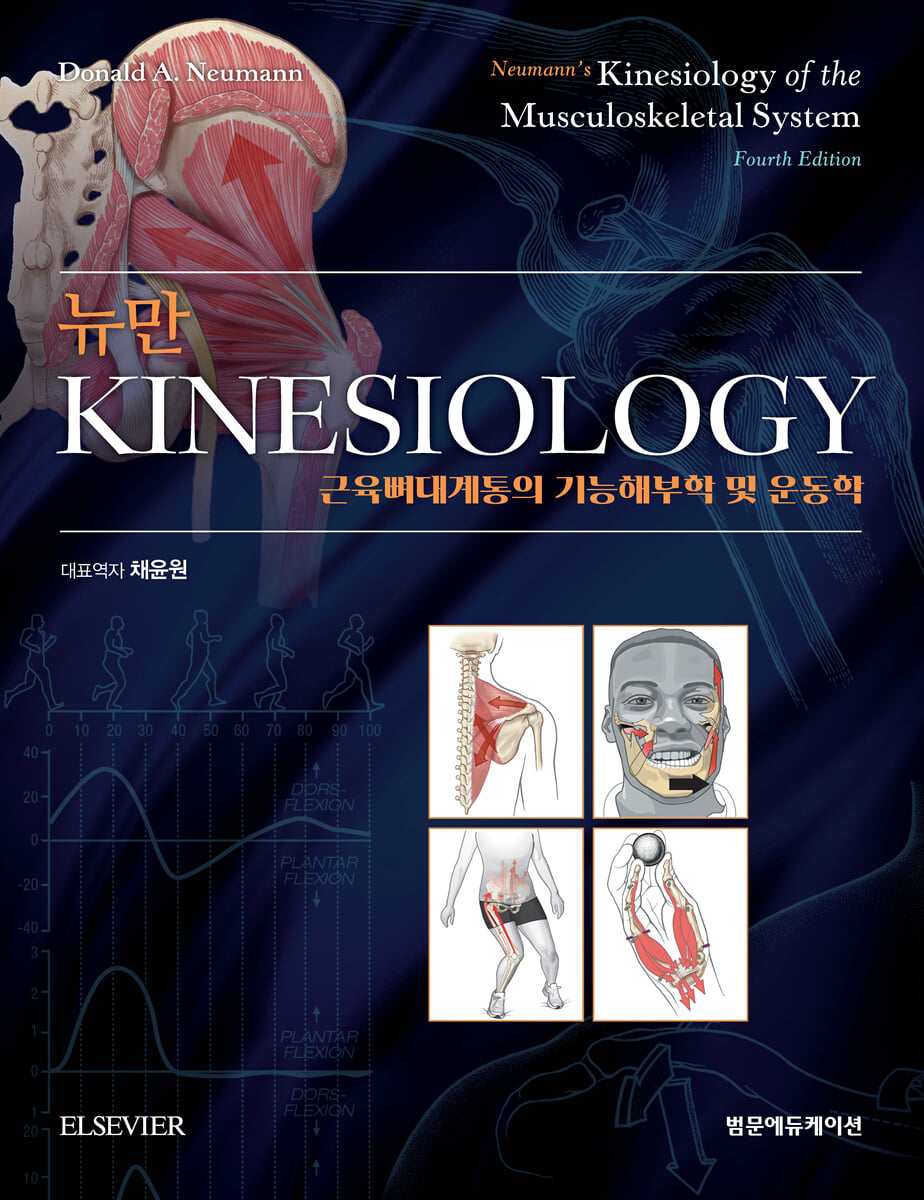
Newman Kinesiology: Functional Anatomy and Kinematics of the Musculoskeletal System
 |
Description
Book Introduction
This fourth edition provides updates in many areas, including the concept of fascia, the role of cytokines, an introduction to epigenetics, blood flow restriction training, a new resistance training method, and the latest trends in the mechanisms and treatment approaches for diseases of each joint.
Of particular interest was the presentation of a new concept called precision physical therapy, which suggests that exercise can influence gene expression through epigenetics and that more precise exercise prescriptions can provide optimal responses through individually targeted interventions.
In this 4th edition, the translation was based on the 6th edition of the Korean Medical Association's Medical Terminology Dictionary.
This revision of medical terminology has a principle that does not allow the mixed use of Korean and Chinese characters.
Therefore, you will notice that there are revised medical terms compared to the previous edition, and that it does not use only pure Korean characters like before.
Even in medical terminology, if the meaning of physical therapy or exercise terms does not match, we have tried to give them as reasonable a meaning as possible.
Of particular interest was the presentation of a new concept called precision physical therapy, which suggests that exercise can influence gene expression through epigenetics and that more precise exercise prescriptions can provide optimal responses through individually targeted interventions.
In this 4th edition, the translation was based on the 6th edition of the Korean Medical Association's Medical Terminology Dictionary.
This revision of medical terminology has a principle that does not allow the mixed use of Korean and Chinese characters.
Therefore, you will notice that there are revised medical terms compared to the previous edition, and that it does not use only pure Korean characters like before.
Even in medical terminology, if the meaning of physical therapy or exercise terms does not match, we have tried to give them as reasonable a meaning as possible.
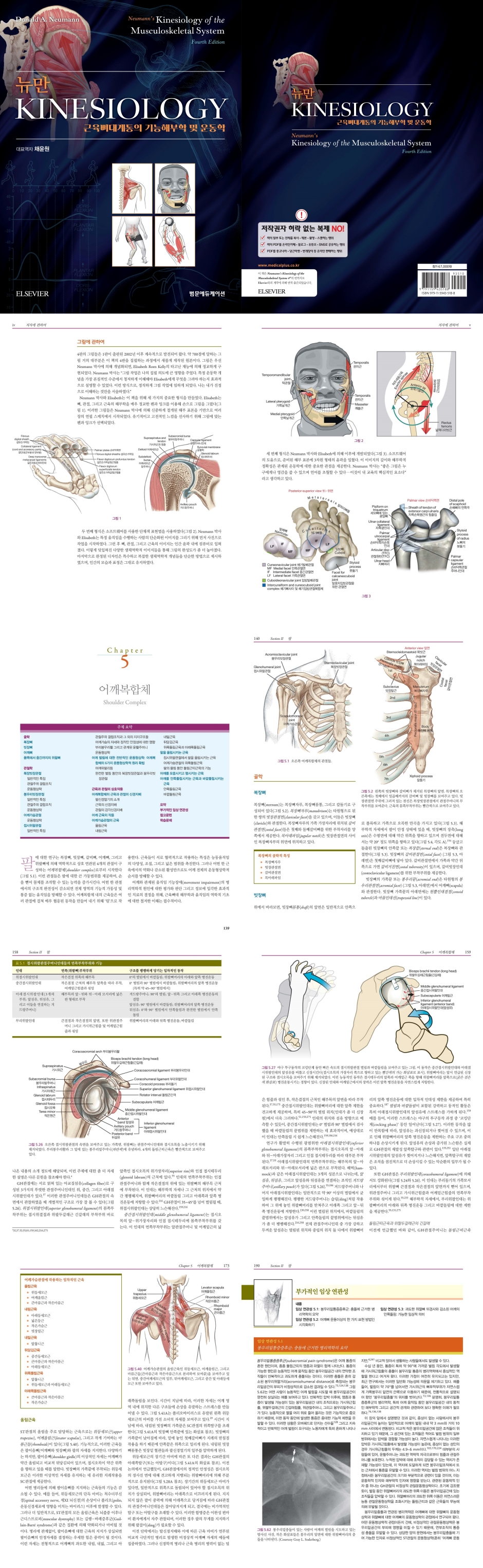
- You can preview some of the book's contents.
Preview
index
About the Author iii
Translator's Preface vi
Author's Preface vii
Section I Important Topics in Kinematics 1
Chapter 1 Introduction · 3
Chapter 2 Arthroscopy: The Study of the Basic Structure and Function of Human Joints · 31
Chapter 3 Muscles: Primary Stabilizers and Motorists of the Skeletal System · 57
Chapter 4: Biomechanical Principles for Understanding Movement · 91
Appendix I Trigonometry Review and Anthropometric Resources · 134
Section II Arm 137
Chapter 5: Shoulder Complex · 139
Chapter 6 Elbows and Forearms · 202
Chapter 7 Wrist · 248
Chapter 8 Hands · 287
Appendix II References for Muscle Attachments and Innervation of the Arm, Muscle Cross-Sectional Areas, and Dermatomes · 347
Section III Torso Skeleton 361
Chapter 9: The Torso Skeleton: Osteology and Arthrology · 363
Chapter 10: The Torso Skeleton: Muscle and Joint Interactions · 441
Chapter 11: Kinematics of Chewing and Ventilation · 492
Appendix III References for the Attachment Sites, Innervation, and Moment Arm of the Muscles of the Cauda Equina and Trunk Skeleton · 529
Section IV Bridge 537
Chapter 12: The Hip Joint · 539
Chapter 13: Knees · 608
Chapter 14 Ankles and Feet · 673
Chapter 15: Kinematics of Walking · 737
Chapter 16: Kinematics of Running · 797
Appendix IV References for Muscle Attachments and Innervation of the Leg, Cross-sectional Areas of Muscles, and Dermatomes · 824
Search 834
Translator's Preface vi
Author's Preface vii
Section I Important Topics in Kinematics 1
Chapter 1 Introduction · 3
Chapter 2 Arthroscopy: The Study of the Basic Structure and Function of Human Joints · 31
Chapter 3 Muscles: Primary Stabilizers and Motorists of the Skeletal System · 57
Chapter 4: Biomechanical Principles for Understanding Movement · 91
Appendix I Trigonometry Review and Anthropometric Resources · 134
Section II Arm 137
Chapter 5: Shoulder Complex · 139
Chapter 6 Elbows and Forearms · 202
Chapter 7 Wrist · 248
Chapter 8 Hands · 287
Appendix II References for Muscle Attachments and Innervation of the Arm, Muscle Cross-Sectional Areas, and Dermatomes · 347
Section III Torso Skeleton 361
Chapter 9: The Torso Skeleton: Osteology and Arthrology · 363
Chapter 10: The Torso Skeleton: Muscle and Joint Interactions · 441
Chapter 11: Kinematics of Chewing and Ventilation · 492
Appendix III References for the Attachment Sites, Innervation, and Moment Arm of the Muscles of the Cauda Equina and Trunk Skeleton · 529
Section IV Bridge 537
Chapter 12: The Hip Joint · 539
Chapter 13: Knees · 608
Chapter 14 Ankles and Feet · 673
Chapter 15: Kinematics of Walking · 737
Chapter 16: Kinematics of Running · 797
Appendix IV References for Muscle Attachments and Innervation of the Leg, Cross-sectional Areas of Muscles, and Dermatomes · 824
Search 834
Detailed image
Publisher's Review
In Korea, 『Newman Kinesiology: Functional Anatomy and Exercises of the Musculoskeletal System』 is a unique textbook not only in physical therapy but also in the field of physical education and sports-related rehabilitation.
This book provides detailed information related to human movement, including the structure, function, pathological mechanisms, and clinical cases of each area of the human body.
The information provided in the book should not be treated as mere comprehension.
It's worth considering that the information in this book also provides open possibilities for thinking about and responding to various situations you might encounter in your own field of activity.
Anyone studying manual therapy should understand what movements are normally restricted by the muscles, ligaments, and joint capsules provided by each joint, and be able to find answers for themselves about what movement problems the restrictions or looseness of these structures cause in the patient, and in which direction and to which structures joint mobilization techniques should be applied for this purpose.
Additionally, for loose structures, you should be able to find your own answer as to what approach to take from a neuromuscular perspective, such as feedforward, beyond the concept of strengthening.
As a translator who translated the first to fourth editions, I feel that the revised editions published every seven years continue to reflect the research achievements of the time.
This fourth edition provides updates in many areas, including the concept of fascia, the role of cytokines, an introduction to epigenetics, blood flow restriction training, a new resistance training method, and the latest trends in the mechanisms and treatment approaches for diseases of each joint.
Of particular interest was the presentation of a new concept called precision physical therapy, which suggests that exercise can influence gene expression through epigenetics and that more precise exercise prescriptions can provide optimal responses through individually targeted interventions.
In this 4th edition, the translation was based on the 6th edition of the Korean Medical Association's Medical Terminology Dictionary.
This revision of medical terminology has a principle that does not allow the mixed use of Korean and Chinese characters.
Therefore, you will notice that there are revised medical terms compared to the previous edition, and that it does not use only pure Korean characters like before.
Even in medical terminology, if the meaning of physical therapy or exercise terms does not match, we have tried to give them as reasonable a meaning as possible.
These efforts have continued since the second edition, and I believe they have had a significant impact.
For example, the term inversion/eversion was presented as inversion/lateralization up to the 5th edition of the medical terminology dictionary, but in this book, it has been translated as inversion/lateralization from the 2nd edition up to the present, and was revised to this term in the 6th edition of the medical terminology dictionary.
I would be happy to hear any comments you may have on these terms.
Finally, I would like to express my gratitude to those who helped translate this book.
I would like to express my gratitude to Professor Ku Hyeon-mo of Kyungsung University, who took charge of translating Part III when translating the first edition, and to whom I am always deeply grateful as I translate the fourth edition based on his work.
And I would like to express my gratitude to my wife, Kim Mi-jeong, my two sons, Sang-wook and Seung-min, and my dog, Thor, who provided me with a place of refuge in my heart while translating this fourth edition.
Finally, I would like to express my gratitude to CEO Yoo Seong-kwon and all the staff at Beommun Education for their hard work in publishing this book.
July 2025
In Shinchang-dong, the city of light
Doctor of Science Chae Yun-won
This book provides detailed information related to human movement, including the structure, function, pathological mechanisms, and clinical cases of each area of the human body.
The information provided in the book should not be treated as mere comprehension.
It's worth considering that the information in this book also provides open possibilities for thinking about and responding to various situations you might encounter in your own field of activity.
Anyone studying manual therapy should understand what movements are normally restricted by the muscles, ligaments, and joint capsules provided by each joint, and be able to find answers for themselves about what movement problems the restrictions or looseness of these structures cause in the patient, and in which direction and to which structures joint mobilization techniques should be applied for this purpose.
Additionally, for loose structures, you should be able to find your own answer as to what approach to take from a neuromuscular perspective, such as feedforward, beyond the concept of strengthening.
As a translator who translated the first to fourth editions, I feel that the revised editions published every seven years continue to reflect the research achievements of the time.
This fourth edition provides updates in many areas, including the concept of fascia, the role of cytokines, an introduction to epigenetics, blood flow restriction training, a new resistance training method, and the latest trends in the mechanisms and treatment approaches for diseases of each joint.
Of particular interest was the presentation of a new concept called precision physical therapy, which suggests that exercise can influence gene expression through epigenetics and that more precise exercise prescriptions can provide optimal responses through individually targeted interventions.
In this 4th edition, the translation was based on the 6th edition of the Korean Medical Association's Medical Terminology Dictionary.
This revision of medical terminology has a principle that does not allow the mixed use of Korean and Chinese characters.
Therefore, you will notice that there are revised medical terms compared to the previous edition, and that it does not use only pure Korean characters like before.
Even in medical terminology, if the meaning of physical therapy or exercise terms does not match, we have tried to give them as reasonable a meaning as possible.
These efforts have continued since the second edition, and I believe they have had a significant impact.
For example, the term inversion/eversion was presented as inversion/lateralization up to the 5th edition of the medical terminology dictionary, but in this book, it has been translated as inversion/lateralization from the 2nd edition up to the present, and was revised to this term in the 6th edition of the medical terminology dictionary.
I would be happy to hear any comments you may have on these terms.
Finally, I would like to express my gratitude to those who helped translate this book.
I would like to express my gratitude to Professor Ku Hyeon-mo of Kyungsung University, who took charge of translating Part III when translating the first edition, and to whom I am always deeply grateful as I translate the fourth edition based on his work.
And I would like to express my gratitude to my wife, Kim Mi-jeong, my two sons, Sang-wook and Seung-min, and my dog, Thor, who provided me with a place of refuge in my heart while translating this fourth edition.
Finally, I would like to express my gratitude to CEO Yoo Seong-kwon and all the staff at Beommun Education for their hard work in publishing this book.
July 2025
In Shinchang-dong, the city of light
Doctor of Science Chae Yun-won
GOODS SPECIFICS
- Date of issue: September 1, 2025
- Format: Hardcover book binding method guide
- Page count, weight, size: 868 pages | 215*276*40mm
- ISBN13: 9791159435188
- ISBN10: 1159435189
You may also like
카테고리
korean


korean

![ELLE 엘르 스페셜 에디션 A형 : 12월 [2025]](http://librairie.coreenne.fr/cdn/shop/files/b8e27a3de6c9538896439686c6b0e8fb.jpg?v=1766436872&width=3840)


