

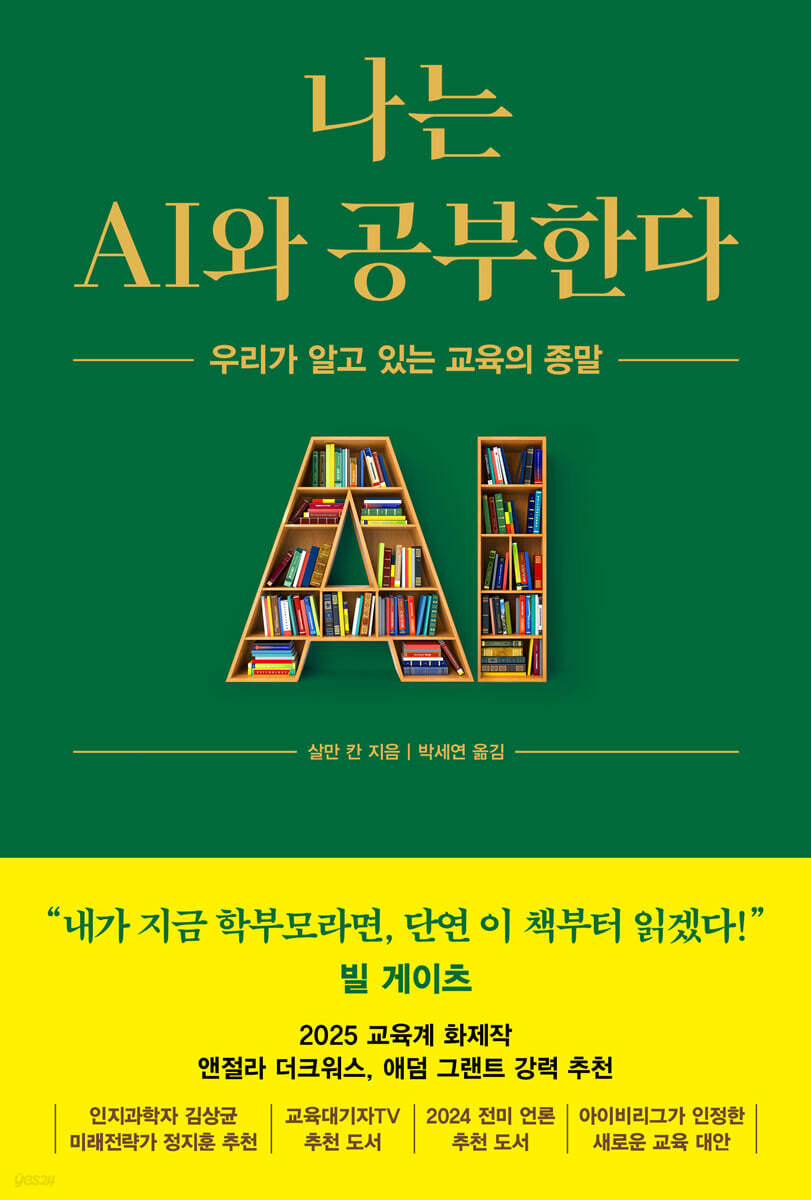
I study with AI
 |
Description
Book Introduction
- A word from MD
-
How AI Can Power EducationA book written by Salman Khan, who has been working to bridge the education gap with technology.
The author has high expectations for education using AI.
There are already many successful cases.
In the end, it is humans who hold the key.
Depending on how it's used, AI can be a powerful tool for better education for everyone.
January 24, 2025. Humanities PD Son Min-gyu
"If I were a parent today, this would be the first book I'd read!" Bill Gates
Cognitive scientist Kim Sang-gyun, future strategist Jeong Ji-hoon, and Education Reporter TV recommend
★ Books to watch in the education world in 2025 ★
Artificial intelligence (AI) is at the heart of all industrial trends these days.
The education sector is no exception.
South Korea plans to gradually introduce AI digital textbooks for English, math, and information science subjects for third and fourth graders in elementary school, first year of middle school, and first year of high school starting in March 2025.
But on the other hand, voices of concern are growing louder.
Many parents and teachers worry about excessive digital reliance, declining literacy, and a diminished role for teachers.
For parents, teachers, and students who are confused about how to embrace these changes, "I Study with AI" has been published. If you want to understand where education is headed in the AI era, this book is all you need.
We present specific examples of how AI-powered educational platforms are actually utilized, what concerns many people have, and what misconceptions and solutions therein.
Salman Khan, along with OpenAI President Greg Brockman and CEO Sam Altman, demonstrated ChatGPT-4 and applied it to the education system to develop the AI-integrated education platform 'Khanmigo'.
By making Kanmigo available to the public and allowing it to be used in actual learning, we hope to alleviate the vague anxieties many people have.
Khan Academy's educational method, represented by Kanmigo, is being taken seriously enough by the Ivy League to be considered a new educational alternative.
Twelve years after his previous work, "I Learn for Free," Salman Khan is optimistic about the potential of AI tutors to spark children's creativity and unlock their potential.
This book provides a glimpse into the future of education.
We are now at a turning point in education.
Cognitive scientist Kim Sang-gyun, future strategist Jeong Ji-hoon, and Education Reporter TV recommend
★ Books to watch in the education world in 2025 ★
Artificial intelligence (AI) is at the heart of all industrial trends these days.
The education sector is no exception.
South Korea plans to gradually introduce AI digital textbooks for English, math, and information science subjects for third and fourth graders in elementary school, first year of middle school, and first year of high school starting in March 2025.
But on the other hand, voices of concern are growing louder.
Many parents and teachers worry about excessive digital reliance, declining literacy, and a diminished role for teachers.
For parents, teachers, and students who are confused about how to embrace these changes, "I Study with AI" has been published. If you want to understand where education is headed in the AI era, this book is all you need.
We present specific examples of how AI-powered educational platforms are actually utilized, what concerns many people have, and what misconceptions and solutions therein.
Salman Khan, along with OpenAI President Greg Brockman and CEO Sam Altman, demonstrated ChatGPT-4 and applied it to the education system to develop the AI-integrated education platform 'Khanmigo'.
By making Kanmigo available to the public and allowing it to be used in actual learning, we hope to alleviate the vague anxieties many people have.
Khan Academy's educational method, represented by Kanmigo, is being taken seriously enough by the Ivy League to be considered a new educational alternative.
Twelve years after his previous work, "I Learn for Free," Salman Khan is optimistic about the potential of AI tutors to spark children's creativity and unlock their potential.
This book provides a glimpse into the future of education.
We are now at a turning point in education.
- You can preview some of the book's contents.
Preview
index
As we enter, we write together
Chapter 1: The Emergence of AI Tutors
Throw away the empty lamp
How to teach everything to everyone
My own friendly private tutor
Chapter 2: Speaking Social Science
Best collaborator and assistant
The Future of Reading: Literature Comes to Life
My most creative friend
How to Converse with Living History
Chapter 3: For Future Innovators
How to Use Science for Science Study
Bridging the Math Gap Through Teamwork
Subjects not taught in school
An important truth we must realize
Chapter 4: Collaborative Learning
Teach together and learn together
An AI counselor who understands my mind
A strong parenting assistant for parents
Parents and children become more connected
Chapter 5: Keeping Children Safe
Finding the Truth in Biased and Distorted Information
Data Collection and Privacy
Transparency isn't always better
Guardian Angel of the Online World
Chapter 6: Education in the AI Era
The overturned classroom
The emergence of AI assistants
Alternative education that becomes perfect
Will AI encourage or improve misconduct?
Chapter 7: The Global Classroom
The future of education: bridging the gap between ideals and reality
The Economics of AI in Education
Chapter 8: Testing and College Entrance Exams in the AI Era
A test that becomes more perfect
Fair and transparent college admissions
Chapter 9: Jobs and Future Prospects
Is AI threatening jobs?
A talent that will never be replaced
AI connecting companies and job seekers
Be educated and courageous!
Acknowledgements│Note
Chapter 1: The Emergence of AI Tutors
Throw away the empty lamp
How to teach everything to everyone
My own friendly private tutor
Chapter 2: Speaking Social Science
Best collaborator and assistant
The Future of Reading: Literature Comes to Life
My most creative friend
How to Converse with Living History
Chapter 3: For Future Innovators
How to Use Science for Science Study
Bridging the Math Gap Through Teamwork
Subjects not taught in school
An important truth we must realize
Chapter 4: Collaborative Learning
Teach together and learn together
An AI counselor who understands my mind
A strong parenting assistant for parents
Parents and children become more connected
Chapter 5: Keeping Children Safe
Finding the Truth in Biased and Distorted Information
Data Collection and Privacy
Transparency isn't always better
Guardian Angel of the Online World
Chapter 6: Education in the AI Era
The overturned classroom
The emergence of AI assistants
Alternative education that becomes perfect
Will AI encourage or improve misconduct?
Chapter 7: The Global Classroom
The future of education: bridging the gap between ideals and reality
The Economics of AI in Education
Chapter 8: Testing and College Entrance Exams in the AI Era
A test that becomes more perfect
Fair and transparent college admissions
Chapter 9: Jobs and Future Prospects
Is AI threatening jobs?
A talent that will never be replaced
AI connecting companies and job seekers
Be educated and courageous!
Acknowledgements│Note
Detailed image
.jpg)
Into the book
What if every student in the world had access to an AI tutor? An AI that could write alongside them, discuss every topic, discover and develop their innate talents, bridge gaps in their learning, help them understand science, technology, engineering, and mathematics in new and effective ways, provide them with unprecedented opportunities to experience the arts, unleash their creativity, and engage with history and literature in ways never before possible?
--- p.52
If we accept the claim that generative AI is, in fact, as creative as humans, will the value of creativity diminish? I don't think so.
When we experience the creativity of others, our own creativity also increases.
For example, when we brainstorm with creative people, we become more creative.
In this respect, a world with generative AI will further accelerate the creative process.
--- p.101~102
Parents will continue to play their role as living, breathing tutors, motivators, mentors, and teachers.
There are bound to be areas in our lives where AI can never help.
By incorporating massive language models into our everyday equations, AI will empower children to learn faster and allow parents to spend more time with their children, enabling them to grow into well-rounded individuals.
--- p.192
Effectively leveraging AI will not only enhance students' learning experiences but also bring back the joy of teaching for many teachers.
Of course, technology alone cannot solve all the problems related to teacher employment and burnout.
To achieve this, more issues, such as improving teachers' treatment, must be considered.
Our society should do everything it can to make teachers more comfortable doing their jobs.
(…) Finally, there is something else that is really important to students.
It's not about technology, it's about experiencing a lot of human-to-human relationships in the classroom.
When teachers disappear, the most important element of learning disappears.
Teachers will always be in charge of the classroom.
And this is something we should really be thankful for.
--- p.234
This moment could be an existential threat to humanity, or an existential opportunity.
People may fear the current leap forward in technology and innovation, or they may be hopeful.
However, I believe that the fate of humanity should not be left to the toss of a coin.
Instead, we all need to be active participants in deciding how we use AI going forward.
--- p.52
If we accept the claim that generative AI is, in fact, as creative as humans, will the value of creativity diminish? I don't think so.
When we experience the creativity of others, our own creativity also increases.
For example, when we brainstorm with creative people, we become more creative.
In this respect, a world with generative AI will further accelerate the creative process.
--- p.101~102
Parents will continue to play their role as living, breathing tutors, motivators, mentors, and teachers.
There are bound to be areas in our lives where AI can never help.
By incorporating massive language models into our everyday equations, AI will empower children to learn faster and allow parents to spend more time with their children, enabling them to grow into well-rounded individuals.
--- p.192
Effectively leveraging AI will not only enhance students' learning experiences but also bring back the joy of teaching for many teachers.
Of course, technology alone cannot solve all the problems related to teacher employment and burnout.
To achieve this, more issues, such as improving teachers' treatment, must be considered.
Our society should do everything it can to make teachers more comfortable doing their jobs.
(…) Finally, there is something else that is really important to students.
It's not about technology, it's about experiencing a lot of human-to-human relationships in the classroom.
When teachers disappear, the most important element of learning disappears.
Teachers will always be in charge of the classroom.
And this is something we should really be thankful for.
--- p.234
This moment could be an existential threat to humanity, or an existential opportunity.
People may fear the current leap forward in technology and innovation, or they may be hopeful.
However, I believe that the fate of humanity should not be left to the toss of a coin.
Instead, we all need to be active participants in deciding how we use AI going forward.
--- p.324
Publisher's Review
“The most realistic suggestion to overcome the crisis facing the education sector.”
Salman Khan, a leading educational thinker, discusses education in the AI era.
Khan Academy has been a non-profit educational organization since its founding in 2008, when Bill Gates mentioned it as “a course I watch with my son.” It has grown into a full-fledged organization with the support of various circles, including the Bill & Melinda Gates Foundation, Google, Netflix founder Reed Hastings, and hedge fund expert Ray Dalio.
After a video of him teaching his cousin math went viral on YouTube, 50,000 students in need of help with their studies began signing up to Khan Academy each month.
For Salman Khan, whose goal was to expand personalized learning programs globally, tailored to each individual's learning pace, a 2022 call from OpenAI, the company behind ChatGPT, confirmed that AI technology would play a key role in achieving his dream.
This was four months before ChatGPT was released.
Salman Khan and the OpenAI team gave GPT-4 a chance to solve college-level biology problems, and when all the testing was done, Khan said:
“I’m going to change the whole world.” That’s how Kanmigo was born.
Drawing on his experience developing Kanmigo, Salman Khan foresees the far-reaching impact of AI-powered educational revolution on students, schools, parents, and teachers.
AI will bring about groundbreaking changes across the entire education system, serving as a friend-like guide for students, an assistant teacher who reduces teachers' workload, and a counselor who looks after their children and shares their situation with parents.
What we need to do is help children use AI more 'smartly'.
AI does all my homework? Will literacy decline?
→ A 'personalized' teacher who helps students find their own answers.
As a father of two, Salman Khan understands the concerns surrounding the use of AI in education. He also recognizes that AI isn't perfect in every way.
Salman Khan has witnessed the advancement of technology over the years as he has developed Kanmigo, improving its features and refining its prompts (the instructions fed to the AI model).
Some worry that AI will do all the homework and assignments for us, leaving children a generation that doesn't do anything on their own.
However, this problem can be easily solved by inputting settings. Instead of providing answers right away, AI encourages participation by asking students questions, much like a competent teacher would.
Above all, what Salman Khan focused on was personalized education that filled the learning gap.
The biggest limitation of current education is that one-on-one instruction is difficult.
In traditional classes, even if students do not understand the basic concepts, they move on to the next level.
AI tutors can help fill this growing learning gap.
In subjects like math, history, chemistry, physics, and art, AI tutors give quizzes and respond to students' requests in real time.
An AI personal tutor can do the work that a teacher cannot do by staying right next to the student every hour.
Will AI replace teachers?
→ Assistant teachers who help teachers with their work, and friendly counselors for parents
One of the biggest concerns about AI is that the emergence of AI tutors will diminish the authority of teachers and replace them.
Salman Khan says that this is not true at all.
The emergence of AI in education signifies the emergence of high-quality education, teamed with technology. AI is not here to take away the attention teachers deserve, but to empower them. AI will become a trusted assistant, easing tedious tasks, fostering student creativity, energizing classes, and inspiring students through engaging learning experiences.
By reducing the burden on teachers in this way, it is expected to play a role in preventing overwork and burnout caused by increased workload.
Additionally, it can serve as a counselor-like role for parents, reporting accurately what their children have been studying recently and which subjects they need help with.
Today, a new platform for individuals to support individuals is emerging in the online world.
Out-of-school students can earn a diploma or even gain admission to college through these programs.
Many universities, including the Ivy League, are increasingly incorporating transcripts issued by platforms like Khan Academy into their admissions decisions. AI is taking these platforms to the next level.
There is something that many people are mistaken about today.
There are areas in our lives where AI can never help.
This is not to say that we should replace everything with AI, but what we need to do is to properly utilize technology to lead our lives in a better direction.
Now it is time for the education sector to embrace change.
Salman Khan, a leading educational thinker, discusses education in the AI era.
Khan Academy has been a non-profit educational organization since its founding in 2008, when Bill Gates mentioned it as “a course I watch with my son.” It has grown into a full-fledged organization with the support of various circles, including the Bill & Melinda Gates Foundation, Google, Netflix founder Reed Hastings, and hedge fund expert Ray Dalio.
After a video of him teaching his cousin math went viral on YouTube, 50,000 students in need of help with their studies began signing up to Khan Academy each month.
For Salman Khan, whose goal was to expand personalized learning programs globally, tailored to each individual's learning pace, a 2022 call from OpenAI, the company behind ChatGPT, confirmed that AI technology would play a key role in achieving his dream.
This was four months before ChatGPT was released.
Salman Khan and the OpenAI team gave GPT-4 a chance to solve college-level biology problems, and when all the testing was done, Khan said:
“I’m going to change the whole world.” That’s how Kanmigo was born.
Drawing on his experience developing Kanmigo, Salman Khan foresees the far-reaching impact of AI-powered educational revolution on students, schools, parents, and teachers.
AI will bring about groundbreaking changes across the entire education system, serving as a friend-like guide for students, an assistant teacher who reduces teachers' workload, and a counselor who looks after their children and shares their situation with parents.
What we need to do is help children use AI more 'smartly'.
AI does all my homework? Will literacy decline?
→ A 'personalized' teacher who helps students find their own answers.
As a father of two, Salman Khan understands the concerns surrounding the use of AI in education. He also recognizes that AI isn't perfect in every way.
Salman Khan has witnessed the advancement of technology over the years as he has developed Kanmigo, improving its features and refining its prompts (the instructions fed to the AI model).
Some worry that AI will do all the homework and assignments for us, leaving children a generation that doesn't do anything on their own.
However, this problem can be easily solved by inputting settings. Instead of providing answers right away, AI encourages participation by asking students questions, much like a competent teacher would.
Above all, what Salman Khan focused on was personalized education that filled the learning gap.
The biggest limitation of current education is that one-on-one instruction is difficult.
In traditional classes, even if students do not understand the basic concepts, they move on to the next level.
AI tutors can help fill this growing learning gap.
In subjects like math, history, chemistry, physics, and art, AI tutors give quizzes and respond to students' requests in real time.
An AI personal tutor can do the work that a teacher cannot do by staying right next to the student every hour.
Will AI replace teachers?
→ Assistant teachers who help teachers with their work, and friendly counselors for parents
One of the biggest concerns about AI is that the emergence of AI tutors will diminish the authority of teachers and replace them.
Salman Khan says that this is not true at all.
The emergence of AI in education signifies the emergence of high-quality education, teamed with technology. AI is not here to take away the attention teachers deserve, but to empower them. AI will become a trusted assistant, easing tedious tasks, fostering student creativity, energizing classes, and inspiring students through engaging learning experiences.
By reducing the burden on teachers in this way, it is expected to play a role in preventing overwork and burnout caused by increased workload.
Additionally, it can serve as a counselor-like role for parents, reporting accurately what their children have been studying recently and which subjects they need help with.
Today, a new platform for individuals to support individuals is emerging in the online world.
Out-of-school students can earn a diploma or even gain admission to college through these programs.
Many universities, including the Ivy League, are increasingly incorporating transcripts issued by platforms like Khan Academy into their admissions decisions. AI is taking these platforms to the next level.
There is something that many people are mistaken about today.
There are areas in our lives where AI can never help.
This is not to say that we should replace everything with AI, but what we need to do is to properly utilize technology to lead our lives in a better direction.
Now it is time for the education sector to embrace change.
GOODS SPECIFICS
- Date of issue: January 27, 2025
- Page count, weight, size: 336 pages | 448g | 142*210*25mm
- ISBN13: 9788925574103
- ISBN10: 8925574101
You may also like
카테고리
korean


korean

![GQ KOREA Mark (Monthly): December [2025]](http://librairie.coreenne.fr/cdn/shop/files/8ef265dbbfbf186523ed75ba7319009d.jpg?v=1765340328&width=3840)


