

Declaration of a Technological Republic
 |
Description
Book Introduction
Reflections and suggestions on the future from Silicon Valley philosopher Alex Karp.
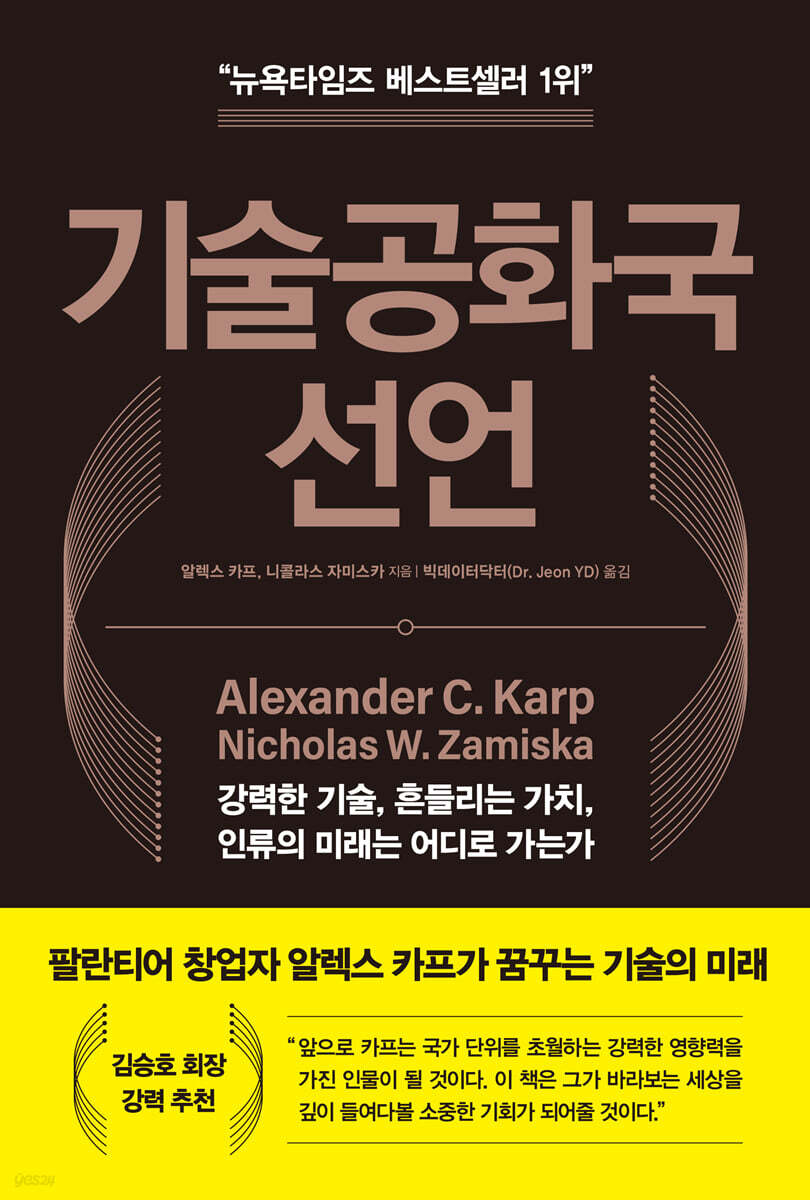
"The Republic of Technology Manifesto," co-authored by Palantir CEO Alex Karp and general counsel Nicholas Jamiska, poses crucial questions for the technological age.
Why is America becoming increasingly weak? The authors argue that technology is at the heart of the problem.
Technology has been the driving force behind America, but the moment that technology loses its ambition for a better future, I believe the entire Western civilization begins to crumble.
The book first examines how Silicon Valley has changed.
Silicon Valley, once a hub for national defense and the public good, has now become a hub for creating consumer products like photo apps and advertising algorithms.
Instead of solving national and societal problems, engineers are now being used as tools for corporate profit.
The authors see this shift as deeply connected not just to the direction of industry, but to the cultural decline of Western society as a whole.
In the past, the United States was a country that pursued development while taking risks, but that is no longer the case.
The tech industry is paying the price for its neglect of its responsibilities to communities and the nation.
The book emphasizes that technology is no longer a mere tool for convenience, but has become a strategic asset that determines the fate of a nation.
In particular, general-purpose technologies such as AI are key to supporting democracy and are emerging as central elements of global politics.
The authors argue that the technology industry should now operate at the center of the nation, not outside it.
Technology must exist for the advancement of human civilization, and AI should be used to redesign and solve core public problems in society, such as healthcare, national defense, and education.
He warns that democracy cannot last if technology ignores publicness and responsibility.
This book strongly criticizes the view that AI development is simply about increasing productivity or entertainment.
In fact, Alex Karp has experience analyzing terrorism and international conflicts using Palantir's software, working with the U.S. Department of Defense, the CIA, and others.
He says AI could be a defender of democracy, or the opposite.
Just as nuclear weapons reshaped the post-war world order, AI should be treated as a strategic asset and used for public and national purposes, he emphasizes.
"The Republic of Technology Manifesto," co-authored by Palantir CEO Alex Karp and general counsel Nicholas Jamiska, poses crucial questions for the technological age.
Why is America becoming increasingly weak? The authors argue that technology is at the heart of the problem.
Technology has been the driving force behind America, but the moment that technology loses its ambition for a better future, I believe the entire Western civilization begins to crumble.
The book first examines how Silicon Valley has changed.
Silicon Valley, once a hub for national defense and the public good, has now become a hub for creating consumer products like photo apps and advertising algorithms.
Instead of solving national and societal problems, engineers are now being used as tools for corporate profit.
The authors see this shift as deeply connected not just to the direction of industry, but to the cultural decline of Western society as a whole.
In the past, the United States was a country that pursued development while taking risks, but that is no longer the case.
The tech industry is paying the price for its neglect of its responsibilities to communities and the nation.
The book emphasizes that technology is no longer a mere tool for convenience, but has become a strategic asset that determines the fate of a nation.
In particular, general-purpose technologies such as AI are key to supporting democracy and are emerging as central elements of global politics.
The authors argue that the technology industry should now operate at the center of the nation, not outside it.
Technology must exist for the advancement of human civilization, and AI should be used to redesign and solve core public problems in society, such as healthcare, national defense, and education.
He warns that democracy cannot last if technology ignores publicness and responsibility.
This book strongly criticizes the view that AI development is simply about increasing productivity or entertainment.
In fact, Alex Karp has experience analyzing terrorism and international conflicts using Palantir's software, working with the U.S. Department of Defense, the CIA, and others.
He says AI could be a defender of democracy, or the opposite.
Just as nuclear weapons reshaped the post-war world order, AI should be treated as a strategic asset and used for public and national purposes, he emphasizes.
- You can preview some of the book's contents.
Preview
index
introduction
PART I The Software Era
Chapter 1: Lost Silicon Valley
Chapter 2 - The Spark of Intelligence
Chapter 3 - The Winner's Mistake
Chapter 4: The End of the Nuclear Age
Part II: The Hollowing Out of the American Spirit
Chapter 5 - Abandonment of Faith
Chapter 6 - The Techno-Agnostic
Chapter 7 - The Balloon with the Broken String
Chapter 8 - Flawed Systems
Chapter 9 - Lost in Toyland
Part III Engineering Mindset
Chapter 10 - Eck's Swarm
Chapter 11 - Improvisational Startups
Chapter 12 - Group Pressure
Chapter 13 - Building Better Weapons for the Military
Chapter 14: Is the World a Cloud or a Clock?
Part IV: Rebuilding the Technological Republic
Chapter 15 - Into the Desert
Chapter 16 - The Price of Integrity
Chapter 17 - The Next Millennium
Chapter 18 - Aesthetic Perspectives
Acknowledgements
Translator's Note
References
References
Image source
Search
PART I The Software Era
Chapter 1: Lost Silicon Valley
Chapter 2 - The Spark of Intelligence
Chapter 3 - The Winner's Mistake
Chapter 4: The End of the Nuclear Age
Part II: The Hollowing Out of the American Spirit
Chapter 5 - Abandonment of Faith
Chapter 6 - The Techno-Agnostic
Chapter 7 - The Balloon with the Broken String
Chapter 8 - Flawed Systems
Chapter 9 - Lost in Toyland
Part III Engineering Mindset
Chapter 10 - Eck's Swarm
Chapter 11 - Improvisational Startups
Chapter 12 - Group Pressure
Chapter 13 - Building Better Weapons for the Military
Chapter 14: Is the World a Cloud or a Clock?
Part IV: Rebuilding the Technological Republic
Chapter 15 - Into the Desert
Chapter 16 - The Price of Integrity
Chapter 17 - The Next Millennium
Chapter 18 - Aesthetic Perspectives
Acknowledgements
Translator's Note
References
References
Image source
Search
Publisher's Review
Why Palantir? Why Kap?
This book outlines the future of power through the philosophy and culture of a unique company called Palantir and the insights of a man named Alex Karp.
It is not a simple interpretation of technology, but an ambitious plan to reconstruct the nation, society, and civilization through technology.
In fact, The Economist named Alex Karp its CEO of the Year for 2024, and in 2025, Time magazine included him in its list of the "100 Most Influential People in the World."
This book clearly shows where the world is headed now.
It is not a mere prediction, but a plan already in motion, a new blueprint that is moving the nation and the market.
This book outlines the future of power through the philosophy and culture of a unique company called Palantir and the insights of a man named Alex Karp.
It is not a simple interpretation of technology, but an ambitious plan to reconstruct the nation, society, and civilization through technology.
In fact, The Economist named Alex Karp its CEO of the Year for 2024, and in 2025, Time magazine included him in its list of the "100 Most Influential People in the World."
This book clearly shows where the world is headed now.
It is not a mere prediction, but a plan already in motion, a new blueprint that is moving the nation and the market.
GOODS SPECIFICS
- Date of issue: August 15, 2025
- Page count, weight, size: 360 pages | 630g | 152*225*23mm
- ISBN13: 9791192248349
- ISBN10: 1192248341
You may also like
카테고리
korean


korean

![GQ KOREA Mark (Monthly): December [2025]](http://librairie.coreenne.fr/cdn/shop/files/8ef265dbbfbf186523ed75ba7319009d.jpg?v=1765340328&width=3840)


