

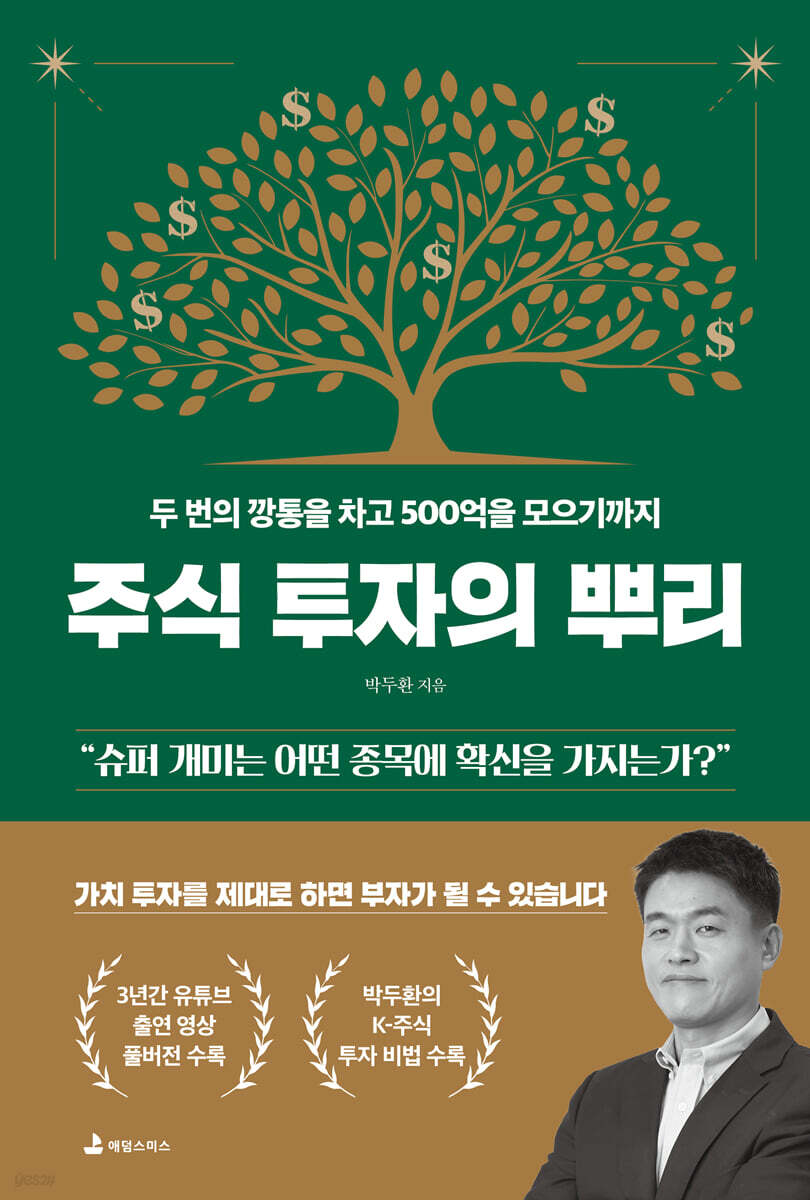
The Roots of Stock Investment
 |
Description
Book Introduction
“Investments with strong roots never fail!”
The Critical Investment Mindset That Will Create a Massive Wealth Gap
Are you currently investing with 'standards and principles'?
It is often said that 'failure is the mother of success'.
However, in the world of stock investment, where a significant amount of money is involved, it is not uncommon for many investors to leave the stock market after a painful fall due to the devastating impact of a single failure.
But here, despite experiencing two failures, he ultimately succeeded as an individual investor managing hundreds of billions in assets.
The main character is Park Du-hwan, the operator of 'Park Du-hwan's Practical Investment Class', which has established itself as a legend among individual investors by amassing over 150,000 subscribers in less than six months since its launch.
The author experienced difficult investment failures during his stock investment journey, once due to overconfidence, and again due to the unavoidable market conditions of the COVID-19 pandemic.
However, instead of remaining stagnant where he had fallen, he went through intense study and self-reflection to understand and practice the 'value of value investing', and ultimately achieved the success that everyone envies.
"The Roots of Stock Investment" is a book filled with the author's insights gained after two brutal failures and practical advice for successful investing.
A concept that the author emphasizes very importantly in the book is 'strongly rooted investment.'
The reeds sway in the wind every day, but because their roots are deep in the ground, they do not fall over easily.
The same goes for investors.
Even if you feel swayed by the ever-fluctuating stock prices, if you have your own investment criteria and beliefs, you can remain steadfast and continue to invest in value.
To deeply and firmly establish the "roots of investment" within us, we must constantly strive to learn and understand the changing world and corporate innovation.
Only then will you develop the insight to recognize the intrinsic value of a company.
At this point, when the KOSPI surpasses 4,000, the Korean stock market is experiencing new momentum and rewriting its remarkable history.
If this trend continues, the KOSPI 5000, which everyone thought was just a dream number, may not be an impossible future at all.
With the expected rise in the valuation of Korean stocks, by building a foundation in value investing with "The Roots of Stock Investment," you'll gain the insight to identify undervalued but incredibly valuable Korean companies.
The Critical Investment Mindset That Will Create a Massive Wealth Gap
Are you currently investing with 'standards and principles'?
It is often said that 'failure is the mother of success'.
However, in the world of stock investment, where a significant amount of money is involved, it is not uncommon for many investors to leave the stock market after a painful fall due to the devastating impact of a single failure.
But here, despite experiencing two failures, he ultimately succeeded as an individual investor managing hundreds of billions in assets.
The main character is Park Du-hwan, the operator of 'Park Du-hwan's Practical Investment Class', which has established itself as a legend among individual investors by amassing over 150,000 subscribers in less than six months since its launch.
The author experienced difficult investment failures during his stock investment journey, once due to overconfidence, and again due to the unavoidable market conditions of the COVID-19 pandemic.
However, instead of remaining stagnant where he had fallen, he went through intense study and self-reflection to understand and practice the 'value of value investing', and ultimately achieved the success that everyone envies.
"The Roots of Stock Investment" is a book filled with the author's insights gained after two brutal failures and practical advice for successful investing.
A concept that the author emphasizes very importantly in the book is 'strongly rooted investment.'
The reeds sway in the wind every day, but because their roots are deep in the ground, they do not fall over easily.
The same goes for investors.
Even if you feel swayed by the ever-fluctuating stock prices, if you have your own investment criteria and beliefs, you can remain steadfast and continue to invest in value.
To deeply and firmly establish the "roots of investment" within us, we must constantly strive to learn and understand the changing world and corporate innovation.
Only then will you develop the insight to recognize the intrinsic value of a company.
At this point, when the KOSPI surpasses 4,000, the Korean stock market is experiencing new momentum and rewriting its remarkable history.
If this trend continues, the KOSPI 5000, which everyone thought was just a dream number, may not be an impossible future at all.
With the expected rise in the valuation of Korean stocks, by building a foundation in value investing with "The Roots of Stock Investment," you'll gain the insight to identify undervalued but incredibly valuable Korean companies.
- You can preview some of the book's contents.
Preview
index
Prologue: From the Despair of Investment Failure to the Roots of Investment
Part 1.
From Failure to Success: My Investment Journey
It's not that I lost money, it's that I lost my way.
The sweetness of reaching your first 100 million, a stroke of luck for beginners.
Broken dreams, deepening darkness
Get back up after failure
My own investment philosophy that blossomed from a broken place
A billion-dollar success and the birth of the North Star
Part 2.
From an Initial Investment of 200 Million to Hundreds of Billions: My Investment Strategy
The Criteria for Value Investing and How to Understand "Value"
Criteria for selecting a company: monopoly power
A strategy of staying with undervalued companies for a long time
How to Invest in Healthy Companies
Why I Don't Buy Stocks That Compete with the US and China
Why focus on domestic investment rather than US investment
Part 3.
What should an investor's mindset be like?
Investments that don't fail, survival strategies
How to Use Credit and Loans Wisely
Short-term trading vs.
Long-Term Holding: Strategies and Choices
Emotional control and patience are essential qualities for investors.
How to Create an Investment Routine and Environment
Mind training to overcome jealousy, comparison, and anxiety
Part 4.
To seize the opportunity without being shaken by the market crash
Finding Opportunity in the Media and News Fear
To develop an eye for reading policies and megatrends
Escape tips for those stuck in the bubble
The necessity and principles of cutting losses
How to take advantage of a plunge caused by a short-term issue
Use securities firm reports for reference only, but don't blindly believe them.
Epilogue_The truth will set you free
Part 1.
From Failure to Success: My Investment Journey
It's not that I lost money, it's that I lost my way.
The sweetness of reaching your first 100 million, a stroke of luck for beginners.
Broken dreams, deepening darkness
Get back up after failure
My own investment philosophy that blossomed from a broken place
A billion-dollar success and the birth of the North Star
Part 2.
From an Initial Investment of 200 Million to Hundreds of Billions: My Investment Strategy
The Criteria for Value Investing and How to Understand "Value"
Criteria for selecting a company: monopoly power
A strategy of staying with undervalued companies for a long time
How to Invest in Healthy Companies
Why I Don't Buy Stocks That Compete with the US and China
Why focus on domestic investment rather than US investment
Part 3.
What should an investor's mindset be like?
Investments that don't fail, survival strategies
How to Use Credit and Loans Wisely
Short-term trading vs.
Long-Term Holding: Strategies and Choices
Emotional control and patience are essential qualities for investors.
How to Create an Investment Routine and Environment
Mind training to overcome jealousy, comparison, and anxiety
Part 4.
To seize the opportunity without being shaken by the market crash
Finding Opportunity in the Media and News Fear
To develop an eye for reading policies and megatrends
Escape tips for those stuck in the bubble
The necessity and principles of cutting losses
How to take advantage of a plunge caused by a short-term issue
Use securities firm reports for reference only, but don't blindly believe them.
Epilogue_The truth will set you free
Detailed image

Into the book
The numbers that appeared before my eyes always seemed to disappear quickly.
My account balance was halved, but I bought riskier stocks to make up for it.
Even then, instead of overcoming the crisis, I was falling deeper into it.
The emotional thought and reckless will to overcome this level of failure actually led to an even greater failure.
While we were picking stocks with only short-term profits in mind and chaotically trading, following the daily news, we neglected to ask the truly important questions.
'Why am I buying this company?' I didn't lose money, I lost my way.
--- p.22
Around the time I was going through the difficult COVID-19 period, a single line of news stopped me in my tracks.
"Working from home and online classes are spreading... demand for laptops is skyrocketing." The moment I saw that sentence, I instinctively thought, "This is a big deal."
As demand for laptops increases, demand for IT components also increases, and as IT moves, semiconductors follow.
It wasn't a sudden insight, but rather a chain reaction that had been ingrained in me for a long time.
I opened the chart again.
Among the KOSDAQ 150 stocks, I placed a strong bet on semiconductor small and medium-sized business stocks.
To drive up the index, large amounts of money will flow into ETFs, which will in turn lead to programmatic buying of stocks with large market capitalizations.
The predictions started to come true.
The stocks I invested in surged, so I sold them and bought back stocks in the same small business sector with market capitalizations of less than 300 billion won that were lower.
--- p.43
I think it was around this time.
I began to see where real 'value' lay, even in places the market ignored.
In my eyes, Doosan seemed like a company with sufficient future value.
Of course, the reaction from the investment community was cynical.
“Nuclear power is finished,” “Doosan is a company that will face a backlash from government policies.” Everyone said that.
But seeing people's reactions, I intuitively felt like I had stumbled upon a great opportunity.
I started slowly moving my money to Doosan.
I sorted out the previously profitable stocks one by one and added them to Doosan like water flowing.
--- p.46
If we had focused only on short-term stock price figures, we would never have been able to survive a bear market or ride a bull market well.
I believe that a good investor is not someone who is good at reading charts, but someone who is good at reading companies.
It has been said that while charts capture people's emotions, a company's intrinsic value captures the truth of its time.
Value investing isn't about picking stocks, it's about asking the question, "Can I trust this company's future?"
Warren Buffett is also said to have said, “The market is impatient, but intrinsic value is not in a hurry.”
I think this short sentence captures the essence of investing.
--- p.52~53
A healthy business is not simply a business that makes a profit.
Short-term gains can be influenced by temporary circumstances, or there may be some external growth that comes from luck.
I believe a healthy company is one that has a structure that can withstand recessions, a constitution that can recover profits, and a strategy that can maintain its balance in a changing environment.
--- p.81
Investing is ultimately an act of making a profit.
So, you have to choose a company that can continue to make money in some way.
To do this, there must be a strong supporter in the market without a strong check.
Against this backdrop, one of my investment principles is 'I don't buy companies that fight the US or China.
It came to be that 'you have to get on board with the company standing next to them'.
If, someday in the distant future, the international situation changes completely, we will have to re-establish this principle.
However, as long as the US and China maintain their dominance of the global economy, this will remain a meaningful strategy for our investors, so please keep that in mind.
--- p.89~90
One interesting thing I've realized about credit is:
What's really important in leveraging credit is the ability to know yourself.
In an investment environment where emotions easily interfere, it's important to be aware of when you're swayed, what news you react to, and what losses you can't afford.
Because credit is a neutral investment tool, the most important thing is the mindset with which it is executed, how it is operated, and the attitude and emotions of the person holding the sword.
That is, the use of credit must always begin from a place where emotions are removed.
--- p.108
So records are important.
Records are longer than memories, and stronger than shaking.
No matter how busy you are or how bad you feel, write down at least one line about 'what stocks I saw today, what I thought, and what I did about it.'
These records pile up and pile up, becoming my own 'standard'.
If you don't organize your daily investment behavior, it won't solidify into a thought, but will just pass by as a simple feeling.
Nothing makes me look at myself more objectively than a sentence I wrote myself.
Moreover, from the moment you start writing your investment journal, you are no longer a consumer of information, but a "producer" who becomes the subject of your own thoughts.
My account balance was halved, but I bought riskier stocks to make up for it.
Even then, instead of overcoming the crisis, I was falling deeper into it.
The emotional thought and reckless will to overcome this level of failure actually led to an even greater failure.
While we were picking stocks with only short-term profits in mind and chaotically trading, following the daily news, we neglected to ask the truly important questions.
'Why am I buying this company?' I didn't lose money, I lost my way.
--- p.22
Around the time I was going through the difficult COVID-19 period, a single line of news stopped me in my tracks.
"Working from home and online classes are spreading... demand for laptops is skyrocketing." The moment I saw that sentence, I instinctively thought, "This is a big deal."
As demand for laptops increases, demand for IT components also increases, and as IT moves, semiconductors follow.
It wasn't a sudden insight, but rather a chain reaction that had been ingrained in me for a long time.
I opened the chart again.
Among the KOSDAQ 150 stocks, I placed a strong bet on semiconductor small and medium-sized business stocks.
To drive up the index, large amounts of money will flow into ETFs, which will in turn lead to programmatic buying of stocks with large market capitalizations.
The predictions started to come true.
The stocks I invested in surged, so I sold them and bought back stocks in the same small business sector with market capitalizations of less than 300 billion won that were lower.
--- p.43
I think it was around this time.
I began to see where real 'value' lay, even in places the market ignored.
In my eyes, Doosan seemed like a company with sufficient future value.
Of course, the reaction from the investment community was cynical.
“Nuclear power is finished,” “Doosan is a company that will face a backlash from government policies.” Everyone said that.
But seeing people's reactions, I intuitively felt like I had stumbled upon a great opportunity.
I started slowly moving my money to Doosan.
I sorted out the previously profitable stocks one by one and added them to Doosan like water flowing.
--- p.46
If we had focused only on short-term stock price figures, we would never have been able to survive a bear market or ride a bull market well.
I believe that a good investor is not someone who is good at reading charts, but someone who is good at reading companies.
It has been said that while charts capture people's emotions, a company's intrinsic value captures the truth of its time.
Value investing isn't about picking stocks, it's about asking the question, "Can I trust this company's future?"
Warren Buffett is also said to have said, “The market is impatient, but intrinsic value is not in a hurry.”
I think this short sentence captures the essence of investing.
--- p.52~53
A healthy business is not simply a business that makes a profit.
Short-term gains can be influenced by temporary circumstances, or there may be some external growth that comes from luck.
I believe a healthy company is one that has a structure that can withstand recessions, a constitution that can recover profits, and a strategy that can maintain its balance in a changing environment.
--- p.81
Investing is ultimately an act of making a profit.
So, you have to choose a company that can continue to make money in some way.
To do this, there must be a strong supporter in the market without a strong check.
Against this backdrop, one of my investment principles is 'I don't buy companies that fight the US or China.
It came to be that 'you have to get on board with the company standing next to them'.
If, someday in the distant future, the international situation changes completely, we will have to re-establish this principle.
However, as long as the US and China maintain their dominance of the global economy, this will remain a meaningful strategy for our investors, so please keep that in mind.
--- p.89~90
One interesting thing I've realized about credit is:
What's really important in leveraging credit is the ability to know yourself.
In an investment environment where emotions easily interfere, it's important to be aware of when you're swayed, what news you react to, and what losses you can't afford.
Because credit is a neutral investment tool, the most important thing is the mindset with which it is executed, how it is operated, and the attitude and emotions of the person holding the sword.
That is, the use of credit must always begin from a place where emotions are removed.
--- p.108
So records are important.
Records are longer than memories, and stronger than shaking.
No matter how busy you are or how bad you feel, write down at least one line about 'what stocks I saw today, what I thought, and what I did about it.'
These records pile up and pile up, becoming my own 'standard'.
If you don't organize your daily investment behavior, it won't solidify into a thought, but will just pass by as a simple feeling.
Nothing makes me look at myself more objectively than a sentence I wrote myself.
Moreover, from the moment you start writing your investment journal, you are no longer a consumer of information, but a "producer" who becomes the subject of your own thoughts.
--- p.123
Publisher's Review
“If you value invest properly, you can become rich!”
After two brutal failures, he became a multi-billionaire.
The Myth of the Super Ant: Park Du-hwan's Value Investing Journey
We often say that our minds, which are easily swayed by external stimuli or changes, are 'like a reed.'
But the reed may sway in the wind, but it does not bend or break easily.
Because it has its roots deep in the ground.
Many investors' minds are swayed like reeds every day.
If you pay attention to the stock prices that fluctuate from time to time and the various issues that cause them to rise and fall, your mind will waver several times a day.
But if we want to make successful investments, what we really need to pay attention to and focus on is not the daily stock prices that pass by like the wind and the flood of news.
Rather, we need to develop the vision to identify companies that will grow over the long term, and equip ourselves with a mindset that supports us on our journey together with those companies.
It may seem like an obvious statement, but there's an unbridgeable river running between those who simply understand the "fundamentals and essence of investment" in their heads and those who put it into practice.
"The Roots of Stock Investment" is a book written by Park Du-hwan, who has failed twice in stock investment but now manages hundreds of billions of won and has established himself as a "super ant." In it, he generously shares his experiences with failure, the lessons he learned from them, and his investment know-how.
The key to deciding whether you become a successful investor or one who leaves the stock market after a single failure lies in your attitude toward failure.
The author, after gaining confidence from the high profits he achieved through beginner's luck, makes a reckless investment and eventually falls into a deep and dark pit of failure.
However, thanks to meticulously reflecting on and reviewing my failures and solidifying the fundamentals of investment, I was able to firmly establish my 'roots in investment'.
“If you are a stock investor, you have probably thought about this at least once.
"Can I change my life with stocks?" Everyone asks this question, and I wanted to answer it with my own experience.
What kind of life changes can a journey of value investing bring, starting from the bottom and building the foundation of investment?
And how did you come to create that 'root'?
This book is a record of my journey.
Some of you reading this book may be enduring a market crash, doubting yourself over and over again, wondering why the stocks keep falling when you buy.
A market where you can't see even an inch ahead, a heart that wavers at every turn, and courage that only gets smaller.
Our tearful story continues somewhere even now.
But please don't lose hope.
“Amidst all these difficulties, if we have just one standard, we can always start over again.” (From the Prologue)
“Never be shaken by the ever-changing market conditions and prices
“Establish your own investment principles and standards!”
From investment selection criteria to mind control know-how
All the essentials of Park Du-hwan's value investing in one book!
The text consists of four parts.
Part 1 details the author's journey from two failures to realizing the true meaning of value investing, ultimately building a fortune worth hundreds of billions of dollars.
The sweetness of the moment when he gained confidence as an investor by achieving seed money of 100 million won in a short period of time, the sudden success that turned out to be poisonous as he lost 200 million won in the blink of an eye and fell into the pit of despair, the time when he pulled himself together and started investing in stocks again to recover, and the second experience of 'can' due to the Corona pandemic that followed, etc. The story of growth and crisis, fall and overcoming unfolds like a drama.
In Part 2, the author outlines his unique value investment strategies and know-how, which formed the basis for his reputation as a "super ant."
For example, he candidly revealed his strategy of pursuing undervalued companies for the long term, his criteria for identifying undervalued companies, and his reasons for focusing on domestic investment rather than investing in the US market, which is currently the trend.
The author foresaw Doosan's future value and growth potential in 2021, a period when no one was paying attention, and began steadily purchasing the company in earnest.
In other words, we boldly placed a bet after recognizing the company's intrinsic value in the undervalued area and recognizing the long-term direction of the market.
By understanding the essence of value investing and practicing it with patience, the author has become an individual investor who now manages hundreds of billions of dollars in assets.
Parts 3 and 4 can be said to be chapters on 'Mindfulness for Value Investors'.
Investors are people who design 'why things have to go up', not fortune tellers who predict 'when things will go up'.
In other words, setting a 'direction' for investment and waiting patiently until then is the basic strategy of a value investor.
So, in addition to discovering companies with good intrinsic value, the most important axis in investing is the mindset that allows investors to maintain their steadfastness even in uncertain investment environments.
In Part 3, we'll learn how to control your emotions and cultivate patience to calm your mind, which fluctuates dozens of times a day, how to create an investment routine and environment that's perfect for you, and how to use mind control to overcome emotions like jealousy and anxiety that hinder healthy investing.
Meanwhile, Part 4 contains know-how to continue investing without losing your mentality even in a market crash.
In particular, practical advice on smart loss-cutting techniques and timing, and how to properly use credit and leverage are essential for real-world investors.
In addition, the book's practicality as a value investment guidebook has been further enhanced by providing space at the back of the book for readers to write their own investment journals and investment checklists.
According to the author, “from the moment you start writing an investment journal, you are no longer a consumer of information, but a ‘producer,’ a subject of thought.”
An investment journal is more than just a record; it's a crucial tool for establishing your own investment philosophy and strategy.
The book includes a sample investment journal actually written by the author, providing readers with a guide to write their own investment journals.
If an investment journal is a daily record of your investments, an investment checklist is a list of questions that help you make objective and standardized investments even when your emotions are swaying.
When faced with issues like short-term price fluctuations, rather than being swayed by emotions and making rash trades, preparing and answering questions that serve as your own benchmarks in advance will allow you to make more rational and reasonable decisions.
“Are you currently making ‘solid investments’?”
The one mindset that will transform you into an investor who reaps overwhelming returns!
This book is not a heroic tale of how an individual investor, who suffered two painful failures, overcame crises and became a super ant.
Rather, it is closer to a self-confession, honestly revealing how he endured the painful times of the stock market crash and repeated self-doubts, and how he maintained his faith in his investments.
According to the author, “learning to invest is not about learning techniques like ‘when the 5-day line breaks, sell, and when the 30-day line rises, buy,’ by looking at a chart. It is a process of building investment convictions that you must create yourself because no one else can do it for you.”
The core of value investing is to 'understand the intrinsic value of a company and invest with a long-term perspective.'
As seen in the case of masters like Warren Buffett, investors who have made their mark in history with overwhelming returns are those who have established the "direction" of their investments through the intrinsic value of a company and have firmly maintained their investment beliefs.
Value investing is not just about picking specific stocks and making long-term investments.
Rather, it's about asking yourself, "Can I trust this company's future?" until the very end, coming up with your own answer, and then waiting with faith until the company's intrinsic value is realized in the market.
Now that the '100-year lifespan' is no longer a dream but a reality, economic power is a matter of survival that is directly linked to a stable and healthy old age.
To have a steady income even in old age when you can't work, you need an income based on investments.
While the wealth gap, centered on real estate, has been the primary variable determining economic power, going forward, the amount of stock held in innovative companies that will transform the future will become a key criterion for determining wealth gaps.
In other words, investing is not just an act of making money; it is an important means of preparing for the future.
If you don't have your own investment beliefs, it's not easy to survive for a long time in the aggressive and threatening stock market.
"The Roots of Stock Investing" teaches you the fundamentals of value investing, as well as how to create and maintain your own investment beliefs.
Until recently, skeptical views such as “the national market is finished” and “the US market is the only answer” were prevalent in the Korean stock market. However, with the recent “KOSPI 4000” era becoming a reality, new vitality is flowing into the Korean stock market.
Here, expectations are growing that the Korea discount will be resolved with policy support such as the revision of the Commercial Act.
With the overall valuation of the Korean stock market expected to rise, if you build a foundation for "strong investment" with "The Roots of Stock Investment," discover the intrinsic value of undervalued companies, and continue investing for the long term, you will undoubtedly be able to transform from an ordinary investor into a successful "super ant investor."
“Value investing is about having faith and waiting.
It's about looking inside a company, asking yourself questions, thinking ahead of the market, and moving forward slowly.
I believe that value always arrives first, and stock price always follows.
I believe that only those who can endure that distance and bear the weight of that time can truly establish the 'roots of investment.'
The entire journey of this book ultimately begins with this one sentence.
“Those who invest in value know how to wait for the essence.” (_'From the text')
After two brutal failures, he became a multi-billionaire.
The Myth of the Super Ant: Park Du-hwan's Value Investing Journey
We often say that our minds, which are easily swayed by external stimuli or changes, are 'like a reed.'
But the reed may sway in the wind, but it does not bend or break easily.
Because it has its roots deep in the ground.
Many investors' minds are swayed like reeds every day.
If you pay attention to the stock prices that fluctuate from time to time and the various issues that cause them to rise and fall, your mind will waver several times a day.
But if we want to make successful investments, what we really need to pay attention to and focus on is not the daily stock prices that pass by like the wind and the flood of news.
Rather, we need to develop the vision to identify companies that will grow over the long term, and equip ourselves with a mindset that supports us on our journey together with those companies.
It may seem like an obvious statement, but there's an unbridgeable river running between those who simply understand the "fundamentals and essence of investment" in their heads and those who put it into practice.
"The Roots of Stock Investment" is a book written by Park Du-hwan, who has failed twice in stock investment but now manages hundreds of billions of won and has established himself as a "super ant." In it, he generously shares his experiences with failure, the lessons he learned from them, and his investment know-how.
The key to deciding whether you become a successful investor or one who leaves the stock market after a single failure lies in your attitude toward failure.
The author, after gaining confidence from the high profits he achieved through beginner's luck, makes a reckless investment and eventually falls into a deep and dark pit of failure.
However, thanks to meticulously reflecting on and reviewing my failures and solidifying the fundamentals of investment, I was able to firmly establish my 'roots in investment'.
“If you are a stock investor, you have probably thought about this at least once.
"Can I change my life with stocks?" Everyone asks this question, and I wanted to answer it with my own experience.
What kind of life changes can a journey of value investing bring, starting from the bottom and building the foundation of investment?
And how did you come to create that 'root'?
This book is a record of my journey.
Some of you reading this book may be enduring a market crash, doubting yourself over and over again, wondering why the stocks keep falling when you buy.
A market where you can't see even an inch ahead, a heart that wavers at every turn, and courage that only gets smaller.
Our tearful story continues somewhere even now.
But please don't lose hope.
“Amidst all these difficulties, if we have just one standard, we can always start over again.” (From the Prologue)
“Never be shaken by the ever-changing market conditions and prices
“Establish your own investment principles and standards!”
From investment selection criteria to mind control know-how
All the essentials of Park Du-hwan's value investing in one book!
The text consists of four parts.
Part 1 details the author's journey from two failures to realizing the true meaning of value investing, ultimately building a fortune worth hundreds of billions of dollars.
The sweetness of the moment when he gained confidence as an investor by achieving seed money of 100 million won in a short period of time, the sudden success that turned out to be poisonous as he lost 200 million won in the blink of an eye and fell into the pit of despair, the time when he pulled himself together and started investing in stocks again to recover, and the second experience of 'can' due to the Corona pandemic that followed, etc. The story of growth and crisis, fall and overcoming unfolds like a drama.
In Part 2, the author outlines his unique value investment strategies and know-how, which formed the basis for his reputation as a "super ant."
For example, he candidly revealed his strategy of pursuing undervalued companies for the long term, his criteria for identifying undervalued companies, and his reasons for focusing on domestic investment rather than investing in the US market, which is currently the trend.
The author foresaw Doosan's future value and growth potential in 2021, a period when no one was paying attention, and began steadily purchasing the company in earnest.
In other words, we boldly placed a bet after recognizing the company's intrinsic value in the undervalued area and recognizing the long-term direction of the market.
By understanding the essence of value investing and practicing it with patience, the author has become an individual investor who now manages hundreds of billions of dollars in assets.
Parts 3 and 4 can be said to be chapters on 'Mindfulness for Value Investors'.
Investors are people who design 'why things have to go up', not fortune tellers who predict 'when things will go up'.
In other words, setting a 'direction' for investment and waiting patiently until then is the basic strategy of a value investor.
So, in addition to discovering companies with good intrinsic value, the most important axis in investing is the mindset that allows investors to maintain their steadfastness even in uncertain investment environments.
In Part 3, we'll learn how to control your emotions and cultivate patience to calm your mind, which fluctuates dozens of times a day, how to create an investment routine and environment that's perfect for you, and how to use mind control to overcome emotions like jealousy and anxiety that hinder healthy investing.
Meanwhile, Part 4 contains know-how to continue investing without losing your mentality even in a market crash.
In particular, practical advice on smart loss-cutting techniques and timing, and how to properly use credit and leverage are essential for real-world investors.
In addition, the book's practicality as a value investment guidebook has been further enhanced by providing space at the back of the book for readers to write their own investment journals and investment checklists.
According to the author, “from the moment you start writing an investment journal, you are no longer a consumer of information, but a ‘producer,’ a subject of thought.”
An investment journal is more than just a record; it's a crucial tool for establishing your own investment philosophy and strategy.
The book includes a sample investment journal actually written by the author, providing readers with a guide to write their own investment journals.
If an investment journal is a daily record of your investments, an investment checklist is a list of questions that help you make objective and standardized investments even when your emotions are swaying.
When faced with issues like short-term price fluctuations, rather than being swayed by emotions and making rash trades, preparing and answering questions that serve as your own benchmarks in advance will allow you to make more rational and reasonable decisions.
“Are you currently making ‘solid investments’?”
The one mindset that will transform you into an investor who reaps overwhelming returns!
This book is not a heroic tale of how an individual investor, who suffered two painful failures, overcame crises and became a super ant.
Rather, it is closer to a self-confession, honestly revealing how he endured the painful times of the stock market crash and repeated self-doubts, and how he maintained his faith in his investments.
According to the author, “learning to invest is not about learning techniques like ‘when the 5-day line breaks, sell, and when the 30-day line rises, buy,’ by looking at a chart. It is a process of building investment convictions that you must create yourself because no one else can do it for you.”
The core of value investing is to 'understand the intrinsic value of a company and invest with a long-term perspective.'
As seen in the case of masters like Warren Buffett, investors who have made their mark in history with overwhelming returns are those who have established the "direction" of their investments through the intrinsic value of a company and have firmly maintained their investment beliefs.
Value investing is not just about picking specific stocks and making long-term investments.
Rather, it's about asking yourself, "Can I trust this company's future?" until the very end, coming up with your own answer, and then waiting with faith until the company's intrinsic value is realized in the market.
Now that the '100-year lifespan' is no longer a dream but a reality, economic power is a matter of survival that is directly linked to a stable and healthy old age.
To have a steady income even in old age when you can't work, you need an income based on investments.
While the wealth gap, centered on real estate, has been the primary variable determining economic power, going forward, the amount of stock held in innovative companies that will transform the future will become a key criterion for determining wealth gaps.
In other words, investing is not just an act of making money; it is an important means of preparing for the future.
If you don't have your own investment beliefs, it's not easy to survive for a long time in the aggressive and threatening stock market.
"The Roots of Stock Investing" teaches you the fundamentals of value investing, as well as how to create and maintain your own investment beliefs.
Until recently, skeptical views such as “the national market is finished” and “the US market is the only answer” were prevalent in the Korean stock market. However, with the recent “KOSPI 4000” era becoming a reality, new vitality is flowing into the Korean stock market.
Here, expectations are growing that the Korea discount will be resolved with policy support such as the revision of the Commercial Act.
With the overall valuation of the Korean stock market expected to rise, if you build a foundation for "strong investment" with "The Roots of Stock Investment," discover the intrinsic value of undervalued companies, and continue investing for the long term, you will undoubtedly be able to transform from an ordinary investor into a successful "super ant investor."
“Value investing is about having faith and waiting.
It's about looking inside a company, asking yourself questions, thinking ahead of the market, and moving forward slowly.
I believe that value always arrives first, and stock price always follows.
I believe that only those who can endure that distance and bear the weight of that time can truly establish the 'roots of investment.'
The entire journey of this book ultimately begins with this one sentence.
“Those who invest in value know how to wait for the essence.” (_'From the text')
GOODS SPECIFICS
- Date of issue: November 10, 2025
- Page count, weight, size: 200 pages | 152*225*20mm
- ISBN13: 9791198758354
You may also like
카테고리
korean


korean

![GQ KOREA Mark (Monthly): December [2025]](http://librairie.coreenne.fr/cdn/shop/files/8ef265dbbfbf186523ed75ba7319009d.jpg?v=1765340328&width=3840)


