

Going through failure
 |
Description
Book Introduction
- A word from MD
-
To those who face countless failuresRecords left by PUBLY founder Park So-ryeong as she looks back on her business journey over the past 10 years.
This book tells the story of one person who learned to be honest with himself amidst the countless confusions and crossroads he faced as a startup founder, and reflects on maintaining a strong attitude as he navigates an uncertain world.
September 23, 2025. Economics and Management PD Oh Da-eun
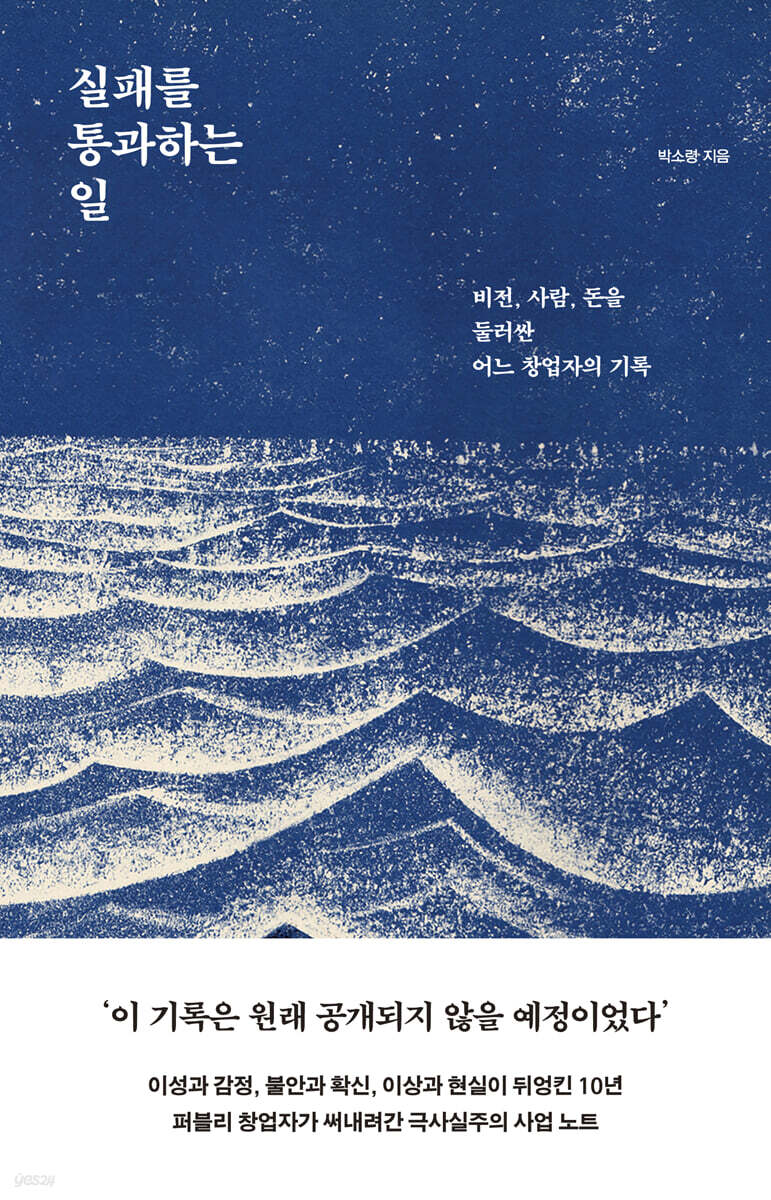
'This record was originally not intended to be made public.'
A hyper-realistic business notebook written over 10 years by the founder of Publi.
《Going Through Failure》 is a business notebook written without reservation by founder Park So-ryeong, who founded and led the content startup 'Publy' for 10 years.
This book is neither a success story of a unicorn company nor a dramatic exit story.
Instead, I honestly recorded the wrong choices, the consequences of those choices, and the crucial scenes where I had to endure in the midst of it all.
The book consists of ten crucial scenes from the ten-year journey.
Each scene vividly depicts the clash between reason and emotion, anxiety and certainty, ideals and reality.
Instead of flashy packaging, misjudgments, regrets, and the weight of responsibility are revealed on every page.
At the same time, it also contains solid insights that can only be gained by those who have faced the entire process head-on.
This book shows readers weary of the glamorous success story what drives them to keep moving forward despite failure and setbacks.
This book, which prioritizes process over results and truth over packaging, will offer honest courage and comfort to all who are wavering on their path.
A hyper-realistic business notebook written over 10 years by the founder of Publi.
《Going Through Failure》 is a business notebook written without reservation by founder Park So-ryeong, who founded and led the content startup 'Publy' for 10 years.
This book is neither a success story of a unicorn company nor a dramatic exit story.
Instead, I honestly recorded the wrong choices, the consequences of those choices, and the crucial scenes where I had to endure in the midst of it all.
The book consists of ten crucial scenes from the ten-year journey.
Each scene vividly depicts the clash between reason and emotion, anxiety and certainty, ideals and reality.
Instead of flashy packaging, misjudgments, regrets, and the weight of responsibility are revealed on every page.
At the same time, it also contains solid insights that can only be gained by those who have faced the entire process head-on.
This book shows readers weary of the glamorous success story what drives them to keep moving forward despite failure and setbacks.
This book, which prioritizes process over results and truth over packaging, will offer honest courage and comfort to all who are wavering on their path.
- You can preview some of the book's contents.
Preview
index
prolog
Journey at a glance
Scene #1.
When the founder quits
Scene #2.
When the founder starts
Scene #3.
Fundraising
Scene #4.
Co-founding (starting together vs.
(People who end together)
Scene #5.
Living as an exhibition CEO
Scene #6.
The problem of resource allocation (when you have more than 10 billion won)
Scene #7.
layoff
Scene #8.
The nature of shareholder relations
Scene #9.
Journey to the End Part 1
Scene #10.
Journey to the End Part 2
Epilogue
References
Journey at a glance
Scene #1.
When the founder quits
Scene #2.
When the founder starts
Scene #3.
Fundraising
Scene #4.
Co-founding (starting together vs.
(People who end together)
Scene #5.
Living as an exhibition CEO
Scene #6.
The problem of resource allocation (when you have more than 10 billion won)
Scene #7.
layoff
Scene #8.
The nature of shareholder relations
Scene #9.
Journey to the End Part 1
Scene #10.
Journey to the End Part 2
Epilogue
References
Into the book
Anyone who takes one step at a time toward a goal they have set for themselves will experience joy and sorrow every day.
Some days I feel full and happy even without eating, and other days I feel like crying or venting my anger alone in a place where no one is around.
Just as the mountain is high, the valley is deep, so too is the joy and frustration.
The time spent going through one's own success or failure is precious and lonely.
So, I hope this book can be a little bit of support to everyone who is quietly going through their own journey, whether it is success or failure.
So that you can go further and longer to where you want to go.
---From the "Prologue"
In the summer of 2017, when I was going through my first layoff, the psychologist I met diagnosed that I was having a hard time because I was so integrated with the company.
Because we are integrated, the company's success and failure are directly linked to my own joys and sorrows.
When good things happened at the company, I felt like I was flying through the clouds, and when bad things happened, I felt like a defeated soldier on the battlefield.
Anyway, the company and I were one, and there was no objection to that.
I thought it was the founder's destiny.
---From "When the Entrepreneur Quits"
Working in the content market was the perfect fit for me, allowing me to immerse myself in something I deeply love while also being able to help others.
It was only after I decided to 'start a business' as a way to work in that market that I was finally convinced.
---From "When an Entrepreneur Starts"
I think that starting a business and investing share similar characteristics in that you have to decide on the conditions for the end before you start, and you have to constantly consider whether to continue or stop after you start.
That you shouldn't be influenced by external circumstances when making decisions.
That your own subjective judgment always comes first.
---From "Fundraising"
I think the question, "Is co-founding necessary?" is similar to the question, "Is marriage necessary?"
If you don't think marriage is necessary, then no matter what people around you say, just don't get married.
On the other hand, if you get caught up in the atmosphere around you and impulsively jump in thinking, "Should I do this too?", you may end up regretting it.
It's the same when you immediately jump to the conclusion of marriage just because you have someone you love.
Because love and marriage are different.
---From "Co-founding"
Entrepreneurs are human too.
As humans, we sometimes face times when our eyes become blind.
Of course, it would be best if you didn't go blind, but what if it's difficult to completely prevent blindness?
I realized, at great cost, that you have to be prepared to get out quickly.
---From "The Problem of Resource Allocation"
Jeff Bezos said that before making a decision, you should first consider whether the decision is reversible or not.
Most decisions are reversible, so if the outcome isn't what you want, you can quickly reverse the decision.
However, decisions regarding shareholders (who to invite as shareholders and what percentage of shares they will have) are difficult to reverse and can be very costly to reverse.
I didn't realize then that a single decision made by a shareholder could have a significant impact on future important decisions for the company.
---From "The Essence of Shareholder Relationships"
One day in February, while I was running, this thought suddenly occurred to me.
'Whatever I do now will have very little impact on whether the company sells well or not.
If the sale goes through, it will be thanks to decisions made over the past decade.
Even if the sale doesn't happen, it's because of the decisions we've made over the past 10 years.
The past ten years cannot be undone, and the final decision on the sale will be made through countless decisions, big and small, that have piled up like layers of sediment.
Well then, let's trust the decisions I've made over the past 10 years.
Just believe.'
---From "Journey to the End Part 1"
Sometimes I think of myself as a pilot flying a plane caught in turbulence.
No matter how severe the turbulence was, I held on tight to the control stick and determined to reach my destination.
Rather than the vague belief that 'I can get there,' the firm determination that 'I will definitely get there' was the fuel that allowed me to grit my teeth and persevere.
I don't think I'll ever forget the feeling of relief I felt the day I finally landed on the ground.
---From "Journey to the End Part 2"
If I had to condense the message of this book into one word, I would say it is 'a ten-year journey of realizing who I am.'
Every decision from the beginning to the end of a business is linked to 'Who am I?'
I've learned that only by knowing who I am can I make decisions that minimize regret.
Some days I feel full and happy even without eating, and other days I feel like crying or venting my anger alone in a place where no one is around.
Just as the mountain is high, the valley is deep, so too is the joy and frustration.
The time spent going through one's own success or failure is precious and lonely.
So, I hope this book can be a little bit of support to everyone who is quietly going through their own journey, whether it is success or failure.
So that you can go further and longer to where you want to go.
---From the "Prologue"
In the summer of 2017, when I was going through my first layoff, the psychologist I met diagnosed that I was having a hard time because I was so integrated with the company.
Because we are integrated, the company's success and failure are directly linked to my own joys and sorrows.
When good things happened at the company, I felt like I was flying through the clouds, and when bad things happened, I felt like a defeated soldier on the battlefield.
Anyway, the company and I were one, and there was no objection to that.
I thought it was the founder's destiny.
---From "When the Entrepreneur Quits"
Working in the content market was the perfect fit for me, allowing me to immerse myself in something I deeply love while also being able to help others.
It was only after I decided to 'start a business' as a way to work in that market that I was finally convinced.
---From "When an Entrepreneur Starts"
I think that starting a business and investing share similar characteristics in that you have to decide on the conditions for the end before you start, and you have to constantly consider whether to continue or stop after you start.
That you shouldn't be influenced by external circumstances when making decisions.
That your own subjective judgment always comes first.
---From "Fundraising"
I think the question, "Is co-founding necessary?" is similar to the question, "Is marriage necessary?"
If you don't think marriage is necessary, then no matter what people around you say, just don't get married.
On the other hand, if you get caught up in the atmosphere around you and impulsively jump in thinking, "Should I do this too?", you may end up regretting it.
It's the same when you immediately jump to the conclusion of marriage just because you have someone you love.
Because love and marriage are different.
---From "Co-founding"
Entrepreneurs are human too.
As humans, we sometimes face times when our eyes become blind.
Of course, it would be best if you didn't go blind, but what if it's difficult to completely prevent blindness?
I realized, at great cost, that you have to be prepared to get out quickly.
---From "The Problem of Resource Allocation"
Jeff Bezos said that before making a decision, you should first consider whether the decision is reversible or not.
Most decisions are reversible, so if the outcome isn't what you want, you can quickly reverse the decision.
However, decisions regarding shareholders (who to invite as shareholders and what percentage of shares they will have) are difficult to reverse and can be very costly to reverse.
I didn't realize then that a single decision made by a shareholder could have a significant impact on future important decisions for the company.
---From "The Essence of Shareholder Relationships"
One day in February, while I was running, this thought suddenly occurred to me.
'Whatever I do now will have very little impact on whether the company sells well or not.
If the sale goes through, it will be thanks to decisions made over the past decade.
Even if the sale doesn't happen, it's because of the decisions we've made over the past 10 years.
The past ten years cannot be undone, and the final decision on the sale will be made through countless decisions, big and small, that have piled up like layers of sediment.
Well then, let's trust the decisions I've made over the past 10 years.
Just believe.'
---From "Journey to the End Part 1"
Sometimes I think of myself as a pilot flying a plane caught in turbulence.
No matter how severe the turbulence was, I held on tight to the control stick and determined to reach my destination.
Rather than the vague belief that 'I can get there,' the firm determination that 'I will definitely get there' was the fuel that allowed me to grit my teeth and persevere.
I don't think I'll ever forget the feeling of relief I felt the day I finally landed on the ground.
---From "Journey to the End Part 2"
If I had to condense the message of this book into one word, I would say it is 'a ten-year journey of realizing who I am.'
Every decision from the beginning to the end of a business is linked to 'Who am I?'
I've learned that only by knowing who I am can I make decisions that minimize regret.
---From the "Epilogue"
Publisher's Review
★ Strongly recommended by Kim Bong-jin, Shin Su-jeong, and Je Hyeon-ju
Ten years of one person who persevered to the end and shouldered responsibility
In 2015, when the concept of paying for digital content was still unfamiliar, 'PUBLY' emerged in the Korean market as an unprecedented business model.
It opened the door to the paid content market by hiring experts and professionals as writers, and has since grown rapidly by launching six services, including the subscription model 'Publy Membership'.
The company's rapid growth, achieved through four rounds of investment from seed to Series B, seemed like a classic success story.
However, the author clearly reveals that even when the company was in the spotlight, countless trials and errors and confusion were repeated internally.
This book is not a chronicle of the company's achievements, but rather a business journal that honestly records the process of overcoming failure.
This book, which speaks of learning rather than regret and the meaning of passing rather than defeat, is the rawest management story that only someone who has embraced and persevered in both business and life can write.
Vision, People, and Money: 10 Crucial Scenes from the Conflict
The author compressed 10 years of time into 10 crucial scenes.
From the start and end of the service, to negotiations with investors, conflicts with shareholders, organizational expansion and painful layoffs, to the final sale.
Each scene is not simply a record of an event, but a moment where vision and reality, data and emotion, collide head-on.
Above all, the key point is that most of the scenes stem from 'wrong decisions' made by the founder.
Some choices created new opportunities, while others came with irreversible consequences.
The subtle tensions with investors, the conflicts with team members, and the cold reactions of customers were always unexpected.
This book captures those moments of conflict, demonstrating that "management is ultimately a battle against uncertainty."
The greatest value of this book lies in the on-site atmosphere and pressure that income statements and strategy reports cannot convey.
This record, which can be called a "hyper-realistic business notebook," does not romanticize failure as a stepping stone to success, but fully conveys its own weight and meaning.
It shows that the process of honestly facing and sharing themes of mistakes, failures, and frustrations can be an asset in itself, and it gives readers the strength to grow together.
Solid insight that only someone who has overcome failure can impart.
From the very first moment of starting a business to the very last moment of sale, the author persistently asks himself, "Who am I?"
And finally, he finds out the real reason why he does this.
The author, who struggled alone, speaks firmly.
“Entrepreneurship is about honestly answering the question, ‘Who am I?’ every day without avoiding it.
So, the most precious thing I have gained over the past 10 years is ‘myself’, who has gone through this time with all my heart.”
While recording painful mistakes, irreversible decisions, and scenes one might wish to ignore, the author does not leave them as mere failures.
Instead, he calmly explains how the process helped him gain a clearer understanding of who he was.
Not only struggling entrepreneurs, but also anyone taking steps toward their self-imposed goals will find relatable moments in this book.
And finally, each of us will find our own answers.
"Why are you doing this? And where are you headed now?" The book poses a simple yet powerful question.
Ultimately, this book is the most honest and realistic management book that allows each person to retrace their life's path and gain the courage to move forward again.
Ten years of one person who persevered to the end and shouldered responsibility
In 2015, when the concept of paying for digital content was still unfamiliar, 'PUBLY' emerged in the Korean market as an unprecedented business model.
It opened the door to the paid content market by hiring experts and professionals as writers, and has since grown rapidly by launching six services, including the subscription model 'Publy Membership'.
The company's rapid growth, achieved through four rounds of investment from seed to Series B, seemed like a classic success story.
However, the author clearly reveals that even when the company was in the spotlight, countless trials and errors and confusion were repeated internally.
This book is not a chronicle of the company's achievements, but rather a business journal that honestly records the process of overcoming failure.
This book, which speaks of learning rather than regret and the meaning of passing rather than defeat, is the rawest management story that only someone who has embraced and persevered in both business and life can write.
Vision, People, and Money: 10 Crucial Scenes from the Conflict
The author compressed 10 years of time into 10 crucial scenes.
From the start and end of the service, to negotiations with investors, conflicts with shareholders, organizational expansion and painful layoffs, to the final sale.
Each scene is not simply a record of an event, but a moment where vision and reality, data and emotion, collide head-on.
Above all, the key point is that most of the scenes stem from 'wrong decisions' made by the founder.
Some choices created new opportunities, while others came with irreversible consequences.
The subtle tensions with investors, the conflicts with team members, and the cold reactions of customers were always unexpected.
This book captures those moments of conflict, demonstrating that "management is ultimately a battle against uncertainty."
The greatest value of this book lies in the on-site atmosphere and pressure that income statements and strategy reports cannot convey.
This record, which can be called a "hyper-realistic business notebook," does not romanticize failure as a stepping stone to success, but fully conveys its own weight and meaning.
It shows that the process of honestly facing and sharing themes of mistakes, failures, and frustrations can be an asset in itself, and it gives readers the strength to grow together.
Solid insight that only someone who has overcome failure can impart.
From the very first moment of starting a business to the very last moment of sale, the author persistently asks himself, "Who am I?"
And finally, he finds out the real reason why he does this.
The author, who struggled alone, speaks firmly.
“Entrepreneurship is about honestly answering the question, ‘Who am I?’ every day without avoiding it.
So, the most precious thing I have gained over the past 10 years is ‘myself’, who has gone through this time with all my heart.”
While recording painful mistakes, irreversible decisions, and scenes one might wish to ignore, the author does not leave them as mere failures.
Instead, he calmly explains how the process helped him gain a clearer understanding of who he was.
Not only struggling entrepreneurs, but also anyone taking steps toward their self-imposed goals will find relatable moments in this book.
And finally, each of us will find our own answers.
"Why are you doing this? And where are you headed now?" The book poses a simple yet powerful question.
Ultimately, this book is the most honest and realistic management book that allows each person to retrace their life's path and gain the courage to move forward again.
GOODS SPECIFICS
- Date of issue: September 19, 2025
- Page count, weight, size: 336 pages | 432g | 135*210*21mm
- ISBN13: 9791175230088
- ISBN10: 1175230081
You may also like
카테고리
korean


korean

![GQ KOREA Mark (Monthly): December [2025]](http://librairie.coreenne.fr/cdn/shop/files/8ef265dbbfbf186523ed75ba7319009d.jpg?v=1765340328&width=3840)


