

People Who Lose to Cancer, People Who Beat Cancer (Longevity Edition)
 |
Description
Book Introduction
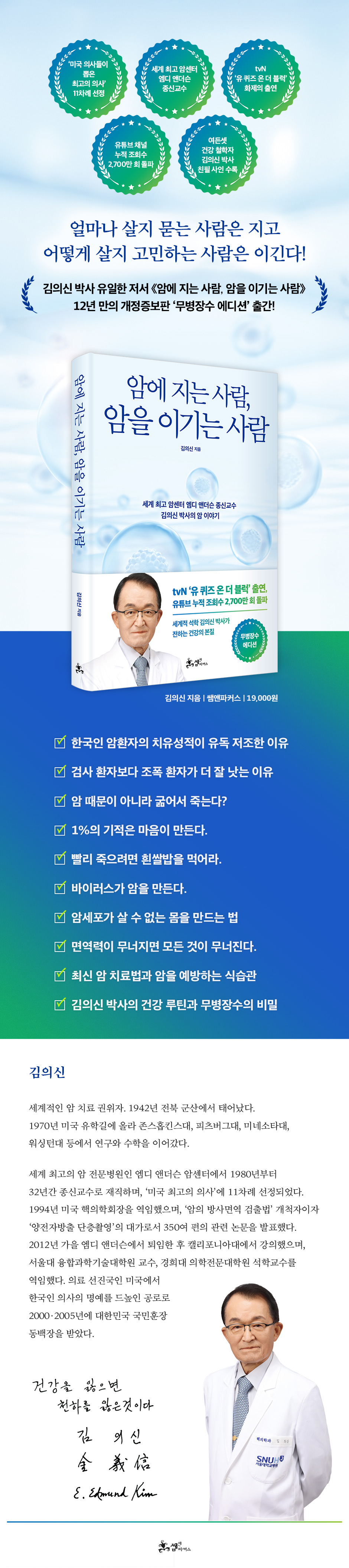
Appearance on tvN's "You Quiz on the Block" surpasses 27 million cumulative YouTube views.
The essence of health, as told by world-renowned scholar Dr. Kim Ui-shin!
"People Who Lose to Cancer, People Who Beat Cancer" is a book written by Dr. Kim Eui-shin about cancer and people who beat it, based on his experience at MD Anderson, the world's leading cancer hospital.
Readers who received comfort and courage have become "active seniors" who dream of a disease-free old age, and in line with this change, the "Healthy Longevity Edition," a revised edition after 12 years, has been published, adding the latest cancer treatments and health routines.
The author, now in his eighties, is living proof of a balanced and healthy life.
It addresses pressing issues for everyone, such as sleep, gut health, blood sugar, and mindset, with practical strategies. Anyone preparing for a healthy old age will find the most reliable answers.
The essence of health, as told by world-renowned scholar Dr. Kim Ui-shin!
"People Who Lose to Cancer, People Who Beat Cancer" is a book written by Dr. Kim Eui-shin about cancer and people who beat it, based on his experience at MD Anderson, the world's leading cancer hospital.
Readers who received comfort and courage have become "active seniors" who dream of a disease-free old age, and in line with this change, the "Healthy Longevity Edition," a revised edition after 12 years, has been published, adding the latest cancer treatments and health routines.
The author, now in his eighties, is living proof of a balanced and healthy life.
It addresses pressing issues for everyone, such as sleep, gut health, blood sugar, and mindset, with practical strategies. Anyone preparing for a healthy old age will find the most reliable answers.
- You can preview some of the book's contents.
Preview
index
|Introducing the Revised Edition|Ancient Wisdom for Saving the Body
|Getting Started|Why Korean Cancer Patients Have Distinctly Low Treatment Results
PART 1: The Story of MD Anderson, the World's Leading Cancer Center
Why Gangster Patients Get Better Than Patients with Probation
Cancer patients who die from starvation, not from cancer
Korean patients are well treated by Korean doctors.
1% of miracles are created by the mind
Don't ask how long you will live, ask how you will live.
joker vs.
A person who cries out loud
Beautiful people who created miracles that seemed impossible
Integrated Medical Care System: A Vision for the Future of the Healthcare Environment
Why do MD Anderson doctors deliberately lose lawsuits?
Our society must move forward 'with' cancer.
Religion and medicine share spirituality.
Volunteer work for cancer patients in progress
A beautiful tradition built through donations
“I am grateful for death.”
PART 2 Changing just a few habits can help prevent and cure cancer.
The chemical composition of white rice is SUGAR
A depressed attitude is a losing battle from the start.
Viruses cause cancer
How to create a body where cancer cells cannot survive
The longer you walk, the longer your healthy lifespan will be.
This is how I stay healthy
Inflammation that killed football players
When your immune system collapses, everything falls apart.
If you live within your means, you won't get seriously sick.
The characteristics of cancer are as diverse as the world's population.
Alzheimer's and vascular diseases are more frightening than cancer.
Why I'm Getting 2,000 Emails a Day
How Our Body Works
Characteristics of young brains
Once you're over 60, age becomes just a number.
PART 3: Walking the Righteous Path with True Faith
Father's advice
What My First Surgery in Vietnam Taught Me
Opportunities opened by prepared English
It may be slow, but it won't stop
When you meet a pioneer, the path opens.
The Correlation Between Cancer Treatment and the Humanities
The joy of learning and sharing together
My will prepared while I am healthy
A life that gives courage to others
A giant who was not afraid of death
Life is a realm governed by God.
School bus driver Gerald
Walk through life at a snail's pace
|In conclusion|The moments that patients gave us as gifts
|Getting Started|Why Korean Cancer Patients Have Distinctly Low Treatment Results
PART 1: The Story of MD Anderson, the World's Leading Cancer Center
Why Gangster Patients Get Better Than Patients with Probation
Cancer patients who die from starvation, not from cancer
Korean patients are well treated by Korean doctors.
1% of miracles are created by the mind
Don't ask how long you will live, ask how you will live.
joker vs.
A person who cries out loud
Beautiful people who created miracles that seemed impossible
Integrated Medical Care System: A Vision for the Future of the Healthcare Environment
Why do MD Anderson doctors deliberately lose lawsuits?
Our society must move forward 'with' cancer.
Religion and medicine share spirituality.
Volunteer work for cancer patients in progress
A beautiful tradition built through donations
“I am grateful for death.”
PART 2 Changing just a few habits can help prevent and cure cancer.
The chemical composition of white rice is SUGAR
A depressed attitude is a losing battle from the start.
Viruses cause cancer
How to create a body where cancer cells cannot survive
The longer you walk, the longer your healthy lifespan will be.
This is how I stay healthy
Inflammation that killed football players
When your immune system collapses, everything falls apart.
If you live within your means, you won't get seriously sick.
The characteristics of cancer are as diverse as the world's population.
Alzheimer's and vascular diseases are more frightening than cancer.
Why I'm Getting 2,000 Emails a Day
How Our Body Works
Characteristics of young brains
Once you're over 60, age becomes just a number.
PART 3: Walking the Righteous Path with True Faith
Father's advice
What My First Surgery in Vietnam Taught Me
Opportunities opened by prepared English
It may be slow, but it won't stop
When you meet a pioneer, the path opens.
The Correlation Between Cancer Treatment and the Humanities
The joy of learning and sharing together
My will prepared while I am healthy
A life that gives courage to others
A giant who was not afraid of death
Life is a realm governed by God.
School bus driver Gerald
Walk through life at a snail's pace
|In conclusion|The moments that patients gave us as gifts
Detailed image
Into the book
There is a saying, “Even rivers and mountains change in 10 years.”
As time passed, my book, “People Who Lose to Cancer, People Who Beat Cancer,” also reached many people.
Twelve years have passed in the blink of an eye, and during that time I've heard from countless cancer patients and their families that this book has given them courage and strength.
Some people said that books were not just information, but a catalyst for life-changing changes.
Every time I hear such stories, I feel a deep sense of gratitude and responsibility.
So, to provide even more help, we have released a revised edition, the 'Healthy Longevity Edition'.
Cancer is like an ever-changing maze.
It has a variety of causes, is constantly undergoing biological changes, and presents differently in each person.
Because it remains an incurable, chronic, systemic disease, we are continually learning how to fight cancer.
As a physician, I have always emphasized the importance of immunotherapy and an integrative approach.
In the past, the goal was to completely eliminate cancer cells using anticancer drugs, but recently, the trend has been to suppress mutations and resistance in cancer cells and reduce the side effects of anticancer treatment.
It has become increasingly important to consider not only the patient's survival rate but also their quality of life, rather than simply treating the disease.
--- pp.7~8, from “Ancient Wisdom for Saving the Body” in the Revised Edition
In contrast, there are certain occupations and people with certain personalities who respond well to treatment.
Treatment results are better in rural areas than in Seoul, in rural areas than in cities, and in people with less education than those with a lot of education.
People who are simple-minded and trusting (even if they sometimes have a short temper) tend to follow doctors' instructions and undergo treatment faithfully, rather than people who think too much and are calculating.
Additionally, people with a cheerful personality tend to tolerate the treatment process well.
Among them, the purity of the so-called 'Kkakdugi' people is impressive to the doctor.
“Tiring~”
“Dr. Kim, I’ll go tomorrow.
“If there is a golf course that is close to the hospital, please let me know.”
“Tiring~”
“Doctor! Oh, you were asleep? I’ll send you a message.
Where's a good bar near the hospital with good drinks? I'd also like to know if my brother's favorite liquor is available for special order.
“It’s Valentine’s Day….”
At this point, I want to ask, 'Does this person know that you're coming to play now?'
And in reality, even after being admitted to the hospital, such patients only think about eating and playing every day.
There is no sign of him being depressed or sad because of the treatment.
These people are just fun and clear about everything.
--- pp.24~25, from “Why Gangster Patients Get Better Than Patients with Prosecutors”
As explained earlier, the medical equipment and skills of medical staff at Korean cancer hospitals are world-class.
This is a fact acknowledged not only by me but also by my colleagues in the United States.
Moreover, thanks to low medical costs, many cancer patients in Korea receive treatment benefits that are unimaginable in other countries.
Moreover, most Korean doctors have completed their studies at renowned overseas hospitals, and Korean cancer hospitals have world-class rates of administering experimental drugs to patients (for example, Seoul National University Hospital ranks fourth in the world).
(…)
Let's take a look at the medical environment again.
The level of medical care is almost the same, but in the US, the cost of tests and medication is nearly 10 times more expensive than in Korea.
You can get a CT or MRI scan at any university hospital or general hospital in Korea for 5 to 10 times cheaper than in the United States.
Recently, with the introduction of robots in surgery, Korean surgeons are performing some of the most efficient surgeries in the world.
The medical facilities at Korean university hospitals are truly world-class.
However, Korean cancer patients seem to be unaware of this reality.
Even though the level of cancer treatment in Korea is evaluated as dazzling in the United States.
But why do Korean cancer patients come to MD Anderson, where the cost is ten times higher, to receive the same treatment? I wondered.
Even the Korean Medical Association politely sends me an official letter every year asking me to tell them what qualities a Korean cancer hospital should have.
I already have everything, so what more can I have? Honestly, whenever I encounter this situation, I feel frustrated and sad.
So what are the real problems?
--- pp.40~42, from “Korean patients are well treated by Korean doctors”
The dining table is one of the easiest things to improve in your daily life if you put your mind to it.
You can think of white rice as just a lump of white sugar.
Imagine sitting across from someone eating a meal and scooping up white sugar with a spoon.
Isn't it scary? If you chew rice for a long time, it actually tastes sweet.
One time, out of curiosity, I ate white rice and checked my blood sugar level.
There was a clear difference when I measured my blood sugar level after eating mixed grain rice.
Of course, when I ate white rice, my blood sugar level rose a lot, but when I ate mixed grain rice, it didn't.
If there's one thing that's difficult about staying in Korea, it's this.
When you go out to eat at a restaurant, most of the time they serve white rice.
It is very rare for barley rice or mixed grain rice to be served.
Even in hospitals, there are places that give white rice to patients.
At first, I doubted my eyes because of the sight that was below common sense.
--- p.115, from “Sugar, the chemical component of white rice”
Hippocrates, the father of medicine, said, “If food is not enough to cure a disease, neither doctors nor medicine can cure it.”
“All disease begins in the gut,” he said.
The human intestine absorbs nutrients over a large surface area equivalent to the size of a tennis court, and gut health is closely related to overall health.
The intestines are not simply an organ that digests food; they are also a second liver that performs detoxification functions and are the largest immune organ, containing over 70% of immune cells.
(…)
Our bodies are at their healthiest when they are slightly alkaline (pH 7.35-7.45), but when inflammation occurs, the body becomes acidic.
Most animal foods, except fish, duck, and black goat, are acidic, while most vegetables are alkaline.
Meat is slow to digest and can remain in the intestines for a long time, causing constipation and diarrhoea.
A diverticulum is a long pouch that forms when a part of a tube inside the body (such as the esophagus, stomach, small intestine, or large intestine) swells.
If the mutation becomes trapped in the sac, it can cause chronic inflammation and increase the risk of developing polyps or cancer.
Therefore, when eating meat, it is advisable to eat it with vegetables rich in fiber.
When the pH of our body falls below 7.0, acidification occurs, which can cause various diseases.
Most vegetables are alkaline, while animal products and carbonated beverages are acidifying.
Osteoporosis also occurs when the body removes calcium from bones to prevent acidification.
African women maintain straight backs and no osteoporosis because they eat a vegetable-based diet.
--- pp.144~145, from “Healthy life expectancy increases as walking time increases”
Foods rich in antioxidants that can help boost brain health and memory include:
1.
Fruits of various colors, such as oranges, pomegranates, and kiwis, are rich in vitamin C, which helps suppress oxidative stress.
2.
Broccoli, spinach, almonds, sunflower seeds, and olive oil are rich in vitamin E, which helps prevent cognitive decline.
3.
Fatty fish such as salmon, tuna, and sardines are rich in omega-3 fatty acids, which may help maintain memory.
4.
Eggs are rich in choline, which helps maintain and develop brain function.
5.
Carrots, tomatoes, sweet potatoes, mangoes, pumpkins, red and orange peppers, and kale are rich in carotenoids.
6.
Blueberries are rich in polyphenols and anthocyanins, which improve memory and cognitive ability.
7.
Dark chocolate is rich in caffeine, flavonoids, and antioxidants, which help improve concentration.
8.
Green tea is rich in catechins and polyphenols, so drinking 1-2 cups a day can improve concentration and have neuroprotective properties.
As time passed, my book, “People Who Lose to Cancer, People Who Beat Cancer,” also reached many people.
Twelve years have passed in the blink of an eye, and during that time I've heard from countless cancer patients and their families that this book has given them courage and strength.
Some people said that books were not just information, but a catalyst for life-changing changes.
Every time I hear such stories, I feel a deep sense of gratitude and responsibility.
So, to provide even more help, we have released a revised edition, the 'Healthy Longevity Edition'.
Cancer is like an ever-changing maze.
It has a variety of causes, is constantly undergoing biological changes, and presents differently in each person.
Because it remains an incurable, chronic, systemic disease, we are continually learning how to fight cancer.
As a physician, I have always emphasized the importance of immunotherapy and an integrative approach.
In the past, the goal was to completely eliminate cancer cells using anticancer drugs, but recently, the trend has been to suppress mutations and resistance in cancer cells and reduce the side effects of anticancer treatment.
It has become increasingly important to consider not only the patient's survival rate but also their quality of life, rather than simply treating the disease.
--- pp.7~8, from “Ancient Wisdom for Saving the Body” in the Revised Edition
In contrast, there are certain occupations and people with certain personalities who respond well to treatment.
Treatment results are better in rural areas than in Seoul, in rural areas than in cities, and in people with less education than those with a lot of education.
People who are simple-minded and trusting (even if they sometimes have a short temper) tend to follow doctors' instructions and undergo treatment faithfully, rather than people who think too much and are calculating.
Additionally, people with a cheerful personality tend to tolerate the treatment process well.
Among them, the purity of the so-called 'Kkakdugi' people is impressive to the doctor.
“Tiring~”
“Dr. Kim, I’ll go tomorrow.
“If there is a golf course that is close to the hospital, please let me know.”
“Tiring~”
“Doctor! Oh, you were asleep? I’ll send you a message.
Where's a good bar near the hospital with good drinks? I'd also like to know if my brother's favorite liquor is available for special order.
“It’s Valentine’s Day….”
At this point, I want to ask, 'Does this person know that you're coming to play now?'
And in reality, even after being admitted to the hospital, such patients only think about eating and playing every day.
There is no sign of him being depressed or sad because of the treatment.
These people are just fun and clear about everything.
--- pp.24~25, from “Why Gangster Patients Get Better Than Patients with Prosecutors”
As explained earlier, the medical equipment and skills of medical staff at Korean cancer hospitals are world-class.
This is a fact acknowledged not only by me but also by my colleagues in the United States.
Moreover, thanks to low medical costs, many cancer patients in Korea receive treatment benefits that are unimaginable in other countries.
Moreover, most Korean doctors have completed their studies at renowned overseas hospitals, and Korean cancer hospitals have world-class rates of administering experimental drugs to patients (for example, Seoul National University Hospital ranks fourth in the world).
(…)
Let's take a look at the medical environment again.
The level of medical care is almost the same, but in the US, the cost of tests and medication is nearly 10 times more expensive than in Korea.
You can get a CT or MRI scan at any university hospital or general hospital in Korea for 5 to 10 times cheaper than in the United States.
Recently, with the introduction of robots in surgery, Korean surgeons are performing some of the most efficient surgeries in the world.
The medical facilities at Korean university hospitals are truly world-class.
However, Korean cancer patients seem to be unaware of this reality.
Even though the level of cancer treatment in Korea is evaluated as dazzling in the United States.
But why do Korean cancer patients come to MD Anderson, where the cost is ten times higher, to receive the same treatment? I wondered.
Even the Korean Medical Association politely sends me an official letter every year asking me to tell them what qualities a Korean cancer hospital should have.
I already have everything, so what more can I have? Honestly, whenever I encounter this situation, I feel frustrated and sad.
So what are the real problems?
--- pp.40~42, from “Korean patients are well treated by Korean doctors”
The dining table is one of the easiest things to improve in your daily life if you put your mind to it.
You can think of white rice as just a lump of white sugar.
Imagine sitting across from someone eating a meal and scooping up white sugar with a spoon.
Isn't it scary? If you chew rice for a long time, it actually tastes sweet.
One time, out of curiosity, I ate white rice and checked my blood sugar level.
There was a clear difference when I measured my blood sugar level after eating mixed grain rice.
Of course, when I ate white rice, my blood sugar level rose a lot, but when I ate mixed grain rice, it didn't.
If there's one thing that's difficult about staying in Korea, it's this.
When you go out to eat at a restaurant, most of the time they serve white rice.
It is very rare for barley rice or mixed grain rice to be served.
Even in hospitals, there are places that give white rice to patients.
At first, I doubted my eyes because of the sight that was below common sense.
--- p.115, from “Sugar, the chemical component of white rice”
Hippocrates, the father of medicine, said, “If food is not enough to cure a disease, neither doctors nor medicine can cure it.”
“All disease begins in the gut,” he said.
The human intestine absorbs nutrients over a large surface area equivalent to the size of a tennis court, and gut health is closely related to overall health.
The intestines are not simply an organ that digests food; they are also a second liver that performs detoxification functions and are the largest immune organ, containing over 70% of immune cells.
(…)
Our bodies are at their healthiest when they are slightly alkaline (pH 7.35-7.45), but when inflammation occurs, the body becomes acidic.
Most animal foods, except fish, duck, and black goat, are acidic, while most vegetables are alkaline.
Meat is slow to digest and can remain in the intestines for a long time, causing constipation and diarrhoea.
A diverticulum is a long pouch that forms when a part of a tube inside the body (such as the esophagus, stomach, small intestine, or large intestine) swells.
If the mutation becomes trapped in the sac, it can cause chronic inflammation and increase the risk of developing polyps or cancer.
Therefore, when eating meat, it is advisable to eat it with vegetables rich in fiber.
When the pH of our body falls below 7.0, acidification occurs, which can cause various diseases.
Most vegetables are alkaline, while animal products and carbonated beverages are acidifying.
Osteoporosis also occurs when the body removes calcium from bones to prevent acidification.
African women maintain straight backs and no osteoporosis because they eat a vegetable-based diet.
--- pp.144~145, from “Healthy life expectancy increases as walking time increases”
Foods rich in antioxidants that can help boost brain health and memory include:
1.
Fruits of various colors, such as oranges, pomegranates, and kiwis, are rich in vitamin C, which helps suppress oxidative stress.
2.
Broccoli, spinach, almonds, sunflower seeds, and olive oil are rich in vitamin E, which helps prevent cognitive decline.
3.
Fatty fish such as salmon, tuna, and sardines are rich in omega-3 fatty acids, which may help maintain memory.
4.
Eggs are rich in choline, which helps maintain and develop brain function.
5.
Carrots, tomatoes, sweet potatoes, mangoes, pumpkins, red and orange peppers, and kale are rich in carotenoids.
6.
Blueberries are rich in polyphenols and anthocyanins, which improve memory and cognitive ability.
7.
Dark chocolate is rich in caffeine, flavonoids, and antioxidants, which help improve concentration.
8.
Green tea is rich in catechins and polyphenols, so drinking 1-2 cups a day can improve concentration and have neuroprotective properties.
--- pp.198~199, from “Characteristics of People with Young Brains”
Publisher's Review
The health bestseller "People Who Lose to Cancer, People Who Beat Cancer" is now in a revised edition after 12 years, a hot topic in the "Healthy Longevity Edition"!
The number of cancer survivors has increased from 610,000 in 2012 to 1.47 million.
This is thanks to a significant increase in the number of people surviving more than five years after being diagnosed with cancer.
Cancer treatment is no longer limited to simply eliminating cancer cells.
The medical paradigm is shifting toward suppressing mutations and resistance, minimizing side effects, and simultaneously improving survival rates and quality of life.
Dr. Kim Ui-shin was the first person to point out this huge turning point.
He served as a tenured professor at MD Anderson for 32 years and was named one of the "Best Doctors in America" 11 times.
Having received the Order of Civil Merit, Dongbaek Medal twice, he has spent 50 years working with countless cancer patients and has come to one conviction.
“Don’t ask how long you have to live, but rather how you will live from now on.” In reality, rather than overcoming cancer, we have seen countless people who have found something to live for, bravely endure treatment, coexist with cancer cells, and live out the rest of their lives in good health.
His insight became more and more brilliant over time.
As his experience and beliefs were accepted not only by the Korean medical community but also by the public, he received attention from various media outlets, including major broadcasters, news agencies, and YouTube.
His only published book, “People Who Lose to Cancer, People Who Win Against Cancer,” has also been revised into a “Healthy Longevity Edition” to keep pace with the “era of cancer survivors” that is currently prevalent in this era.
Beyond simply overcoming cancer, it contains deep insights and practical routines for living a long, disease-free life.
The attitude toward life proven by 83-year-old health philosopher Dr. Kim Eui-shin through his own practice.
The 'Longevity and Health Edition' of 'People Who Defeat Cancer, People Who Beat Cancer' declares its expansion beyond a book on cancer treatment into a book on life recovery.
Even at the age of eighty-three, Dr. Kim Ui-shin continues to lecture and write between Korea and the United States, and his life is the most convincing evidence of a long and healthy life.
The book is full of specific advice on maintaining balance in your life.
He recommends that cancer patients and those trying to prevent cancer chew duck and black goat meat thoroughly.
Our bodies are at their healthiest when they are slightly alkaline, with a pH level of 7.35 to 7.45, but they become acidic when inflammation occurs.
Most animal foods are acidic, but fish, duck, and black goat are exceptions that are closer to alkaline foods.
He says this eating habit helps prevent acidification of the body and maintain immunity.
He introduced seaweed as the secret to turtles' longevity on tvN's 'You Quiz on the Block', creating a nationwide seaweed craze. He faithfully included in his book the healthy ingredients that were not introduced on TV.
Exercise is also an essential part of health.
“Exercise is part of the treatment,” says Dr. Kim, emphasizing swimming in particular.
Swimming not only balances your entire body, but it also helps relieve chronic pain by blocking pain signals and promoting the release of endorphins.
Rather than simply relieving pain, it is a method that improves the root cause of pain by reducing inflammation.
In addition, the book is notable for the additions that were made to reflect readers' requests and the trends of the times.
'Life spans as long as the walking time', 'This is how to stay healthy', 'How our body works', 'The brain is a characteristic of people who are young', 'Age becomes a number after 60', etc. contain practical insights into how the body and brain work, healthy aging, and daily routines.
Beyond overcoming cancer, we focus on changing daily life and improving quality of life.
Dr. Kim Ui-shin always says this.
“If you lose your health, you lose the world.” His handwritten message makes this revised edition even more special.
Still living a healthy life at the age of eighty-three, he appears before readers again as a 'persuader proven by life', beyond being a medical expert.
There is a clear path to a long, disease-free life, and anyone can begin that journey with this book.
This book, steeped in a philosophy of health, will inspire those preparing for a healthy old age to embrace a more robust and freer approach to life.
The number of cancer survivors has increased from 610,000 in 2012 to 1.47 million.
This is thanks to a significant increase in the number of people surviving more than five years after being diagnosed with cancer.
Cancer treatment is no longer limited to simply eliminating cancer cells.
The medical paradigm is shifting toward suppressing mutations and resistance, minimizing side effects, and simultaneously improving survival rates and quality of life.
Dr. Kim Ui-shin was the first person to point out this huge turning point.
He served as a tenured professor at MD Anderson for 32 years and was named one of the "Best Doctors in America" 11 times.
Having received the Order of Civil Merit, Dongbaek Medal twice, he has spent 50 years working with countless cancer patients and has come to one conviction.
“Don’t ask how long you have to live, but rather how you will live from now on.” In reality, rather than overcoming cancer, we have seen countless people who have found something to live for, bravely endure treatment, coexist with cancer cells, and live out the rest of their lives in good health.
His insight became more and more brilliant over time.
As his experience and beliefs were accepted not only by the Korean medical community but also by the public, he received attention from various media outlets, including major broadcasters, news agencies, and YouTube.
His only published book, “People Who Lose to Cancer, People Who Win Against Cancer,” has also been revised into a “Healthy Longevity Edition” to keep pace with the “era of cancer survivors” that is currently prevalent in this era.
Beyond simply overcoming cancer, it contains deep insights and practical routines for living a long, disease-free life.
The attitude toward life proven by 83-year-old health philosopher Dr. Kim Eui-shin through his own practice.
The 'Longevity and Health Edition' of 'People Who Defeat Cancer, People Who Beat Cancer' declares its expansion beyond a book on cancer treatment into a book on life recovery.
Even at the age of eighty-three, Dr. Kim Ui-shin continues to lecture and write between Korea and the United States, and his life is the most convincing evidence of a long and healthy life.
The book is full of specific advice on maintaining balance in your life.
He recommends that cancer patients and those trying to prevent cancer chew duck and black goat meat thoroughly.
Our bodies are at their healthiest when they are slightly alkaline, with a pH level of 7.35 to 7.45, but they become acidic when inflammation occurs.
Most animal foods are acidic, but fish, duck, and black goat are exceptions that are closer to alkaline foods.
He says this eating habit helps prevent acidification of the body and maintain immunity.
He introduced seaweed as the secret to turtles' longevity on tvN's 'You Quiz on the Block', creating a nationwide seaweed craze. He faithfully included in his book the healthy ingredients that were not introduced on TV.
Exercise is also an essential part of health.
“Exercise is part of the treatment,” says Dr. Kim, emphasizing swimming in particular.
Swimming not only balances your entire body, but it also helps relieve chronic pain by blocking pain signals and promoting the release of endorphins.
Rather than simply relieving pain, it is a method that improves the root cause of pain by reducing inflammation.
In addition, the book is notable for the additions that were made to reflect readers' requests and the trends of the times.
'Life spans as long as the walking time', 'This is how to stay healthy', 'How our body works', 'The brain is a characteristic of people who are young', 'Age becomes a number after 60', etc. contain practical insights into how the body and brain work, healthy aging, and daily routines.
Beyond overcoming cancer, we focus on changing daily life and improving quality of life.
Dr. Kim Ui-shin always says this.
“If you lose your health, you lose the world.” His handwritten message makes this revised edition even more special.
Still living a healthy life at the age of eighty-three, he appears before readers again as a 'persuader proven by life', beyond being a medical expert.
There is a clear path to a long, disease-free life, and anyone can begin that journey with this book.
This book, steeped in a philosophy of health, will inspire those preparing for a healthy old age to embrace a more robust and freer approach to life.
GOODS SPECIFICS
- Date of issue: May 14, 2025
- Page count, weight, size: 296 pages | 520g | 153*224*20mm
- ISBN13: 9791194755197
- ISBN10: 1194755194
You may also like
카테고리
korean


korean

![ELLE 엘르 스페셜 에디션 A형 : 12월 [2025]](http://librairie.coreenne.fr/cdn/shop/files/b8e27a3de6c9538896439686c6b0e8fb.jpg?v=1766436872&width=3840)


