

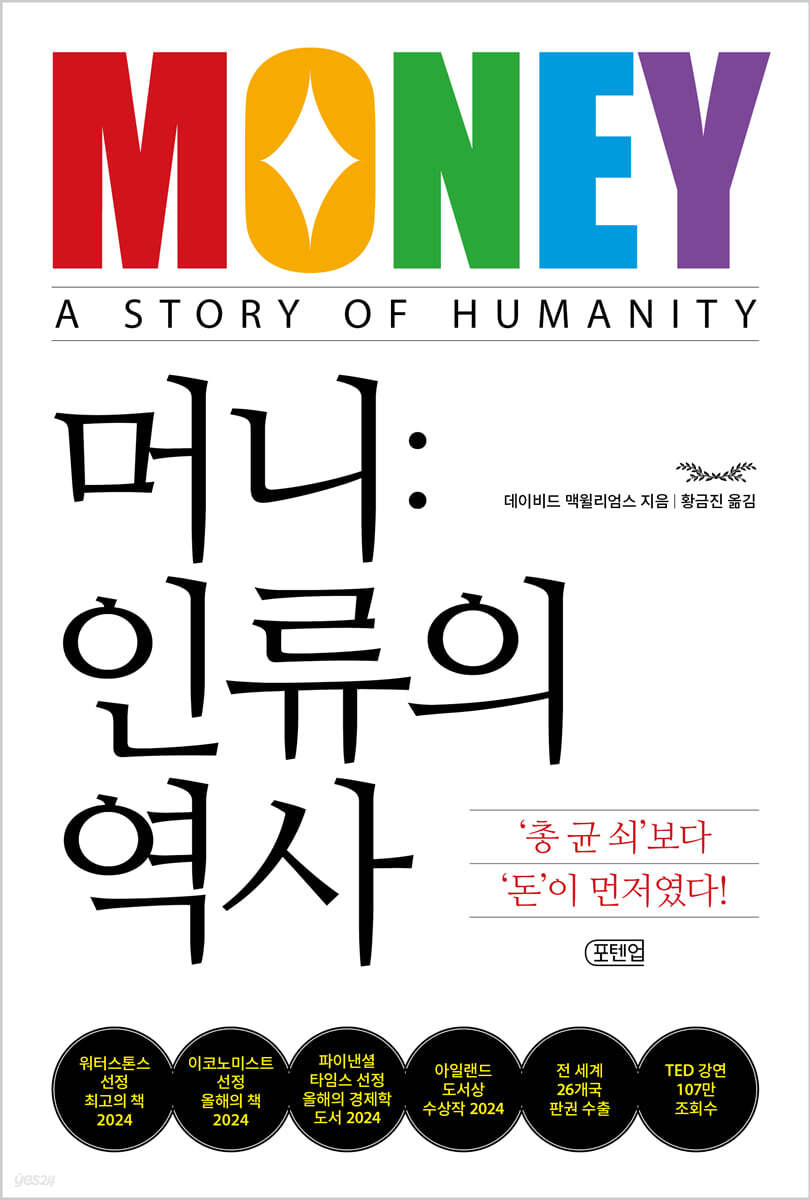
Money: A History of Humanity
 |
Description
Book Introduction
- A word from MD
-
Homo sapiens evolved with money.From the fall of the Roman Empire to the modern digital economy.
The most powerful force that has driven human history has been 'money'.
Economist David McWilliams reinterprets the evolution of money and 5,000 years of civilization with sharp insight and humor.
The hidden truths of money, the greatest technology that defines the nature of humanity.
September 19, 2025. Economics and Management PD Oh Da-eun
than 'Guns, Germs, and Steel'
'Money' came first!
The human history of money, praised by media and intellectuals around the world
★Waterstones' Best Books of 2024
★[Economist] Books of the Year 2024
★[Financial Times] Economics Book of the Year 2024
★2024 Irish Book Award Winner
★Exported to 26 countries worldwide
★TED Talk 1.07 million views
★[Prospect Magazine] Book of the Year 2024
★6th most influential economist in the world
★James Joyce Award-winning author
“In the end, it was money that ruled mankind!”
Observing 5,000 Years of History Through Money, Humanity's Greatest Invention
David McWilliams, an Irish economist who holds the title of the 6th most influential economist in the world and a James Joyce Award-winning author.
『Money: A History of Humanity』, which he wrote over the course of five years, is a work that reinterprets 5,000 years of human history focusing on the 'money issue'.
Why did the Roman Empire fall? Why did Europe come to dominate the world? How did the small 17th-century Netherlands establish colonies around the world? Why was the world's first printing press invented in Germany? Why did a revolution overthrow the king occur in France, of all European countries? How did global hegemony shift from Britain to the United States? What is the common answer to all these questions? It's that behind the scenes, there was a hidden agenda: money.
In fact, this problem is so commonplace that it is easy to overlook.
Moreover, because all historical events are superficially wrapped in plausible justifications, the essential issues are often obscured by political rhetoric and not clearly visible.
While many people may know that Roman emperors devalued their currency to cover their living expenses, many may not realize how closely linked the fall of the Roman Empire and the devaluation of their currency were.
We also know that Europe dominated the world by colonizing Africa and the Americas with the immense power of 'guns, germs, and steel', but we do not know that it was 'finance' that made colonial business possible.
In fact, behind the development of technology and the development of the maritime and trade industries, there existed a financial system led by a sophisticated credit system.
This is in contrast to the Aztec Empire, which was created by Native Americans.
For them, only a very basic form of currency existed, and there was no financial system whatsoever.
David McWilliams wows readers with humor, wit, and a smooth writing style while thoroughly exposing the fundamental problems inherent in historical events we already know.
This book was selected as one of the best books of 2024 by Waterstones, the largest bookstore chain in the UK, and was so talked about that it was selected as the book of the year (2024) by several media outlets including [The Economist], [The Financial Times], and [Prospect Magazine].
Currently, it is exported to 26 countries, and the number of exporting countries is increasing.
'Money' came first!
The human history of money, praised by media and intellectuals around the world
★Waterstones' Best Books of 2024
★[Economist] Books of the Year 2024
★[Financial Times] Economics Book of the Year 2024
★2024 Irish Book Award Winner
★Exported to 26 countries worldwide
★TED Talk 1.07 million views
★[Prospect Magazine] Book of the Year 2024
★6th most influential economist in the world
★James Joyce Award-winning author
“In the end, it was money that ruled mankind!”
Observing 5,000 Years of History Through Money, Humanity's Greatest Invention
David McWilliams, an Irish economist who holds the title of the 6th most influential economist in the world and a James Joyce Award-winning author.
『Money: A History of Humanity』, which he wrote over the course of five years, is a work that reinterprets 5,000 years of human history focusing on the 'money issue'.
Why did the Roman Empire fall? Why did Europe come to dominate the world? How did the small 17th-century Netherlands establish colonies around the world? Why was the world's first printing press invented in Germany? Why did a revolution overthrow the king occur in France, of all European countries? How did global hegemony shift from Britain to the United States? What is the common answer to all these questions? It's that behind the scenes, there was a hidden agenda: money.
In fact, this problem is so commonplace that it is easy to overlook.
Moreover, because all historical events are superficially wrapped in plausible justifications, the essential issues are often obscured by political rhetoric and not clearly visible.
While many people may know that Roman emperors devalued their currency to cover their living expenses, many may not realize how closely linked the fall of the Roman Empire and the devaluation of their currency were.
We also know that Europe dominated the world by colonizing Africa and the Americas with the immense power of 'guns, germs, and steel', but we do not know that it was 'finance' that made colonial business possible.
In fact, behind the development of technology and the development of the maritime and trade industries, there existed a financial system led by a sophisticated credit system.
This is in contrast to the Aztec Empire, which was created by Native Americans.
For them, only a very basic form of currency existed, and there was no financial system whatsoever.
David McWilliams wows readers with humor, wit, and a smooth writing style while thoroughly exposing the fundamental problems inherent in historical events we already know.
This book was selected as one of the best books of 2024 by Waterstones, the largest bookstore chain in the UK, and was so talked about that it was selected as the book of the year (2024) by several media outlets including [The Economist], [The Financial Times], and [Prospect Magazine].
Currently, it is exported to 26 countries, and the number of exporting countries is increasing.
- You can preview some of the book's contents.
Preview
index
Map 011
The fight over who will win the trust Michael Lewis 015
Preface: Money is more powerful than religion, ideology, or the military. 018
Plate 033
Part 1: Ancient Money
Chapter 1: In the Beginning Was There Money? 050
Chapter 2: On the Rivers of Babylon 059
Chapter 3: The Birth of Coins 069
Chapter 4: Money and the Greek Spirit 080
Chapter 5: The Roman Empire: A Land of Money and Credit 094
Part 2 Medieval Money
Chapter 6: The Fall and Resurgence of Money 120
Chapter 7: Saracen Magic 135
Chapter 8: From Darkness to Light 152
Chapter 9: God's Printing Press 174
Part 3 Revolutionary Money
Chapter 10: The Rise of the Financial Bourgeoisie 196
Chapter 11: The Father of Monetary Economics 215
Chapter 12: The Bishop of Money 230
Chapter 13: Money and the American Republic 246
Part 4 Modern Money
Chapter 14: Money, the Energy Source of the Evolutionary Economy 264
Chapter 15: Blood Money 280
Chapter 16: Yellow Brick Road 298
Chapter 17: An Era Overflowing with Capital and Ideas 313
Chapter 18: The Pit of Despair 328
Part 5: Money Unbound
Chapter 19: Who Controls Money? 350
Chapter 20: The Psychology of Money 371
Chapter 21: The Evolution of Money 387
Acknowledgments 404
Americas 409
Americas Commentary 421
Source of illustration 428
Index 429
The fight over who will win the trust Michael Lewis 015
Preface: Money is more powerful than religion, ideology, or the military. 018
Plate 033
Part 1: Ancient Money
Chapter 1: In the Beginning Was There Money? 050
Chapter 2: On the Rivers of Babylon 059
Chapter 3: The Birth of Coins 069
Chapter 4: Money and the Greek Spirit 080
Chapter 5: The Roman Empire: A Land of Money and Credit 094
Part 2 Medieval Money
Chapter 6: The Fall and Resurgence of Money 120
Chapter 7: Saracen Magic 135
Chapter 8: From Darkness to Light 152
Chapter 9: God's Printing Press 174
Part 3 Revolutionary Money
Chapter 10: The Rise of the Financial Bourgeoisie 196
Chapter 11: The Father of Monetary Economics 215
Chapter 12: The Bishop of Money 230
Chapter 13: Money and the American Republic 246
Part 4 Modern Money
Chapter 14: Money, the Energy Source of the Evolutionary Economy 264
Chapter 15: Blood Money 280
Chapter 16: Yellow Brick Road 298
Chapter 17: An Era Overflowing with Capital and Ideas 313
Chapter 18: The Pit of Despair 328
Part 5: Money Unbound
Chapter 19: Who Controls Money? 350
Chapter 20: The Psychology of Money 371
Chapter 21: The Evolution of Money 387
Acknowledgments 404
Americas 409
Americas Commentary 421
Source of illustration 428
Index 429
Detailed image

Into the book
In ancient times, when women were considered nothing more than property, Lydian women had the right to refuse marriage and choose their own spouses.
These early, small traces of women's liberation clearly demonstrate the freedom and power that money symbolized (remember, most people at this time were slaves).
--- p.74
One of the reasons Protestantism was so attractive was that if a monarch converted, he could seize the property of the Catholic Church.
Henry VIII, the English king, who was known for being a great traitor and a terrible financial mismanager, was very tempted by the idea of confiscating church lands.
--- p.191
Money is a powerful tool for innovation.
Just looking at the fact that the Aztec civilization had no financial system, doesn't that tell us why Europe had to be technologically ahead?
--- p.193
The Netherlands is known as a free and inclusive country, but in reality, the wealth they acquired was plundered from Africa and Asia.
They borrowed money from merchants to support their navy.
--- p.202
Classical economics, taught in universities around the world, assumes that people are rational when making decisions about money, unswayed by emotions or rumors.
But have you ever met such a person? Humans are beautiful, yet flawed creatures.
--- p.209
The truth hidden behind the lofty ideals and flashy rhetoric is that most revolutions are ultimately about money.
And revolutionaries usually promise to 'give the money back to the people.'
--- p.233
Monoculture is the same in evolutionary economics.
This is a shortcut to poverty.
Diversity is the path to wealth, except in oil-producing countries.
Diversity opens up more choices, more combinations, and new possibilities for commercial interaction.
--- p.277
Lenin saw colonialism as the pinnacle of capitalism.
Because the balance of wealth was tilted towards the imperialist countries.
There was a continuous 100-year period in which the flow of money was determined by which countries conquered and were conquered.
This period also saw innovations in finance, stock markets, and international capital, unifying the world into a single monetary system.
--- p.295~296
From that perspective, it is only natural that the era of fiat currency coincided with the most dynamic period of global economic expansion in human history.
When people have money, the economy becomes dynamic and miracles happen.
These early, small traces of women's liberation clearly demonstrate the freedom and power that money symbolized (remember, most people at this time were slaves).
--- p.74
One of the reasons Protestantism was so attractive was that if a monarch converted, he could seize the property of the Catholic Church.
Henry VIII, the English king, who was known for being a great traitor and a terrible financial mismanager, was very tempted by the idea of confiscating church lands.
--- p.191
Money is a powerful tool for innovation.
Just looking at the fact that the Aztec civilization had no financial system, doesn't that tell us why Europe had to be technologically ahead?
--- p.193
The Netherlands is known as a free and inclusive country, but in reality, the wealth they acquired was plundered from Africa and Asia.
They borrowed money from merchants to support their navy.
--- p.202
Classical economics, taught in universities around the world, assumes that people are rational when making decisions about money, unswayed by emotions or rumors.
But have you ever met such a person? Humans are beautiful, yet flawed creatures.
--- p.209
The truth hidden behind the lofty ideals and flashy rhetoric is that most revolutions are ultimately about money.
And revolutionaries usually promise to 'give the money back to the people.'
--- p.233
Monoculture is the same in evolutionary economics.
This is a shortcut to poverty.
Diversity is the path to wealth, except in oil-producing countries.
Diversity opens up more choices, more combinations, and new possibilities for commercial interaction.
--- p.277
Lenin saw colonialism as the pinnacle of capitalism.
Because the balance of wealth was tilted towards the imperialist countries.
There was a continuous 100-year period in which the flow of money was determined by which countries conquered and were conquered.
This period also saw innovations in finance, stock markets, and international capital, unifying the world into a single monetary system.
--- p.295~296
From that perspective, it is only natural that the era of fiat currency coincided with the most dynamic period of global economic expansion in human history.
When people have money, the economy becomes dynamic and miracles happen.
--- p.354
Publisher's Review
than 'Guns, Germs, and Steel'
'Money' came first!
The human history of money, praised by media and intellectuals around the world
★Waterstones' Best Books of 2024
★[Economist] Books of the Year 2024
★[Financial Times] Economics Book of the Year 2024
★2024 Irish Book Award Winner
★Exported to 26 countries worldwide
★TED Talk 1.07 million views
★[Prospect Magazine] Book of the Year 2024
★6th most influential economist in the world
★James Joyce Award-winning author
“In the end, it was money that ruled mankind!”
Observing 5,000 Years of History Through Money, Humanity's Greatest Invention
Money controls everything.
A person's life, the joys and sorrows of life, and even human relationships.
If we analyze the causes of the numerous incidents and accidents that appear on the social news pages every day, we find that many of them are actually triggered by money.
Because humans are survival machines and money is an essential element for survival.
So, would human history be significantly different? Of course not.
David McWilliams, an Irish economist who holds the title of the 6th most influential economist in the world and a James Joyce Award-winning author.
『Money: A History of Humanity』, which he wrote over the course of five years, is a work that reinterprets 5,000 years of human history centered around the 'money issue'.
This book discusses the evolution of money, from the time when most of humanity was enslaved, through barter, the emergence of metal currency, the emergence of paper money in the Middle Ages, the development of commerce and financial systems, and now the digital economy and cryptocurrencies of today.
Why did the Roman Empire fall? Why did Europe come to dominate the world? How did the small 17th-century Netherlands establish colonies around the world? Why was the world's first printing press invented in Germany? Why did a revolution overthrow the king occur in France, of all European countries? How did global hegemony shift from Britain to the United States? What's the common answer to all these questions? It's that behind the scenes, there was a hidden agenda: money.
In fact, this problem is so commonplace that it is easy to overlook.
Moreover, because all historical events are superficially wrapped in plausible justifications, the essential issues are often obscured by political rhetoric and not clearly visible.
While many people may know that Roman emperors devalued their currency to cover their living expenses, many may not realize how closely linked the fall of the Roman Empire and the devaluation of their currency were.
We also know that Europe dominated the world by colonizing Africa and the Americas with the immense power of 'guns, germs, and steel', but we do not know that it was 'finance' that made colonial business possible.
In fact, behind the development of technology and the development of the maritime and trade industries, there existed a financial system led by a sophisticated credit system.
This is in contrast to the Aztec Empire, which was created by Native Americans.
For them, only a very basic form of currency existed, and there was no financial system whatsoever.
David McWilliams wows readers with humor, wit, and a smooth writing style while thoroughly exposing the fundamental problems inherent in historical events we already know.
This book was selected as one of the best books of 2024 by Waterstones, the largest bookstore chain in the UK, and was so talked about that it was selected as the book of the year (2024) by several media outlets including [The Economist], [The Financial Times], and [Prospect Magazine].
Also, “It makes all the other books about money that have ever been published meaningless,” “It’s the only economics book I’ve ever read that I wanted to read again from the beginning,” “His writing style is like a mix of Bill Bryson’s lightness and Clive James’s wit and erudition.
His book is enthusiastic not only among opinion leaders but also among general readers who do not know much about economics, as evidenced by the reader reviews that say things like, “It’s a masterpiece!”
This book has been exported to 26 countries and the number of exporting countries is increasing.
The Power of Money to Change the World
A writer who combines the lightness of Bill Bryson with the weight of Jared Diamond.
As can be seen from the extensive list of reference books, which exceeds 200 volumes, the content of this book is not that simple, as it covers the history of mankind.
Also, ordinary readers who feel a headache just from seeing terms like balance sheet, double-entry bookkeeping, perpetual bonds, reserve currency, fiat currency, central bank, and collateralized loan may shake their heads before even reading.
However, the author's writing draws the reader in from the introduction.
This is because you will find yourself drawn into his narrative, which begins with the episode of Hitler's counterfeiting operation and Lenin's currency destruction policy, which recognized the power of money as more powerful than force early on.
The author excels at transforming dry topics into captivating narratives based on thorough research.
This is thanks to the way the story unfolds centered around characters rather than listing events chronologically, and the author's characteristically intellectual humor and brisk writing style add to the story's power.
Starting with Kusim, the first person whose name is recorded in human history, through Emperors Nero and Vespasian, Dante, Fibonacci, Gutenberg and Peter the Great, Jonathan Swift and Charles Talleyrand, Alexander Hamilton who laid the foundation for today's fiat currency system, Charles Darwin who was inspired by Thomas Malthus's "Essay on the Principle of Population" and completed the theory of evolution, Roger Casement who was executed as a human rights activist and traitor, James Joyce who showed that the fundamentals of businessmen and artists are not different, and even [The Wizard of Oz] which symbolizes the class struggle and culture war in America, each and every story the author tells is not only intellectually entertaining but also incredibly interesting, like watching a high-quality masterpiece drama.
“No money, no history.”
Illustrations and maps to help you understand the human history of money.
The front of this book contains maps and a wealth of illustrations to help you understand the content.
Maps showing ancient and medieval currencies, and trade routes between the Netherlands and England, Portugal and France, and Spain, will be helpful when compared with the text.
In addition, the 35 illustrations, including the Isabel bone made around 18,000 BC that appears in the text, an owl coin from the Greek era, a fresco of Mercury, the god of commerce, discovered in the ruins of Pompeii, and the Colosseum, will be of great help in understanding the content.
Amazon Reader Reviews
★★★★★Excellent.
I have over 50 books on money, and this one makes them all meaningless.
His writing style seems to combine the lightness of Bill Bryson with the wit and erudition of Clive James.
It's a masterpiece! Mr.
PJ
Masters
★★★★★A great book that even people who aren't interested in economics will find really enjoyable.
"Money" is a remarkable book, the only economics book I've ever read that made me want to read it all over again.
Emma
★★★★★A perfect book to save as a Christmas gift and read during the holidays.
The author is truly a fountain of knowledge! Preno
★★★★★A book that is hard to put down.
It is a fascinating story, characterized by an easy and flowing writing style.
It sparkles with interesting facts from beginning to end.
Mrs. F Taylerson
★★★★★Exactly the book I was looking for! barbara.taylor
★★★★★This book is really great.
Thoroughly entertaining and informative from beginning to end.
This is the best economics book for non-experts I've ever read! markr
★★★★★The author transforms a common and difficult subject into a story that is dazzlingly new, interesting, and entertaining!
Nadim Chaudhry
★★★★★ A book that made me think about the mysterious power of money.
Frank Drebin
'Money' came first!
The human history of money, praised by media and intellectuals around the world
★Waterstones' Best Books of 2024
★[Economist] Books of the Year 2024
★[Financial Times] Economics Book of the Year 2024
★2024 Irish Book Award Winner
★Exported to 26 countries worldwide
★TED Talk 1.07 million views
★[Prospect Magazine] Book of the Year 2024
★6th most influential economist in the world
★James Joyce Award-winning author
“In the end, it was money that ruled mankind!”
Observing 5,000 Years of History Through Money, Humanity's Greatest Invention
Money controls everything.
A person's life, the joys and sorrows of life, and even human relationships.
If we analyze the causes of the numerous incidents and accidents that appear on the social news pages every day, we find that many of them are actually triggered by money.
Because humans are survival machines and money is an essential element for survival.
So, would human history be significantly different? Of course not.
David McWilliams, an Irish economist who holds the title of the 6th most influential economist in the world and a James Joyce Award-winning author.
『Money: A History of Humanity』, which he wrote over the course of five years, is a work that reinterprets 5,000 years of human history centered around the 'money issue'.
This book discusses the evolution of money, from the time when most of humanity was enslaved, through barter, the emergence of metal currency, the emergence of paper money in the Middle Ages, the development of commerce and financial systems, and now the digital economy and cryptocurrencies of today.
Why did the Roman Empire fall? Why did Europe come to dominate the world? How did the small 17th-century Netherlands establish colonies around the world? Why was the world's first printing press invented in Germany? Why did a revolution overthrow the king occur in France, of all European countries? How did global hegemony shift from Britain to the United States? What's the common answer to all these questions? It's that behind the scenes, there was a hidden agenda: money.
In fact, this problem is so commonplace that it is easy to overlook.
Moreover, because all historical events are superficially wrapped in plausible justifications, the essential issues are often obscured by political rhetoric and not clearly visible.
While many people may know that Roman emperors devalued their currency to cover their living expenses, many may not realize how closely linked the fall of the Roman Empire and the devaluation of their currency were.
We also know that Europe dominated the world by colonizing Africa and the Americas with the immense power of 'guns, germs, and steel', but we do not know that it was 'finance' that made colonial business possible.
In fact, behind the development of technology and the development of the maritime and trade industries, there existed a financial system led by a sophisticated credit system.
This is in contrast to the Aztec Empire, which was created by Native Americans.
For them, only a very basic form of currency existed, and there was no financial system whatsoever.
David McWilliams wows readers with humor, wit, and a smooth writing style while thoroughly exposing the fundamental problems inherent in historical events we already know.
This book was selected as one of the best books of 2024 by Waterstones, the largest bookstore chain in the UK, and was so talked about that it was selected as the book of the year (2024) by several media outlets including [The Economist], [The Financial Times], and [Prospect Magazine].
Also, “It makes all the other books about money that have ever been published meaningless,” “It’s the only economics book I’ve ever read that I wanted to read again from the beginning,” “His writing style is like a mix of Bill Bryson’s lightness and Clive James’s wit and erudition.
His book is enthusiastic not only among opinion leaders but also among general readers who do not know much about economics, as evidenced by the reader reviews that say things like, “It’s a masterpiece!”
This book has been exported to 26 countries and the number of exporting countries is increasing.
The Power of Money to Change the World
A writer who combines the lightness of Bill Bryson with the weight of Jared Diamond.
As can be seen from the extensive list of reference books, which exceeds 200 volumes, the content of this book is not that simple, as it covers the history of mankind.
Also, ordinary readers who feel a headache just from seeing terms like balance sheet, double-entry bookkeeping, perpetual bonds, reserve currency, fiat currency, central bank, and collateralized loan may shake their heads before even reading.
However, the author's writing draws the reader in from the introduction.
This is because you will find yourself drawn into his narrative, which begins with the episode of Hitler's counterfeiting operation and Lenin's currency destruction policy, which recognized the power of money as more powerful than force early on.
The author excels at transforming dry topics into captivating narratives based on thorough research.
This is thanks to the way the story unfolds centered around characters rather than listing events chronologically, and the author's characteristically intellectual humor and brisk writing style add to the story's power.
Starting with Kusim, the first person whose name is recorded in human history, through Emperors Nero and Vespasian, Dante, Fibonacci, Gutenberg and Peter the Great, Jonathan Swift and Charles Talleyrand, Alexander Hamilton who laid the foundation for today's fiat currency system, Charles Darwin who was inspired by Thomas Malthus's "Essay on the Principle of Population" and completed the theory of evolution, Roger Casement who was executed as a human rights activist and traitor, James Joyce who showed that the fundamentals of businessmen and artists are not different, and even [The Wizard of Oz] which symbolizes the class struggle and culture war in America, each and every story the author tells is not only intellectually entertaining but also incredibly interesting, like watching a high-quality masterpiece drama.
“No money, no history.”
Illustrations and maps to help you understand the human history of money.
The front of this book contains maps and a wealth of illustrations to help you understand the content.
Maps showing ancient and medieval currencies, and trade routes between the Netherlands and England, Portugal and France, and Spain, will be helpful when compared with the text.
In addition, the 35 illustrations, including the Isabel bone made around 18,000 BC that appears in the text, an owl coin from the Greek era, a fresco of Mercury, the god of commerce, discovered in the ruins of Pompeii, and the Colosseum, will be of great help in understanding the content.
Amazon Reader Reviews
★★★★★Excellent.
I have over 50 books on money, and this one makes them all meaningless.
His writing style seems to combine the lightness of Bill Bryson with the wit and erudition of Clive James.
It's a masterpiece! Mr.
PJ
Masters
★★★★★A great book that even people who aren't interested in economics will find really enjoyable.
"Money" is a remarkable book, the only economics book I've ever read that made me want to read it all over again.
Emma
★★★★★A perfect book to save as a Christmas gift and read during the holidays.
The author is truly a fountain of knowledge! Preno
★★★★★A book that is hard to put down.
It is a fascinating story, characterized by an easy and flowing writing style.
It sparkles with interesting facts from beginning to end.
Mrs. F Taylerson
★★★★★Exactly the book I was looking for! barbara.taylor
★★★★★This book is really great.
Thoroughly entertaining and informative from beginning to end.
This is the best economics book for non-experts I've ever read! markr
★★★★★The author transforms a common and difficult subject into a story that is dazzlingly new, interesting, and entertaining!
Nadim Chaudhry
★★★★★ A book that made me think about the mysterious power of money.
Frank Drebin
GOODS SPECIFICS
- Date of issue: September 25, 2025
- Page count, weight, size: 448 pages | 676g | 152*225*28mm
- ISBN13: 9791198902566
- ISBN10: 1198902566
You may also like
카테고리
korean


korean

![ELLE 엘르 스페셜 에디션 A형 : 12월 [2025]](http://librairie.coreenne.fr/cdn/shop/files/b8e27a3de6c9538896439686c6b0e8fb.jpg?v=1766436872&width=3840)


