

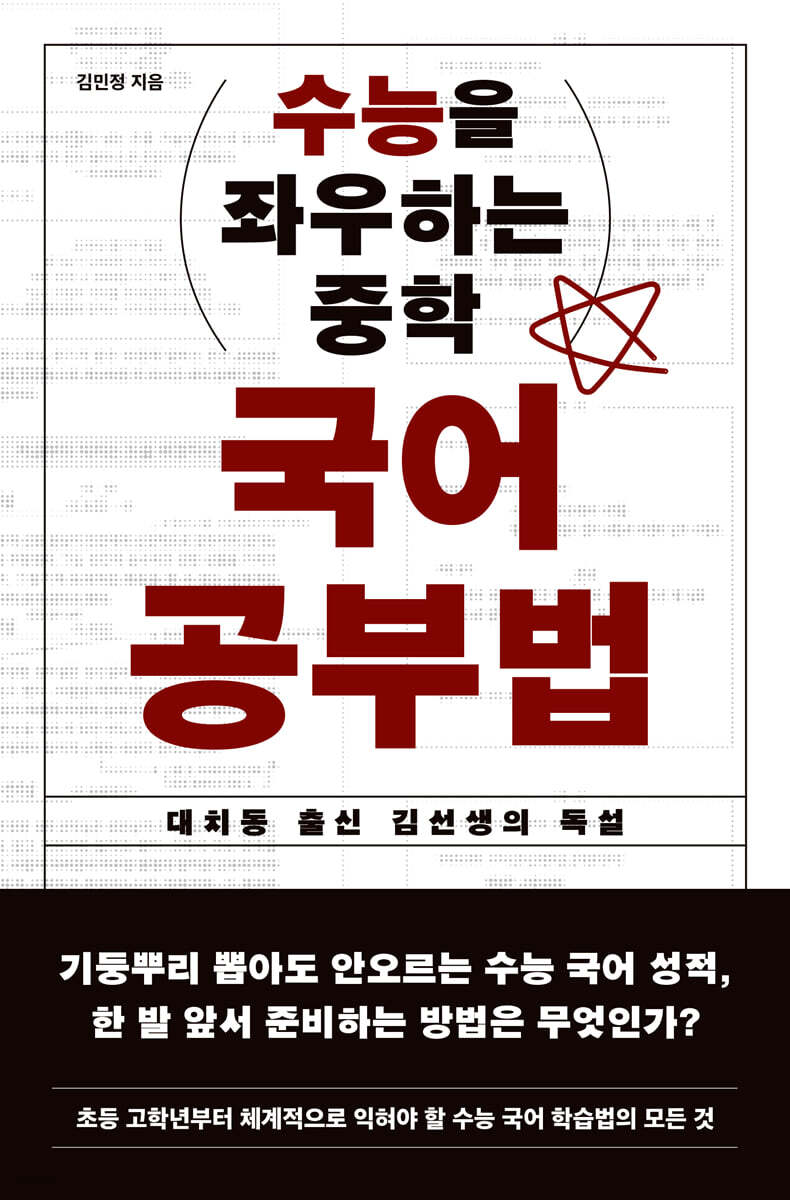
Middle School Korean Language Study Methods That Affect the College Scholastic Ability Test
 |
Description
Book Introduction
* From now on, literacy will determine the CSAT score. How to properly master the Korean language, which is holding back top students.
* A sharp comment and a detailed schedule from Mr. Kim from Daechi-dong who has parents excited on social media.
* A complete summary of the elementary and middle school Korean language learning roadmap that parents are most curious about.
“My child is good at math and science, but he is very weak in Korean and English.” “In math and English, the results are proportional to the amount of money you put into them, but in Korean, even if you pull out three of the pillars, it doesn’t work.” No matter how much private tutoring you receive, you can’t improve your child’s grades in Korean in a short period of time.
The author, a Korean language education expert, points out the reality that children suffer from going from one academy to another and parents lose money on private education, but do not achieve results commensurate with the amount of effort they put in after entering middle school. He introduces a customized Korean language study method that actually helps improve grades and college entrance.
From how to choose academies and textbooks to how to study Chinese characters, writing, grammar, reading literature and non-fiction, and preparing for exams, let's take a closer look at the essential Korean language education for each stage, from preschool through middle school 1st, 2nd, and 3rd grade.
You will see at a glance the Korean language learning roadmap that will lead to successful college admission.
* A sharp comment and a detailed schedule from Mr. Kim from Daechi-dong who has parents excited on social media.
* A complete summary of the elementary and middle school Korean language learning roadmap that parents are most curious about.
“My child is good at math and science, but he is very weak in Korean and English.” “In math and English, the results are proportional to the amount of money you put into them, but in Korean, even if you pull out three of the pillars, it doesn’t work.” No matter how much private tutoring you receive, you can’t improve your child’s grades in Korean in a short period of time.
The author, a Korean language education expert, points out the reality that children suffer from going from one academy to another and parents lose money on private education, but do not achieve results commensurate with the amount of effort they put in after entering middle school. He introduces a customized Korean language study method that actually helps improve grades and college entrance.
From how to choose academies and textbooks to how to study Chinese characters, writing, grammar, reading literature and non-fiction, and preparing for exams, let's take a closer look at the essential Korean language education for each stage, from preschool through middle school 1st, 2nd, and 3rd grade.
You will see at a glance the Korean language learning roadmap that will lead to successful college admission.
- You can preview some of the book's contents.
Preview
index
Starting with the mindset before becoming a parent of a middle school student
Part 1.
Why should I study Korean in middle school?
1.
The subject that holds back top students at the very gates of medical school
2.
Korean has become the second most important language after math in college entrance exams.
The Importance of Literacy and the Revised 2028 College Scholastic Ability Test
3.
Why You Should Start Studying Korean Seriously in Middle School
· Friends with reading comprehension skills up to 3rd year of middle school vs.
Friends who don't have one
· The polarization of elementary school students' literacy skills in the COVID-19 era.
4.
Cooking is easy when the knife is sharp.
· If your goal is to enter a Korean university, English kindergartens are not recommended.
|A word from Mr. Kim_I regret sending my child to an English kindergarten.
5.
My child has always been the top student in middle school. Should I send him to a Korean language academy?
Should I study vocabulary separately? If so, when should I start?
· Recommended method for faster vocabulary growth
|A word from Mr. Kim_This is the best way to quickly memorize vocabulary.
· If you don't have time, reading newspapers and novels is not recommended.
· If you really want to read the newspaper, do it like this
Part 2.
The truth and lies of the Korean language section of the CSAT, as revealed by the teacher himself.
1.
Is reading multiple times always beneficial? NO!
2.
How to Tackle Difficult Non-Fiction Problems
· Look at the problem first and then solve it? Why it absolutely won't work.
· The key points are all between paragraphs 1 and 3.
· Establish proper standards for underlining.
· Find parts where the same thing is expressed differently
· Be sure to take notes on science, technology, engineering, medicine, and economics texts.
· Infer the meaning of unfamiliar vocabulary by considering the context.
3.
How can I build non-literary background knowledge?
· Preparing for the law field fingerprint
· Preparing for the economics section
· Prepare for the Philosophy and Humanities section
· Prepare for fingerprints in science and engineering
|A word from Mr. Kim: Don't try to understand the extremely difficult non-literary text; just say, "I guess so."
4.
How to prepare for the Korean language mock exam
· A classic way to solve Korean mock exams
· Literature: Master the concepts before entering the first year of high school.
· Grammar: Complete reading twice before entering the first year of high school.
|A word from Mr. Kim_After taking the test, you should develop the habit of analyzing your own weaknesses.
Part 3.
Reading and writing, coaching like this is extremely effective.
1.
In fact, your child may not have hated books at all.
·The secret to Korean language skills is romance novels?
·The countless opportunities that come with reading and writing well
·The writing I read while being dirty becomes mine.
2.
If you're planning to attend a specialized or autonomous high school, a reading list is even more important.
· Thoughts on the changed college entrance exam system
A Word from Mr. Kim: Think Before Sending Your Child to a Science High School or Gifted School
· What kind of students do private high schools across the country select?
· Writing a self-introduction for admission to a specialized high school
|A word from Mr. Kim_Is my child a child who will adapt well to private high schools and specialized high schools?
· Prepare experiences or activities related to character development
· Recommended activity table for preparing for admission to specialized high schools by grade level
3.
How to organize a reading list
· The secret to creating a high-quality reading list
· Be sure to copy and keep your reading log.
|A word from Mr. Kim_It is difficult to be fooled by just one reading lecture you heard at the academy!
4.
A writing framework that will enrich your life
· The structure of a light-hearted reading log (reading report)
· The writing structure of a light-hearted essay
· The importance of writing an outline
· Write a lot vs.
Rewrite the same text multiple times
Part 4 Korean Language Academy: When and Which Academy Should I Send My Child to?
1.
If you haven't studied Chinese characters, please start now!
2.
The best time to see results by sending your child to a Korean language academy
· Why does it start in the 6th grade of elementary school?
A Word from Mr. Kim: This is how students in Daechi-dong manage their smartphones.
· If you lack knowledge of Korean history, you can't do literature.
· Reading and writing are only available until the first semester of the first year of middle school.
· The Korean language section of the high school level college entrance exam begins during the summer vacation of the second year of middle school.
|A word from Mr. Kim_What if I want to raise my grades right now?
· Grammar study starts from 2nd year of middle school
|A Word from Mr. Kim_What to Keep in Mind When Sending Your Child to an Academy
|A Word from Mr. Kim_Mr. Kim's PICK Internet Lecture
· Students in Daechi-dong start learning Korean in their third year of middle school?
· What if I send my child to two Korean language academies?
· Korean language proficiency is a must.
3.
This is the kind of Korean language academy that is good.
·Criteria for judging a good Korean language academy
·Which teacher is competent?
4.
If possible, avoid sending your child to these kinds of Korean language academies.
|A Word from Mr. Kim_Children Who Should and Shouldn't Go to Large-Scale Korean Language Academy
Part 5.
How to choose Korean language workbooks and online lectures
1.
Don't blindly buy the workbooks that others say are good!
· How to determine your child's objective Korean language skills
|A word from Mr. Kim_The children who were said to have done well in Korean got hit in the back of the head
· Nevertheless, a collection of recommended problem sets for each area
|A Word from Mr. Kim: Don't Take the Answer Sheets Away from Your Child
· How to use the mock exam question booklet as a daily study material
· Chew through the workbook by organizing incorrect answers
2.
Quality is the most important thing when choosing an online course.
· Everyone's first hit may not be my first hit in life.
· If you choose a lecture, listen like this
Part 6.
Ultimate goal: Raise children who learn on their own.
1.
The Blind Spot of Self-Directed Learning
· Does studying depend on talent or effort?
|A word from Mr. Kim_Fundamentally, earnestness and lack were the driving force of life.
Even if you're trying to study desperately, you need a plan.
2.
Q&A on Study Plans: What Students Are Most Curious About
· Should I set it by quantity or by time?
· What is the appropriate amount of planning?
· All subjects equally? Or just one subject?
· What should I do when taking online lectures?
· How about rest?
· How do you design your pure study time?
· How do I use the scheduler?
3.
Study methods suitable for each test type
· How should I study to get a high score on the CSAT?
· The winning study method for 5-option multiple-choice questions
· The secret to flawlessly preparing for middle school entrance exams
In conclusion, no matter what anyone says, the test is 'momentum'
_Final Key Summary
_A Review of Mr. Kim's Effective Korean Study Method
_supplement
·Mock exam analysis sheet
·Study Plan Forms 1 and 2
Part 1.
Why should I study Korean in middle school?
1.
The subject that holds back top students at the very gates of medical school
2.
Korean has become the second most important language after math in college entrance exams.
The Importance of Literacy and the Revised 2028 College Scholastic Ability Test
3.
Why You Should Start Studying Korean Seriously in Middle School
· Friends with reading comprehension skills up to 3rd year of middle school vs.
Friends who don't have one
· The polarization of elementary school students' literacy skills in the COVID-19 era.
4.
Cooking is easy when the knife is sharp.
· If your goal is to enter a Korean university, English kindergartens are not recommended.
|A word from Mr. Kim_I regret sending my child to an English kindergarten.
5.
My child has always been the top student in middle school. Should I send him to a Korean language academy?
Should I study vocabulary separately? If so, when should I start?
· Recommended method for faster vocabulary growth
|A word from Mr. Kim_This is the best way to quickly memorize vocabulary.
· If you don't have time, reading newspapers and novels is not recommended.
· If you really want to read the newspaper, do it like this
Part 2.
The truth and lies of the Korean language section of the CSAT, as revealed by the teacher himself.
1.
Is reading multiple times always beneficial? NO!
2.
How to Tackle Difficult Non-Fiction Problems
· Look at the problem first and then solve it? Why it absolutely won't work.
· The key points are all between paragraphs 1 and 3.
· Establish proper standards for underlining.
· Find parts where the same thing is expressed differently
· Be sure to take notes on science, technology, engineering, medicine, and economics texts.
· Infer the meaning of unfamiliar vocabulary by considering the context.
3.
How can I build non-literary background knowledge?
· Preparing for the law field fingerprint
· Preparing for the economics section
· Prepare for the Philosophy and Humanities section
· Prepare for fingerprints in science and engineering
|A word from Mr. Kim: Don't try to understand the extremely difficult non-literary text; just say, "I guess so."
4.
How to prepare for the Korean language mock exam
· A classic way to solve Korean mock exams
· Literature: Master the concepts before entering the first year of high school.
· Grammar: Complete reading twice before entering the first year of high school.
|A word from Mr. Kim_After taking the test, you should develop the habit of analyzing your own weaknesses.
Part 3.
Reading and writing, coaching like this is extremely effective.
1.
In fact, your child may not have hated books at all.
·The secret to Korean language skills is romance novels?
·The countless opportunities that come with reading and writing well
·The writing I read while being dirty becomes mine.
2.
If you're planning to attend a specialized or autonomous high school, a reading list is even more important.
· Thoughts on the changed college entrance exam system
A Word from Mr. Kim: Think Before Sending Your Child to a Science High School or Gifted School
· What kind of students do private high schools across the country select?
· Writing a self-introduction for admission to a specialized high school
|A word from Mr. Kim_Is my child a child who will adapt well to private high schools and specialized high schools?
· Prepare experiences or activities related to character development
· Recommended activity table for preparing for admission to specialized high schools by grade level
3.
How to organize a reading list
· The secret to creating a high-quality reading list
· Be sure to copy and keep your reading log.
|A word from Mr. Kim_It is difficult to be fooled by just one reading lecture you heard at the academy!
4.
A writing framework that will enrich your life
· The structure of a light-hearted reading log (reading report)
· The writing structure of a light-hearted essay
· The importance of writing an outline
· Write a lot vs.
Rewrite the same text multiple times
Part 4 Korean Language Academy: When and Which Academy Should I Send My Child to?
1.
If you haven't studied Chinese characters, please start now!
2.
The best time to see results by sending your child to a Korean language academy
· Why does it start in the 6th grade of elementary school?
A Word from Mr. Kim: This is how students in Daechi-dong manage their smartphones.
· If you lack knowledge of Korean history, you can't do literature.
· Reading and writing are only available until the first semester of the first year of middle school.
· The Korean language section of the high school level college entrance exam begins during the summer vacation of the second year of middle school.
|A word from Mr. Kim_What if I want to raise my grades right now?
· Grammar study starts from 2nd year of middle school
|A Word from Mr. Kim_What to Keep in Mind When Sending Your Child to an Academy
|A Word from Mr. Kim_Mr. Kim's PICK Internet Lecture
· Students in Daechi-dong start learning Korean in their third year of middle school?
· What if I send my child to two Korean language academies?
· Korean language proficiency is a must.
3.
This is the kind of Korean language academy that is good.
·Criteria for judging a good Korean language academy
·Which teacher is competent?
4.
If possible, avoid sending your child to these kinds of Korean language academies.
|A Word from Mr. Kim_Children Who Should and Shouldn't Go to Large-Scale Korean Language Academy
Part 5.
How to choose Korean language workbooks and online lectures
1.
Don't blindly buy the workbooks that others say are good!
· How to determine your child's objective Korean language skills
|A word from Mr. Kim_The children who were said to have done well in Korean got hit in the back of the head
· Nevertheless, a collection of recommended problem sets for each area
|A Word from Mr. Kim: Don't Take the Answer Sheets Away from Your Child
· How to use the mock exam question booklet as a daily study material
· Chew through the workbook by organizing incorrect answers
2.
Quality is the most important thing when choosing an online course.
· Everyone's first hit may not be my first hit in life.
· If you choose a lecture, listen like this
Part 6.
Ultimate goal: Raise children who learn on their own.
1.
The Blind Spot of Self-Directed Learning
· Does studying depend on talent or effort?
|A word from Mr. Kim_Fundamentally, earnestness and lack were the driving force of life.
Even if you're trying to study desperately, you need a plan.
2.
Q&A on Study Plans: What Students Are Most Curious About
· Should I set it by quantity or by time?
· What is the appropriate amount of planning?
· All subjects equally? Or just one subject?
· What should I do when taking online lectures?
· How about rest?
· How do you design your pure study time?
· How do I use the scheduler?
3.
Study methods suitable for each test type
· How should I study to get a high score on the CSAT?
· The winning study method for 5-option multiple-choice questions
· The secret to flawlessly preparing for middle school entrance exams
In conclusion, no matter what anyone says, the test is 'momentum'
_Final Key Summary
_A Review of Mr. Kim's Effective Korean Study Method
_supplement
·Mock exam analysis sheet
·Study Plan Forms 1 and 2
Detailed image

Into the book
To be blunt, academies and teachers who force students to study far ahead of the regular curriculum are "selling well." Most school districts are filled with academies that teach elementary school students calculus and promise to help third-graders "master" the TOEFL.
Just looking at the advertising copy makes me feel anxious.
Perhaps because of that situation, the most common comment on my post was one of gratitude, saying, “I finally found a good route that makes sense.”
--- p.18
Math and English haven't changed much, and Korean hasn't changed much either, except that you have to learn grammar.
There is a tremendous shift in perception in the subject of inquiry.
Now, even science students must learn integrated social studies, and even liberal arts students must learn integrated science.
In this situation, the keyword that has emerged among education experts is ‘literacy.’
--- p.35
In particular, anyone who works as a Korean language teacher for a school district inevitably hears, “My child is good at math and science, but is very weak in Korean and English.”
Me too.
Now, when I hear things like this, I think to myself, 'So you're saying that my child isn't in the top tier.
I think, 'It won't be easy to send them to medical school (a term referring to medical schools, dental schools, oriental medicine schools, pharmacy schools, etc.).'
--- p.46
After all, your native language skills are like a sword.
When sharpened, the knife can slice through any hard and large material given to it, allowing it to digest everything.
Cooking is a lot easier with one very sharp knife than with several dull ones.
The sharpest sword that should be used as a tool to acquire knowledge is one's native language.
Therefore, it is impossible to discuss studying without considering Korean language skills.
--- p.56
This is because, even in Daechi-dong, I have seen more than one or two students who graduated from a very famous English kindergarten, but when they became high school students, they couldn't get a 1st grade in English (as mentioned earlier, you only need to get over 90 points to get a 1st grade in English, but getting over 90 is by no means easy) because they didn't know the correct vocabulary like "equip" and "intermittent", and so they were stuck in a 2nd grade.
Ultimately, if you're raising a child who plans to take the college entrance exam in Korea, I recommend investing heavily in learning Chinese characters and reading and writing, rather than just learning English.
--- p.58
The CSAT is composed of passages and questions designed to determine whether a student can do 'difficult reading comprehension' beyond simply reading and understanding the text.
Ultimately, even children who have read a lot of books and written a lot are bound to fail this exam if they do not practice for many years to accurately read difficult passages and quickly find answers.
--- p.86
If you don't underline anything, you won't be able to read and understand the text, which has a complex arrangement of information, as in the example above.
But if you underline every single sentence, it's no different than not underlining anything at all.
--- p.102
Children who graduated from private elementary schools often take tests at school and often have Chinese characters included in the curriculum, so it may be a bit less so, but children who attended public elementary schools often arrive at middle school blind and do not know a single Chinese character unless they are given special attention.
The problem is that even though the curriculum has been changed like this, the Korean language section of the CSAT has actually become more difficult.
--- p.232
During the three years of middle school, you need to maintain a good balance in your studies. Looking at the weight of the CSAT, math comes first, Korean comes second, and if you study by continuously memorizing English words, you are more likely to get a good score.
In other words, please keep in mind that you can only study exploratory subjects if your math and Korean skills are like a two-horse carriage and you don't lose points in English.
--- p.239
I've actually seen many middle school students ask whether Yun Dong-ju was a person from the Imjin War or whether Hwang Jin-i was the name of a trot singer.
“Hey, no way.” You can say that, but if you lose your mind, the kids will inevitably end up like that.
So, when teaching Chinese characters, it would be really great if we could help students study Korean history and the flow of modern and contemporary history until the first year of middle school, either by teaching them Korean history textbooks or by having them read historical comics multiple times.
--- p.246
In this case, since there is no written test, the Korean language textbook itself may have become more difficult, but it is difficult for children to perceive the difficulty of the Korean language subject themselves.
Because there is no test.
Then, when you reach the second year of middle school, you become overwhelmed by the rhetorical techniques (language decoration techniques) that are on a whole different level from when you were in the first year of middle school and the literary terms that are all Chinese characters.
Usually, many children visit Korean language academies during this period (March to July of the second year of middle school).
However, if there is no suitable academy nearby, it is a good idea to use online lectures.
--- p.251
Regardless of the subject, a good academy is one that gives clear, negative feedback (your child didn't do their homework, their grades have dropped a lot, their mind seems elsewhere these days, this class seems too difficult for your child's level, send them to a different academy, etc.) regardless of the subject (the child didn't do their homework, their grades have dropped a lot, their mind seems elsewhere, send them to a different academy, etc.). This academy is truly good and runs with courage and conscience.
--- p.268
Have you ever seen a middle school student who likes to study? I don't, for one.
Even I, who was good at studying and still make a living from studying, don't want to study.
I sat down to study, something I already hated, but the workbook was so ugly, and the font (in my opinion) was just awful. And the editing was so poorly done that just looking at it made me feel sick. How much more disgusted would I be if I felt this way?
--- p.302
Ultimately, we want to create a child who can learn on his own, but the timing is very important.
The key point is that self-directed learning is possible only when the baseline is set at “when the rough range of progress has been covered, even if only superficially.”
The 'progress range' mentioned here is the level of high school 1st grade or higher.
--- p.326
If you measure your study time, you will be shocked to discover that you have studied on your own for less than 4 hours.
Look at the expressions on the children's faces when they realize the obvious fact that the reason their grades aren't improving is because they haven't studied enough!
Just looking at the advertising copy makes me feel anxious.
Perhaps because of that situation, the most common comment on my post was one of gratitude, saying, “I finally found a good route that makes sense.”
--- p.18
Math and English haven't changed much, and Korean hasn't changed much either, except that you have to learn grammar.
There is a tremendous shift in perception in the subject of inquiry.
Now, even science students must learn integrated social studies, and even liberal arts students must learn integrated science.
In this situation, the keyword that has emerged among education experts is ‘literacy.’
--- p.35
In particular, anyone who works as a Korean language teacher for a school district inevitably hears, “My child is good at math and science, but is very weak in Korean and English.”
Me too.
Now, when I hear things like this, I think to myself, 'So you're saying that my child isn't in the top tier.
I think, 'It won't be easy to send them to medical school (a term referring to medical schools, dental schools, oriental medicine schools, pharmacy schools, etc.).'
--- p.46
After all, your native language skills are like a sword.
When sharpened, the knife can slice through any hard and large material given to it, allowing it to digest everything.
Cooking is a lot easier with one very sharp knife than with several dull ones.
The sharpest sword that should be used as a tool to acquire knowledge is one's native language.
Therefore, it is impossible to discuss studying without considering Korean language skills.
--- p.56
This is because, even in Daechi-dong, I have seen more than one or two students who graduated from a very famous English kindergarten, but when they became high school students, they couldn't get a 1st grade in English (as mentioned earlier, you only need to get over 90 points to get a 1st grade in English, but getting over 90 is by no means easy) because they didn't know the correct vocabulary like "equip" and "intermittent", and so they were stuck in a 2nd grade.
Ultimately, if you're raising a child who plans to take the college entrance exam in Korea, I recommend investing heavily in learning Chinese characters and reading and writing, rather than just learning English.
--- p.58
The CSAT is composed of passages and questions designed to determine whether a student can do 'difficult reading comprehension' beyond simply reading and understanding the text.
Ultimately, even children who have read a lot of books and written a lot are bound to fail this exam if they do not practice for many years to accurately read difficult passages and quickly find answers.
--- p.86
If you don't underline anything, you won't be able to read and understand the text, which has a complex arrangement of information, as in the example above.
But if you underline every single sentence, it's no different than not underlining anything at all.
--- p.102
Children who graduated from private elementary schools often take tests at school and often have Chinese characters included in the curriculum, so it may be a bit less so, but children who attended public elementary schools often arrive at middle school blind and do not know a single Chinese character unless they are given special attention.
The problem is that even though the curriculum has been changed like this, the Korean language section of the CSAT has actually become more difficult.
--- p.232
During the three years of middle school, you need to maintain a good balance in your studies. Looking at the weight of the CSAT, math comes first, Korean comes second, and if you study by continuously memorizing English words, you are more likely to get a good score.
In other words, please keep in mind that you can only study exploratory subjects if your math and Korean skills are like a two-horse carriage and you don't lose points in English.
--- p.239
I've actually seen many middle school students ask whether Yun Dong-ju was a person from the Imjin War or whether Hwang Jin-i was the name of a trot singer.
“Hey, no way.” You can say that, but if you lose your mind, the kids will inevitably end up like that.
So, when teaching Chinese characters, it would be really great if we could help students study Korean history and the flow of modern and contemporary history until the first year of middle school, either by teaching them Korean history textbooks or by having them read historical comics multiple times.
--- p.246
In this case, since there is no written test, the Korean language textbook itself may have become more difficult, but it is difficult for children to perceive the difficulty of the Korean language subject themselves.
Because there is no test.
Then, when you reach the second year of middle school, you become overwhelmed by the rhetorical techniques (language decoration techniques) that are on a whole different level from when you were in the first year of middle school and the literary terms that are all Chinese characters.
Usually, many children visit Korean language academies during this period (March to July of the second year of middle school).
However, if there is no suitable academy nearby, it is a good idea to use online lectures.
--- p.251
Regardless of the subject, a good academy is one that gives clear, negative feedback (your child didn't do their homework, their grades have dropped a lot, their mind seems elsewhere these days, this class seems too difficult for your child's level, send them to a different academy, etc.) regardless of the subject (the child didn't do their homework, their grades have dropped a lot, their mind seems elsewhere, send them to a different academy, etc.). This academy is truly good and runs with courage and conscience.
--- p.268
Have you ever seen a middle school student who likes to study? I don't, for one.
Even I, who was good at studying and still make a living from studying, don't want to study.
I sat down to study, something I already hated, but the workbook was so ugly, and the font (in my opinion) was just awful. And the editing was so poorly done that just looking at it made me feel sick. How much more disgusted would I be if I felt this way?
--- p.302
Ultimately, we want to create a child who can learn on his own, but the timing is very important.
The key point is that self-directed learning is possible only when the baseline is set at “when the rough range of progress has been covered, even if only superficially.”
The 'progress range' mentioned here is the level of high school 1st grade or higher.
--- p.326
If you measure your study time, you will be shocked to discover that you have studied on your own for less than 4 hours.
Look at the expressions on the children's faces when they realize the obvious fact that the reason their grades aren't improving is because they haven't studied enough!
--- p.341
Publisher's Review
“I didn’t know that Korean had to be taught like this.
“That was really helpful.” “Now I’ve found a good route that makes sense!”
Before you uproot your Korean language, you must read this warning from a Korean language teacher from Daechi-dong.
In the summer of 2024, a single post set the thread abuzz.
The article was titled, 'SKY sending route recommended by private education providers.'
As a professional Korean language instructor in Daechi-dong, when the author published an article outlining his thoughts on the "desirable private education curriculum," 2,000 subscribers followed him that day alone.
In the comments, many parents responded, saying that they realized the importance of Korean and that they had found a proper route for Korean language pre-learning.
This means that middle school students and their parents were thirsty for vivid information and a concrete roadmap related to learning Korean.
Accordingly, the author has published a practical Korean language education book titled “Middle School Korean Language Study Methods that Affect the College Scholastic Ability Test” that outlines how to teach Korean language to children entering middle school.
Students often seek out academies or private tutoring when they feel their Korean language skills are limited in the second year of middle school or right after entering high school, when the Korean language curriculum becomes more difficult.
The author, who has observed these students in the private education field for many years, analyzes that because the current curriculum teaches fewer Chinese characters and reduces the number of school exams, students' basic literacy skills are bound to be significantly weaker than those of their parents' generation.
He also added that students' Korean language skills have been polarized since the COVID-19 pandemic, when social distancing forced them to learn online.
Contrary to the weakening of students' literacy skills, the difficulty of the Korean language subject in the CSAT is gradually increasing.
In addition, the author emphasizes that with the recent announcement of the 2028 college entrance reform plan, the key to successful college entrance will undoubtedly be the Korean language.
Since literacy skills cannot be immediately improved by taking private lessons once or attending an academy for a few months, it is too late to start learning Korean in earnest in high school.
If you start studying Korean from the second year of middle school at the latest, you will be less likely to shed tears of blood over Korean in high school.
The author also says that we should invest more in Korean because learning other important subjects will be easier if we have solid Korean language skills. He recommends strategic Korean language study by detailing how to build a foundation in the mother tongue starting from elementary school and a study system to achieve a high score on the Korean language section of the CSAT.
“The Korean language must be a sharp sword to cut up difficult knowledge into small pieces.”
How should I study Korean for my school grades and the CSAT?
Everything you need to know about cutting-edge Korean language learning, from smart private tutoring to self-directed learning!
“I’m just going to choose one of five options in my native language anyway, so why should I study separately?” Students and parents who neglect or overlook Korean language learning with this mindset and end up hitting a “Korean language wall” often feel at a loss as to where and how to begin studying.
For those who are unsure whether they should just go to a famous, large academy, read all 100 books recommended by Seoul National University, or solve thousands of mock exam problems, the author provides a step-by-step guide to the learning process and methods for developing actual literacy skills, based on a high score on the CSAT.
The point is to build a solid foundation in the native language through sufficient reading and writing activities starting in the lower grades of elementary school, and then, starting in middle school, to learn the content needed for each grade level by appropriately utilizing private education, while focusing on studying Korean with a focus on achieving high scores on the CSAT.
The author, who emphasizes that children who will ultimately take the CSAT in Korea and go to a Korean university should avoid sending them to an "English kindergarten (English academy for children)" if possible, introduces a method to build a foundation for Korean language skills through reading books and writing diaries in childhood, and to focus on studying Chinese characters to build vocabulary as they enter the upper grades of elementary school, thereby strengthening the foundation of the mother tongue.
After entering middle school, the book explains the learning content and amount required for each grade by dividing it into grammar, literature, and non-literature, and also goes into detail about specific learning methods such as how to find a suitable academy, how to choose reference books, and how to utilize online lectures.
Meanwhile, it also introduces in detail practical study methods that require hands-on practice, such as how to organize incorrect answers after solving a problem and how to read while taking notes on the passage, as well as writing training methods related to college entrance exams, such as essays and reading logs.
Furthermore, if you have become somewhat accustomed to this study method, you can utilize academies or online lectures appropriately, but the basic concept of 'pure study time' is explained so that you can practice 'self-directed learning', and tips for creating a study plan are also explained without fail.
If you have the literacy to read properly, you can develop the thinking ability to properly understand any difficult content, and that thinking ability ultimately becomes the driving force behind self-directed learning.
Ultimately, learning Korean should be viewed as a process that goes beyond simple academic study and creates the driving force for self-directed learning.
To make the process as efficient as possible, "Middle School Korean Language Study Methods that Affect the College Scholastic Ability Test" contains "everything about Korean language learning" currently used in Korea's most competitive educational settings.
If you follow the guidance in this book, even students who can't choose the best private tutoring classes in education-intensive areas like Daechi-dong or Mok-dong will be able to achieve high scores on the CSAT and enter a prestigious university.
Recommendation
My child is a native English speaker, so Korean has always been the most difficult language for him and he lacks confidence in it.
The idioms and proverbs are unfamiliar, but in fact, the Chinese character words themselves are Korean words that must be memorized.
Even though that child had a high level of literacy, he had a very difficult time with both the Korean language test and the college entrance exam.
My long experience of attending classes at large Korean language academies actually became a poison to me, so I only did my homework in a hurry once a week and had given up on self-directed learning.
That child met teacher Kim Min-jeong and experienced many changes.
The first class evaluation test diagnosed my child's current condition as not being a literacy problem, but rather a problem with vocabulary interpretation.
He helped me translate Chinese characters and idioms into English and consistently study basic concepts to reduce errors in interpreting Chinese characters.
It took me nearly six months to grasp the basic concepts, including the middle school basics, but I gradually became less afraid of the Korean language, which had not improved even after three years at a large academy I had previously attended, and I finally achieved the result of perfectly interpreting non-literature texts and logically finding answers.
-Mother of Lee Myeong-myeong, a student entering Minjok History High School in 2024
Through teacher Kim Min-jeong's Korean language class, I was able to learn how to read deeply.
The experience of studying literary works by going beyond simply reading them and grasping their meaning and emotions remains a solid foundation for my reading comprehension skills.
Additionally, the literary concepts, Chinese characters, and problem-solving methods I learned in middle school were of great help even after I entered high school.
-Kim M M, a student entering Yongin Foreign Language High School in 2023
“That was really helpful.” “Now I’ve found a good route that makes sense!”
Before you uproot your Korean language, you must read this warning from a Korean language teacher from Daechi-dong.
In the summer of 2024, a single post set the thread abuzz.
The article was titled, 'SKY sending route recommended by private education providers.'
As a professional Korean language instructor in Daechi-dong, when the author published an article outlining his thoughts on the "desirable private education curriculum," 2,000 subscribers followed him that day alone.
In the comments, many parents responded, saying that they realized the importance of Korean and that they had found a proper route for Korean language pre-learning.
This means that middle school students and their parents were thirsty for vivid information and a concrete roadmap related to learning Korean.
Accordingly, the author has published a practical Korean language education book titled “Middle School Korean Language Study Methods that Affect the College Scholastic Ability Test” that outlines how to teach Korean language to children entering middle school.
Students often seek out academies or private tutoring when they feel their Korean language skills are limited in the second year of middle school or right after entering high school, when the Korean language curriculum becomes more difficult.
The author, who has observed these students in the private education field for many years, analyzes that because the current curriculum teaches fewer Chinese characters and reduces the number of school exams, students' basic literacy skills are bound to be significantly weaker than those of their parents' generation.
He also added that students' Korean language skills have been polarized since the COVID-19 pandemic, when social distancing forced them to learn online.
Contrary to the weakening of students' literacy skills, the difficulty of the Korean language subject in the CSAT is gradually increasing.
In addition, the author emphasizes that with the recent announcement of the 2028 college entrance reform plan, the key to successful college entrance will undoubtedly be the Korean language.
Since literacy skills cannot be immediately improved by taking private lessons once or attending an academy for a few months, it is too late to start learning Korean in earnest in high school.
If you start studying Korean from the second year of middle school at the latest, you will be less likely to shed tears of blood over Korean in high school.
The author also says that we should invest more in Korean because learning other important subjects will be easier if we have solid Korean language skills. He recommends strategic Korean language study by detailing how to build a foundation in the mother tongue starting from elementary school and a study system to achieve a high score on the Korean language section of the CSAT.
“The Korean language must be a sharp sword to cut up difficult knowledge into small pieces.”
How should I study Korean for my school grades and the CSAT?
Everything you need to know about cutting-edge Korean language learning, from smart private tutoring to self-directed learning!
“I’m just going to choose one of five options in my native language anyway, so why should I study separately?” Students and parents who neglect or overlook Korean language learning with this mindset and end up hitting a “Korean language wall” often feel at a loss as to where and how to begin studying.
For those who are unsure whether they should just go to a famous, large academy, read all 100 books recommended by Seoul National University, or solve thousands of mock exam problems, the author provides a step-by-step guide to the learning process and methods for developing actual literacy skills, based on a high score on the CSAT.
The point is to build a solid foundation in the native language through sufficient reading and writing activities starting in the lower grades of elementary school, and then, starting in middle school, to learn the content needed for each grade level by appropriately utilizing private education, while focusing on studying Korean with a focus on achieving high scores on the CSAT.
The author, who emphasizes that children who will ultimately take the CSAT in Korea and go to a Korean university should avoid sending them to an "English kindergarten (English academy for children)" if possible, introduces a method to build a foundation for Korean language skills through reading books and writing diaries in childhood, and to focus on studying Chinese characters to build vocabulary as they enter the upper grades of elementary school, thereby strengthening the foundation of the mother tongue.
After entering middle school, the book explains the learning content and amount required for each grade by dividing it into grammar, literature, and non-literature, and also goes into detail about specific learning methods such as how to find a suitable academy, how to choose reference books, and how to utilize online lectures.
Meanwhile, it also introduces in detail practical study methods that require hands-on practice, such as how to organize incorrect answers after solving a problem and how to read while taking notes on the passage, as well as writing training methods related to college entrance exams, such as essays and reading logs.
Furthermore, if you have become somewhat accustomed to this study method, you can utilize academies or online lectures appropriately, but the basic concept of 'pure study time' is explained so that you can practice 'self-directed learning', and tips for creating a study plan are also explained without fail.
If you have the literacy to read properly, you can develop the thinking ability to properly understand any difficult content, and that thinking ability ultimately becomes the driving force behind self-directed learning.
Ultimately, learning Korean should be viewed as a process that goes beyond simple academic study and creates the driving force for self-directed learning.
To make the process as efficient as possible, "Middle School Korean Language Study Methods that Affect the College Scholastic Ability Test" contains "everything about Korean language learning" currently used in Korea's most competitive educational settings.
If you follow the guidance in this book, even students who can't choose the best private tutoring classes in education-intensive areas like Daechi-dong or Mok-dong will be able to achieve high scores on the CSAT and enter a prestigious university.
Recommendation
My child is a native English speaker, so Korean has always been the most difficult language for him and he lacks confidence in it.
The idioms and proverbs are unfamiliar, but in fact, the Chinese character words themselves are Korean words that must be memorized.
Even though that child had a high level of literacy, he had a very difficult time with both the Korean language test and the college entrance exam.
My long experience of attending classes at large Korean language academies actually became a poison to me, so I only did my homework in a hurry once a week and had given up on self-directed learning.
That child met teacher Kim Min-jeong and experienced many changes.
The first class evaluation test diagnosed my child's current condition as not being a literacy problem, but rather a problem with vocabulary interpretation.
He helped me translate Chinese characters and idioms into English and consistently study basic concepts to reduce errors in interpreting Chinese characters.
It took me nearly six months to grasp the basic concepts, including the middle school basics, but I gradually became less afraid of the Korean language, which had not improved even after three years at a large academy I had previously attended, and I finally achieved the result of perfectly interpreting non-literature texts and logically finding answers.
-Mother of Lee Myeong-myeong, a student entering Minjok History High School in 2024
Through teacher Kim Min-jeong's Korean language class, I was able to learn how to read deeply.
The experience of studying literary works by going beyond simply reading them and grasping their meaning and emotions remains a solid foundation for my reading comprehension skills.
Additionally, the literary concepts, Chinese characters, and problem-solving methods I learned in middle school were of great help even after I entered high school.
-Kim M M, a student entering Yongin Foreign Language High School in 2023
GOODS SPECIFICS
- Date of issue: May 15, 2025
- Page count, weight, size: 368 pages | 382g | 147*223*30mm
- ISBN13: 9791193865170
- ISBN10: 1193865174
You may also like
카테고리
korean


korean

![GQ KOREA Mark (Monthly): December [2025]](http://librairie.coreenne.fr/cdn/shop/files/8ef265dbbfbf186523ed75ba7319009d.jpg?v=1765340328&width=3840)


