

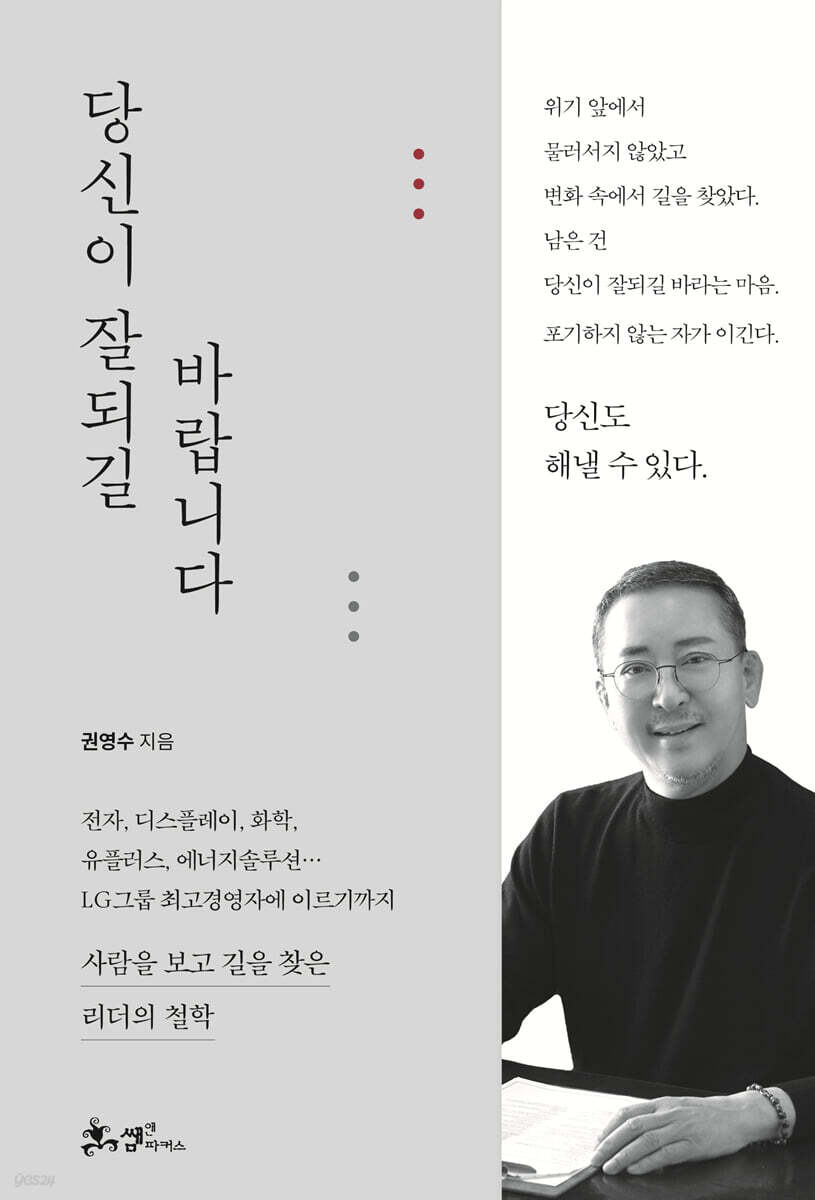
I hope you do well
 |
Description
Book Introduction
- A word from MD
-
All that's left is to wish you wellIn an era that demands performance and speed, former Vice Chairman Kwon Young-soo, who led the LG Group, shares his people-centered leadership, proven over 45 years in the field.
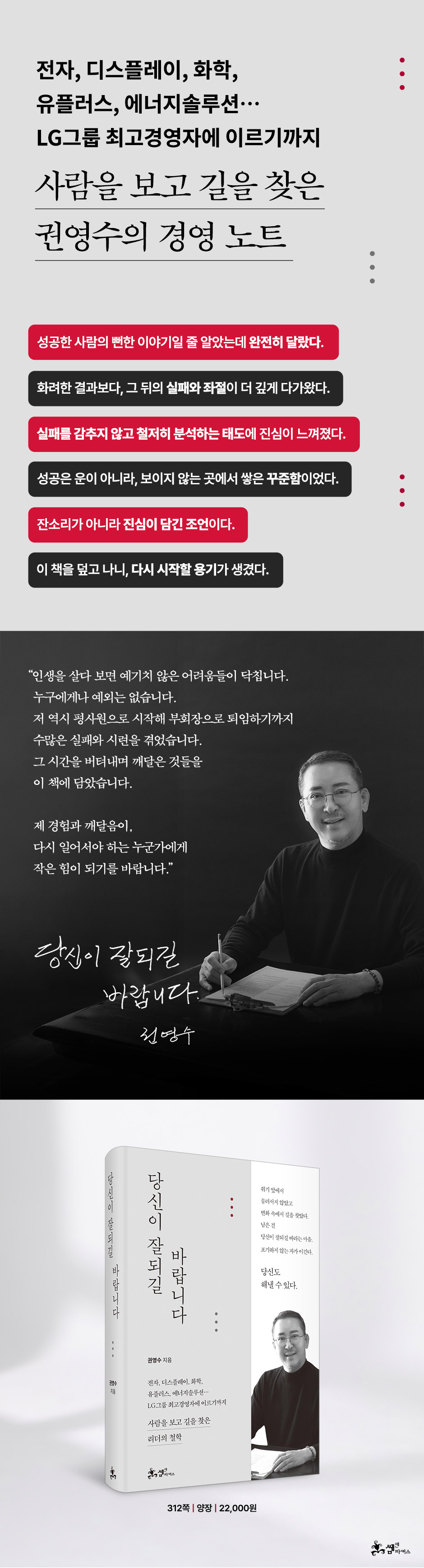
A book that shows how trust paves the way through moments of overcoming failure and getting back up again.
November 21, 2025. Self-Development PD Oh Da-eun
A heartfelt management note from LG Group's Kwon Young-soo, inducted into the Korea Corporate Hall of Fame.
From a rank-and-file employee to CEO of LG Group, Vice Chairman Kwon Young-soo has led the organization through countless challenging moments, alternating between decisiveness and perseverance.
"I Wish You Well," which contains the essence of a management philosophy that he has honed through his own experiences of success and failure, shows that "management is about winning people's hearts" through the worries and challenges he faced in the field and the insights he gained through getting to know people.
The story he tells goes beyond the records of one CEO.
To all those who are wondering, "Where is the battleground before me?" amidst uncertainty and pressure, we offer the foresight and motivation to persevere and move forward.
This book is the only official biography that fully captures the 45 years of experience and is a message of encouragement to the younger generation.
From a rank-and-file employee to CEO of LG Group, Vice Chairman Kwon Young-soo has led the organization through countless challenging moments, alternating between decisiveness and perseverance.
"I Wish You Well," which contains the essence of a management philosophy that he has honed through his own experiences of success and failure, shows that "management is about winning people's hearts" through the worries and challenges he faced in the field and the insights he gained through getting to know people.
The story he tells goes beyond the records of one CEO.
To all those who are wondering, "Where is the battleground before me?" amidst uncertainty and pressure, we offer the foresight and motivation to persevere and move forward.
This book is the only official biography that fully captures the 45 years of experience and is a message of encouragement to the younger generation.
- You can preview some of the book's contents.
Preview
index
Prologue: If someone is happy because of me, that is my happiness.
Chapter 1: My Development is the Company's Development
Cherish unexpected connections
Lead your work rather than being dragged around by it
Doing what you want to do is innovation
Small habits lead to big results.
My development is the company's development.
Chapter 2: Difficulties Come When Learning Is Needed
Opportunity comes to those who are prepared.
If you don't know, be more humble.
Experience the power of teamwork
Injustice is savings for the future.
If it's the right thing to do, then say what you want to say.
Become a Nakdong River duck egg
Business failures are sinners.
Promote a failed person
Chapter 3: Never Give Up
Even if the sky falls, there is a hole to emerge from.
Experience the life of a dead person
Falling into the trap of universal business innovation
Correct information is the fundamental competitive advantage of a company.
Overcoming a crisis with mental preparation
Chapter 4: Management is about winning people's hearts.
If people don't follow, look back at me.
I'm thinking about my abilities as a CEO.
Extreme Challenge: Building Confidence That You Can Do It
The desire to do something makes you number one in the world.
Be number one in the world
Putting the right people in the right positions
Management is about winning people's hearts.
Make decisions firmly and execute them strongly.
Four competencies a leader must possess
Chapter 5: If you really want it, your dreams will come true.
Demoted to General Manager, does that mean I should quit?
Hamheung Chasa Battery Business Division Manager
Battery business in crisis
Making a decisive move at a critical moment
Making a Miracle 208
“Let’s do a sweep.”
Help comes to those who do good deeds.
Win hearts through field management
Learn humility
Have you tried Chapter 6? Try it!
Studying is the only way to survive
Have you tried it? Try it!
appoint a secret royal inspector
A healthy organizational culture increases intellectual productivity.
Someone has probably thought about any problem.
Please do many good things in your daily life.
Throwing a curveball by differentiating content
Go to the holding company
Conditions for AI success
Recalls and Smart Factories
A company you want to run to when you wake up in the morning
Epilogue_I hope you are doing well
Chapter 1: My Development is the Company's Development
Cherish unexpected connections
Lead your work rather than being dragged around by it
Doing what you want to do is innovation
Small habits lead to big results.
My development is the company's development.
Chapter 2: Difficulties Come When Learning Is Needed
Opportunity comes to those who are prepared.
If you don't know, be more humble.
Experience the power of teamwork
Injustice is savings for the future.
If it's the right thing to do, then say what you want to say.
Become a Nakdong River duck egg
Business failures are sinners.
Promote a failed person
Chapter 3: Never Give Up
Even if the sky falls, there is a hole to emerge from.
Experience the life of a dead person
Falling into the trap of universal business innovation
Correct information is the fundamental competitive advantage of a company.
Overcoming a crisis with mental preparation
Chapter 4: Management is about winning people's hearts.
If people don't follow, look back at me.
I'm thinking about my abilities as a CEO.
Extreme Challenge: Building Confidence That You Can Do It
The desire to do something makes you number one in the world.
Be number one in the world
Putting the right people in the right positions
Management is about winning people's hearts.
Make decisions firmly and execute them strongly.
Four competencies a leader must possess
Chapter 5: If you really want it, your dreams will come true.
Demoted to General Manager, does that mean I should quit?
Hamheung Chasa Battery Business Division Manager
Battery business in crisis
Making a decisive move at a critical moment
Making a Miracle 208
“Let’s do a sweep.”
Help comes to those who do good deeds.
Win hearts through field management
Learn humility
Have you tried Chapter 6? Try it!
Studying is the only way to survive
Have you tried it? Try it!
appoint a secret royal inspector
A healthy organizational culture increases intellectual productivity.
Someone has probably thought about any problem.
Please do many good things in your daily life.
Throwing a curveball by differentiating content
Go to the holding company
Conditions for AI success
Recalls and Smart Factories
A company you want to run to when you wake up in the morning
Epilogue_I hope you are doing well
Detailed image
Into the book
After a few months, problems began to appear.
Each department needs to finalize its accounts at the end of the month before we can re-determine the budget, but it's always late.
The January settlement was supposed to come out after mid-February.
At that time, departments would write down each expenditure by hand and create vouchers.
When I took the handwritten voucher to the accounting department, they entered it into the computer.
Even if the accounting staff worked all night, it took a long time and there were bound to be many mistakes because the amount of vouchers was so large.
When you look at the way things are done, it's incredibly inefficient.
It's like doing the same thing twice.
It was a waste of manpower and time.
So, we created a system where each department would work on the computer from the very beginning when they wrote the voucher.
(…)
If we look at what we do, we can divide it into three categories.
First is the 'main task' that must be done, second is the 'auxiliary task' that is necessary to do the main task, and third is the unnecessary task, that is, the task that is 'lossful' if done.
To work more efficiently within a limited time, we need to increase the value of our work.
We need to examine what we're doing from scratch, analyze it thoroughly, eliminate any losses, minimize any ancillary work, and focus on the main task.
Innovation is also about avoiding repeating the same thing over and over again.
(…) By innovating the voucher system, the budget, accounting, and finance departments have all become more convenient.
By cutting out unnecessary tasks, the time was shortened by a third.
What would have taken three weeks was done in a week.
--- p.24~26, from “Doing What You Want to Do Leads to Innovation”
Among the psychological theories, there is the 'Johari's Window' theory.
The perception of one's relationship with oneself and others is divided into four windows.
That is, there is an 'open window' that I know and the other person knows, a 'hidden window' that I know but the other person doesn't know, an 'invisible window' that I don't know but the other person can easily observe me, and an 'unknown window' that neither I nor the other person knows.
It is said that among these four windows, the wider the 'open window' that both you and the other person know, the more a true relationship is formed.
If we apply this theory to conversation, we can summarize it as follows.
Let's say there are A and B.
The first relationship is when you only say nice things to each other.
We are never good at saying bad things.
The second relationship is one where A only says bad things to B, but B cannot say the same to A.
The third relationship is the opposite, where only B says bad things to A.
The second and third ones will often appear in unequal relationships, such as hierarchical relationships.
Finally, the fourth relationship is one where both A and B can say nice things to each other as well as unpleasant things to hear, and both can accept it.
When you reach this fourth relationship, you can have real conversations and build authentic relationships.
--- p.53~54, from “Realizing the Power of Teamwork”
Just as in war, understanding the terrain and occupying advantageous high ground is the shortcut to victory, so too must you occupy advantageous high ground in negotiations.
The important thing in this negotiation was price.
So I said, “I’ll sell it for $10 billion.”
It was more than 30 times the amount initially offered by the opposing company.
The reaction of the other party upon hearing this was as expected.
“YS, are you serious?”
“I’m serious.”
He must have decided that he couldn't talk to me anymore, so he asked me to call someone else.
So I made it clear that I was the one in charge of the negotiations.
When doing M&A, you need to give full authority to one person.
If the person in charge changes, the other side can play a trick on you.
The negotiator on the other side's side's face turned red and blue and he suddenly got up from his seat.
“Then we cannot negotiate.”
Then he grabs his bag and runs out.
(…) After about a week, I finally got a call from the other company.
“It’s an amount I can never accept, but let’s hear the story,” he said.
The spark of negotiation has been rekindled.
And the initiative has passed to us.
Because we have to start negotiations again at the amount we proposed.
When negotiating, the party trying to lower or raise the proposed price will try to come up with all sorts of reasons.
The side that made the offer defends by saying, 'I'll raise it a little' or 'I'll lower it a little'.
At first, we had to come up with all sorts of reasons to raise the price from the $200-$300 million that the other company had offered, but now we are in a situation where we have to find reasons for the other company to lower the price from the $10 billion that we have offered.
--- p.85~89, from “Even if the sky falls, there is a hole to emerge from”
Since the employees have reached the level of 'wanting to do it', there isn't much for me to do.
All I had to do was ask how I could help.
If there's one thing I did well in this whole process, it was finding the right place to win.
To make any business successful, you must first establish a strategy that can enhance the fundamental competitiveness of the business.
In other words, you have to carefully decide where to compete.
But if you look closely, it seems that 'yield' is the key competitive edge in displays.
Yield refers to the proportion of normal products that are not defective among the total production.
The higher the yield, the better the production efficiency and the lower the cost.
Creating a perfect production system without defects was the key to turning a profit.
At that time, our clients had at least three or four suppliers.
This is because only then can we control suppliers while appropriately distributing quantities.
Sometimes, they even beat the supply price.
(…)
What is it in the end?
In a fight with competitors, the question is who can make something cheap and with good quality.
Under the same production conditions, if we produce 100 units and our competitor produces 90 units, our quality is 100% and our competitor's is 90%.
That's where the game is decided.
In this way, we sought to find a competitive edge in yield, and through activities such as Maxcapa Minlos, Extreme Challenge, and creating a fun workplace, we challenged ourselves to achieve the world's highest yield.
And finally, I was able to become number one in the world.
--- p.150~152, from “Becoming the World’s Best”
When we found out that Volkswagen, our biggest customer, was negative about our product, we thought, 'We're in big trouble.'
Among the problems they pointed out, the most critical was the packaging.
We wrapped the battery material in a thin film like a ramen bag, and this is called a pouch-type battery.
The competitor's packaging material was aluminum.
Car companies are worried about the thin ramen packets being placed inside cars made entirely of steel.
In fact, our product has low strength, so even if the adhesive is good, there have been cases where the sides of the packaging would burst.
As a result, Volkswagen conducted several sample tests, but all failed, and it was only after much begging that we finally got a chance.
If we fail the test this time, we will face a crisis that could shake up our entire business.
The employees also became very anxious and despairing as they continued to fail.
So, there was a tense standoff between the opinions that "It's not too late to change to our competitors' way" and "We should continue to do things our way."
In times like these when we are lost and confused, the leader must make a firm 'decision'.
The conclusion I came to was, “Let’s just go with it.”
Instead, if we have been focusing on making up for our shortcomings up until now, we will now focus on maximizing our strengths.
Every product has its pros and cons.
If you keep thinking about your shortcomings, you will have no choice but to continue to be on the defensive.
--- p.201-202, from “Making a decisive move in a life-or-death situation”
The telecommunications business is a regulated industry where the government controls everything.
As a result, three of the 4Ps—product, price, and distribution—are identical, making differentiation difficult. SK Telecom, KT, and LG U+ all sell the same Apple, Samsung, and LG phones. The government sets their own rate plans, and distribution is predictable.
In the end, since they could only change their advertising strategy, they ended up focusing only on promotions, such as using expensive models for advertising.
That made me feel a bit suffocated.
I was wondering if there was anything that could differentiate it.
What I thought about then was content.
We decided to bet on content.
When I think about differentiation, I always think about what customers want but competitors can't.
Netflix just happened to catch my eye.
I thought that I could succeed in differentiating myself by working with this company.
But because Netflix was doing so well, I became a bit arrogant.
When they came to Korea, they said they would do it independently without cooperating with any telecommunications company.
I thought, 'I guess so, I can't help it.'
But the business is a bit sluggish.
While watching, I made an unexpected suggestion to Executive Director Kim Sang-bu, who was in charge of strategy.
“I think now is the time, as Netflix is struggling.
Maybe you need help from a telecommunications company now, so let's contact them.
However, please demand that our company be the exclusive supplier.” When I said this, Director Kim and the employees went crazy.
“We’re number three in the industry, so why would Netflix give us an exclusive?”
“Yes, that’s right.
Let's try anyway.
“Can’t you even dream?”
Each department needs to finalize its accounts at the end of the month before we can re-determine the budget, but it's always late.
The January settlement was supposed to come out after mid-February.
At that time, departments would write down each expenditure by hand and create vouchers.
When I took the handwritten voucher to the accounting department, they entered it into the computer.
Even if the accounting staff worked all night, it took a long time and there were bound to be many mistakes because the amount of vouchers was so large.
When you look at the way things are done, it's incredibly inefficient.
It's like doing the same thing twice.
It was a waste of manpower and time.
So, we created a system where each department would work on the computer from the very beginning when they wrote the voucher.
(…)
If we look at what we do, we can divide it into three categories.
First is the 'main task' that must be done, second is the 'auxiliary task' that is necessary to do the main task, and third is the unnecessary task, that is, the task that is 'lossful' if done.
To work more efficiently within a limited time, we need to increase the value of our work.
We need to examine what we're doing from scratch, analyze it thoroughly, eliminate any losses, minimize any ancillary work, and focus on the main task.
Innovation is also about avoiding repeating the same thing over and over again.
(…) By innovating the voucher system, the budget, accounting, and finance departments have all become more convenient.
By cutting out unnecessary tasks, the time was shortened by a third.
What would have taken three weeks was done in a week.
--- p.24~26, from “Doing What You Want to Do Leads to Innovation”
Among the psychological theories, there is the 'Johari's Window' theory.
The perception of one's relationship with oneself and others is divided into four windows.
That is, there is an 'open window' that I know and the other person knows, a 'hidden window' that I know but the other person doesn't know, an 'invisible window' that I don't know but the other person can easily observe me, and an 'unknown window' that neither I nor the other person knows.
It is said that among these four windows, the wider the 'open window' that both you and the other person know, the more a true relationship is formed.
If we apply this theory to conversation, we can summarize it as follows.
Let's say there are A and B.
The first relationship is when you only say nice things to each other.
We are never good at saying bad things.
The second relationship is one where A only says bad things to B, but B cannot say the same to A.
The third relationship is the opposite, where only B says bad things to A.
The second and third ones will often appear in unequal relationships, such as hierarchical relationships.
Finally, the fourth relationship is one where both A and B can say nice things to each other as well as unpleasant things to hear, and both can accept it.
When you reach this fourth relationship, you can have real conversations and build authentic relationships.
--- p.53~54, from “Realizing the Power of Teamwork”
Just as in war, understanding the terrain and occupying advantageous high ground is the shortcut to victory, so too must you occupy advantageous high ground in negotiations.
The important thing in this negotiation was price.
So I said, “I’ll sell it for $10 billion.”
It was more than 30 times the amount initially offered by the opposing company.
The reaction of the other party upon hearing this was as expected.
“YS, are you serious?”
“I’m serious.”
He must have decided that he couldn't talk to me anymore, so he asked me to call someone else.
So I made it clear that I was the one in charge of the negotiations.
When doing M&A, you need to give full authority to one person.
If the person in charge changes, the other side can play a trick on you.
The negotiator on the other side's side's face turned red and blue and he suddenly got up from his seat.
“Then we cannot negotiate.”
Then he grabs his bag and runs out.
(…) After about a week, I finally got a call from the other company.
“It’s an amount I can never accept, but let’s hear the story,” he said.
The spark of negotiation has been rekindled.
And the initiative has passed to us.
Because we have to start negotiations again at the amount we proposed.
When negotiating, the party trying to lower or raise the proposed price will try to come up with all sorts of reasons.
The side that made the offer defends by saying, 'I'll raise it a little' or 'I'll lower it a little'.
At first, we had to come up with all sorts of reasons to raise the price from the $200-$300 million that the other company had offered, but now we are in a situation where we have to find reasons for the other company to lower the price from the $10 billion that we have offered.
--- p.85~89, from “Even if the sky falls, there is a hole to emerge from”
Since the employees have reached the level of 'wanting to do it', there isn't much for me to do.
All I had to do was ask how I could help.
If there's one thing I did well in this whole process, it was finding the right place to win.
To make any business successful, you must first establish a strategy that can enhance the fundamental competitiveness of the business.
In other words, you have to carefully decide where to compete.
But if you look closely, it seems that 'yield' is the key competitive edge in displays.
Yield refers to the proportion of normal products that are not defective among the total production.
The higher the yield, the better the production efficiency and the lower the cost.
Creating a perfect production system without defects was the key to turning a profit.
At that time, our clients had at least three or four suppliers.
This is because only then can we control suppliers while appropriately distributing quantities.
Sometimes, they even beat the supply price.
(…)
What is it in the end?
In a fight with competitors, the question is who can make something cheap and with good quality.
Under the same production conditions, if we produce 100 units and our competitor produces 90 units, our quality is 100% and our competitor's is 90%.
That's where the game is decided.
In this way, we sought to find a competitive edge in yield, and through activities such as Maxcapa Minlos, Extreme Challenge, and creating a fun workplace, we challenged ourselves to achieve the world's highest yield.
And finally, I was able to become number one in the world.
--- p.150~152, from “Becoming the World’s Best”
When we found out that Volkswagen, our biggest customer, was negative about our product, we thought, 'We're in big trouble.'
Among the problems they pointed out, the most critical was the packaging.
We wrapped the battery material in a thin film like a ramen bag, and this is called a pouch-type battery.
The competitor's packaging material was aluminum.
Car companies are worried about the thin ramen packets being placed inside cars made entirely of steel.
In fact, our product has low strength, so even if the adhesive is good, there have been cases where the sides of the packaging would burst.
As a result, Volkswagen conducted several sample tests, but all failed, and it was only after much begging that we finally got a chance.
If we fail the test this time, we will face a crisis that could shake up our entire business.
The employees also became very anxious and despairing as they continued to fail.
So, there was a tense standoff between the opinions that "It's not too late to change to our competitors' way" and "We should continue to do things our way."
In times like these when we are lost and confused, the leader must make a firm 'decision'.
The conclusion I came to was, “Let’s just go with it.”
Instead, if we have been focusing on making up for our shortcomings up until now, we will now focus on maximizing our strengths.
Every product has its pros and cons.
If you keep thinking about your shortcomings, you will have no choice but to continue to be on the defensive.
--- p.201-202, from “Making a decisive move in a life-or-death situation”
The telecommunications business is a regulated industry where the government controls everything.
As a result, three of the 4Ps—product, price, and distribution—are identical, making differentiation difficult. SK Telecom, KT, and LG U+ all sell the same Apple, Samsung, and LG phones. The government sets their own rate plans, and distribution is predictable.
In the end, since they could only change their advertising strategy, they ended up focusing only on promotions, such as using expensive models for advertising.
That made me feel a bit suffocated.
I was wondering if there was anything that could differentiate it.
What I thought about then was content.
We decided to bet on content.
When I think about differentiation, I always think about what customers want but competitors can't.
Netflix just happened to catch my eye.
I thought that I could succeed in differentiating myself by working with this company.
But because Netflix was doing so well, I became a bit arrogant.
When they came to Korea, they said they would do it independently without cooperating with any telecommunications company.
I thought, 'I guess so, I can't help it.'
But the business is a bit sluggish.
While watching, I made an unexpected suggestion to Executive Director Kim Sang-bu, who was in charge of strategy.
“I think now is the time, as Netflix is struggling.
Maybe you need help from a telecommunications company now, so let's contact them.
However, please demand that our company be the exclusive supplier.” When I said this, Director Kim and the employees went crazy.
“We’re number three in the industry, so why would Netflix give us an exclusive?”
“Yes, that’s right.
Let's try anyway.
“Can’t you even dream?”
--- p.278-279, from “Taking a Gamble with Content Differentiation”
Publisher's Review
A principle that remains unshaken even as times change
The world surrounding businesses these days is cold.
Results are demanded quickly, and people are easily forgotten.
Some say, “The era of loyalty to a company is over,” while others conclude, “Leadership can no longer be trusted.”
But even amidst the cynicism, there are still leaders who believe in people and build organizations.
“I hope you do well” is a book that started from that very belief.
For today's youth, every day is a 'game-changer'.
In an age where a single decision can change the future, opportunities pass by in an instant, and anxiety is always nearby.
The process becomes blurred, and efforts are sometimes betrayed.
Still, I can't stop.
Some people persevere, some people start again.
This book is a record of a leader's strong encouragement to young people trying to find their way through these difficult times.
Former Vice Chairman Kwon Young-soo, the leader of LG Group who never backed down from crisis for 45 years and found his way through change, is a person who upheld the belief that “those who never give up ultimately win.”
So his story is not a winner's record.
This is the life note of a 'gambler' who has competed with sincerity.
Where does a leader place his bets?
People, not technology; trust, not performance.
The book consists of six chapters in total.
From his days as an employee to CEO, we follow Vice Chairman Kwon Young-soo's journey and show what he has learned and grown in each industry.
Chapter 1 covers how to grow with an organization during one's early years in society, and Chapter 2 covers the process of developing execution skills and responsibility in domestic and international fields.
Chapter 3 deals with leadership based on principles and judgment in times of crisis through M&A and his experience as CFO of LG Electronics during the IMF era. Chapter 4 records the moment when he realized that the answer lies in the field and people during LG Display's turnaround.
Chapter 5 looks back on the driving force behind LG Chem's growth, which led the company to become the world's number one in the battery industry. Chapter 6, focusing on his experience at LG Uplus, addresses leadership based on communication and empathy, and outlines the philosophy of a "leader who takes responsibility to the end."
Although industries and times may differ, the essence of leadership remains the same.
It's about winning people's hearts and believing that sincerity will ultimately win the day, no matter where you are.
His success as CEO was always due to his 'eye for recognizing the key points of victory.'
He listed four virtues necessary for a leader: discernment, listening, decision-making, and execution.
They say that if these four things come together well, it is worth trying no matter what the difficulty.
For nearly 20 years, Vice Chairman Kwon Young-soo has been using this virtue to find solutions in various industrial settings.
His management philosophy was to penetrate the core of the business, discover talented people who could do the job, win their hearts, and lead them to action.
LG Display has made yield its core competitive edge.
Yield is the ratio of normal products to total production, and is an indicator that determines production efficiency and cost.
He focused on creating a defect-free production system and realized that only by ensuring quality and reliability could he survive in the market.
I believed that quality would only follow when employees found meaning in their work and took pride in their roles.
LG Chem has found a winning strategy in the battery industry's "all or nothing" structure.
In a structure where winning an order secures the entire quantity, and failing to do so leaves nothing to be gained, he realized that the only answer was to increase product quality.
To gain the trust of automakers, we focused all our efforts on improving performance, and we gained confidence that the trust built through quality would save the company.
LG U+ has bet its money on content and customer experience.
It was a time when communications expanded beyond a simple network into an industry that connected people's daily lives and emotions.
He simplified the reporting structure, introduced a culture of using names instead of titles, and engaged directly with younger employees to develop their ideas into business.
A culture of horizontal communication and autonomy has created a company that people want to work for when they wake up in the morning.
LG Energy Solution pursued harmony between technology and people through AI-based smart factories.
He maintained the philosophy that technology is meant to make people easier, not replace them.
We have established a 'human-led technology structure' while reducing defect rates and increasing production efficiency through artificial intelligence.
Having worked in several industries, he was convinced of one thing.
All battles start from people and are completed through people.
The key to yield and competitiveness in product power ultimately came from the voices of those on the ground.
His philosophy that the depth of sincerity and the depth of listening are directly proportional remains unchanged.
In the end, the essence of victory was not skill but people, not performance but trust.
“All that’s left is to wish you well.”
He who never gives up wins, you can do it too
The reason "I Hope You're Well" resonates so deeply with so many readers is because it's not a formula for success, but a record of overcoming failure and getting back up again.
One reader said, “I thought it would be just a typical story about successful people, but I liked it better because it honestly included even their failures and frustrations.”
In the book, he does not cover up his failures, but analyzes himself to determine why he failed and tries not to repeat the same mistakes again.
As one reader said, “I realized that success is the result of consistent effort built up in places that are invisible to the eye,” this book serves as a solid support for anyone, giving them the “courage to start again.”
Even after his retirement, Vice Chairman Kwon Young-soo continues to receive lecture requests from numerous companies, universities, and public institutions.
His philosophy on leadership is timeless.
This is because his method of not hiding his failures, treating people with sincerity, and finding a winning strategy through listening still serves as a standard for many juniors and organizational leaders.
For some, this book will be a leadership textbook that helps them find their way in the harsh realities of life, while for others, it will be a life book that will help them find their true self.
The world surrounding businesses these days is cold.
Results are demanded quickly, and people are easily forgotten.
Some say, “The era of loyalty to a company is over,” while others conclude, “Leadership can no longer be trusted.”
But even amidst the cynicism, there are still leaders who believe in people and build organizations.
“I hope you do well” is a book that started from that very belief.
For today's youth, every day is a 'game-changer'.
In an age where a single decision can change the future, opportunities pass by in an instant, and anxiety is always nearby.
The process becomes blurred, and efforts are sometimes betrayed.
Still, I can't stop.
Some people persevere, some people start again.
This book is a record of a leader's strong encouragement to young people trying to find their way through these difficult times.
Former Vice Chairman Kwon Young-soo, the leader of LG Group who never backed down from crisis for 45 years and found his way through change, is a person who upheld the belief that “those who never give up ultimately win.”
So his story is not a winner's record.
This is the life note of a 'gambler' who has competed with sincerity.
Where does a leader place his bets?
People, not technology; trust, not performance.
The book consists of six chapters in total.
From his days as an employee to CEO, we follow Vice Chairman Kwon Young-soo's journey and show what he has learned and grown in each industry.
Chapter 1 covers how to grow with an organization during one's early years in society, and Chapter 2 covers the process of developing execution skills and responsibility in domestic and international fields.
Chapter 3 deals with leadership based on principles and judgment in times of crisis through M&A and his experience as CFO of LG Electronics during the IMF era. Chapter 4 records the moment when he realized that the answer lies in the field and people during LG Display's turnaround.
Chapter 5 looks back on the driving force behind LG Chem's growth, which led the company to become the world's number one in the battery industry. Chapter 6, focusing on his experience at LG Uplus, addresses leadership based on communication and empathy, and outlines the philosophy of a "leader who takes responsibility to the end."
Although industries and times may differ, the essence of leadership remains the same.
It's about winning people's hearts and believing that sincerity will ultimately win the day, no matter where you are.
His success as CEO was always due to his 'eye for recognizing the key points of victory.'
He listed four virtues necessary for a leader: discernment, listening, decision-making, and execution.
They say that if these four things come together well, it is worth trying no matter what the difficulty.
For nearly 20 years, Vice Chairman Kwon Young-soo has been using this virtue to find solutions in various industrial settings.
His management philosophy was to penetrate the core of the business, discover talented people who could do the job, win their hearts, and lead them to action.
LG Display has made yield its core competitive edge.
Yield is the ratio of normal products to total production, and is an indicator that determines production efficiency and cost.
He focused on creating a defect-free production system and realized that only by ensuring quality and reliability could he survive in the market.
I believed that quality would only follow when employees found meaning in their work and took pride in their roles.
LG Chem has found a winning strategy in the battery industry's "all or nothing" structure.
In a structure where winning an order secures the entire quantity, and failing to do so leaves nothing to be gained, he realized that the only answer was to increase product quality.
To gain the trust of automakers, we focused all our efforts on improving performance, and we gained confidence that the trust built through quality would save the company.
LG U+ has bet its money on content and customer experience.
It was a time when communications expanded beyond a simple network into an industry that connected people's daily lives and emotions.
He simplified the reporting structure, introduced a culture of using names instead of titles, and engaged directly with younger employees to develop their ideas into business.
A culture of horizontal communication and autonomy has created a company that people want to work for when they wake up in the morning.
LG Energy Solution pursued harmony between technology and people through AI-based smart factories.
He maintained the philosophy that technology is meant to make people easier, not replace them.
We have established a 'human-led technology structure' while reducing defect rates and increasing production efficiency through artificial intelligence.
Having worked in several industries, he was convinced of one thing.
All battles start from people and are completed through people.
The key to yield and competitiveness in product power ultimately came from the voices of those on the ground.
His philosophy that the depth of sincerity and the depth of listening are directly proportional remains unchanged.
In the end, the essence of victory was not skill but people, not performance but trust.
“All that’s left is to wish you well.”
He who never gives up wins, you can do it too
The reason "I Hope You're Well" resonates so deeply with so many readers is because it's not a formula for success, but a record of overcoming failure and getting back up again.
One reader said, “I thought it would be just a typical story about successful people, but I liked it better because it honestly included even their failures and frustrations.”
In the book, he does not cover up his failures, but analyzes himself to determine why he failed and tries not to repeat the same mistakes again.
As one reader said, “I realized that success is the result of consistent effort built up in places that are invisible to the eye,” this book serves as a solid support for anyone, giving them the “courage to start again.”
Even after his retirement, Vice Chairman Kwon Young-soo continues to receive lecture requests from numerous companies, universities, and public institutions.
His philosophy on leadership is timeless.
This is because his method of not hiding his failures, treating people with sincerity, and finding a winning strategy through listening still serves as a standard for many juniors and organizational leaders.
For some, this book will be a leadership textbook that helps them find their way in the harsh realities of life, while for others, it will be a life book that will help them find their true self.
GOODS SPECIFICS
- Date of issue: November 3, 2025
- Format: Hardcover book binding method guide
- Page count, weight, size: 312 pages | 480g | 128*188*23mm
- ISBN13: 9791194755982
- ISBN10: 1194755984
You may also like
카테고리
korean


korean

![ELLE 엘르 스페셜 에디션 A형 : 12월 [2025]](http://librairie.coreenne.fr/cdn/shop/files/b8e27a3de6c9538896439686c6b0e8fb.jpg?v=1766436872&width=3840)


