

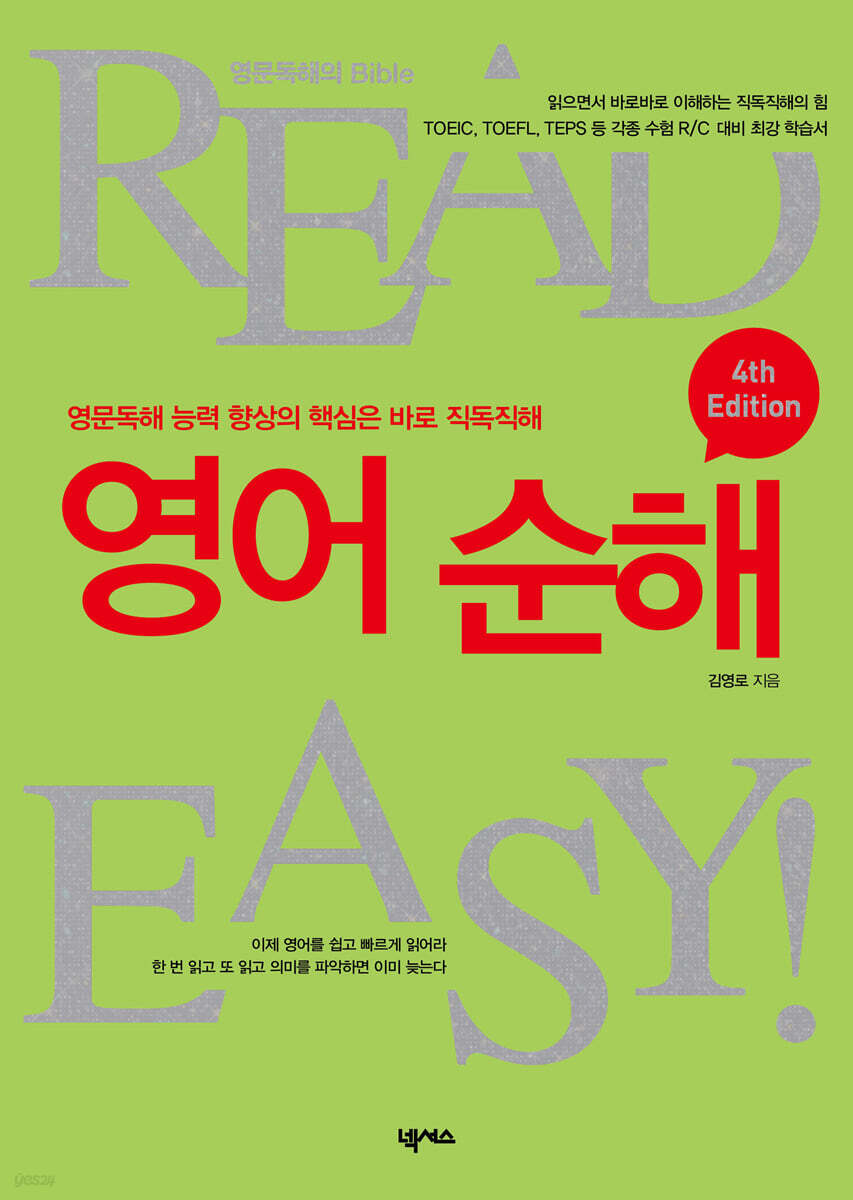
English Pure 4th Edition
 |
Description
Book Introduction
A reading textbook loved by many people for its revolutionary direct reading and interpretation method.
The reason why this book has been able to establish itself as a must-read for English learners for over 30 years since its publication is because the author's insight and analysis comparing English and Korean are outstanding, and this is directly linked to improving learners' reading comprehension skills.
Even now, 30 years later, it's hard to find another book that rivals this one. However, the author has replaced about 20% of the example sentences with better English ones he's collected over the years, and added his signature "contextual" explanations to enhance understanding of English context.
Additionally, the editing structure and design have been completely revamped to make learning easier and more effective.
The reason why this book has been able to establish itself as a must-read for English learners for over 30 years since its publication is because the author's insight and analysis comparing English and Korean are outstanding, and this is directly linked to improving learners' reading comprehension skills.
Even now, 30 years later, it's hard to find another book that rivals this one. However, the author has replaced about 20% of the example sentences with better English ones he's collected over the years, and added his signature "contextual" explanations to enhance understanding of English context.
Additionally, the editing structure and design have been completely revamped to make learning easier and more effective.
- You can preview some of the book's contents.
Preview
index
Chapter 1: STRUCTURE: Understanding English Structure
1.
Understanding the basic structure
Intransitive verb (basic) / Intransitive verb (passive meaning) / Transitive verb / Intransitive verb + complement (basic) / Intransitive verb + prepositional phrase (spread of basic expression) / Intransitive verb + complement (meaning) / Complement form (structural features of English) / Complement and English-style thought / State and action (intransitive-transitive) / Skeleton and modifier / Movement of sentence components
2.
Combination of information
Logical development order: Don't try to understand English backwards / Information linking device: Appositive / Information linking device: Supplementary explanation / Information linking device: Relative noun / Relative clause → Adjective phrase / Information linking device: Participle phrase
3.
Structural development
Conjunctive prepositions - From clauses to phrases / Conjunctive prepositions - Logical connection (structure and information) / Evolution of that-clause
Conjunctive preposition with / Conjunctive preposition at, on, in / Sentence adverb
Chapter 2: STYLE: Groundwork for Understanding Context
1.
Subject transition: inanimate subject
2.
Part of speech conversion: verb → noun → adjective
3.
Avoid repetition
Replace with a pronoun / Noun substitute / Verb and other substitute / Replace with another word with the same meaning / Change the writing style
Chapter 3: Understanding Context
1.
The skeleton of the text
Thesis Sentence / Topic Sentence / Key Words
2.
Reading the Extract: Framework and Examples
3.
Logical Reading: A device that shows logical relationships
4.
Context and meaning
What is context? / The fundamental reason for seeking meaning within context / What understanding true context means / The necessity of imagination
Chapter 4: The English Way of Thinking
1.
Prepositions to watch out for
Prepositions and Mobile Thoughts / Prepositions and Omissions
2.
Word Order Different from Korean: Passive Expressions to Watch Out for
3.
Economic Verbs: Transitive Verbs of 'Compare'
4.
logic of denial
Indirect negation (euphemistic negation) / negation + negation / negation logic different from Korean
5.
Different formulas from Korean
English loves adjectives / The relationship between modifier and modifier / Hyphen-adjective
Chapter 5: EXPRESSION: The Aesthetics of Expression
1.
The Effect of Expression: The Development of Meaning
2.
The Discovery of Nuclear Expression: Coloring Expression
3.
Pun
APPENDIX 1 Model Exam Questions
Understanding the topic / Understanding logical relationships
APPENDIX 2 READING SELECTION
Lost and Found / What Makes Tycoons Tick? / “They Hassle People at Whim” / “The Pole of Cold and Cruelty” / The Man in the Water / Fall Leads Man 'Inward' / “Dig Into the World” / Unforgettable Albert Einstein / Jean-Paul Sartre (1905-1980) / Bacon and the Experimental Method
Special appendix
Exercise meaning / Side note meaning
1.
Understanding the basic structure
Intransitive verb (basic) / Intransitive verb (passive meaning) / Transitive verb / Intransitive verb + complement (basic) / Intransitive verb + prepositional phrase (spread of basic expression) / Intransitive verb + complement (meaning) / Complement form (structural features of English) / Complement and English-style thought / State and action (intransitive-transitive) / Skeleton and modifier / Movement of sentence components
2.
Combination of information
Logical development order: Don't try to understand English backwards / Information linking device: Appositive / Information linking device: Supplementary explanation / Information linking device: Relative noun / Relative clause → Adjective phrase / Information linking device: Participle phrase
3.
Structural development
Conjunctive prepositions - From clauses to phrases / Conjunctive prepositions - Logical connection (structure and information) / Evolution of that-clause
Conjunctive preposition with / Conjunctive preposition at, on, in / Sentence adverb
Chapter 2: STYLE: Groundwork for Understanding Context
1.
Subject transition: inanimate subject
2.
Part of speech conversion: verb → noun → adjective
3.
Avoid repetition
Replace with a pronoun / Noun substitute / Verb and other substitute / Replace with another word with the same meaning / Change the writing style
Chapter 3: Understanding Context
1.
The skeleton of the text
Thesis Sentence / Topic Sentence / Key Words
2.
Reading the Extract: Framework and Examples
3.
Logical Reading: A device that shows logical relationships
4.
Context and meaning
What is context? / The fundamental reason for seeking meaning within context / What understanding true context means / The necessity of imagination
Chapter 4: The English Way of Thinking
1.
Prepositions to watch out for
Prepositions and Mobile Thoughts / Prepositions and Omissions
2.
Word Order Different from Korean: Passive Expressions to Watch Out for
3.
Economic Verbs: Transitive Verbs of 'Compare'
4.
logic of denial
Indirect negation (euphemistic negation) / negation + negation / negation logic different from Korean
5.
Different formulas from Korean
English loves adjectives / The relationship between modifier and modifier / Hyphen-adjective
Chapter 5: EXPRESSION: The Aesthetics of Expression
1.
The Effect of Expression: The Development of Meaning
2.
The Discovery of Nuclear Expression: Coloring Expression
3.
Pun
APPENDIX 1 Model Exam Questions
Understanding the topic / Understanding logical relationships
APPENDIX 2 READING SELECTION
Lost and Found / What Makes Tycoons Tick? / “They Hassle People at Whim” / “The Pole of Cold and Cruelty” / The Man in the Water / Fall Leads Man 'Inward' / “Dig Into the World” / Unforgettable Albert Einstein / Jean-Paul Sartre (1905-1980) / Bacon and the Experimental Method
Special appendix
Exercise meaning / Side note meaning
Publisher's Review
Features of this book
* The only reading book that approaches comparative linguistics
Most of the reading comprehension textbooks in our country are either lists of examples without any system or categorized according to grammar classification methods.
This book abandons that method and systematically covers the most 'important' and 'difficult' aspects of learning English for Koreans by comparing English and Korean.
* 'Direct reading and direct interpretation' that saves time
If you read it once and read it again to understand the meaning, it takes too much time.
In order to correct the uneconomical habit of interpreting English text backwards, we have made it possible to practice direct reading and interpretation by translating English text from front to back.
* Carefully selected logical and educational examples
We have thoroughly excluded the sophistry and illogical examples that are often found in English textbooks in Korea, and have carefully selected examples based on their educational value and English learning value to enable logical thinking training.
* The fun of encountering various Englishes
We have created a proper mix of traditional and modern English, written and spoken English, to help you become familiar with all aspects of the English language.
* Food that is both nutritious and delicious
It's a world where books that are only delicious but not nutritious are rampant.
Also, if it is nutritious but not tasty, it is difficult to eat.
To this end, the author has included some interesting humor and quotes that can act as a refreshing drink to relieve study fatigue and help you in your life.
Most of the reading comprehension textbooks in our country are either lists of examples without any system or categorized according to grammar classification methods.
This book abandons that method and systematically covers the most 'important' and 'difficult' aspects of learning English for Koreans by comparing English and Korean.
* 'Direct reading and direct interpretation' that saves time
If you read it once and read it again to understand the meaning, it takes too much time.
In order to correct the uneconomical habit of interpreting English text backwards, we have made it possible to practice direct reading and interpretation by translating English text from front to back.
* Carefully selected logical and educational examples
We have thoroughly excluded the sophistry and illogical examples that are often found in English textbooks in Korea, and have carefully selected examples based on their educational value and English learning value to enable logical thinking training.
* The fun of encountering various Englishes
We have created a proper mix of traditional and modern English, written and spoken English, to help you become familiar with all aspects of the English language.
* Food that is both nutritious and delicious
It's a world where books that are only delicious but not nutritious are rampant.
Also, if it is nutritious but not tasty, it is difficult to eat.
To this end, the author has included some interesting humor and quotes that can act as a refreshing drink to relieve study fatigue and help you in your life.
GOODS SPECIFICS
- Date of issue: February 5, 2011
- Page count, weight, size: 403 pages | 924g | 188*254*30mm
- ISBN13: 9788957974643
- ISBN10: 8957974644
You may also like
카테고리
korean


korean

![GQ KOREA Mark (Monthly): December [2025]](http://librairie.coreenne.fr/cdn/shop/files/8ef265dbbfbf186523ed75ba7319009d.jpg?v=1765340328&width=3840)


