

The Hidden Management Strategy Behind an Ordinary Omelet Rice
 |
Description
Book Introduction
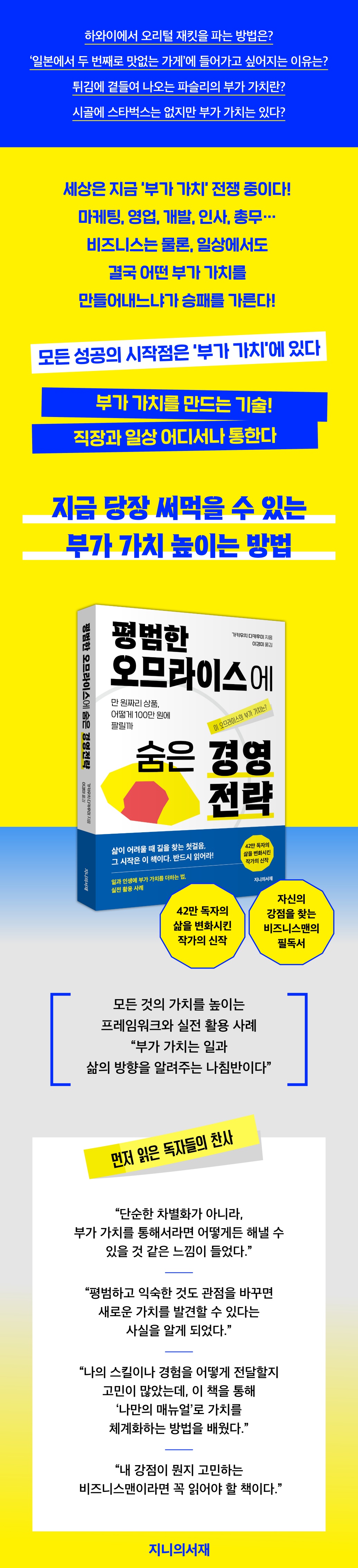
The starting point of all success lies in 'added value'.
A small idea that will increase the value of my life by 100 times.
How to Add Value to Your Work and Life
The author's new book, "If you keep failing interviews, you must read this book," has changed the lives of 420,000 readers.
President Online, Japan's leading economics and management journal
Would you understand if an ordinary omelet rice were worth 8,000 won and another was worth 1 million won?
Whether it's buying expensive merchandise from your favorite idol or focusing on branding for business success, the answer lies in "added value."
We always live and work by only basic values, but those who are recognized and loved in the world always have something that goes beyond those 'basics'.
The author calls that something 'added value'.
Added value is not a talent that only special people have.
It is a power that anyone can create with a small idea and a change of perspective.
If we can add unexpected joy and meaning to the trivial things of everyday life, things we take for granted, the ordinary naturally transforms into the extraordinary.
There is an ordinary omelet rice that no one would pay attention to.
But the moment it's mentioned as 'a winning menu that famous players eat before every game', its value changes completely.
A simple meal can become a special experience for die-hard fans worth a million won.
If you write a message with ketchup and connect that omelet rice to a donation, it is no longer a meal, but a 'heart of support'.
This is an example that shows that value is inherently invisible and can change depending on our perspective.
The same principle works in advertising.
A simple description of the function alone cannot move people's hearts.
However, the green juice advertising slogan, “It’s not tasty! One more glass!” instantly transformed the then-unfamiliar drink into a nationwide hit.
It was able to leave a surprising impression by stimulating curiosity and making people wonder, 'Is it really that tasteless?'
The moment emotional value is added to functional value, the product gains new meaning and persuasiveness.
This is true in all areas of work and life.
The results can vary dramatically depending on how we express ourselves and what emotions we evoke.
The author is a veteran planner and editor who has been active in the Japanese publishing industry for over 30 years and has produced numerous bestsellers.
Boasting a staggering 14 million copies sold, he has extensive experience in both the advertising and publishing industries, and has a deeper understanding of how to add value to people and content than anyone else.
What makes his explanation so compelling is that it is not just an empty theory, but a living insight proven in the field.
This book is full of practical examples and techniques that can be applied immediately to your daily life and work.
It vividly demonstrates how small ideas can increase the value of products and services, revitalize organizations, connect people, and enhance individual value.
As you read, you will gain the courage to try it right now, and you will discover new possibilities hidden in your daily life and work.
Now all that's needed is one thing.
The belief that even ordinary days and repetitive tasks can add value.
Just as a plate of omelet rice tells a special story, add small meanings, emotions, and new perspectives to your work and life.
The difference between those who are successful and those who are not is whether they create added value.
A small idea that will increase the value of my life by 100 times.
How to Add Value to Your Work and Life
The author's new book, "If you keep failing interviews, you must read this book," has changed the lives of 420,000 readers.
President Online, Japan's leading economics and management journal
Would you understand if an ordinary omelet rice were worth 8,000 won and another was worth 1 million won?
Whether it's buying expensive merchandise from your favorite idol or focusing on branding for business success, the answer lies in "added value."
We always live and work by only basic values, but those who are recognized and loved in the world always have something that goes beyond those 'basics'.
The author calls that something 'added value'.
Added value is not a talent that only special people have.
It is a power that anyone can create with a small idea and a change of perspective.
If we can add unexpected joy and meaning to the trivial things of everyday life, things we take for granted, the ordinary naturally transforms into the extraordinary.
There is an ordinary omelet rice that no one would pay attention to.
But the moment it's mentioned as 'a winning menu that famous players eat before every game', its value changes completely.
A simple meal can become a special experience for die-hard fans worth a million won.
If you write a message with ketchup and connect that omelet rice to a donation, it is no longer a meal, but a 'heart of support'.
This is an example that shows that value is inherently invisible and can change depending on our perspective.
The same principle works in advertising.
A simple description of the function alone cannot move people's hearts.
However, the green juice advertising slogan, “It’s not tasty! One more glass!” instantly transformed the then-unfamiliar drink into a nationwide hit.
It was able to leave a surprising impression by stimulating curiosity and making people wonder, 'Is it really that tasteless?'
The moment emotional value is added to functional value, the product gains new meaning and persuasiveness.
This is true in all areas of work and life.
The results can vary dramatically depending on how we express ourselves and what emotions we evoke.
The author is a veteran planner and editor who has been active in the Japanese publishing industry for over 30 years and has produced numerous bestsellers.
Boasting a staggering 14 million copies sold, he has extensive experience in both the advertising and publishing industries, and has a deeper understanding of how to add value to people and content than anyone else.
What makes his explanation so compelling is that it is not just an empty theory, but a living insight proven in the field.
This book is full of practical examples and techniques that can be applied immediately to your daily life and work.
It vividly demonstrates how small ideas can increase the value of products and services, revitalize organizations, connect people, and enhance individual value.
As you read, you will gain the courage to try it right now, and you will discover new possibilities hidden in your daily life and work.
Now all that's needed is one thing.
The belief that even ordinary days and repetitive tasks can add value.
Just as a plate of omelet rice tells a special story, add small meanings, emotions, and new perspectives to your work and life.
The difference between those who are successful and those who are not is whether they create added value.
- You can preview some of the book's contents.
Preview
index
prolog
Warm-up
Part 1 What Determines Value?
.
Why You're Crazy to Buy Your Favorite Idol Merchandise and Luxury Goods
.
Please give me the added value of this omelet rice.
.
Why do the same t-shirts sell well in some places and not in others?
.
Three types of value: added value, existing value, and unnecessary value
.
What value does your work create?
.
Failure in business begins with a lack of added value.
Part 2: Strategies for Making Added Value a Reality
.
Added value that anyone can start right away
.
Could "Japan's Second Worst Restaurant" Be a Value-Added Product?
.
The world is at war with added value
.
We spend money on added value
Part 3: Added Value That Makes Ordinary People Special
.
The real reason for failing the interview lies elsewhere.
.
Don't change your personality, change your perspective.
.
What value can I add?
.
The Hidden Cause of Repeated Failure
.
You can't succeed by just doing what you're told.
Column: Why Do Explanations Sometimes Backfire?
Part 4: The Thinking Habits of People Who Increase Value
.
The value-added principle that successful people follow
.
Added value begins with a difference in perspective.
.
Let's think of just one person's happiness first
.
Customer delight is the real added value.
.
The Secret to Intentional Effort and Added Value
.
Clear communication is also an added value.
.
There is no added value without basic value.
Column: The 'Invisible Failure' Hidden Behind 'Small Failures'
Part 5: Practical Know-How to Create Added Value
.
Techniques for Creating Added Value - Perspectives with and without
.
Techniques for Creating Added Value - Redefinition
.
Techniques for Creating Added Value - Expression Conversion
.
Techniques for Creating Added Value - Direction Change
.
Techniques for Creating Added Value - Mobility
.
Techniques for creating added value - decomposition
.
Techniques for Creating Added Value - Segmentation
.
Techniques for Creating Added Value - Small Talk Plus
.
Techniques for Creating Added Value - Before, After, After
.
Techniques for creating added value - experientialization
.
Techniques for Creating Added Value - Organizing (Storing) Methods
.
Techniques for Creating Added Value - The Art of Loss for Profit
.
Techniques for Creating Added Value - Turning Discomfort into Opportunity
.
A technique for creating added value - the reversal of roles
.
Techniques for Creating Added Value - The Law of Choice Plus
.
Techniques for Creating Added Value - Multi-Value Addition
.
A technique for creating added value - the multiplication method
Column: Transforming "Ideology (Mission)" from Existing Value to Added Value
Epilogue: Add value to today too
Warm-up
Part 1 What Determines Value?
.
Why You're Crazy to Buy Your Favorite Idol Merchandise and Luxury Goods
.
Please give me the added value of this omelet rice.
.
Why do the same t-shirts sell well in some places and not in others?
.
Three types of value: added value, existing value, and unnecessary value
.
What value does your work create?
.
Failure in business begins with a lack of added value.
Part 2: Strategies for Making Added Value a Reality
.
Added value that anyone can start right away
.
Could "Japan's Second Worst Restaurant" Be a Value-Added Product?
.
The world is at war with added value
.
We spend money on added value
Part 3: Added Value That Makes Ordinary People Special
.
The real reason for failing the interview lies elsewhere.
.
Don't change your personality, change your perspective.
.
What value can I add?
.
The Hidden Cause of Repeated Failure
.
You can't succeed by just doing what you're told.
Column: Why Do Explanations Sometimes Backfire?
Part 4: The Thinking Habits of People Who Increase Value
.
The value-added principle that successful people follow
.
Added value begins with a difference in perspective.
.
Let's think of just one person's happiness first
.
Customer delight is the real added value.
.
The Secret to Intentional Effort and Added Value
.
Clear communication is also an added value.
.
There is no added value without basic value.
Column: The 'Invisible Failure' Hidden Behind 'Small Failures'
Part 5: Practical Know-How to Create Added Value
.
Techniques for Creating Added Value - Perspectives with and without
.
Techniques for Creating Added Value - Redefinition
.
Techniques for Creating Added Value - Expression Conversion
.
Techniques for Creating Added Value - Direction Change
.
Techniques for Creating Added Value - Mobility
.
Techniques for creating added value - decomposition
.
Techniques for Creating Added Value - Segmentation
.
Techniques for Creating Added Value - Small Talk Plus
.
Techniques for Creating Added Value - Before, After, After
.
Techniques for creating added value - experientialization
.
Techniques for Creating Added Value - Organizing (Storing) Methods
.
Techniques for Creating Added Value - The Art of Loss for Profit
.
Techniques for Creating Added Value - Turning Discomfort into Opportunity
.
A technique for creating added value - the reversal of roles
.
Techniques for Creating Added Value - The Law of Choice Plus
.
Techniques for Creating Added Value - Multi-Value Addition
.
A technique for creating added value - the multiplication method
Column: Transforming "Ideology (Mission)" from Existing Value to Added Value
Epilogue: Add value to today too
Detailed image
Into the book
** The psychology of someone buying a down jacket for travel purposes is similar to that of someone choosing a swimsuit for a trip to a warm southern resort.
There may be a hidden desire to wear bright and flashy colors that you wouldn't normally try, and to experience a special feeling of breaking away from the everyday.
Therefore, proposing the jacket as an 'unusual outfit' becomes an effective selling point.
** Parsley cannot be a 'main ingredient' in a dish.
Because the customer ordered croquettes, pork cutlet, and fried shrimp, the dish would be complete even without parsley.
So, is parsley a "value-added" or "unnecessary" value? It's difficult to say definitively.
For those who know the meaning of parsley and love it, it is definitely an added value.
But if you don't know why parsley is included, or if you know why but don't like it, parsley becomes an unnecessary value.
** “You’re so good at your job, do you have any special qualifications?” But the answers I got back were always unexpected.
“No, it’s just ordinary.
But most of our customers are just ordinary people like us.
So, rather, I, an ordinary person, can understand their hearts better.
“Even ordinariness can be a powerful weapon.” The moment I heard those words, I was shocked as if I had been hit hard in the head.
And only then did I realize.
How I have been trapped by such narrow and prejudiced standards.
** "The second-worst restaurant in Japan!" What does that mean? Why did they bother to write that it's not tasty? What's the intention? Looking at the sign, various thoughts crossed my mind.
What's interesting is that this approach of highlighting 'negative elements' is surprisingly used in a variety of fields.
A prime example is a famous copy that appeared in a TV commercial a long time ago.
"It's not tasty! One more glass!" This advertisement is said to have played a decisive role in introducing the then-unknown health drink "green juice" to the public.
** When I introduce someone, I always include a short anecdote about that person if possible.
Because even a little small talk can reveal the other person's charm and personality more clearly.
The reason why small talk leads to added value is because of its ‘power to increase resolution.’
As resolution increases, understanding deepens, which naturally leads to interest and curiosity.
** 'Why isn't it selling?' But the real question he should have asked in this situation wasn't 'Why isn't it selling?' but 'How can I make it sell well?'
At first glance, 'Why isn't it selling?' and 'How can I make it sell well?' sound like the same thing.
‘Why isn’t it selling?’ and ‘How can I make it sell well?’ These may seem similar, but they are actually completely different questions.
This is because our brain has a tendency to seek answers when asked questions.
** One restaurant famous for its hamburgers asks customers to wear aprons to prevent grease from splattering as they serve their burgers on a hot griddle.
It may feel a bit cumbersome, but this process actually increases the anticipation for the experience of eating a delicious hamburger.
Products and services that intentionally incorporate a bit of effort like this are gaining increasing attention not only because they provide enjoyment to customers, but also because they can become a hot topic through social media and videos.
** Herein lies the hidden hint to create added value.
In other words, value is placed on ‘what exists (animal ecology)’ rather than ‘what does not exist (various animals)’.
You can't find solutions by fixating on what you don't have: budget constraints, lack of manpower, location limitations, time constraints, etc.
It's important to focus on the resources you already have and find added value within them.
This is how you utilize the 'have' and 'have not' perspectives.
There may be a hidden desire to wear bright and flashy colors that you wouldn't normally try, and to experience a special feeling of breaking away from the everyday.
Therefore, proposing the jacket as an 'unusual outfit' becomes an effective selling point.
** Parsley cannot be a 'main ingredient' in a dish.
Because the customer ordered croquettes, pork cutlet, and fried shrimp, the dish would be complete even without parsley.
So, is parsley a "value-added" or "unnecessary" value? It's difficult to say definitively.
For those who know the meaning of parsley and love it, it is definitely an added value.
But if you don't know why parsley is included, or if you know why but don't like it, parsley becomes an unnecessary value.
** “You’re so good at your job, do you have any special qualifications?” But the answers I got back were always unexpected.
“No, it’s just ordinary.
But most of our customers are just ordinary people like us.
So, rather, I, an ordinary person, can understand their hearts better.
“Even ordinariness can be a powerful weapon.” The moment I heard those words, I was shocked as if I had been hit hard in the head.
And only then did I realize.
How I have been trapped by such narrow and prejudiced standards.
** "The second-worst restaurant in Japan!" What does that mean? Why did they bother to write that it's not tasty? What's the intention? Looking at the sign, various thoughts crossed my mind.
What's interesting is that this approach of highlighting 'negative elements' is surprisingly used in a variety of fields.
A prime example is a famous copy that appeared in a TV commercial a long time ago.
"It's not tasty! One more glass!" This advertisement is said to have played a decisive role in introducing the then-unknown health drink "green juice" to the public.
** When I introduce someone, I always include a short anecdote about that person if possible.
Because even a little small talk can reveal the other person's charm and personality more clearly.
The reason why small talk leads to added value is because of its ‘power to increase resolution.’
As resolution increases, understanding deepens, which naturally leads to interest and curiosity.
** 'Why isn't it selling?' But the real question he should have asked in this situation wasn't 'Why isn't it selling?' but 'How can I make it sell well?'
At first glance, 'Why isn't it selling?' and 'How can I make it sell well?' sound like the same thing.
‘Why isn’t it selling?’ and ‘How can I make it sell well?’ These may seem similar, but they are actually completely different questions.
This is because our brain has a tendency to seek answers when asked questions.
** One restaurant famous for its hamburgers asks customers to wear aprons to prevent grease from splattering as they serve their burgers on a hot griddle.
It may feel a bit cumbersome, but this process actually increases the anticipation for the experience of eating a delicious hamburger.
Products and services that intentionally incorporate a bit of effort like this are gaining increasing attention not only because they provide enjoyment to customers, but also because they can become a hot topic through social media and videos.
** Herein lies the hidden hint to create added value.
In other words, value is placed on ‘what exists (animal ecology)’ rather than ‘what does not exist (various animals)’.
You can't find solutions by fixating on what you don't have: budget constraints, lack of manpower, location limitations, time constraints, etc.
It's important to focus on the resources you already have and find added value within them.
This is how you utilize the 'have' and 'have not' perspectives.
--- From the text
Publisher's Review
“Added value is the compass that guides our work and life.”
If I put added value at the center of my work and life,
The world looks completely different
When we often think of something 'valuable', we tend to think of something expensive or coveted.
But let's stop and think for a moment.
It's the same omelet rice, but some cost 8,000 won and some cost 1 million won.
Is it simply a price difference, or is it the hidden, invisible power—the "added value"? The basic flavor and ingredients are merely "original value."
When story, emotion, and meaning are added, an ordinary omelet rice becomes a special experience.
Conversely, efforts that no one recognizes are nothing more than 'unnecessary value'.
These values don't just come into play when choosing products or services.
The same applies to our work, our relationships, and our lives.
The author defines work as an act that creates added value.
Developers of products that have astonished the world, salespeople with remarkable achievements, entrepreneurs who have solved social problems, and creators who have captivated the public.
Although their fields are different, they have one thing in common: their outstanding ability to create added value.
We always pursue values at work and in our daily lives, and we live influenced by those values.
So the moment you understand the added value, your work and life become much clearer.
What to prioritize, what goals to set, and how to act become clear, and added value soon becomes the compass for work and life.
And most importantly, the process of creating added value is incredibly enjoyable.
So how can we create invisible value in our work and lives, and transform the ordinary into the extraordinary?
Proven in practice for 30 years
Practical Applications to Increase the Value of Products, Services, and Individuals
To understand added value, you must first understand 'why something is special'.
The moment a story is added to an ordinary dish, its value changes, and a single line of advertising slogan can transform an unfamiliar product into a national hit.
Discount ads on the subway are usually overlooked, but the tagline, "It's not tasty! One more!" instantly captured the hearts of consumers.
What we can learn here is that added value comes from emotion rather than logic, from experience rather than function.
So how can we create added value? The author presents 17 specific techniques.
The method of changing direction transforms the same object into a completely different meaning, just as it changes a zoo from a mere attraction to a 'place for ecological education'.
Decomposition is a method of dividing an object into its components to properly understand it and create value.
The law of substitution creates new experiences by applying existing frameworks to something else, such as sending a congratulatory message with an omelet rice instead of a cake.
Adding choice expansion here enriches the consumer's experience and creates new value in itself.
But technology alone is not enough.
True added value starts with how you think.
Even if you wash the dishes, there is a huge difference between doing it out of compulsion and doing it out of love for your family.
Even inconvenience and hardship can become valuable if you put your heart into it, but conversely, unfriendly treatment or an indifferent attitude immediately becomes a 'negative added value' and pushes the other person away.
Ultimately, added value comes from small attitudes and mindsets.
The power to create added value is the ability to look at the same object from different perspectives.
This book deals with that very power.
Numerous real-life examples demonstrate why some words move people, while others fall flat, and why the same product or space is sometimes ignored and sometimes admired.
What's more important is that anyone can immediately apply these principles to their daily lives.
Whether you're writing a report, preparing for an interview, or engaging in everyday conversation, even a small idea or shift in perspective can create new added value.
Ultimately, the question boils down to one thing:
“What value are you adding to what right now?”
This book provides the most practical hints to answer that question.
The moment you read it, an ordinary day will become special, and you will begin to transform into a more valuable person.
If I put added value at the center of my work and life,
The world looks completely different
When we often think of something 'valuable', we tend to think of something expensive or coveted.
But let's stop and think for a moment.
It's the same omelet rice, but some cost 8,000 won and some cost 1 million won.
Is it simply a price difference, or is it the hidden, invisible power—the "added value"? The basic flavor and ingredients are merely "original value."
When story, emotion, and meaning are added, an ordinary omelet rice becomes a special experience.
Conversely, efforts that no one recognizes are nothing more than 'unnecessary value'.
These values don't just come into play when choosing products or services.
The same applies to our work, our relationships, and our lives.
The author defines work as an act that creates added value.
Developers of products that have astonished the world, salespeople with remarkable achievements, entrepreneurs who have solved social problems, and creators who have captivated the public.
Although their fields are different, they have one thing in common: their outstanding ability to create added value.
We always pursue values at work and in our daily lives, and we live influenced by those values.
So the moment you understand the added value, your work and life become much clearer.
What to prioritize, what goals to set, and how to act become clear, and added value soon becomes the compass for work and life.
And most importantly, the process of creating added value is incredibly enjoyable.
So how can we create invisible value in our work and lives, and transform the ordinary into the extraordinary?
Proven in practice for 30 years
Practical Applications to Increase the Value of Products, Services, and Individuals
To understand added value, you must first understand 'why something is special'.
The moment a story is added to an ordinary dish, its value changes, and a single line of advertising slogan can transform an unfamiliar product into a national hit.
Discount ads on the subway are usually overlooked, but the tagline, "It's not tasty! One more!" instantly captured the hearts of consumers.
What we can learn here is that added value comes from emotion rather than logic, from experience rather than function.
So how can we create added value? The author presents 17 specific techniques.
The method of changing direction transforms the same object into a completely different meaning, just as it changes a zoo from a mere attraction to a 'place for ecological education'.
Decomposition is a method of dividing an object into its components to properly understand it and create value.
The law of substitution creates new experiences by applying existing frameworks to something else, such as sending a congratulatory message with an omelet rice instead of a cake.
Adding choice expansion here enriches the consumer's experience and creates new value in itself.
But technology alone is not enough.
True added value starts with how you think.
Even if you wash the dishes, there is a huge difference between doing it out of compulsion and doing it out of love for your family.
Even inconvenience and hardship can become valuable if you put your heart into it, but conversely, unfriendly treatment or an indifferent attitude immediately becomes a 'negative added value' and pushes the other person away.
Ultimately, added value comes from small attitudes and mindsets.
The power to create added value is the ability to look at the same object from different perspectives.
This book deals with that very power.
Numerous real-life examples demonstrate why some words move people, while others fall flat, and why the same product or space is sometimes ignored and sometimes admired.
What's more important is that anyone can immediately apply these principles to their daily lives.
Whether you're writing a report, preparing for an interview, or engaging in everyday conversation, even a small idea or shift in perspective can create new added value.
Ultimately, the question boils down to one thing:
“What value are you adding to what right now?”
This book provides the most practical hints to answer that question.
The moment you read it, an ordinary day will become special, and you will begin to transform into a more valuable person.
GOODS SPECIFICS
- Date of issue: November 10, 2025
- Page count, weight, size: 272 pages | 147*212*20mm
- ISBN13: 9791194620198
- ISBN10: 1194620191
You may also like
카테고리
korean


korean

![ELLE 엘르 스페셜 에디션 A형 : 12월 [2025]](http://librairie.coreenne.fr/cdn/shop/files/b8e27a3de6c9538896439686c6b0e8fb.jpg?v=1766436872&width=3840)


