

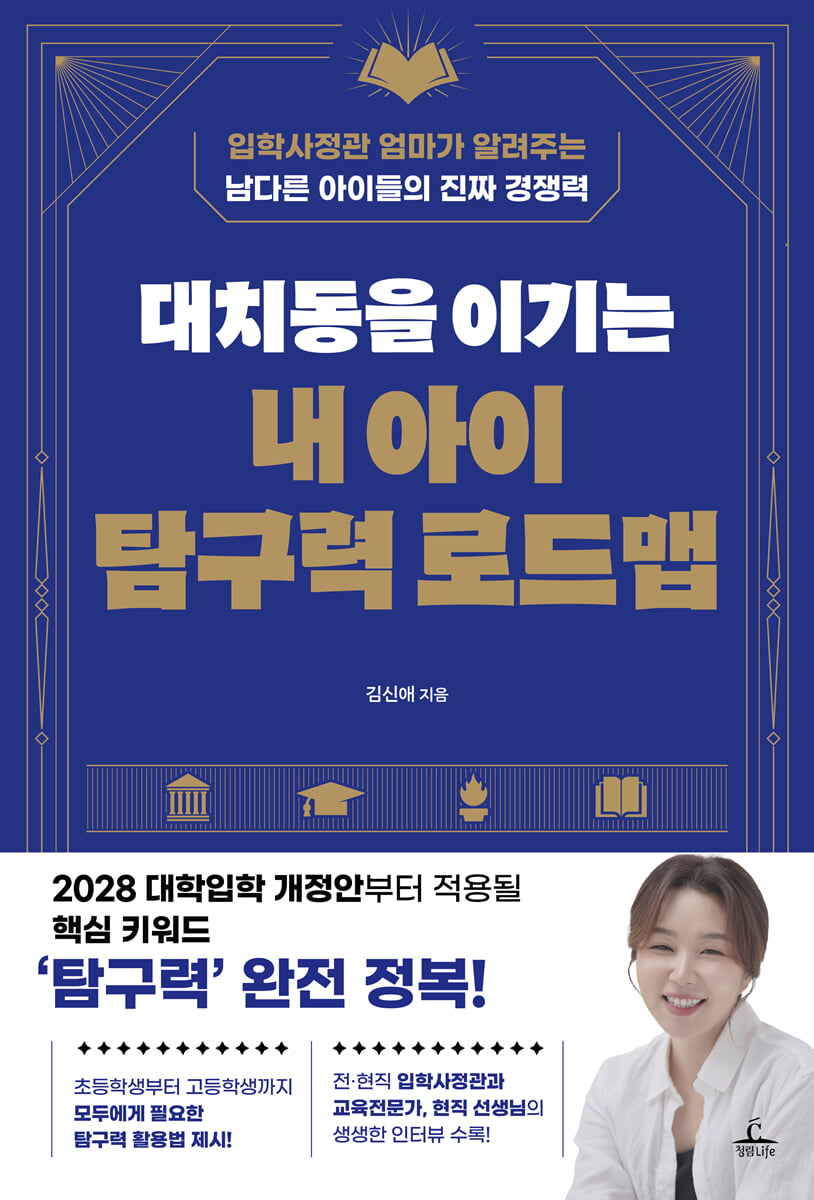
My Child's Roadmap to Exploration to Beat Daechi-dong
 |
Description
Book Introduction
Highly recommended by teacher Eun-kyung Lee of 'Wise Elementary School Life'!
Through interviews with current admissions officers, high school teachers, and education experts
An in-depth analysis of the new college admissions policy and the power of inquiry!
A roadmap for elementary through high school students on "inquiry," the key to the 2028 college entrance exam!
My child's special weapon that cannot be created through good deeds!
What's important now is 'exploratory power'!
Have you ever heard of the term "exploratory academy"? While math, English, and Korean academies are familiar, the term "exploratory academy" might be unfamiliar.
In that sense, the ability to explore has not been clearly established in the private education market.
However, the situation changed with the announcement of the '2028 College Admissions Revision'.
Universities have declared that they no longer want students who are simply good at studying, but students who have the ability to ask questions and find answers—in other words, students with a spirit of inquiry.
But ironically, the ability to explore is not something that can be learned by force at an academy.
This is because the ability to inquire is a virtue that can only be truly developed if it is nurtured step by step from home.
"My Child's Exploration Ability Roadmap to Beat Daechi-dong" is a book written by the author, who met countless students as a college admissions officer and a consultant for admissions in Daechi-dong. The author personally realized the importance of inquiry skills and how to foster them at home, presenting an elementary, middle, and high school inquiry ability roadmap tailored to the child's developmental stage.
In elementary school, we build our basic physical strength through 'reviewing, comparing, and diagramming thoughts', and in middle school, we build a framework for inquiry based on reading and train ourselves to write 'real inquiry reports'.
Upon entering high school, students further expand their exploratory skills through extracurricular activities and self-directed projects that leave a lasting impression on their student records.
The reason for developing your curiosity is not simply to get into a good college.
A child with a strong inquisitive mind goes beyond academics and asks questions about his or her own life, and in the process of finding his or her own answers, he or she grows to a higher level.
Not only will you achieve success in the college entrance exam competition, but you will also gain the strength to forge your own path in society and life in the future.
And, of course, "My Child's Exploration Roadmap to Overcome Daechi-dong" will serve as a reliable guide for parents and children on their journey of growing their explorative abilities together.
Through interviews with current admissions officers, high school teachers, and education experts
An in-depth analysis of the new college admissions policy and the power of inquiry!
A roadmap for elementary through high school students on "inquiry," the key to the 2028 college entrance exam!
My child's special weapon that cannot be created through good deeds!
What's important now is 'exploratory power'!
Have you ever heard of the term "exploratory academy"? While math, English, and Korean academies are familiar, the term "exploratory academy" might be unfamiliar.
In that sense, the ability to explore has not been clearly established in the private education market.
However, the situation changed with the announcement of the '2028 College Admissions Revision'.
Universities have declared that they no longer want students who are simply good at studying, but students who have the ability to ask questions and find answers—in other words, students with a spirit of inquiry.
But ironically, the ability to explore is not something that can be learned by force at an academy.
This is because the ability to inquire is a virtue that can only be truly developed if it is nurtured step by step from home.
"My Child's Exploration Ability Roadmap to Beat Daechi-dong" is a book written by the author, who met countless students as a college admissions officer and a consultant for admissions in Daechi-dong. The author personally realized the importance of inquiry skills and how to foster them at home, presenting an elementary, middle, and high school inquiry ability roadmap tailored to the child's developmental stage.
In elementary school, we build our basic physical strength through 'reviewing, comparing, and diagramming thoughts', and in middle school, we build a framework for inquiry based on reading and train ourselves to write 'real inquiry reports'.
Upon entering high school, students further expand their exploratory skills through extracurricular activities and self-directed projects that leave a lasting impression on their student records.
The reason for developing your curiosity is not simply to get into a good college.
A child with a strong inquisitive mind goes beyond academics and asks questions about his or her own life, and in the process of finding his or her own answers, he or she grows to a higher level.
Not only will you achieve success in the college entrance exam competition, but you will also gain the strength to forge your own path in society and life in the future.
And, of course, "My Child's Exploration Roadmap to Overcome Daechi-dong" will serve as a reliable guide for parents and children on their journey of growing their explorative abilities together.
- You can preview some of the book's contents.
Preview
index
Entering
Chapter 1: Entrance Exams Flow from Top to Bottom
1.
Parents' concerns amidst the overflow of educational information
2.
The Impact of the 2028 College Entrance Examination Reform
What the keywords of the high school credit system, college entrance reform, and 5-grade relative evaluation have left us with
- Self-directed ability to study for entrance exams
3.
I know the school type, but I don't know
- It's hard to do well in the regular admissions process, so do I need to know about the special admissions process as well?
- School species are best friends with rumors.
- The golden time to take advantage of the summer vacation of the third year of high school is the special admissions process.
- Characteristics of high schools that frequently send students to Seoul National University
TIP: High School Special Programs My Child Should Take Advantage of
4.
All you need to know is the 'Seoul National University Comprehensive Student Admissions Process'
- Inquiry, a representative competency of Seoul National University's academic field
- Seoul National University's hidden card: reading
Expert columnist Eun-kyung Lee, author of "Smart Elementary School Life"
The Reality of the 2025 College Entrance Exam and the Essence of School Types
Chapter 2: Why is the power of inquiry so important?
1.
My Child's First Extracurricular Activity
- Spin the top and write non-curricular activities.
- If you've ever heard that 'special features' are important
- The reason why we cannot help but be obsessed with the power of inquiry
2.
Performance evaluation and inquiry skills
- Elementary School Students: The Power of Inquiry: Why Anyone Can Develop It
- Middle school students: Academic achievement begins with performance evaluation.
- High school students: A time when performance assessments should be exploratory activities.
3.
Inquiry skills prepared from elementary school
- The beginning of the power of inquiry
- The research report is research.
- Why writing your first research report is difficult
- The power of inquiry that begins in everyday life
Interview with Teacher Eun-kyung Lee from "Wise Elementary School Life": "The Power of Inquiry That Connects Elementary to High School"
4.
How to avoid the temptation of fake curiosity
- The mechanism of fake exploration to appear real
- The beginning of inquiry comes from the power to ask questions.
TIP If you want to receive consulting, know this.
5.
Core competencies that can be developed in elementary school
Chapter 3: A Roadmap for Moms to Prepare in Advance for the Exam
1.
5th and 6th grades of elementary school, the foundation of career competency
- Career competencies that motivate study
- Expanded self-directed learning
2.
Practical extracurricular activities for first and second year middle school students
- Developing school record management skills
- Reading that enriches extracurricular activities
- Experience-based career exploration
3.
Middle school 3rd year, high school 1st year, choosing and executing
- High school entrance and high school selection
- Student management methods focused on college entrance exams
Interview: "The Art of School Management" from a High School Teacher with 20 Years of Experience
Interview: "Everything About Student Assessment" from a Current Admissions Officer
TIP: A look at the student records of successful applicants through their passing stories
Chapter 4: Comprehensive Student Admissions: How to Prepare Now
1.
Finding Your Way Through the Flood of College Entrance Information
- Where can I find information on school types?
- What kind of students do universities prefer?
- How should we interpret the evaluation criteria?
TIP: College Entrance Exam Information Parents Should Know First
Going out words
: Why Moms Need to Understand the Full Context of College Entrance Exams
Chapter 1: Entrance Exams Flow from Top to Bottom
1.
Parents' concerns amidst the overflow of educational information
2.
The Impact of the 2028 College Entrance Examination Reform
What the keywords of the high school credit system, college entrance reform, and 5-grade relative evaluation have left us with
- Self-directed ability to study for entrance exams
3.
I know the school type, but I don't know
- It's hard to do well in the regular admissions process, so do I need to know about the special admissions process as well?
- School species are best friends with rumors.
- The golden time to take advantage of the summer vacation of the third year of high school is the special admissions process.
- Characteristics of high schools that frequently send students to Seoul National University
TIP: High School Special Programs My Child Should Take Advantage of
4.
All you need to know is the 'Seoul National University Comprehensive Student Admissions Process'
- Inquiry, a representative competency of Seoul National University's academic field
- Seoul National University's hidden card: reading
Expert columnist Eun-kyung Lee, author of "Smart Elementary School Life"
The Reality of the 2025 College Entrance Exam and the Essence of School Types
Chapter 2: Why is the power of inquiry so important?
1.
My Child's First Extracurricular Activity
- Spin the top and write non-curricular activities.
- If you've ever heard that 'special features' are important
- The reason why we cannot help but be obsessed with the power of inquiry
2.
Performance evaluation and inquiry skills
- Elementary School Students: The Power of Inquiry: Why Anyone Can Develop It
- Middle school students: Academic achievement begins with performance evaluation.
- High school students: A time when performance assessments should be exploratory activities.
3.
Inquiry skills prepared from elementary school
- The beginning of the power of inquiry
- The research report is research.
- Why writing your first research report is difficult
- The power of inquiry that begins in everyday life
Interview with Teacher Eun-kyung Lee from "Wise Elementary School Life": "The Power of Inquiry That Connects Elementary to High School"
4.
How to avoid the temptation of fake curiosity
- The mechanism of fake exploration to appear real
- The beginning of inquiry comes from the power to ask questions.
TIP If you want to receive consulting, know this.
5.
Core competencies that can be developed in elementary school
Chapter 3: A Roadmap for Moms to Prepare in Advance for the Exam
1.
5th and 6th grades of elementary school, the foundation of career competency
- Career competencies that motivate study
- Expanded self-directed learning
2.
Practical extracurricular activities for first and second year middle school students
- Developing school record management skills
- Reading that enriches extracurricular activities
- Experience-based career exploration
3.
Middle school 3rd year, high school 1st year, choosing and executing
- High school entrance and high school selection
- Student management methods focused on college entrance exams
Interview: "The Art of School Management" from a High School Teacher with 20 Years of Experience
Interview: "Everything About Student Assessment" from a Current Admissions Officer
TIP: A look at the student records of successful applicants through their passing stories
Chapter 4: Comprehensive Student Admissions: How to Prepare Now
1.
Finding Your Way Through the Flood of College Entrance Information
- Where can I find information on school types?
- What kind of students do universities prefer?
- How should we interpret the evaluation criteria?
TIP: College Entrance Exam Information Parents Should Know First
Going out words
: Why Moms Need to Understand the Full Context of College Entrance Exams
Detailed image

Into the book
Why are mothers the only ones who live with what others might consider premature worries? It's likely because mothers are the first to experience the vast, vast world of education, a world entirely different from the past.
As a mother, I know that there are parents in every neighborhood who are gathering information and working hard to achieve the goals of their children who will enter college with them, though in different ways.
--- p.4
The keyword for the 2028 college entrance reform is ‘integration.’
This is not to say that we should fear the emergence of an ‘integrated society’ or ‘integrated science.’
This means that the college entrance exam questions will now be based on the connection between subjects.
Memorization of subject-specific knowledge continues to decline in importance.
The ability to integrate, analyze, and synthesize multiple concepts across subjects will be increasingly demanded.
It is difficult to connect various types of knowledge by blindly memorizing them as before.
Ultimately, you need a comprehensive understanding of the knowledge to the point where you can discuss, explain, and present it.
Rather than solving workbooks, reading related material or conducting research on a chosen topic may be a more appropriate study method.
--- p.24
The younger you are, the more progress you can make in your explorations, even if it's just by achieving small accomplishments at each step.
One time, it's enough to ask additional questions about Mom's ideas, and another time, it's enough to gather new information about something you were curious about through the book.
It's a fragmented exploration experience that doesn't lead to a whole, but it can be continued later as you grow.
If you increase the number of circles in your mind map, you can create the lines connecting them after your mind has matured a bit more.
--- p.100
What can mothers do to help their children take their first steps toward developing inquiry skills during elementary and middle school? Above all, it's crucial to establish a thought process in their children's minds so they can organize and express their thoughts effectively.
It is a mother's secret goal to not only help her child simply accept information or experiences, but also to look at them again, structure them, and lead them to higher-level thinking where they can organize their thoughts on their own.
--- p.116
Up until now, the focus has been on "career exploration to find your dream," but from now on, I'd like to carefully discuss "entrance exam-oriented interest" in career paths.
The first year of high school is a time when customized information gathering is necessary just for the child.
Therefore, from now on, mothers must also seriously study information about college entrance exams.
You should regularly check the college admissions policy and consider the course selection and direction within the high school credit system.
--- p.189
The admissions system ultimately influences how universities select students, which in turn influences high school choices.
Because high school entrance exams aren't something everyone experiences, there isn't as much information about high school as there is about college entrance exams.
There are many videos and materials focused on information about some famous high schools.
So, while college entrance exams involve looking at the big picture and digging into the details, high school entrance exams are better when you look around you and gradually expand your horizons.
--- p.221
Parents who understand the big picture of college admissions can find their bearings amidst complex structures and changes.
Based on this, you can convey consistent and clear expectations to your children, which will serve as a basis for them to design their own career path and goals.
In fact, research shows that the clearer and more consistent a parent's expectations are, the more steadily the child progresses toward self-actualization.
As a mother, I know that there are parents in every neighborhood who are gathering information and working hard to achieve the goals of their children who will enter college with them, though in different ways.
--- p.4
The keyword for the 2028 college entrance reform is ‘integration.’
This is not to say that we should fear the emergence of an ‘integrated society’ or ‘integrated science.’
This means that the college entrance exam questions will now be based on the connection between subjects.
Memorization of subject-specific knowledge continues to decline in importance.
The ability to integrate, analyze, and synthesize multiple concepts across subjects will be increasingly demanded.
It is difficult to connect various types of knowledge by blindly memorizing them as before.
Ultimately, you need a comprehensive understanding of the knowledge to the point where you can discuss, explain, and present it.
Rather than solving workbooks, reading related material or conducting research on a chosen topic may be a more appropriate study method.
--- p.24
The younger you are, the more progress you can make in your explorations, even if it's just by achieving small accomplishments at each step.
One time, it's enough to ask additional questions about Mom's ideas, and another time, it's enough to gather new information about something you were curious about through the book.
It's a fragmented exploration experience that doesn't lead to a whole, but it can be continued later as you grow.
If you increase the number of circles in your mind map, you can create the lines connecting them after your mind has matured a bit more.
--- p.100
What can mothers do to help their children take their first steps toward developing inquiry skills during elementary and middle school? Above all, it's crucial to establish a thought process in their children's minds so they can organize and express their thoughts effectively.
It is a mother's secret goal to not only help her child simply accept information or experiences, but also to look at them again, structure them, and lead them to higher-level thinking where they can organize their thoughts on their own.
--- p.116
Up until now, the focus has been on "career exploration to find your dream," but from now on, I'd like to carefully discuss "entrance exam-oriented interest" in career paths.
The first year of high school is a time when customized information gathering is necessary just for the child.
Therefore, from now on, mothers must also seriously study information about college entrance exams.
You should regularly check the college admissions policy and consider the course selection and direction within the high school credit system.
--- p.189
The admissions system ultimately influences how universities select students, which in turn influences high school choices.
Because high school entrance exams aren't something everyone experiences, there isn't as much information about high school as there is about college entrance exams.
There are many videos and materials focused on information about some famous high schools.
So, while college entrance exams involve looking at the big picture and digging into the details, high school entrance exams are better when you look around you and gradually expand your horizons.
--- p.221
Parents who understand the big picture of college admissions can find their bearings amidst complex structures and changes.
Based on this, you can convey consistent and clear expectations to your children, which will serve as a basis for them to design their own career path and goals.
In fact, research shows that the clearer and more consistent a parent's expectations are, the more steadily the child progresses toward self-actualization.
--- p.245
Publisher's Review
Key words to be applied starting with the 2028 college admissions revision
Completely conquering the power of exploration!
The upcoming 2028 college entrance exam will present a completely different paradigm from previous entrance exams.
Passing the exam is not guaranteed by simply memorizing knowledge and studying problem-solving.
Universities have already emphasized through numerous announcements that they will "select talents with convergent thinking and creative problem-solving skills in the future."
This means that it is no longer possible to secure competitiveness based on academic performance alone.
The students who catch the attention of universities are those who demonstrate a depth of learning through the process of asking questions and finding answers on their own.
"My Child's Exploration Ability Roadmap to Beat Daechi-dong" is a book that began with the question of how to foster the exploratory ability desired by universities from a young age.
Based on numerous cases personally confirmed by the author while working as a college admissions officer and a consultant in Daechi-dong, he says, “The power that will ultimately determine success or failure in future college entrance exams is the ability to research.”
This book accurately identifies the changing college entrance exam environment for anxious parents and offers clear answers on how to cultivate inquiry skills, which will become the new standard for children's education.
Creating differentiated entrance exam competitiveness from elementary school to high school students
Step-by-step instructions on how to use your investigative skills!
The ability to explore is not developed overnight.
You have to build up your skills step by step from elementary school to shine in high school.
"My Child's Exploration Roadmap to Beat Daechi-dong" systematically presents an exploration roadmap for elementary, middle, and high school students, taking into account the child's developmental stages.
In elementary school, students develop basic inquiry skills through training such as 'reviewing, comparing, and diagramming thoughts', and in middle school, they build a framework for inquiry centered on reading and learn how to write a 'real inquiry report'.
During high school, students directly connect their investigative skills to college entrance exams through extracurricular activities and projects that leave an impression on the student body.
This process is designed so that parents can practice it sufficiently at home, thereby overcoming the limitation that it is difficult to develop inquiry skills.
It is different in that it does not simply list study methods, but contains methods that parents and children can practice while growing together.
Ultimately, this book will serve as the most realistic guide to helping children grow into self-directed learners throughout the long journey from elementary school to high school.
Through interviews with former and current admissions officers, education experts, and current teachers
2028 New Analysis of the Correlation Between College Admissions and Exploration Ability!
Another strength of "My Child's Exploration Roadmap to Overcome Daechi-dong" is that it goes beyond being a simple theoretical book and vividly captures voices from the field.
The book includes the author's experience as a college admissions officer and admissions consultant in Daechi-dong, as well as interviews with a high school teacher with 20 years of experience on "the art of school management," a current admissions officer on "everything about student evaluation," and an education expert on "the power of inquiry that continues from elementary to high school."
Through this, readers can obtain a concrete and three-dimensional picture of how the 'inquiry power', which is often considered an abstract concept, is actually cultivated and reflected in college entrance exams.
Exploration in elementary school is literally the time to plant the seeds of inquiry.
As children develop the habit of asking questions and finding answers on their own, they develop their thinking and problem-solving skills.
This experience directly influences the writing of the detailed abilities and special skills required for college entrance exams, as it leads to middle school performance assessments and high school extracurricular activities.
In college, students are evaluated not simply on their ability to memorize, but on the process of defining and solving problems. Therefore, the small exploratory experiences from elementary school accumulate and become great assets.
Eun-kyung Lee (child education expert, CEO of Smart Elementary School Life)
Completely conquering the power of exploration!
The upcoming 2028 college entrance exam will present a completely different paradigm from previous entrance exams.
Passing the exam is not guaranteed by simply memorizing knowledge and studying problem-solving.
Universities have already emphasized through numerous announcements that they will "select talents with convergent thinking and creative problem-solving skills in the future."
This means that it is no longer possible to secure competitiveness based on academic performance alone.
The students who catch the attention of universities are those who demonstrate a depth of learning through the process of asking questions and finding answers on their own.
"My Child's Exploration Ability Roadmap to Beat Daechi-dong" is a book that began with the question of how to foster the exploratory ability desired by universities from a young age.
Based on numerous cases personally confirmed by the author while working as a college admissions officer and a consultant in Daechi-dong, he says, “The power that will ultimately determine success or failure in future college entrance exams is the ability to research.”
This book accurately identifies the changing college entrance exam environment for anxious parents and offers clear answers on how to cultivate inquiry skills, which will become the new standard for children's education.
Creating differentiated entrance exam competitiveness from elementary school to high school students
Step-by-step instructions on how to use your investigative skills!
The ability to explore is not developed overnight.
You have to build up your skills step by step from elementary school to shine in high school.
"My Child's Exploration Roadmap to Beat Daechi-dong" systematically presents an exploration roadmap for elementary, middle, and high school students, taking into account the child's developmental stages.
In elementary school, students develop basic inquiry skills through training such as 'reviewing, comparing, and diagramming thoughts', and in middle school, they build a framework for inquiry centered on reading and learn how to write a 'real inquiry report'.
During high school, students directly connect their investigative skills to college entrance exams through extracurricular activities and projects that leave an impression on the student body.
This process is designed so that parents can practice it sufficiently at home, thereby overcoming the limitation that it is difficult to develop inquiry skills.
It is different in that it does not simply list study methods, but contains methods that parents and children can practice while growing together.
Ultimately, this book will serve as the most realistic guide to helping children grow into self-directed learners throughout the long journey from elementary school to high school.
Through interviews with former and current admissions officers, education experts, and current teachers
2028 New Analysis of the Correlation Between College Admissions and Exploration Ability!
Another strength of "My Child's Exploration Roadmap to Overcome Daechi-dong" is that it goes beyond being a simple theoretical book and vividly captures voices from the field.
The book includes the author's experience as a college admissions officer and admissions consultant in Daechi-dong, as well as interviews with a high school teacher with 20 years of experience on "the art of school management," a current admissions officer on "everything about student evaluation," and an education expert on "the power of inquiry that continues from elementary to high school."
Through this, readers can obtain a concrete and three-dimensional picture of how the 'inquiry power', which is often considered an abstract concept, is actually cultivated and reflected in college entrance exams.
Exploration in elementary school is literally the time to plant the seeds of inquiry.
As children develop the habit of asking questions and finding answers on their own, they develop their thinking and problem-solving skills.
This experience directly influences the writing of the detailed abilities and special skills required for college entrance exams, as it leads to middle school performance assessments and high school extracurricular activities.
In college, students are evaluated not simply on their ability to memorize, but on the process of defining and solving problems. Therefore, the small exploratory experiences from elementary school accumulate and become great assets.
Eun-kyung Lee (child education expert, CEO of Smart Elementary School Life)
GOODS SPECIFICS
- Date of issue: October 8, 2025
- Page count, weight, size: 248 pages | 152*224*20mm
- ISBN13: 9791193842492
- ISBN10: 1193842492
- KC Certification: Certification Type: Conformity Confirmation
You may also like
카테고리
korean


korean

![GQ KOREA Mark (Monthly): December [2025]](http://librairie.coreenne.fr/cdn/shop/files/8ef265dbbfbf186523ed75ba7319009d.jpg?v=1765340328&width=3840)


