

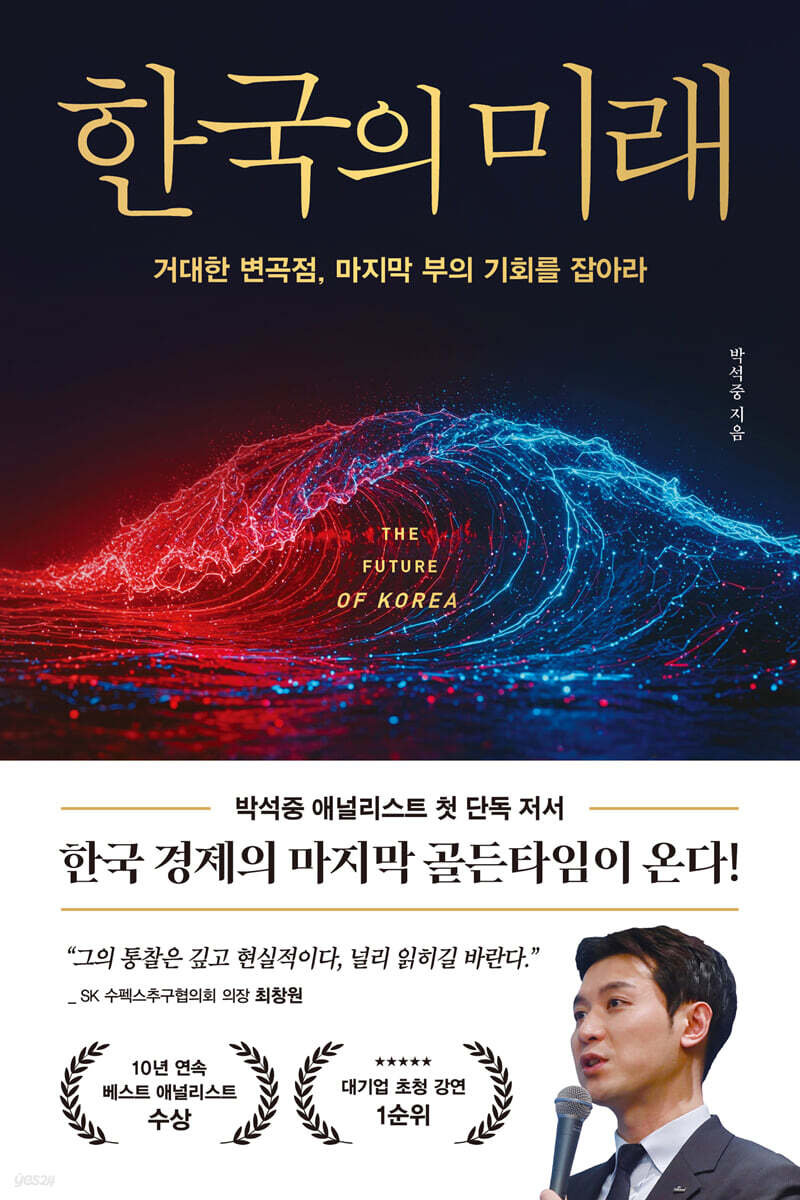
Korea's future
 |
Description
Book Introduction
- A word from MD
-
At the threshold of the last golden timeAnalyst Park Seok-joong's first solo book.
Gain insight into the realities and opportunities of the Korean economy amidst the turbulent international order.
We assess the shocks and possibilities that South Korea will face amid the restructuring of production and hegemony due to America First.
It presents solutions for households, businesses, and the government facing structural limitations and asks about the conditions for the survival of the Korean economy.
Economic and Management PD Oh Da-eun
Top priority for lecture invitations from leading domestic corporations such as SK, LG, and Samsung!
Shinhan Investment & Securities analyst Park Seok-joong's first solo book
“This is the book I’ve been waiting for.
His insights are always deep and realistic.
I hope it will be widely read.”
_ Choi Chang-won, Chairman of SK Supex Pursuit Council
From Trump's reorganization of the world order toward a greater America
The future scenario of the new Lee Jae-myung administration, aiming for KOSPI 5000.
The story behind the technological revolution that shook the world!
Welcome to the final golden time that will determine Korea's future!
Shinhan Investment & Securities analyst Park Seok-joong's first solo book
“This is the book I’ve been waiting for.
His insights are always deep and realistic.
I hope it will be widely read.”
_ Choi Chang-won, Chairman of SK Supex Pursuit Council
From Trump's reorganization of the world order toward a greater America
The future scenario of the new Lee Jae-myung administration, aiming for KOSPI 5000.
The story behind the technological revolution that shook the world!
Welcome to the final golden time that will determine Korea's future!
- You can preview some of the book's contents.
Preview
index
At the threshold of the last golden time of the West Gate
PART 1: The Great Transformation of the World Economy Begins
01 Trump's Second Term: New Challenges for the Korean Economy
Trump's global threat
America is no longer great?
Three Gurus Who Predicted America's Rise and Fall
The United States, where the collapse of social order has begun
02 The world economic order reorganized every 30 years
The First 30 Years: The Breton Woods System (1944–1980)
The Second Thirty Years: The Plaza Accord (1980–2010)
The Third Thirty Years: China's Incorporation into the System (1995–2025)
The Fourth Thirty Years: The Trump Administration (2025–?)
03 Economic and financial market order established under the leadership of the United States
The United States fostered China as the world's factory.
The United States monopolizes the added value of advanced manufacturing.
04 Trump's New Economic Order
Make America Great Again!
The Optimal Policy Combination for Promoting American Manufacturing
05 Trump Scenario
Why distinguish between constants and variables?
A greater danger awaits
Presentation of US-China conflict scenarios and response strategies
06 Structural Risks and Cyclical Opportunities Facing Korea
Structural risks facing Korea
Calls for fiscal expansion need greater significance.
07 Paradigm Shift in the Financial Market
A historic turning point for the Korean economy
Financial markets where past experience doesn't work
08 Portfolio Strategy by Investment Asset
Stocks: A New Portfolio Strategy Is Needed
Bonds: Recognizing a Paradigm Shift
09 Korea is at the center of danger. What is our attitude at this time?
PART 2 Korea's Future: On the Brink of the Last Golden Time
100% Growth, South Korea's Economy Faces Risk
The Korean economy entered 0% growth
Structural risks facing Korea
The abnormal growth of the three major economic entities
Chapter 11: Great Rotation, Korea's version of the Great Household Asset Migration
The domestic market slump with no end in sight
Risks caused by rising household debt and overheated real estate markets
Why You Should Pay Attention to Government Policy Changes
Prepare for a massive shift in household assets.
Why are we so obsessed with real estate?
The Golden Time for Changes in Household Asset Portfolio
Investment alternatives to watch now
Chapter 12: Korea's Hope Still Lies in Corporations
Korean companies in dire straits
The History of the Great Shift in Manufacturing Hegemony
The target of the front-line teacher: Japan's lost 30 years
Implications of Japan's Fall for Korea
The Secret Behind Japan's Corporate Restructuring: The Keiretsu Trap
Korea's top 10 conglomerates need to restructure their portfolios.
Two Suggestions for Korean Companies
Why You Should Give Up on a Business You're Good at
The fortunes of Korean companies are being divided.
13 Government: Expectations for the New Government's Structural Reforms
The changing role of government
Five Agenda Points for the New Government
Will government spending of 700 trillion won usher in economic recovery?
Trade negotiations with the US require well-founded confidence.
The new government's top policy priority: industrial development.
Can KOSPI 5,000 and Gangnam real estate stabilize?
The government is preparing for a Korean version of a great transformation.
PART 3: TECHNOLOGICAL INNOVATION: UNDERSTANDING LONG-TERM WAVES
14 A world connected by technological innovation
Technological innovation has been at the turning point of the global economy.
Who will seize the new power hegemony?
15 Technological innovation waves that are influencing the global economy
Technological innovation stronger than economic order
Reading the Wave of Technological Innovation Through the Business Cycle
The Paradox of the Trade War: The Advent of an Era of Accelerated Technological Innovation
The Trump crisis requires a counterintuitive approach.
Historical examples of turning crises into opportunities
In the end, only the surviving companies monopolize everything.
17 AI, the prelude to a megacycle
The AI industry hasn't even started yet.
Why is AI spreading so rapidly?
The AI Industry's Growth Path as Seen Through the S-Curve
A Five-Year Bull Market Driven by AI
18 AI Next Stage: Five Stages of Technological Innovation
Five Stages of Technological Innovation
What stage are we at now?
19 Understanding the Global AI Ecosystem
An AI ecosystem completed in five steps
Infrastructure sovereignty: the core of the AI value chain
The AI ecosystem dominated by the US and China
20. Will Korea's AI Sovereign Strategy Succeed or Fail?
The national grand strategy to build sovereign AI has begun.
Strategy for Building a Korean Sovereign AI
Our stance toward technological innovation
The pinnacle of the industrial revolution brought about by AI
Ride the technological wave of innovation through the eyes of capitalists.
Specific Investment Strategies in the AI Era
PART 1: The Great Transformation of the World Economy Begins
01 Trump's Second Term: New Challenges for the Korean Economy
Trump's global threat
America is no longer great?
Three Gurus Who Predicted America's Rise and Fall
The United States, where the collapse of social order has begun
02 The world economic order reorganized every 30 years
The First 30 Years: The Breton Woods System (1944–1980)
The Second Thirty Years: The Plaza Accord (1980–2010)
The Third Thirty Years: China's Incorporation into the System (1995–2025)
The Fourth Thirty Years: The Trump Administration (2025–?)
03 Economic and financial market order established under the leadership of the United States
The United States fostered China as the world's factory.
The United States monopolizes the added value of advanced manufacturing.
04 Trump's New Economic Order
Make America Great Again!
The Optimal Policy Combination for Promoting American Manufacturing
05 Trump Scenario
Why distinguish between constants and variables?
A greater danger awaits
Presentation of US-China conflict scenarios and response strategies
06 Structural Risks and Cyclical Opportunities Facing Korea
Structural risks facing Korea
Calls for fiscal expansion need greater significance.
07 Paradigm Shift in the Financial Market
A historic turning point for the Korean economy
Financial markets where past experience doesn't work
08 Portfolio Strategy by Investment Asset
Stocks: A New Portfolio Strategy Is Needed
Bonds: Recognizing a Paradigm Shift
09 Korea is at the center of danger. What is our attitude at this time?
PART 2 Korea's Future: On the Brink of the Last Golden Time
100% Growth, South Korea's Economy Faces Risk
The Korean economy entered 0% growth
Structural risks facing Korea
The abnormal growth of the three major economic entities
Chapter 11: Great Rotation, Korea's version of the Great Household Asset Migration
The domestic market slump with no end in sight
Risks caused by rising household debt and overheated real estate markets
Why You Should Pay Attention to Government Policy Changes
Prepare for a massive shift in household assets.
Why are we so obsessed with real estate?
The Golden Time for Changes in Household Asset Portfolio
Investment alternatives to watch now
Chapter 12: Korea's Hope Still Lies in Corporations
Korean companies in dire straits
The History of the Great Shift in Manufacturing Hegemony
The target of the front-line teacher: Japan's lost 30 years
Implications of Japan's Fall for Korea
The Secret Behind Japan's Corporate Restructuring: The Keiretsu Trap
Korea's top 10 conglomerates need to restructure their portfolios.
Two Suggestions for Korean Companies
Why You Should Give Up on a Business You're Good at
The fortunes of Korean companies are being divided.
13 Government: Expectations for the New Government's Structural Reforms
The changing role of government
Five Agenda Points for the New Government
Will government spending of 700 trillion won usher in economic recovery?
Trade negotiations with the US require well-founded confidence.
The new government's top policy priority: industrial development.
Can KOSPI 5,000 and Gangnam real estate stabilize?
The government is preparing for a Korean version of a great transformation.
PART 3: TECHNOLOGICAL INNOVATION: UNDERSTANDING LONG-TERM WAVES
14 A world connected by technological innovation
Technological innovation has been at the turning point of the global economy.
Who will seize the new power hegemony?
15 Technological innovation waves that are influencing the global economy
Technological innovation stronger than economic order
Reading the Wave of Technological Innovation Through the Business Cycle
The Paradox of the Trade War: The Advent of an Era of Accelerated Technological Innovation
The Trump crisis requires a counterintuitive approach.
Historical examples of turning crises into opportunities
In the end, only the surviving companies monopolize everything.
17 AI, the prelude to a megacycle
The AI industry hasn't even started yet.
Why is AI spreading so rapidly?
The AI Industry's Growth Path as Seen Through the S-Curve
A Five-Year Bull Market Driven by AI
18 AI Next Stage: Five Stages of Technological Innovation
Five Stages of Technological Innovation
What stage are we at now?
19 Understanding the Global AI Ecosystem
An AI ecosystem completed in five steps
Infrastructure sovereignty: the core of the AI value chain
The AI ecosystem dominated by the US and China
20. Will Korea's AI Sovereign Strategy Succeed or Fail?
The national grand strategy to build sovereign AI has begun.
Strategy for Building a Korean Sovereign AI
Our stance toward technological innovation
The pinnacle of the industrial revolution brought about by AI
Ride the technological wave of innovation through the eyes of capitalists.
Specific Investment Strategies in the AI Era
Detailed image

Into the book
The reason the Trump campaign's policy slogan, "Make America Great Again," was able to resonate deeply with the public may be evidence of a sense of crisis that "America is no longer great."
Is American hegemony truly on the path to decline? If we project America's long-term cyclical cycle across its political, economic, financial, social, and moral systems, we see that the United States has already entered a cycle of structural decline as a hegemonic power.
At the same time, debt-driven growth is also reaching a critical point.
It is also undeniable that we are in a period of inter-class conflict caused by the widening gap between the rich and the poor, and that we are in the process of re-establishing laws, institutions, and social systems.
The big picture of American reconstruction emphasized by Trump ultimately leads to the goal of the "Great Rotation."
To understand this, we need to take a long-term perspective and read the historical flow.
--- p.23
Let's get to the point.
The current risks facing the Korean economy stem from long-standing, accumulated imbalances.
Gross domestic product (GDP) is composed of exports, investment, consumption, and government spending.
Since 1970, Korea has maintained high growth within a virtuous economic cycle where corporate sales (exports) have led to domestic investment, creating jobs and expanding the domestic market.
The virtuous cycle of growth began to break down in 2012.
Following the US-originated financial crisis, China implemented large-scale economic stimulus policies, leading to a recovery in demand from China and a supply shortage.
From this point on, Korean companies' overseas direct investment in China began in earnest.
--- p.105
Why did I emphasize the urgency of change? It's because we're creating an environment that's completely different from the one we've seen over the past 20 to 30 years, and we must recognize that this poses a grave risk to Korean households.
As corporate (export) competitiveness began to decline in earnest, a long-term recession in the job market began.
The burden of high interest rates, which are at their highest level in 20 years, is also prolonged, exposing us to direct risks.
Household consumption and real estate speculation driven by debt expansion and rising real estate prices are no longer sustainable.
--- p.121
We stand at a crossroads.
The choice is whether to pursue preemptive restructuring, or to pursue large-scale corporate bankruptcies and government-led forced mergers and acquisitions due to the expansion of corporate insolvency, as in Japan's case.
Korean companies are moving in the latter direction, though still slowly.
Ultimately, rebalancing a Korean company's business portfolio should be a process of "giving up businesses that we know we can do well in based on past experience and choosing businesses we haven't tried before but must do anyway."
--- p.164
Government policy must extend beyond institutional reforms like the Commercial Act to improving the overall structure of industry and the economy.
In a changing policy environment, companies must demonstrate growth potential (=profit growth) through new industries and secure stable cash flow (=resources for shareholder returns) through restructuring existing businesses.
Only when these two work together can the goals of increasing ROE, revaluing the stock price, and reaching a KOSPI of 5,000 become a reality.
--- p.194
Did you know that crises that have struck the global economy have been recurring? The 1986 US Special Offer and Loan (S&L) crisis, the 1997 East Asian financial crisis, the 2008 US-originated financial crisis, and the 2019 pandemic all occurred at intervals of 10 to 12 years.
What's interesting is that repeated crises have invariably been followed by massive government stimulus measures, and these strong policies have ultimately expanded to drive robust investment and technological innovation.
Like a rhythm that follows a certain cycle, the global economy has moved through major currents of crisis, policy, investment, and technological innovation.
--- p.218
AI technology is no longer confined to subscription services; it is rapidly expanding into advertising, online shopping, and even enterprise work tools.
Along with this, demand for peripheral technologies and services such as power, security, communications, and digital devices is also expected to increase significantly.
In conclusion, now is the time to focus on ‘companies that create value with technology’ rather than ‘companies that created technology.’
As technology becomes more widespread, the landscape of industry changes as well.
Investors also need strategies to broaden their horizons to accommodate these changes.
--- p.246
Investing always requires a core.
This is especially important in fields of rapid change, such as technological innovation. The US and China have already established a difficult barrier to entry when it comes to AI leadership.
However, as we are still in the infrastructure construction stage, we cannot predict the entire evolution of the technology.
It's similar to past experiences, where no one predicted that platform companies would ultimately benefit from the smartphone revolution.
There are technology-focused stock indices in the US and China, including the NASDAQ in the US, the STAR Market in China, and the Hang Seng Tech in Hong Kong.
It is advisable to adopt a long-term holding strategy with the stock indices of these two countries as the core.
A more effective strategy is to supplement or maximize index returns through thematic ETFs rather than individual companies.
Is American hegemony truly on the path to decline? If we project America's long-term cyclical cycle across its political, economic, financial, social, and moral systems, we see that the United States has already entered a cycle of structural decline as a hegemonic power.
At the same time, debt-driven growth is also reaching a critical point.
It is also undeniable that we are in a period of inter-class conflict caused by the widening gap between the rich and the poor, and that we are in the process of re-establishing laws, institutions, and social systems.
The big picture of American reconstruction emphasized by Trump ultimately leads to the goal of the "Great Rotation."
To understand this, we need to take a long-term perspective and read the historical flow.
--- p.23
Let's get to the point.
The current risks facing the Korean economy stem from long-standing, accumulated imbalances.
Gross domestic product (GDP) is composed of exports, investment, consumption, and government spending.
Since 1970, Korea has maintained high growth within a virtuous economic cycle where corporate sales (exports) have led to domestic investment, creating jobs and expanding the domestic market.
The virtuous cycle of growth began to break down in 2012.
Following the US-originated financial crisis, China implemented large-scale economic stimulus policies, leading to a recovery in demand from China and a supply shortage.
From this point on, Korean companies' overseas direct investment in China began in earnest.
--- p.105
Why did I emphasize the urgency of change? It's because we're creating an environment that's completely different from the one we've seen over the past 20 to 30 years, and we must recognize that this poses a grave risk to Korean households.
As corporate (export) competitiveness began to decline in earnest, a long-term recession in the job market began.
The burden of high interest rates, which are at their highest level in 20 years, is also prolonged, exposing us to direct risks.
Household consumption and real estate speculation driven by debt expansion and rising real estate prices are no longer sustainable.
--- p.121
We stand at a crossroads.
The choice is whether to pursue preemptive restructuring, or to pursue large-scale corporate bankruptcies and government-led forced mergers and acquisitions due to the expansion of corporate insolvency, as in Japan's case.
Korean companies are moving in the latter direction, though still slowly.
Ultimately, rebalancing a Korean company's business portfolio should be a process of "giving up businesses that we know we can do well in based on past experience and choosing businesses we haven't tried before but must do anyway."
--- p.164
Government policy must extend beyond institutional reforms like the Commercial Act to improving the overall structure of industry and the economy.
In a changing policy environment, companies must demonstrate growth potential (=profit growth) through new industries and secure stable cash flow (=resources for shareholder returns) through restructuring existing businesses.
Only when these two work together can the goals of increasing ROE, revaluing the stock price, and reaching a KOSPI of 5,000 become a reality.
--- p.194
Did you know that crises that have struck the global economy have been recurring? The 1986 US Special Offer and Loan (S&L) crisis, the 1997 East Asian financial crisis, the 2008 US-originated financial crisis, and the 2019 pandemic all occurred at intervals of 10 to 12 years.
What's interesting is that repeated crises have invariably been followed by massive government stimulus measures, and these strong policies have ultimately expanded to drive robust investment and technological innovation.
Like a rhythm that follows a certain cycle, the global economy has moved through major currents of crisis, policy, investment, and technological innovation.
--- p.218
AI technology is no longer confined to subscription services; it is rapidly expanding into advertising, online shopping, and even enterprise work tools.
Along with this, demand for peripheral technologies and services such as power, security, communications, and digital devices is also expected to increase significantly.
In conclusion, now is the time to focus on ‘companies that create value with technology’ rather than ‘companies that created technology.’
As technology becomes more widespread, the landscape of industry changes as well.
Investors also need strategies to broaden their horizons to accommodate these changes.
--- p.246
Investing always requires a core.
This is especially important in fields of rapid change, such as technological innovation. The US and China have already established a difficult barrier to entry when it comes to AI leadership.
However, as we are still in the infrastructure construction stage, we cannot predict the entire evolution of the technology.
It's similar to past experiences, where no one predicted that platform companies would ultimately benefit from the smartphone revolution.
There are technology-focused stock indices in the US and China, including the NASDAQ in the US, the STAR Market in China, and the Hang Seng Tech in Hong Kong.
It is advisable to adopt a long-term holding strategy with the stock indices of these two countries as the core.
A more effective strategy is to supplement or maximize index returns through thematic ETFs rather than individual companies.
--- p.271
Publisher's Review
Trump's Global Economic Restructuring: Embrace the New Order
"After reading this book, you'll see the current economic environment in a completely new light."
_From reader reviews
With the start of Trump's second term, disturbing news is breaking out every day.
Trump's indiscriminate policies, championing America First, may at first seem like individual, arbitrary actions, but they are in line with the goal of restructuring the world order that has been in place since President Obama.
Until now, the United States has made China and emerging Asian countries the world's factories, and as a result, Korea has risen to the ranks of the "Four Tigers of Asia" and leaped to the ranks of advanced countries.
But now, the United States plans to completely overturn the world order.
Through America First, the United States will become the main producer and will not give up its status as a hegemonic power even if it means inciting conflict between nations.
And in this process, it will be Korea that will face the greatest crisis.
This book explains Trump's global economic restructuring and analyzes the impact of these changes on Korean households, businesses, and the government.
It is very significant that the solo book by analyst Park Seok-joong, who is highly sought after for corporate lectures, has been published at this time.
Having continued to give corporate lectures under the title “The Future of Korea,” he decided to write his first solo book after numerous audience requests for him to publish it.
This book explores the path Korea should take in the new order that will unfold in the future.
Korean Economic Scenario for the Next Three Years
The last golden time for the Korean economy is coming!
While it is true that the reorganization of the global order poses a major crisis for the Korean economy, the author argues in his book that now is not the time to panic, but to devise a strategy.
The author specifically identifies the realities facing the three pillars of the Korean economy: households, businesses, and the government.
These days, we are bombarded with words that incite a sense of crisis, such as stagnant domestic demand, rising household debt, and declining corporate competitiveness. However, this book presents realistic answers to the questions about what options are available to resolve these issues.
We analyze the Lee Jae-myung administration's scenario for achieving a KOSPI 5000 index and present specific strategies for Korean companies to overcome the current crisis.
Through this, individual investors will also be able to gain insight into the current economy.
We will also introduce asset allocation strategies and promising investment themes available to individual investors, and provide specific investment scenarios for the next 30 years.
Finally, we examine the megacycle of AI and technological innovation at the center of changing global order, the Sovereign AI strategy, and present investment themes that can be realized through this.
I recommend reading this book to the end, as it is useful for both businesses and individual investors.
After reading this book, your vague anxiety will disappear and you will be able to look at the current economy with a wise perspective.
"After reading this book, you'll see the current economic environment in a completely new light."
_From reader reviews
With the start of Trump's second term, disturbing news is breaking out every day.
Trump's indiscriminate policies, championing America First, may at first seem like individual, arbitrary actions, but they are in line with the goal of restructuring the world order that has been in place since President Obama.
Until now, the United States has made China and emerging Asian countries the world's factories, and as a result, Korea has risen to the ranks of the "Four Tigers of Asia" and leaped to the ranks of advanced countries.
But now, the United States plans to completely overturn the world order.
Through America First, the United States will become the main producer and will not give up its status as a hegemonic power even if it means inciting conflict between nations.
And in this process, it will be Korea that will face the greatest crisis.
This book explains Trump's global economic restructuring and analyzes the impact of these changes on Korean households, businesses, and the government.
It is very significant that the solo book by analyst Park Seok-joong, who is highly sought after for corporate lectures, has been published at this time.
Having continued to give corporate lectures under the title “The Future of Korea,” he decided to write his first solo book after numerous audience requests for him to publish it.
This book explores the path Korea should take in the new order that will unfold in the future.
Korean Economic Scenario for the Next Three Years
The last golden time for the Korean economy is coming!
While it is true that the reorganization of the global order poses a major crisis for the Korean economy, the author argues in his book that now is not the time to panic, but to devise a strategy.
The author specifically identifies the realities facing the three pillars of the Korean economy: households, businesses, and the government.
These days, we are bombarded with words that incite a sense of crisis, such as stagnant domestic demand, rising household debt, and declining corporate competitiveness. However, this book presents realistic answers to the questions about what options are available to resolve these issues.
We analyze the Lee Jae-myung administration's scenario for achieving a KOSPI 5000 index and present specific strategies for Korean companies to overcome the current crisis.
Through this, individual investors will also be able to gain insight into the current economy.
We will also introduce asset allocation strategies and promising investment themes available to individual investors, and provide specific investment scenarios for the next 30 years.
Finally, we examine the megacycle of AI and technological innovation at the center of changing global order, the Sovereign AI strategy, and present investment themes that can be realized through this.
I recommend reading this book to the end, as it is useful for both businesses and individual investors.
After reading this book, your vague anxiety will disappear and you will be able to look at the current economy with a wise perspective.
GOODS SPECIFICS
- Date of issue: September 2, 2025
- Page count, weight, size: 276 pages | 460g | 140*210*24mm
- ISBN13: 9791169851589
- ISBN10: 1169851584
You may also like
카테고리
korean


korean

![ELLE 엘르 스페셜 에디션 A형 : 12월 [2025]](http://librairie.coreenne.fr/cdn/shop/files/b8e27a3de6c9538896439686c6b0e8fb.jpg?v=1766436872&width=3840)


