

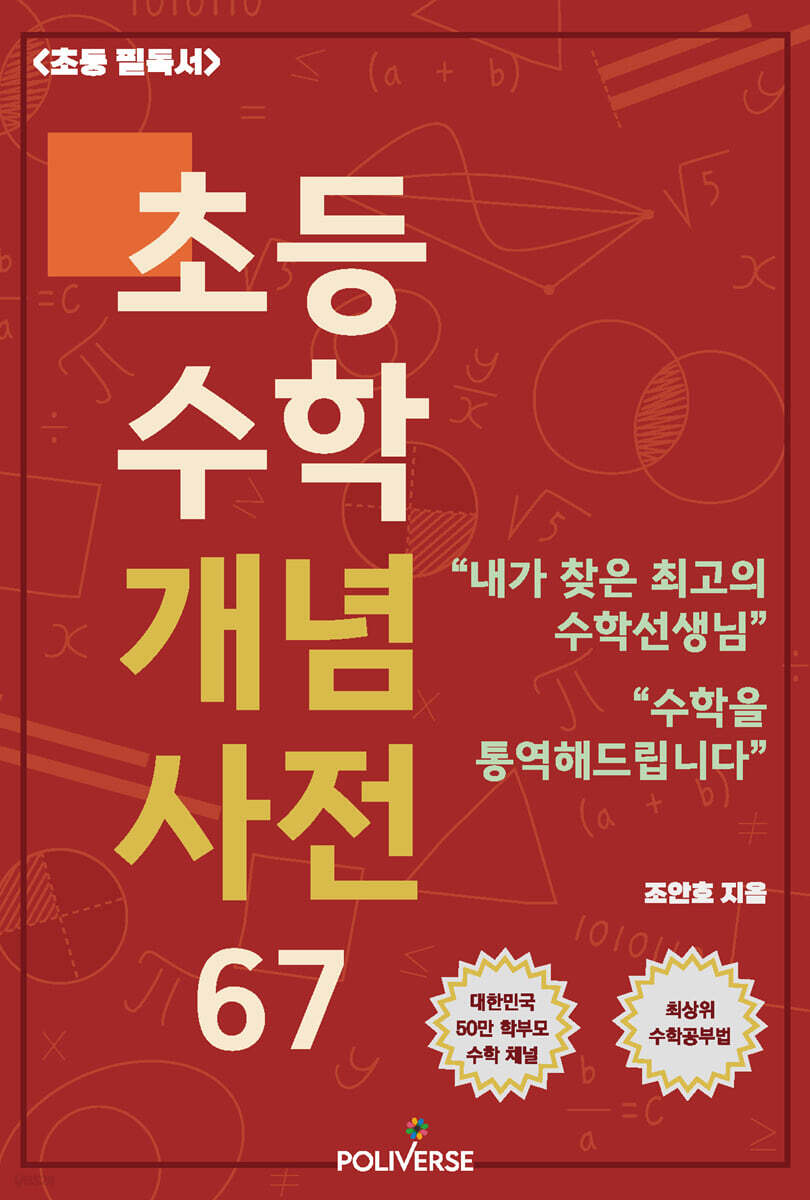
Elementary Mathematics Concept Dictionary 67
 |
Description
Book Introduction
A unique elementary math concept dictionary, perfected with 30 years of field expertise.
I have been teaching math to elementary, middle, and high school students, mostly one-on-one, for the past 30 years.
What is unique is that instead of showing the child how to solve the problem directly, only the necessary operations and concepts are taught and the child is left to solve the problem.
However, the concept was not found anywhere in the concept workbook or textbook.
Even books called "concept dictionaries" on the market were merely extensions of textbooks and full of errors.
In the end, I created each concept one by one and arrived at what I am today.
When we taught the children the necessary calculations and concepts they were lacking, most of them showed remarkable results, and in many cases, children who were at the bottom of the school eventually reached the top of the school.
With this confidence, he defined mathematics education as “cultivating persistence using calculations and concepts as tools.”
As you can see if you look around, most of the elementary and middle school concepts will be found only in my books.
I have been teaching math to elementary, middle, and high school students, mostly one-on-one, for the past 30 years.
What is unique is that instead of showing the child how to solve the problem directly, only the necessary operations and concepts are taught and the child is left to solve the problem.
However, the concept was not found anywhere in the concept workbook or textbook.
Even books called "concept dictionaries" on the market were merely extensions of textbooks and full of errors.
In the end, I created each concept one by one and arrived at what I am today.
When we taught the children the necessary calculations and concepts they were lacking, most of them showed remarkable results, and in many cases, children who were at the bottom of the school eventually reached the top of the school.
With this confidence, he defined mathematics education as “cultivating persistence using calculations and concepts as tools.”
As you can see if you look around, most of the elementary and middle school concepts will be found only in my books.
- You can preview some of the book's contents.
Preview
index
Prologue: Why Elementary School Children Need a Math Concept Dictionary
Part 1: Mathematics is the study of numbers.
1-1.
What is a 'number' in mathematics?
1-2.
Is an apple a number?
1-3.
Natural number: a number that exists in nature
1-4.
Centuries (1): The number of numbers that increase by 1
1-5.
Centuries (2): If you don't start from 1, make it start from 1?
1-6.
Centuries (3): The number of numbers that increase by several units
1-7.
digit, place value, number in place, value represented by number in place
1-8.
The most difficult and important number: 0
1-9.
Jeongsu: Recommended for teaching in 4th grade
1-10.
Even and odd numbers
1-11.
Prime numbers among natural numbers
1-12.
Meaning of fraction
1-13.
Are the numerator and denominator of a fraction both natural numbers?
1-14.
Types of fractions
1-15.
Important Criteria for Fractions: Unit Fractions
1-16.
The great properties of fractions
1-17.
Why should we make it into a reduced fraction?
1-18.
Explain all the properties of decimals using fractions.
1-19.
Memorize only 7 prime numbers.
1-20.
Prime numbers are friendly with 10, 100, and 1000.
1-21.
unknown: a number that is not yet known
Part 2 Meaning of +, -, ×, ÷: In mathematics, only numbers are calculated.
2-1.
What is a formula?
2-2.
Plus sign (+): All numbers must have the same base to be calculated.
2-3.
Addition of fractions: The bases must be the same to add.
2-4.
Minus sign (-): Subtracting a natural number makes it smaller.
2-5.
Subtracting Fractions: If It Doesn't Add Up, Make It Add Up
2-6.
Multiplication (×): What is a faster way to add the same number?
2-7.
Multiples and divisors
2-8.
Drainage determination method
2-9.
Multiplying Fractions: There are numbers that become smaller when multiplied.
2-10.
Exponentiation: This is what makes addition and multiplication confusing.
2-11.
Division (÷): If you solved a word problem without knowing the definition of division, you guessed everything.
2-12.
Equal distribution and inclusion
2-13.
Division of Fractions: Converting Division to Multiplication
2-14.
Predicting the answer instead of calculating it
Part 3: Parentheses and Arithmetic
3-1.
Mixed calculation order
3-2.
Parentheses: Command symbol to calculate first
3-3.
Operator symbol by promise
3-4.
Addition of many numbers and multiplication of many numbers
3-5.
The relationship between 'sum' and 'difference'
3-6.
Confusion between addition and multiplication
3-7.
Fraction arithmetic with unknown variables: For students in grades 6 and above who have completed the four basic arithmetic operations.
3-8.
Dividing fractions: You can divide fractions by dividing the numerators and denominators.
3-9.
Partial fractions: A fraction can also be viewed as the difference between two fractions.
3-10.
Gabi's Lee: Even if you add the same amount of rain, it's the same.
Part 4: Equal sign (=) and inequality (>, <, ≥, ≤)
4-1.
Equal sign (=): The most important symbol in mathematics
4-2.
Types of equations
4-3.
What is an equation?
4-4.
Solving equations using the properties of equations
4-5.
The order of solving complex equations
4-6.
Create an equation
4-7.
vertical
4-8.
Inequalities (>, <, ≥, ≤): Read inequalities with unknown variables!
4-9.
Classification of numbers
4-10.
Types of approximate numbers and inequalities
Part 5: Extension of numbers and formulas
5-1.
Everything flows to a fountain
5-2.
Rain is a relative comparison
5-3.
Various ratios
5-4.
Replace the nature of rain with the 'great nature of fountains'.
5-5.
The relationship between quantity and reference quantity - Kids have a hard time with this!
5-6.
Percentage: A ratio whose base is 100
5-7.
Halpoonli: A collection of different standards
5-8.
Principal Total: (Principal) + (Interest)
5-9.
Converting a proportion into an equation
5-10.
The opposite of proportion is not inverse proportion.
5-11.
Fuel economy: 3 or more consecutive rains
5-12.
Proportional Distribution: What is Distribution?
Epilogue: Mathematics Needs Interpretation, Too
Part 1: Mathematics is the study of numbers.
1-1.
What is a 'number' in mathematics?
1-2.
Is an apple a number?
1-3.
Natural number: a number that exists in nature
1-4.
Centuries (1): The number of numbers that increase by 1
1-5.
Centuries (2): If you don't start from 1, make it start from 1?
1-6.
Centuries (3): The number of numbers that increase by several units
1-7.
digit, place value, number in place, value represented by number in place
1-8.
The most difficult and important number: 0
1-9.
Jeongsu: Recommended for teaching in 4th grade
1-10.
Even and odd numbers
1-11.
Prime numbers among natural numbers
1-12.
Meaning of fraction
1-13.
Are the numerator and denominator of a fraction both natural numbers?
1-14.
Types of fractions
1-15.
Important Criteria for Fractions: Unit Fractions
1-16.
The great properties of fractions
1-17.
Why should we make it into a reduced fraction?
1-18.
Explain all the properties of decimals using fractions.
1-19.
Memorize only 7 prime numbers.
1-20.
Prime numbers are friendly with 10, 100, and 1000.
1-21.
unknown: a number that is not yet known
Part 2 Meaning of +, -, ×, ÷: In mathematics, only numbers are calculated.
2-1.
What is a formula?
2-2.
Plus sign (+): All numbers must have the same base to be calculated.
2-3.
Addition of fractions: The bases must be the same to add.
2-4.
Minus sign (-): Subtracting a natural number makes it smaller.
2-5.
Subtracting Fractions: If It Doesn't Add Up, Make It Add Up
2-6.
Multiplication (×): What is a faster way to add the same number?
2-7.
Multiples and divisors
2-8.
Drainage determination method
2-9.
Multiplying Fractions: There are numbers that become smaller when multiplied.
2-10.
Exponentiation: This is what makes addition and multiplication confusing.
2-11.
Division (÷): If you solved a word problem without knowing the definition of division, you guessed everything.
2-12.
Equal distribution and inclusion
2-13.
Division of Fractions: Converting Division to Multiplication
2-14.
Predicting the answer instead of calculating it
Part 3: Parentheses and Arithmetic
3-1.
Mixed calculation order
3-2.
Parentheses: Command symbol to calculate first
3-3.
Operator symbol by promise
3-4.
Addition of many numbers and multiplication of many numbers
3-5.
The relationship between 'sum' and 'difference'
3-6.
Confusion between addition and multiplication
3-7.
Fraction arithmetic with unknown variables: For students in grades 6 and above who have completed the four basic arithmetic operations.
3-8.
Dividing fractions: You can divide fractions by dividing the numerators and denominators.
3-9.
Partial fractions: A fraction can also be viewed as the difference between two fractions.
3-10.
Gabi's Lee: Even if you add the same amount of rain, it's the same.
Part 4: Equal sign (=) and inequality (>, <, ≥, ≤)
4-1.
Equal sign (=): The most important symbol in mathematics
4-2.
Types of equations
4-3.
What is an equation?
4-4.
Solving equations using the properties of equations
4-5.
The order of solving complex equations
4-6.
Create an equation
4-7.
vertical
4-8.
Inequalities (>, <, ≥, ≤): Read inequalities with unknown variables!
4-9.
Classification of numbers
4-10.
Types of approximate numbers and inequalities
Part 5: Extension of numbers and formulas
5-1.
Everything flows to a fountain
5-2.
Rain is a relative comparison
5-3.
Various ratios
5-4.
Replace the nature of rain with the 'great nature of fountains'.
5-5.
The relationship between quantity and reference quantity - Kids have a hard time with this!
5-6.
Percentage: A ratio whose base is 100
5-7.
Halpoonli: A collection of different standards
5-8.
Principal Total: (Principal) + (Interest)
5-9.
Converting a proportion into an equation
5-10.
The opposite of proportion is not inverse proportion.
5-11.
Fuel economy: 3 or more consecutive rains
5-12.
Proportional Distribution: What is Distribution?
Epilogue: Mathematics Needs Interpretation, Too
Detailed image

Into the book
Director Cho's One-Line Concept 55
Division (÷) is a symbol created because it was too cumbersome to count how many times the same number was subtracted.
If you ask children, “What is multiplication?”, they will often say, “It’s adding the same number.”
But few children answer the question, “What is division?”
I can't answer this question because I've been teaching it in school for over a month, but I haven't explicitly taught the definition of division.
If you insist that you learned something even though you can't answer, then you don't know what studying is.
Even if a child is a genius, if he or she can't read an easy storybook, how is he or she any different from an idiot?
It is nonsense if a child is solving a word problem about division without being able to verbalize the definition of division.
This is because it does not ask you to do division, but to create a division formula.
This is not a question of computation, it is a question of understanding the concept.
If the child solved the division problem without using the division definition, even if he or she got all the division word problems right, this was all guesswork.
Division (÷) is a symbol created because it was too cumbersome to count how many times the same number was subtracted.
If you ask children, “What is multiplication?”, they will often say, “It’s adding the same number.”
But few children answer the question, “What is division?”
I can't answer this question because I've been teaching it in school for over a month, but I haven't explicitly taught the definition of division.
If you insist that you learned something even though you can't answer, then you don't know what studying is.
Even if a child is a genius, if he or she can't read an easy storybook, how is he or she any different from an idiot?
It is nonsense if a child is solving a word problem about division without being able to verbalize the definition of division.
This is because it does not ask you to do division, but to create a division formula.
This is not a question of computation, it is a question of understanding the concept.
If the child solved the division problem without using the division definition, even if he or she got all the division word problems right, this was all guesswork.
--- From the text
GOODS SPECIFICS
- Date of issue: July 7, 2025
- Page count, weight, size: 576 pages | 152*225*35mm
- ISBN13: 9791197620768
- ISBN10: 1197620761
You may also like
카테고리
korean


korean

![GQ KOREA Mark (Monthly): December [2025]](http://librairie.coreenne.fr/cdn/shop/files/8ef265dbbfbf186523ed75ba7319009d.jpg?v=1765340328&width=3840)


