

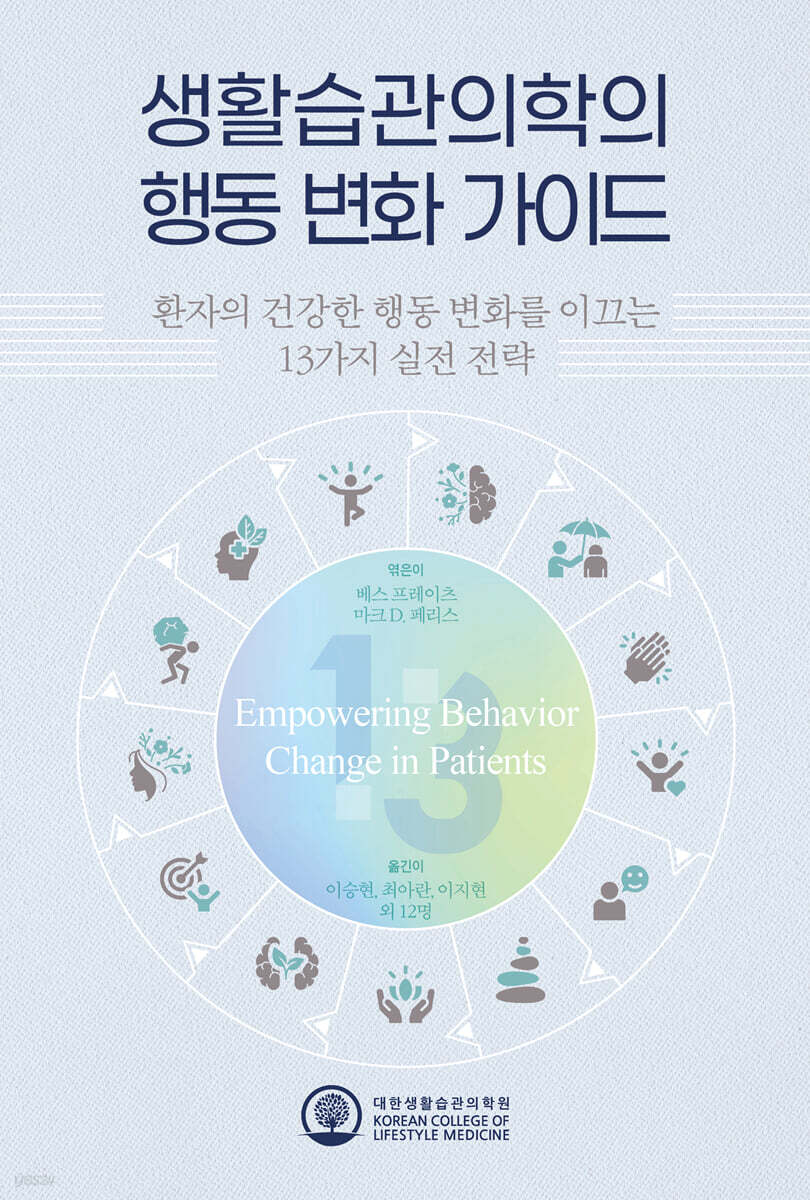
A Guide to Behavioral Change in Lifestyle Medicine
 |
Description
Book Introduction
A Practical Guide to Leading Patients to Healthy Behavior Change
In this age of chronic disease, we know all too well the importance of a healthy lifestyle, yet many people still struggle to break free from unhealthy habits.
While the "what to do" is clear—eating a balanced diet, getting regular physical activity, getting enough sleep, forming positive social relationships, avoiding harmful substances, and managing stress—the challenge remains how to put it into action and maintain it.
Although medical professionals can sufficiently explain to patients 'what to do' based on their expertise, they often feel at a loss when it comes to actually guiding patients to change and maintain their behavior.
This book is a practical tool to bridge the gap between 'knowledge' and 'practice'.
This is a practical guide to help medical professionals and other healthcare providers effectively lead healthy behavioral changes in patients in real-world settings.
In this age of chronic disease, we know all too well the importance of a healthy lifestyle, yet many people still struggle to break free from unhealthy habits.
While the "what to do" is clear—eating a balanced diet, getting regular physical activity, getting enough sleep, forming positive social relationships, avoiding harmful substances, and managing stress—the challenge remains how to put it into action and maintain it.
Although medical professionals can sufficiently explain to patients 'what to do' based on their expertise, they often feel at a loss when it comes to actually guiding patients to change and maintain their behavior.
This book is a practical tool to bridge the gap between 'knowledge' and 'practice'.
This is a practical guide to help medical professionals and other healthcare providers effectively lead healthy behavioral changes in patients in real-world settings.
- You can preview some of the book's contents.
Preview
index
introduction
Series Preface
Translator's Preface
editor
Contributor
Book Introduction
Chapter 1.
Introduction to Behavior Change
Chapter 2.
Stages of change
Chapter 3.
Building confidence
Chapter 4.
Motivational Interviewing
Chapter 5.
The power of autonomy
Chapter 6.
Positive Exploration
Chapter 7.
Goal Setting and Planning
Chapter 8.
Stay motivated
Chapter 9.
Overcoming obstacles
Chapter 10.
Leverage your strengths
Chapter 11.
responsibility
Chapter 12.
A 5-Step Cycle for Collaboration
Chapter 13.
Group healthcare interventions in lifestyle medicine
Chapter 14.
Lifestyle Medicine Guidelines and Statistics
Chapter 15.
summation
About the Translator
index
Series Preface
Translator's Preface
editor
Contributor
Book Introduction
Chapter 1.
Introduction to Behavior Change
Chapter 2.
Stages of change
Chapter 3.
Building confidence
Chapter 4.
Motivational Interviewing
Chapter 5.
The power of autonomy
Chapter 6.
Positive Exploration
Chapter 7.
Goal Setting and Planning
Chapter 8.
Stay motivated
Chapter 9.
Overcoming obstacles
Chapter 10.
Leverage your strengths
Chapter 11.
responsibility
Chapter 12.
A 5-Step Cycle for Collaboration
Chapter 13.
Group healthcare interventions in lifestyle medicine
Chapter 14.
Lifestyle Medicine Guidelines and Statistics
Chapter 15.
summation
About the Translator
index
Detailed image

Into the book
In the 'coaching approach,' coaches and patients work together to find solutions to problems related to chronic illness or behavior change.
In this case, the solution is not a one-sided directive, but a multifaceted approach from various perspectives.
In the 'coaching approach,' coaches and clients work together to explore ideas for solving problems.
Of course, coaches are not without solutions to offer patients, and they may have useful and appropriate ideas.
The key is for patients and coaches to brainstorm together to explore various solutions, and for patients to be empowered to choose the one that best suits them.
Problem solving is the patient's responsibility, and the clinician is a companion who helps with the conversation and provides direction in the process.
Ultimately, it is up to the patient to decide which solutions to try and when.
--- p.67~68
We forget that we are constantly asking our clients to take the next step or change their behavior: take a pill, lose weight, exercise, go to the doctor.
For some, change comes relatively easily, but for others, attempting change requires an attitude of vulnerability, humility, and a willingness to enter unknown territory.
As clinicians, we may not fully understand the feeling of vulnerability we feel when we are forced to commit to something without knowing the outcome or take action we truly do not want to take.
Recognizing that we are experts in a specific health field and that our clients are experts on themselves—that is, acknowledging their own vulnerability—can help us achieve balance in our interactions with clients.
The key to motivational interviewing is to combine these two.
That is, the clinician brings expertise in ‘health’, and the client brings expertise in ‘themselves’.
--- p.176
Autonomy means that an individual feels that he or she has choice and control over his or her own actions.
This innate need to feel “in the driver’s seat” of one’s own life is essential to achieving lasting behavioral change.
Clinicians can support patient autonomy by acknowledging patients' feelings, respecting their values and interests, and using collaborative communication skills to enhance patients' choices.
This autonomy support has been shown to positively impact various lifestyle habits and clinically important behaviors, such as improved medication adherence and increased fruit and vegetable intake in patients with diabetes.
--- p.224
Clinicians who utilize a coaching approach view patients not as "objects to be fixed," but as individuals with the ability and resources to create healthy behavioral changes.
Patients are not simply people with illness or problems, but rather individuals who can take meaningful action based on their own values and beliefs.
Patients have basic psychological needs: 'competence' in the actions they perform, 'relatedness' in feeling connected and cared for by those around them, and 'autonomy' in making their own decisions about their lives.
With this in mind, clinicians treat patients as the experts who best know their own lives, respecting them as individuals with the potential to enhance their health and well-being by expanding their valuable insights and awareness and exploring their possibilities.
In exploring patients' values, coaching becomes a powerful tool for eliciting autonomous motivation for change.
--- p.234
Being 'open' or 'ready to receive' means the ability to remain in a state of readiness to recognize and accept what is present in the present moment, and to be ready to detect all signals coming from the client.
This is an attitude of openness without preconceptions, accompanied by a tone of unconditional positive regard and respect.
At this time, the medical professional listens empathetically without interrupting, and uses open-ended questions and reflections to ensure that communication with the client is taking place properly.
True openness involves recognizing that factors such as a client's ethnicity, sexual orientation, economic and social status, and physical appearance can interfere with the therapeutic alliance through unconscious biases or attitudes of the practitioner.
Practicing openness means having the opportunity to recognize moments when entrenched beliefs on both sides, such as those that might hinder meaningful interaction, emerge.
Conversely, in a 'closed' state, factors that interfere with the presence of the healthcare provider mentioned above (e.g., the healthcare provider's biases, stereotypes, fears, boredom, fatigue, etc.) are at play, increasing the likelihood of missing important signals from the client.
This can lead clients to question whether the healthcare provider is a trustworthy partner who truly understands and cares for them, and as a result, their motivation to maintain behavior change is weakened.
--- p.318~319
Many people believe that change requires methods such as education, coercion, threats, advice, fear-mongering, and pushing, but this is not the case.
Education, information, and sometimes advice can help, but other methods that involve coercion or fear are ineffective.
This approach not only fails to elicit spontaneous change in people, but also fails to inspire or motivate them, and can actually foster rebellion.
So, what are effective ways to inspire change in people? Some behaviors that empower people to make change include consideration, listening, respect, trust, guidance, brainstorming ideas together, identifying and leveraging strengths, acknowledging them, and believing in them.
As Dr. Dean Ornish said, love is one of the most powerful motivators.
Fear-mongering may work in the short term, but it doesn't lead to sustainable change.
On the other hand, love is a driving force that sustains change and a powerful force that induces people to change voluntarily.
In this case, the solution is not a one-sided directive, but a multifaceted approach from various perspectives.
In the 'coaching approach,' coaches and clients work together to explore ideas for solving problems.
Of course, coaches are not without solutions to offer patients, and they may have useful and appropriate ideas.
The key is for patients and coaches to brainstorm together to explore various solutions, and for patients to be empowered to choose the one that best suits them.
Problem solving is the patient's responsibility, and the clinician is a companion who helps with the conversation and provides direction in the process.
Ultimately, it is up to the patient to decide which solutions to try and when.
--- p.67~68
We forget that we are constantly asking our clients to take the next step or change their behavior: take a pill, lose weight, exercise, go to the doctor.
For some, change comes relatively easily, but for others, attempting change requires an attitude of vulnerability, humility, and a willingness to enter unknown territory.
As clinicians, we may not fully understand the feeling of vulnerability we feel when we are forced to commit to something without knowing the outcome or take action we truly do not want to take.
Recognizing that we are experts in a specific health field and that our clients are experts on themselves—that is, acknowledging their own vulnerability—can help us achieve balance in our interactions with clients.
The key to motivational interviewing is to combine these two.
That is, the clinician brings expertise in ‘health’, and the client brings expertise in ‘themselves’.
--- p.176
Autonomy means that an individual feels that he or she has choice and control over his or her own actions.
This innate need to feel “in the driver’s seat” of one’s own life is essential to achieving lasting behavioral change.
Clinicians can support patient autonomy by acknowledging patients' feelings, respecting their values and interests, and using collaborative communication skills to enhance patients' choices.
This autonomy support has been shown to positively impact various lifestyle habits and clinically important behaviors, such as improved medication adherence and increased fruit and vegetable intake in patients with diabetes.
--- p.224
Clinicians who utilize a coaching approach view patients not as "objects to be fixed," but as individuals with the ability and resources to create healthy behavioral changes.
Patients are not simply people with illness or problems, but rather individuals who can take meaningful action based on their own values and beliefs.
Patients have basic psychological needs: 'competence' in the actions they perform, 'relatedness' in feeling connected and cared for by those around them, and 'autonomy' in making their own decisions about their lives.
With this in mind, clinicians treat patients as the experts who best know their own lives, respecting them as individuals with the potential to enhance their health and well-being by expanding their valuable insights and awareness and exploring their possibilities.
In exploring patients' values, coaching becomes a powerful tool for eliciting autonomous motivation for change.
--- p.234
Being 'open' or 'ready to receive' means the ability to remain in a state of readiness to recognize and accept what is present in the present moment, and to be ready to detect all signals coming from the client.
This is an attitude of openness without preconceptions, accompanied by a tone of unconditional positive regard and respect.
At this time, the medical professional listens empathetically without interrupting, and uses open-ended questions and reflections to ensure that communication with the client is taking place properly.
True openness involves recognizing that factors such as a client's ethnicity, sexual orientation, economic and social status, and physical appearance can interfere with the therapeutic alliance through unconscious biases or attitudes of the practitioner.
Practicing openness means having the opportunity to recognize moments when entrenched beliefs on both sides, such as those that might hinder meaningful interaction, emerge.
Conversely, in a 'closed' state, factors that interfere with the presence of the healthcare provider mentioned above (e.g., the healthcare provider's biases, stereotypes, fears, boredom, fatigue, etc.) are at play, increasing the likelihood of missing important signals from the client.
This can lead clients to question whether the healthcare provider is a trustworthy partner who truly understands and cares for them, and as a result, their motivation to maintain behavior change is weakened.
--- p.318~319
Many people believe that change requires methods such as education, coercion, threats, advice, fear-mongering, and pushing, but this is not the case.
Education, information, and sometimes advice can help, but other methods that involve coercion or fear are ineffective.
This approach not only fails to elicit spontaneous change in people, but also fails to inspire or motivate them, and can actually foster rebellion.
So, what are effective ways to inspire change in people? Some behaviors that empower people to make change include consideration, listening, respect, trust, guidance, brainstorming ideas together, identifying and leveraging strengths, acknowledging them, and believing in them.
As Dr. Dean Ornish said, love is one of the most powerful motivators.
Fear-mongering may work in the short term, but it doesn't lead to sustainable change.
On the other hand, love is a driving force that sustains change and a powerful force that induces people to change voluntarily.
--- p.595
Publisher's Review
A New Paradigm in the Medical Field: A Role Shift from "Expert" to "Coach"
This book places the patient at the center of change.
This is because the prevention, treatment, and reversal of chronic diseases ultimately depend on ‘changes in the patient’s behavior.’
Rather than treating patients as 'experts' who simply instruct and explain, I suggest that medical professionals transform into 'coaches' who assist patients on their journey of change.
True change can only occur when each patient discovers the meaning of lifestyle changes in their own way, within the context of their individual reality and difficulties.
It emphasizes the perspective that patients are the agents of change, and that medical professionals must have the ability to discover and draw out the motivation and autonomy within patients.
The intersection of behavioral science, coaching, psychology, and lifestyle medicine
This book organically integrates behavioral science, coaching, psychology, and lifestyle medicine.
Behavior change experts from various countries, including the US, UK, and Australia, participated in the writing, and 13 core strategies are introduced based on their clinical experience and research-based knowledge.
First, open a dialogue with the patient's interests as a guide, approach the patient according to their stage of change, and build a foundation of trust by respecting their autonomy.
On top of that, motivational interviewing and positive inquiry techniques are used to elicit the patient's inner motivation and to build self-confidence by reminding them of past successful experiences.
Once you have the drive for change, work with the patient to develop specific goals and develop a plan to overcome anticipated obstacles.
In this process, we discover and utilize the patient's unique strengths, and establish accountability to increase execution capabilities.
Furthermore, by integrating this entire process into a five-step cycle for collaboration and leveraging the power of strong social connections through group interventions, this book organically and systematically guides you through the entire process of patient behavior change.
Each chapter is packed with evidence-based information, practical application strategies, case studies, and examples of language expressions, making it a "toolbox" you can use immediately in your practice with patients.
Change begins with empathy, not information.
This book will be a reliable companion for medical professionals who are concerned not with “how to cure” patients but “how to truly help them.”
This book is not a simple theoretical text or a dogmatic manual; it is as practical and compassionate as the advice of an experienced colleague.
It provides specific guidance on where and how to begin counseling, how to ignite the spark of change, and how to draw out the patient's motivation and strengths, all at every moment.
This book is intended to help patients change, but it is also a book for medical professionals who walk the path of change together.
Connecting authentically with patients and building a therapeutic alliance with them brings deep satisfaction and reward to healthcare professionals.
This has the power to reduce burnout among medical professionals and help them remember the original values and original intentions of medicine.
We will guide you on a journey of empathy and change where patients and healthcare professionals can prosper together.
Who is this book for?
This book is written for all professionals working in the healthcare and wellness fields to help people make changes.
This book is beneficial to everyone who supports patients' health recovery and behavior change, from doctors and nurses to therapists, social workers, nutritionists, sleep, addiction, and mental health specialists, and fitness coaches.
Additionally, anyone—parents, caregivers, colleagues, and others—can make a difference by applying the theories and strategies in this book to their own lives, their families, and the lives of those they care for.
This book is designed to be flexible enough for readers from diverse backgrounds to adapt to their own roles.
This book places the patient at the center of change.
This is because the prevention, treatment, and reversal of chronic diseases ultimately depend on ‘changes in the patient’s behavior.’
Rather than treating patients as 'experts' who simply instruct and explain, I suggest that medical professionals transform into 'coaches' who assist patients on their journey of change.
True change can only occur when each patient discovers the meaning of lifestyle changes in their own way, within the context of their individual reality and difficulties.
It emphasizes the perspective that patients are the agents of change, and that medical professionals must have the ability to discover and draw out the motivation and autonomy within patients.
The intersection of behavioral science, coaching, psychology, and lifestyle medicine
This book organically integrates behavioral science, coaching, psychology, and lifestyle medicine.
Behavior change experts from various countries, including the US, UK, and Australia, participated in the writing, and 13 core strategies are introduced based on their clinical experience and research-based knowledge.
First, open a dialogue with the patient's interests as a guide, approach the patient according to their stage of change, and build a foundation of trust by respecting their autonomy.
On top of that, motivational interviewing and positive inquiry techniques are used to elicit the patient's inner motivation and to build self-confidence by reminding them of past successful experiences.
Once you have the drive for change, work with the patient to develop specific goals and develop a plan to overcome anticipated obstacles.
In this process, we discover and utilize the patient's unique strengths, and establish accountability to increase execution capabilities.
Furthermore, by integrating this entire process into a five-step cycle for collaboration and leveraging the power of strong social connections through group interventions, this book organically and systematically guides you through the entire process of patient behavior change.
Each chapter is packed with evidence-based information, practical application strategies, case studies, and examples of language expressions, making it a "toolbox" you can use immediately in your practice with patients.
Change begins with empathy, not information.
This book will be a reliable companion for medical professionals who are concerned not with “how to cure” patients but “how to truly help them.”
This book is not a simple theoretical text or a dogmatic manual; it is as practical and compassionate as the advice of an experienced colleague.
It provides specific guidance on where and how to begin counseling, how to ignite the spark of change, and how to draw out the patient's motivation and strengths, all at every moment.
This book is intended to help patients change, but it is also a book for medical professionals who walk the path of change together.
Connecting authentically with patients and building a therapeutic alliance with them brings deep satisfaction and reward to healthcare professionals.
This has the power to reduce burnout among medical professionals and help them remember the original values and original intentions of medicine.
We will guide you on a journey of empathy and change where patients and healthcare professionals can prosper together.
Who is this book for?
This book is written for all professionals working in the healthcare and wellness fields to help people make changes.
This book is beneficial to everyone who supports patients' health recovery and behavior change, from doctors and nurses to therapists, social workers, nutritionists, sleep, addiction, and mental health specialists, and fitness coaches.
Additionally, anyone—parents, caregivers, colleagues, and others—can make a difference by applying the theories and strategies in this book to their own lives, their families, and the lives of those they care for.
This book is designed to be flexible enough for readers from diverse backgrounds to adapt to their own roles.
GOODS SPECIFICS
- Date of issue: October 31, 2025
- Page count, weight, size: 628 pages | 152*225*35mm
- ISBN13: 9791196734831
- ISBN10: 1196734836
You may also like
카테고리
korean


korean

![ELLE 엘르 스페셜 에디션 A형 : 12월 [2025]](http://librairie.coreenne.fr/cdn/shop/files/b8e27a3de6c9538896439686c6b0e8fb.jpg?v=1766436872&width=3840)


