

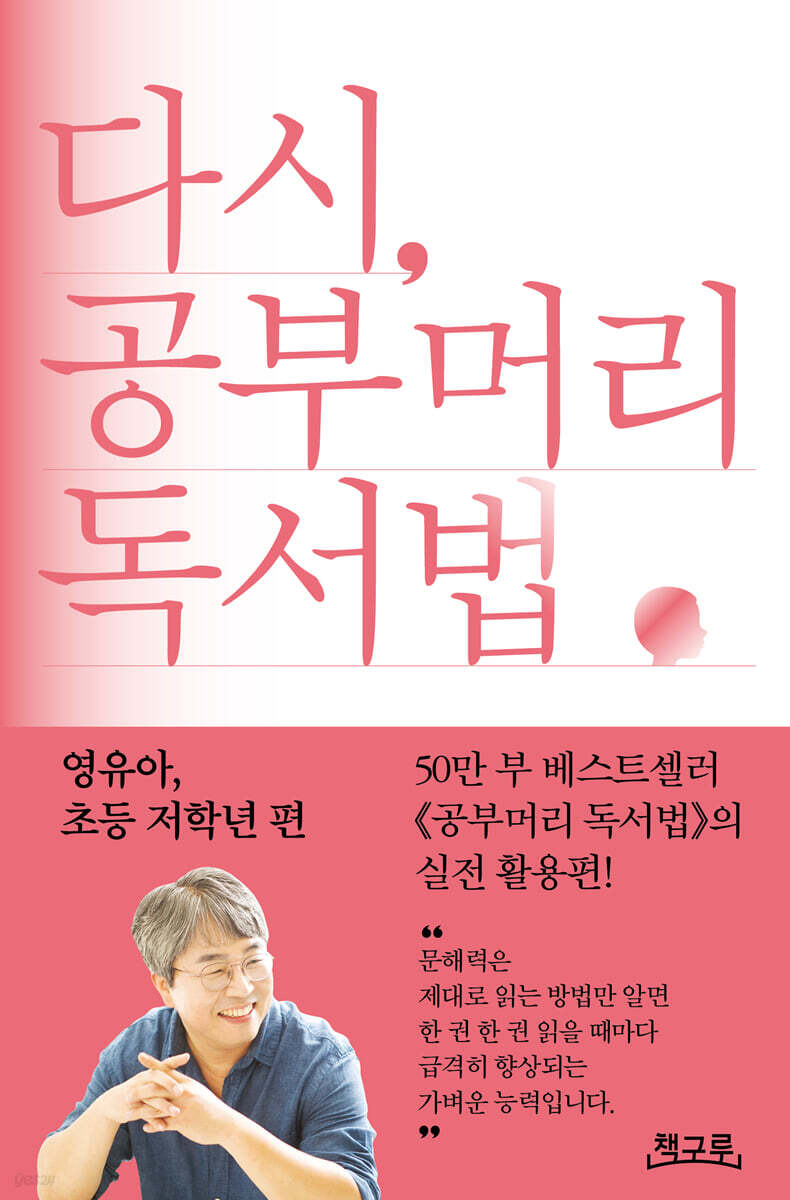
Again, the study head reading method
 |
Description
Book Introduction
If 『Study Head Reading Method』 is a theory book,
This book is a practical guide!
Back with a more detailed and practical guide
Our children's reading education bible!
Choi Seung-pil, a reading education expert who sparked a literacy craze in Korea with his book "Study Head Reading Method," has published a friendly guide that can be applied directly to guiding our children's reading.
This is 『Again, Study Mind Reading Method: Infants, Toddlers, and Elementary School Lower Grades』, which covers how to build a solid foundation for study.
This book contains methods for dealing with problematic situations that may arise during reading instruction for children from infants to third graders.
It covers questions received through various channels, including over 1,000 lectures, [Our Family Empathy Reading] audio clips, and the [Study Head Reading Method Naver Cafe] with 200,000 members.
You can find specific solutions to all literacy problems encountered at home, including the essence of reading for infants, toddlers, and elementary school children, specific reading methods, book reports, how to write a diary, reading English books, and reading for returnees.
Literacy is a simple skill that improves rapidly with each book you read, as long as you know how to read properly.
However, if you guide your child with incorrect misconceptions such as 'balanced reading', 'reading high-quality books will improve reading ability', or 'you must read required books', it will have the negative effect of making them dislike books, and you will not be able to enjoy the effect of improving literacy.
This is why, when a problem arises, you need to check whether you are leading your child in the wrong direction and correct the direction.
This book will help you understand why your child is experiencing these problems now and anticipate what problems may arise in the future.
Based on this understanding, if you refer to the relevant table of contents when a specific problem arises, it will be of great help in guiding your child in the right direction.
This book is a practical guide!
Back with a more detailed and practical guide
Our children's reading education bible!
Choi Seung-pil, a reading education expert who sparked a literacy craze in Korea with his book "Study Head Reading Method," has published a friendly guide that can be applied directly to guiding our children's reading.
This is 『Again, Study Mind Reading Method: Infants, Toddlers, and Elementary School Lower Grades』, which covers how to build a solid foundation for study.
This book contains methods for dealing with problematic situations that may arise during reading instruction for children from infants to third graders.
It covers questions received through various channels, including over 1,000 lectures, [Our Family Empathy Reading] audio clips, and the [Study Head Reading Method Naver Cafe] with 200,000 members.
You can find specific solutions to all literacy problems encountered at home, including the essence of reading for infants, toddlers, and elementary school children, specific reading methods, book reports, how to write a diary, reading English books, and reading for returnees.
Literacy is a simple skill that improves rapidly with each book you read, as long as you know how to read properly.
However, if you guide your child with incorrect misconceptions such as 'balanced reading', 'reading high-quality books will improve reading ability', or 'you must read required books', it will have the negative effect of making them dislike books, and you will not be able to enjoy the effect of improving literacy.
This is why, when a problem arises, you need to check whether you are leading your child in the wrong direction and correct the direction.
This book will help you understand why your child is experiencing these problems now and anticipate what problems may arise in the future.
Based on this understanding, if you refer to the relevant table of contents when a specific problem arises, it will be of great help in guiding your child in the right direction.
- You can preview some of the book's contents.
Preview
index
How to Use "Again, the Study Head Reading Method"
Part 1.
infants and toddlers
Reading a book, is this how it should be done?
1.
What is the key to teaching reading to young children?
2.
Can we not provide any other education besides reading books?
3.
What are the benefits of reading books?
4.
How many books should I read?
5.
What book should I read?
6.
My child has difficulty choosing books.
7.
How should I read it?
8.
My child asks a question that is difficult to answer.
9.
It's hard to read a book to a child who wants to look at the pictures first.
10.
My child turns the pages too quickly.
11.
My child keeps doing something else when I read to him.
12.
I read a book to my child, but he doesn't remember the content.
13.
They keep asking me to read the same book over and over again.
14.
I'm trying to read only one type of book.
15.
How can I best utilize the collection?
16.
Even if I read a book to him, he says he doesn't like it.
17.
How do I map out my toddler's smartphone?
18.
Is it okay to listen to audiobooks?
19.
Can I show you the fairy tale in a video?
20.
What about working moms and dads who don't have time to read books?
21.
How should I read a family with multiple children?
22.
When is the best time to start learning Korean?
23.
When should I start teaching my child to read on their own?
24.
Do parents have to read books to raise their children to be readers?
25.
My child hates sad and touching books.
Part 2.
Lower elementary school students
How can I achieve independent reading?
1.
What are the key points of reading instruction for elementary school students?
2.
Even though I'm in elementary school, I keep asking him to read to me.
3.
Can I read to first graders like I did to toddlers?
4.
How do I achieve reading independence?
5.
My child has a hard time choosing books.
6.
I just want to read storybooks.
7.
I only want to read knowledge books.
8.
A book that's both a comic book and a picture book. Can I let you read it?
9.
Ask them to buy you some provocative books like ghost stories and encyclopedias of monsters.
10.
When I'm told to read a book, I only watch educational cartoons.
11.
If you read the textbook well, wouldn't it be okay to allow educational comics?
12.
Are there any children who are good at reading educational comics and books?
13.
I try to read books that are above my age level.
14.
I hate must-reads and recommended books.
15.
How do you improve the quality of your reading?
16.
I read books too fast
17.
I can't remember the main character's name, the book title, or proper nouns.
18.
Which is more effective, reading aloud or silently?
19.
Read the end of the sentence roughly
20.
I skip words when I read a book.
21.
When I'm reading a book, I keep saying I want to read another book.
22.
How do I check if I've read the book well?
23.
I only try to read books in bed.
24.
I have bad posture when reading a book
25.
Multi-child families find it difficult to guide reading.
26.
Would a vocabulary book be helpful?
27.
Should I learn Chinese characters separately?
28.
When is the best time to send your child to a reading and writing academy?
29.
What post-reading activities are most effective?
30.
I have trouble writing reading logs and book reports.
31.
He said there was nothing to write in his diary.
32.
Is repeated reading and copying effective for lower elementary school students?
33.
Why can't elementary school students do slow reading?
34.
Can I read books on my smart device?
35.
Does reading English books also improve literacy?
36.
How should I guide the reading of 'Returnee'?
37.
I'm upset because my child doesn't seem to have a talent for reading.
Search
Part 1.
infants and toddlers
Reading a book, is this how it should be done?
1.
What is the key to teaching reading to young children?
2.
Can we not provide any other education besides reading books?
3.
What are the benefits of reading books?
4.
How many books should I read?
5.
What book should I read?
6.
My child has difficulty choosing books.
7.
How should I read it?
8.
My child asks a question that is difficult to answer.
9.
It's hard to read a book to a child who wants to look at the pictures first.
10.
My child turns the pages too quickly.
11.
My child keeps doing something else when I read to him.
12.
I read a book to my child, but he doesn't remember the content.
13.
They keep asking me to read the same book over and over again.
14.
I'm trying to read only one type of book.
15.
How can I best utilize the collection?
16.
Even if I read a book to him, he says he doesn't like it.
17.
How do I map out my toddler's smartphone?
18.
Is it okay to listen to audiobooks?
19.
Can I show you the fairy tale in a video?
20.
What about working moms and dads who don't have time to read books?
21.
How should I read a family with multiple children?
22.
When is the best time to start learning Korean?
23.
When should I start teaching my child to read on their own?
24.
Do parents have to read books to raise their children to be readers?
25.
My child hates sad and touching books.
Part 2.
Lower elementary school students
How can I achieve independent reading?
1.
What are the key points of reading instruction for elementary school students?
2.
Even though I'm in elementary school, I keep asking him to read to me.
3.
Can I read to first graders like I did to toddlers?
4.
How do I achieve reading independence?
5.
My child has a hard time choosing books.
6.
I just want to read storybooks.
7.
I only want to read knowledge books.
8.
A book that's both a comic book and a picture book. Can I let you read it?
9.
Ask them to buy you some provocative books like ghost stories and encyclopedias of monsters.
10.
When I'm told to read a book, I only watch educational cartoons.
11.
If you read the textbook well, wouldn't it be okay to allow educational comics?
12.
Are there any children who are good at reading educational comics and books?
13.
I try to read books that are above my age level.
14.
I hate must-reads and recommended books.
15.
How do you improve the quality of your reading?
16.
I read books too fast
17.
I can't remember the main character's name, the book title, or proper nouns.
18.
Which is more effective, reading aloud or silently?
19.
Read the end of the sentence roughly
20.
I skip words when I read a book.
21.
When I'm reading a book, I keep saying I want to read another book.
22.
How do I check if I've read the book well?
23.
I only try to read books in bed.
24.
I have bad posture when reading a book
25.
Multi-child families find it difficult to guide reading.
26.
Would a vocabulary book be helpful?
27.
Should I learn Chinese characters separately?
28.
When is the best time to send your child to a reading and writing academy?
29.
What post-reading activities are most effective?
30.
I have trouble writing reading logs and book reports.
31.
He said there was nothing to write in his diary.
32.
Is repeated reading and copying effective for lower elementary school students?
33.
Why can't elementary school students do slow reading?
34.
Can I read books on my smart device?
35.
Does reading English books also improve literacy?
36.
How should I guide the reading of 'Returnee'?
37.
I'm upset because my child doesn't seem to have a talent for reading.
Search
Detailed image

Into the book
The early childhood years are the time when a child's first impression of reading and the direction of parental reading guidance are determined.
If you find a 'good book' or a 'helpful book', reading becomes a study for both the child and the parent.
If that happens, you won't be able to continue reading.
“You don’t need anything else. Just think about this: I’ll make reading a fun activity.”
Reading that does not bring pleasure cannot last.
--- p.19
The ideal amount of reading is a question of quality before quantity.
Even if you read a lot, if parents and children do not actively enjoy it together, it cannot be said that the ideal amount of reading has been achieved.
On the other hand, if you read for thirty minutes a day and focus fully and enjoy reading, you can say that you have read enough.
It is important to set aside just enough time for both the child and the parent to focus and enjoy reading together.
--- p.40
Choosing books on one's own is so important that it goes far beyond the question of what it means for a child to choose the books they want to read, or the question of sustainability, which means that children can only continue reading if they read the books they want to read.
This is because the core ability of a reader is not the ability to read books, but the ability to choose books and the reading sense that allows one to find books that are right for oneself.
Of course.
You need to have a sense of what books you can immerse yourself in and read right now to be able to read high-quality books, and you need to read high-quality books to improve your reading skills.
--- p.42~43
When a child asks to read only one genre of books, it means there is a genre in which they can become deeply immersed.
In times like these, you need to support your child by saying, "That's right," so that he or she can immerse himself or herself in that field.
Not only will your concentration and comprehension skills improve dramatically, but it will also be an opportunity for you to grow into a young expert who is knowledgeable in one field.
--- p.95
When reading traditional or classic fairy tales, there are times when I feel concerned because of outdated values that do not fit with today's reality.
Examples include filial piety that sacrifices one's life, patriarchal gender awareness, and class consciousness.
Just make it clear to your child that this is a story from the past and that things are different now.
That alone can block the influence of old values.
It could be an opportunity to experience the difference between the times and think, 'That's how it was in the old days' or 'There was a different way of thinking than now.'
--- p.100
In reading education, the lower grades of elementary school are called the reading preparation period.
This is because the first and second grades of elementary school are not a period of full-fledged reading, but rather a period of solidifying the two skills necessary for reading: a high level of interest in books and automatic reading.
--- p.152
Choosing a book is not only about finding a book to read, but also about developing a reading sense by browsing through books.
Rather than just "coming out looking for books to read," give your child enough time to "look at books."
Even if you haven't read them, a list of books you've seen will be a solid foundation for your child's reading life.
--- p.153
To read a book, you must first become proficient at reading the sounds of the letters.
The moment you see the letters, you will read them without even realizing it.
The skill of being able to read letters as soon as you see them is called 'reading automation', and only after achieving reading automation can you read and understand the text.
In reading education, the first and second grades of elementary school are called the 'reading preparation period.'
This is because it is a time to learn letters before reading and to move towards automatic reading through repeated reading practice.
Parents should, of course, read to their children until they have fully automated their reading skills.
Only then can you continue to enjoy the fun and utility of books.
If you find a 'good book' or a 'helpful book', reading becomes a study for both the child and the parent.
If that happens, you won't be able to continue reading.
“You don’t need anything else. Just think about this: I’ll make reading a fun activity.”
Reading that does not bring pleasure cannot last.
--- p.19
The ideal amount of reading is a question of quality before quantity.
Even if you read a lot, if parents and children do not actively enjoy it together, it cannot be said that the ideal amount of reading has been achieved.
On the other hand, if you read for thirty minutes a day and focus fully and enjoy reading, you can say that you have read enough.
It is important to set aside just enough time for both the child and the parent to focus and enjoy reading together.
--- p.40
Choosing books on one's own is so important that it goes far beyond the question of what it means for a child to choose the books they want to read, or the question of sustainability, which means that children can only continue reading if they read the books they want to read.
This is because the core ability of a reader is not the ability to read books, but the ability to choose books and the reading sense that allows one to find books that are right for oneself.
Of course.
You need to have a sense of what books you can immerse yourself in and read right now to be able to read high-quality books, and you need to read high-quality books to improve your reading skills.
--- p.42~43
When a child asks to read only one genre of books, it means there is a genre in which they can become deeply immersed.
In times like these, you need to support your child by saying, "That's right," so that he or she can immerse himself or herself in that field.
Not only will your concentration and comprehension skills improve dramatically, but it will also be an opportunity for you to grow into a young expert who is knowledgeable in one field.
--- p.95
When reading traditional or classic fairy tales, there are times when I feel concerned because of outdated values that do not fit with today's reality.
Examples include filial piety that sacrifices one's life, patriarchal gender awareness, and class consciousness.
Just make it clear to your child that this is a story from the past and that things are different now.
That alone can block the influence of old values.
It could be an opportunity to experience the difference between the times and think, 'That's how it was in the old days' or 'There was a different way of thinking than now.'
--- p.100
In reading education, the lower grades of elementary school are called the reading preparation period.
This is because the first and second grades of elementary school are not a period of full-fledged reading, but rather a period of solidifying the two skills necessary for reading: a high level of interest in books and automatic reading.
--- p.152
Choosing a book is not only about finding a book to read, but also about developing a reading sense by browsing through books.
Rather than just "coming out looking for books to read," give your child enough time to "look at books."
Even if you haven't read them, a list of books you've seen will be a solid foundation for your child's reading life.
--- p.153
To read a book, you must first become proficient at reading the sounds of the letters.
The moment you see the letters, you will read them without even realizing it.
The skill of being able to read letters as soon as you see them is called 'reading automation', and only after achieving reading automation can you read and understand the text.
In reading education, the first and second grades of elementary school are called the 'reading preparation period.'
This is because it is a time to learn letters before reading and to move towards automatic reading through repeated reading practice.
Parents should, of course, read to their children until they have fully automated their reading skills.
Only then can you continue to enjoy the fun and utility of books.
--- p.157
Publisher's Review
500,000 copies bestseller
Based on the 『Study Head Reading Method』
A practical version completed after 7 years of hard work!
After the publication of 『Study Head Reading Method』, the paradigm of education in Korea changed.
In a climate where English and math were highly valued, literacy suddenly became a hot topic.
The overwhelming proportion of students who cannot read their grade-level textbooks has surfaced, and the link between the decline in reading and academic achievement has been clearly revealed.
Author Seungpil Choi, who has been teaching reading in the field for over 10 years, has also proven that 'if a child enjoys reading, their literacy skills will improve rapidly even after reading just one book.'
It is a nice way to shatter the baseless common sense that reading difficult books is necessary to improve literacy.
"The Study Head Reading Method" became a craze, and author Choi Seung-pil became incredibly busy.
Parents' concerns poured out through over 1,000 lectures, the Naver Cafe [Study Head Reading Method] with 200,000 members, various broadcasts, podcasts, and YouTube.
Although 『Study Head Reading Method』 clearly established the standards for reading guidance, when it was actually applied to children, anxiety often came first.
"Is it okay to only read really interesting books?", "If a child is completely absorbed in reading, can I just leave them alone?", "Shouldn't we discourage them from reading books on only one topic?" To overcome the deep-rooted misunderstandings and anxieties about reading, we needed a practical guide that went beyond theory and provided direct guidance on these detailed issues.
That is how 『Again, the Study Head Reading Method』 was born.
It is no exaggeration to say that a child's ability to study is determined by how they are guided when problems arise with their reading.
This is because many parents often stunt their children's literacy skills by teaching them to read in the wrong way.
A typical example is when a child reads the same book over and over again, and you try to stop the child by thinking that he or she needs to read multiple books.
Repeated reading is called the reading method of geniuses.
If you read the same book over and over again, the logical development and progression of the book will become internalized in your child.
The flow of thoughts becomes smoother, richer, and deeper than when you read a book once.
Moreover, repeated reading cannot be forced.
What would happen if we prevent our children from repeating reading with incorrect common sense?
The key to developing a reading mindset like this is not adding new methods to children's reading, but removing incorrect teaching methods.
This is why 『Again, Study Head Reading Method』 is structured to collect all the problems that can be encountered during the reading guidance process and to meticulously solve them one by one.
Author Seungpil Choi doesn't just write books; he also provides tools that can be used at home or in educational settings.
[Study Head Reading Method] We opened a communication channel through Naver Cafe, conducted slow reading during every vacation, and created a reading quiz set to easily check children's reading status.
It took seven years of hard work to compile all the reading-related questions, organize practical solutions to improve literacy, and create tools to help guide reading, all into one book.
Because the vast questions cannot be contained in one volume, 『Again, Study Head Reading Method』 is published in two volumes.
The first book, 『Reading Methods for Study Heads Again: Infants, Toddlers, and Lower Elementary School Students』, covers reading methods from the early childhood years, when children's first impressions of reading and the direction of parental reading guidance are determined, to the third grade of elementary school, when two essential reading skills are firmly established.
It clearly addresses not only direct problems encountered in reading life, such as 'How much should I read to my child?', 'I read to my child, but he doesn't remember the content', and 'He keeps asking me to read to him even though he's in elementary school', but also various questions related to literacy, such as how to write book reports, diaries, read English books, and how to guide returnee reading.
Author Seungpil Choi says:
Reading instruction is either 'fail hard or succeed easily.'
If you simply guide your child to read books that match his or her interests and eye level, his or her literacy skills will easily improve.
Rather, if parents make a reading list, conduct systematic post-reading activities, and make difficult books read in a row, it is bound to fail.
This is because reading is not a study, but a cultural activity in which one finds and reads the books he or she wants to read.
When reading becomes a fun part of a child's life, their curiosity grows.
"Again, the Study Head Reading Method: Infants, Toddlers, and Lower Elementary School Students" will firmly establish the first step in developing a reading culture for our children.
(『Again, Study Head Reading Method: Elementary School Upper Grades, Adolescents』 scheduled for publication in the second half of 2025)
Based on the 『Study Head Reading Method』
A practical version completed after 7 years of hard work!
After the publication of 『Study Head Reading Method』, the paradigm of education in Korea changed.
In a climate where English and math were highly valued, literacy suddenly became a hot topic.
The overwhelming proportion of students who cannot read their grade-level textbooks has surfaced, and the link between the decline in reading and academic achievement has been clearly revealed.
Author Seungpil Choi, who has been teaching reading in the field for over 10 years, has also proven that 'if a child enjoys reading, their literacy skills will improve rapidly even after reading just one book.'
It is a nice way to shatter the baseless common sense that reading difficult books is necessary to improve literacy.
"The Study Head Reading Method" became a craze, and author Choi Seung-pil became incredibly busy.
Parents' concerns poured out through over 1,000 lectures, the Naver Cafe [Study Head Reading Method] with 200,000 members, various broadcasts, podcasts, and YouTube.
Although 『Study Head Reading Method』 clearly established the standards for reading guidance, when it was actually applied to children, anxiety often came first.
"Is it okay to only read really interesting books?", "If a child is completely absorbed in reading, can I just leave them alone?", "Shouldn't we discourage them from reading books on only one topic?" To overcome the deep-rooted misunderstandings and anxieties about reading, we needed a practical guide that went beyond theory and provided direct guidance on these detailed issues.
That is how 『Again, the Study Head Reading Method』 was born.
It is no exaggeration to say that a child's ability to study is determined by how they are guided when problems arise with their reading.
This is because many parents often stunt their children's literacy skills by teaching them to read in the wrong way.
A typical example is when a child reads the same book over and over again, and you try to stop the child by thinking that he or she needs to read multiple books.
Repeated reading is called the reading method of geniuses.
If you read the same book over and over again, the logical development and progression of the book will become internalized in your child.
The flow of thoughts becomes smoother, richer, and deeper than when you read a book once.
Moreover, repeated reading cannot be forced.
What would happen if we prevent our children from repeating reading with incorrect common sense?
The key to developing a reading mindset like this is not adding new methods to children's reading, but removing incorrect teaching methods.
This is why 『Again, Study Head Reading Method』 is structured to collect all the problems that can be encountered during the reading guidance process and to meticulously solve them one by one.
Author Seungpil Choi doesn't just write books; he also provides tools that can be used at home or in educational settings.
[Study Head Reading Method] We opened a communication channel through Naver Cafe, conducted slow reading during every vacation, and created a reading quiz set to easily check children's reading status.
It took seven years of hard work to compile all the reading-related questions, organize practical solutions to improve literacy, and create tools to help guide reading, all into one book.
Because the vast questions cannot be contained in one volume, 『Again, Study Head Reading Method』 is published in two volumes.
The first book, 『Reading Methods for Study Heads Again: Infants, Toddlers, and Lower Elementary School Students』, covers reading methods from the early childhood years, when children's first impressions of reading and the direction of parental reading guidance are determined, to the third grade of elementary school, when two essential reading skills are firmly established.
It clearly addresses not only direct problems encountered in reading life, such as 'How much should I read to my child?', 'I read to my child, but he doesn't remember the content', and 'He keeps asking me to read to him even though he's in elementary school', but also various questions related to literacy, such as how to write book reports, diaries, read English books, and how to guide returnee reading.
Author Seungpil Choi says:
Reading instruction is either 'fail hard or succeed easily.'
If you simply guide your child to read books that match his or her interests and eye level, his or her literacy skills will easily improve.
Rather, if parents make a reading list, conduct systematic post-reading activities, and make difficult books read in a row, it is bound to fail.
This is because reading is not a study, but a cultural activity in which one finds and reads the books he or she wants to read.
When reading becomes a fun part of a child's life, their curiosity grows.
"Again, the Study Head Reading Method: Infants, Toddlers, and Lower Elementary School Students" will firmly establish the first step in developing a reading culture for our children.
(『Again, Study Head Reading Method: Elementary School Upper Grades, Adolescents』 scheduled for publication in the second half of 2025)
GOODS SPECIFICS
- Date of issue: March 31, 2025
- Page count, weight, size: 328 pages | 600g | 147*223*20mm
- ISBN13: 9791196316860
- ISBN10: 1196316864
You may also like
카테고리
korean


korean

![GQ KOREA Mark (Monthly): December [2025]](http://librairie.coreenne.fr/cdn/shop/files/8ef265dbbfbf186523ed75ba7319009d.jpg?v=1765340328&width=3840)


