

Life is tennis!
 |
Description
Book Introduction
“Why don’t my skills show up in real life?”
Victory is determined by mentality, not skill.
The Secret of Winners: Mental Lessons on the Court
"Pro Lee Dong-hyeok flies in from LA to teach coaches."
- Tennis Korea
“It reminds us that ‘psychology’ is more important than technology.
“A coach who changes not only tennis but also your attitude towards life.”
- DL Tennis Academy Student Reviews
The number of people looking for tennis courts is increasing explosively.
As recreational sports have regained their vitality since the COVID-19 pandemic, tennis has become more than just a sport; it has become a social trend.
The number of hobby clubs is increasing exponentially, and courts are so crowded on weekends that it is difficult to make a reservation.
But when it comes to actually holding a racket and entering a match, everyone faces the same concerns.
The shots that were good during practice become shaky during a match, and I can't perform to my full potential because I'm nervous.
In the end, many people painfully realize that the biggest wall in tennis is not technique, but 'mentality'.
Coach Lee Dong-hyeok, the author of this book, tackles that very point head-on.
He is a certified teaching professional by the United States Tennis Teachers Association (USPTA) and the Professional Tennis Registry (PTR).
He moved to the United States at the age of 23 and built a coaching career of 21 years. He is currently back in Korea and leading the DL Tennis Academy.
His teaching style, which goes beyond simple technical lessons and encompasses management that controls the flow of the game, routines that establish attitude, and even the details that help you perfect your own weapon, has earned him the deep trust of many amateurs and players.
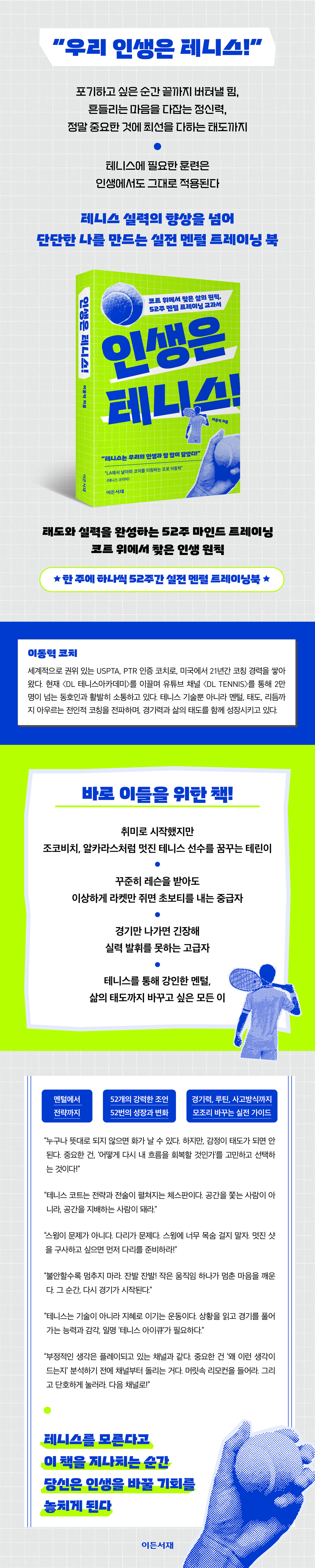
"Life is Tennis!" is a 52-week mental training textbook that encapsulates his experiences and philosophy.
The book begins with how to turn pre-game nerves into excitement, then moves on to a recovery routine that won't let you crumble in moments of crisis, the small details that create true skill, strategies for perfecting your own weapon, and management that dominates the flow of the game, ultimately concluding with the message that attitude determines skill.
By following the short and clear lessons over a total of 52 weeks, readers will gradually experience a steadying of themselves on the court.
Above all, it is written in vivid coaching language that can be applied immediately in the field, rather than being a difficult theory, so anyone can easily read and put it into practice.
What makes this book special is that it doesn't just teach you how to play tennis well.
It addresses the anxieties and insecurities that anyone who enjoys tennis experiences, while also providing insight into one's attitude toward life.
The realization that focusing on one ball, one point, ultimately leads to one's attitude toward life will resonate deeply with many readers.
Beyond winning or losing in a game, the process of becoming unwavering becomes a life-changing journey.
Here's why this book is a must-read for anyone who has started playing tennis, is enjoying it, or is interested in tennis but is still hesitant.
People often say, “Tennis is a lifelong sport,” but it’s not just about playing for a long time that matters; it’s about how you enjoy and learn.
"Life is Tennis!" is the textbook that will most firmly guide you along that path.
And the moment you close the book, you will realize that this is a book about tennis, but also a book about life.
Victory is determined by mentality, not skill.
The Secret of Winners: Mental Lessons on the Court
"Pro Lee Dong-hyeok flies in from LA to teach coaches."
- Tennis Korea
“It reminds us that ‘psychology’ is more important than technology.
“A coach who changes not only tennis but also your attitude towards life.”
- DL Tennis Academy Student Reviews
The number of people looking for tennis courts is increasing explosively.
As recreational sports have regained their vitality since the COVID-19 pandemic, tennis has become more than just a sport; it has become a social trend.
The number of hobby clubs is increasing exponentially, and courts are so crowded on weekends that it is difficult to make a reservation.
But when it comes to actually holding a racket and entering a match, everyone faces the same concerns.
The shots that were good during practice become shaky during a match, and I can't perform to my full potential because I'm nervous.
In the end, many people painfully realize that the biggest wall in tennis is not technique, but 'mentality'.
Coach Lee Dong-hyeok, the author of this book, tackles that very point head-on.
He is a certified teaching professional by the United States Tennis Teachers Association (USPTA) and the Professional Tennis Registry (PTR).
He moved to the United States at the age of 23 and built a coaching career of 21 years. He is currently back in Korea and leading the DL Tennis Academy.
His teaching style, which goes beyond simple technical lessons and encompasses management that controls the flow of the game, routines that establish attitude, and even the details that help you perfect your own weapon, has earned him the deep trust of many amateurs and players.
"Life is Tennis!" is a 52-week mental training textbook that encapsulates his experiences and philosophy.
The book begins with how to turn pre-game nerves into excitement, then moves on to a recovery routine that won't let you crumble in moments of crisis, the small details that create true skill, strategies for perfecting your own weapon, and management that dominates the flow of the game, ultimately concluding with the message that attitude determines skill.
By following the short and clear lessons over a total of 52 weeks, readers will gradually experience a steadying of themselves on the court.
Above all, it is written in vivid coaching language that can be applied immediately in the field, rather than being a difficult theory, so anyone can easily read and put it into practice.
What makes this book special is that it doesn't just teach you how to play tennis well.
It addresses the anxieties and insecurities that anyone who enjoys tennis experiences, while also providing insight into one's attitude toward life.
The realization that focusing on one ball, one point, ultimately leads to one's attitude toward life will resonate deeply with many readers.
Beyond winning or losing in a game, the process of becoming unwavering becomes a life-changing journey.
Here's why this book is a must-read for anyone who has started playing tennis, is enjoying it, or is interested in tennis but is still hesitant.
People often say, “Tennis is a lifelong sport,” but it’s not just about playing for a long time that matters; it’s about how you enjoy and learn.
"Life is Tennis!" is the textbook that will most firmly guide you along that path.
And the moment you close the book, you will realize that this is a book about tennis, but also a book about life.
- You can preview some of the book's contents.
Preview
index
Before you start this book
PART 1.
The one who decides the game - the game has already begun
Week 1 Don't let your feelings become your attitude!
Week 2: Change your tension into excitement!
Week 3: Designing Yourself in 3 Months
Week 4: Challenge the Seemingly Impossible Goal
Week 5: Praise yourself for what you did well
Week 6: Discover a Better You Than Yesterday
To you who says “I can’t run!” as soon as Week 7 starts
Week 8: Don't make excuses, it's all about mentality.
Week 9: The one who leads, not the one who is led
PART 2.
A person who becomes stronger in a moment of crisis - A routine that helps me recover when I'm shaken
Week 10: When anxiety strikes, wake up with a few taps and a few breaths.
Week 11: Smashing Fear: Don't Run Away, Just Stand One Step
Week 12 Change your thought channel to negative thoughts and say “Bye!”
Week 13 Yesterday worked, but today doesn't? It's okay, let it go!
Week 14 “It’s not growing anymore” What if you feel like giving up?
Week 15 It's okay during lessons, but why can't I just play the game?
Week 16 Don't Just Say No, Find the Reason
Week 17 It's not that I can't do it, I just don't do it!
Week 18 When Things Don't Go Your Way, Back to the Basics
PART 3.
People who speak with their skills - Details that create real skills
Week 19 Hitting hard from the start? Control comes first!
Week 20 Swing First? No, Legs First!
Week 21: Learn to play within the court and square
Week 22 There is no result without a process, what efforts have you made?
Week 23: Confidence based on facts, trust in yourself through practice!
Week 24: Raise Your Tennis IQ
Week 25: Manners Come Before Skill, Manners Become Skill
Week 26: When small laxities accumulate, it only takes a moment for them to collapse.
Week 27 Don't bet your life on winning or losing
PART 4.
A person who wins with his own weapon _ Perfect the art of fighting and the weapon
Week 28 There is no right answer, there is only a way that works for me!
Week 29: Build Your Own Data
Week 30: How to truly improve your skills? Don't just memorize, write it down!
Week 31: Offensive or Defensive? Find Your Style
Week 32 Steal the timing by controlling space and height
Week 33: A precise shot begins with a precise target.
Week 34 Hitting Hard vs. Hitting Confidently
Week 35 If you want to learn, you have to try it. You have to try it to know!
Week 36 Don't think about 'hitting', think about 'going'!
Week 37: Deal the finishing blow with your own unique weapon.
PART 5.
The person who controls the flow of the game _ Management skills that dominate the game
Week 38 The net is a battlefield, and there needs to be a strategy to fight!
Week 39: Shake Your Opponent and Make Them Think
Week 40: He who controls the flow ultimately wins.
Week 41 The winning team never stops talking.
Week 42 Don't Risk Your Life on a Stroke
Week 43: Let go of the desire to finish everything in one go.
Week 44 The moment you hesitate, the opportunity disappears.
Week 45: What if you're winning but still feeling anxious?
Week 46 The moment you think it's over, it really is.
PART 6.
Beyond Tennis, a Life-Changing Person - The Moment Your Attitude Completes Your Skills
Week 47: Are you afraid? The more you are, the more you have to face it!
Week 48: Redefine Your Standards
Week 49 Be confident, be humble!
Week 50 Grow with People
Week 51 Tennis, Your Season Is Definitely Coming
Week 52 Enjoy tennis that helps you in life
PART 1.
The one who decides the game - the game has already begun
Week 1 Don't let your feelings become your attitude!
Week 2: Change your tension into excitement!
Week 3: Designing Yourself in 3 Months
Week 4: Challenge the Seemingly Impossible Goal
Week 5: Praise yourself for what you did well
Week 6: Discover a Better You Than Yesterday
To you who says “I can’t run!” as soon as Week 7 starts
Week 8: Don't make excuses, it's all about mentality.
Week 9: The one who leads, not the one who is led
PART 2.
A person who becomes stronger in a moment of crisis - A routine that helps me recover when I'm shaken
Week 10: When anxiety strikes, wake up with a few taps and a few breaths.
Week 11: Smashing Fear: Don't Run Away, Just Stand One Step
Week 12 Change your thought channel to negative thoughts and say “Bye!”
Week 13 Yesterday worked, but today doesn't? It's okay, let it go!
Week 14 “It’s not growing anymore” What if you feel like giving up?
Week 15 It's okay during lessons, but why can't I just play the game?
Week 16 Don't Just Say No, Find the Reason
Week 17 It's not that I can't do it, I just don't do it!
Week 18 When Things Don't Go Your Way, Back to the Basics
PART 3.
People who speak with their skills - Details that create real skills
Week 19 Hitting hard from the start? Control comes first!
Week 20 Swing First? No, Legs First!
Week 21: Learn to play within the court and square
Week 22 There is no result without a process, what efforts have you made?
Week 23: Confidence based on facts, trust in yourself through practice!
Week 24: Raise Your Tennis IQ
Week 25: Manners Come Before Skill, Manners Become Skill
Week 26: When small laxities accumulate, it only takes a moment for them to collapse.
Week 27 Don't bet your life on winning or losing
PART 4.
A person who wins with his own weapon _ Perfect the art of fighting and the weapon
Week 28 There is no right answer, there is only a way that works for me!
Week 29: Build Your Own Data
Week 30: How to truly improve your skills? Don't just memorize, write it down!
Week 31: Offensive or Defensive? Find Your Style
Week 32 Steal the timing by controlling space and height
Week 33: A precise shot begins with a precise target.
Week 34 Hitting Hard vs. Hitting Confidently
Week 35 If you want to learn, you have to try it. You have to try it to know!
Week 36 Don't think about 'hitting', think about 'going'!
Week 37: Deal the finishing blow with your own unique weapon.
PART 5.
The person who controls the flow of the game _ Management skills that dominate the game
Week 38 The net is a battlefield, and there needs to be a strategy to fight!
Week 39: Shake Your Opponent and Make Them Think
Week 40: He who controls the flow ultimately wins.
Week 41 The winning team never stops talking.
Week 42 Don't Risk Your Life on a Stroke
Week 43: Let go of the desire to finish everything in one go.
Week 44 The moment you hesitate, the opportunity disappears.
Week 45: What if you're winning but still feeling anxious?
Week 46 The moment you think it's over, it really is.
PART 6.
Beyond Tennis, a Life-Changing Person - The Moment Your Attitude Completes Your Skills
Week 47: Are you afraid? The more you are, the more you have to face it!
Week 48: Redefine Your Standards
Week 49 Be confident, be humble!
Week 50 Grow with People
Week 51 Tennis, Your Season Is Definitely Coming
Week 52 Enjoy tennis that helps you in life
Detailed image
Into the book
** Tennis is a sport that expresses emotions.
One point can cause mixed emotions, and one mistake can cause a broken expression.
But if emotions take precedence over skill, the flow of the game begins to tilt.
Everyone makes mistakes.
Everyone feels emotions.
But not everyone makes the same choices.
Some people lose their flow, others return to their routine.
What makes the difference is being able to choose how to get back into my flow in that moment when emotions arise.
If you have a routine to manage your emotions, your skills and performance will come alive.
--- p.21
** It is not easy for a friend who has only been holding a tennis racket for a few years to actually win a championship trophy within a year.
I'm not saying you have to win within a year.
It's a story about mindset.
Anything can happen in a year.
With just these words, “I’ll do it right this time,” your training method, the flow of the game, and even your attitude will change.
The moment you set an absurd goal, absurd changes begin.
Some people say, “I’ll win” even though they’re not ready, while others say, “Winning is a long way off” until they’re fully prepared.
These may seem like completely different things, but they are similar in that they can ultimately delay or render meaningless failure.
Failure is okay.
The problem is ignoring that failure or repeating it mindlessly.
What matters is what you see after failure and how you move again.
You may hesitate for a moment.
But if you don't stop and keep moving forward, you are already growing.
--- p.38
** Did I really not succeed? Or did I just give up because I felt like it wouldn't work? My mind subtly whispers to me to compromise.
If you are fooled into thinking, ‘This is okay’ or ‘There’s nothing you can do about this,’ you will not be able to do what you can do and your skills will stagnate.
Of course, you can't catch a ball that falls from behind the baseline right in front of the net.
But such cases are rare.
I thought I couldn't run, but if I ran, I could catch a lot more balls.
In the end, it wasn't that I couldn't run, it was that I didn't run.
The moment you realize this, change begins.
We need a routine that changes our thinking from 'It won't work' to 'Let's try', and from 'It's no use trying' to 'Let's just take one step at a time'.
And let's ask ourselves this question every day.
'Why did I give up before I even started?' Just this one question can change your tennis.
--- p.61
** Tennis is ultimately a game played by people.
That's why it has to change every day.
If your body is heavy, hit safely, and if your sense is good, adjust your target to be challenging.
'My backhand isn't great, but my volley is good.' 'I make a lot of mistakes, but my persistence has gotten stronger.' Even if it's not as perfect as yesterday, let's find small improvements that can be applied now.
Even professional athletes are different every day.
Even Djokovic had days where he wasn't good, and even Federer had many days where he wasn't perfect.
So let's just say, 'It's okay.'
The moment I say, 'This is enough for today,' my mind feels at ease.
When your mind is at ease, your body is also at ease, and you can play naturally.
Let it go! Let's put aside yesterday's expectations for a moment and look at today's me as I am.
Meeting a different version of myself every day is also a deep charm of tennis.
--- p.102
** People think that coaches and players have some special and flashy skills, but the most noticeable difference in their skills is the fundamentals.
The split step must come alive first before the steps can follow.
Split stepping allows your step to be naturally divided at the moment of landing, allowing your body to react freely in any direction.
The center of gravity is lowered and the posture is stable.
There is no need to rush, as your body is already prepared before the ball arrives.
You can position yourself comfortably and keep your center of gravity low.
If your posture is stable like this, your gaze will not waver.
You can see the ball all the way through and confidently follow through after impact.
It all starts with the split step.
The taller the building, the more important the foundation.
If the foundation is weak, it can collapse in an instant.
--- p.128
** But what's the reality? You say, "I want to hit well," but what are you actually doing at home? Do you practice your swing, even in front of a mirror? Have you ever checked your arm path or your posture at impact? Beyond lessons, you need to put in the effort to ingrain good posture into your body.
I think my skills will improve just by taking lessons and playing games.
Although they work hard at the game, they spend relatively less time on basic practice.
No stretching, no basic physical exercise, no posture correction.
If you keep playing, you will only develop bad habits.
You keep hitting with the wrong posture and wonder, 'Why isn't it working?'
It's like complaining that you keep going down the wrong path and never reach your destination.
--- p.154
** If you start the game, be brutal! The moment you let your guard down and think you're winning, the momentum is lost in an instant.
If you can win 6-0, you have to finish it that way.
If you are losing, never give up and fight even harder.
Negative words or actions are absolutely forbidden.
Boost your energy by constantly talking to your partner.
When you meet again at the net after a fierce battle like that, show respect to each other regardless of win or loss.
Give a sincere greeting to those who fought with you and did their best.
Fiercely competitive during the match, fighting with your partner, and respectful after the match! Manners are your skill.
You must never forget this feeling at any moment.
In the end, what's more important than winning or losing is my attitude.
--- p.176
** Finding the right posture for me isn't something that can be achieved just once.
The body is constantly changing.
Conditions change, muscle strength changes, and sensations change.
So, we need to keep checking and see if we are doing well.
Don't be fooled by someone's seemingly perfect posture.
That person's 10 years cannot be your 1 day.
The important thing is to recognize ‘now, here, me.’
The sensations my body remembers, the comfort I feel, the rhythm that resonates within me.
We must find the real answer in it.
Make it yours even if it takes a little longer.
True skill comes not from copying others, but from creating your own.
--- p.196
** Even if you practice with a target in mind, it is rare to hit a shot that sticks right from the start.
It keeps going off to the side of the cone, or the direction is correct but the distance is uneven.
What is needed in such cases is ‘zero aiming.’
In shooting, 'zero aiming' is the process of aligning the aiming line with the actual point of impact.
The same goes for tennis.
Set a target, observe the actual shot trajectory, and then find out the cause of the misalignment and make adjustments.
This is what is meant by 'zero aim' in tennis.
What if you clearly intended to serve sideways but kept hitting with your body? You need to track the difference between your body's aim and the actual result by comparing your posture, the direction of your follow-through, the position and height of your toss, and the angle of your racket face.
This is not a vague expectation that 'if you hit it a lot, it will hit you someday.'
It is a routine to accurately recognize which part of the body is out of alignment and make fine adjustments.
Let's review how many times we got hit, in what position we got hit correctly, and what pattern of failure we repeat.
--- p.226 ~227p
** Tennis is not just a sport where you pass the ball back and forth.
Eyes exchange, words exchange, and emotions exchange.
The flow is created within it and the atmosphere of the game is determined.
The most important thing on a tennis court is not the racket or the ball, but the people.
Of course, socializing with people isn't always easy or pleasant.
When we are in the same space, our emotions clash and we feel hurt for no reason.
At times like that, I think it might be more comfortable to train alone.
But not every day can be good.
Not every day can be hot and perfect.
So we have to go together.
When I'm shaken, if a word from someone next to me can lift me up, and if someone can hold me where I'm standing, that relationship will ultimately make me stronger.
Create a gathering where you can feel the level, class, and culture just by hearing the name.
And grow together in it.
We can only last long if we stay together.
Together, we can go far.
One point can cause mixed emotions, and one mistake can cause a broken expression.
But if emotions take precedence over skill, the flow of the game begins to tilt.
Everyone makes mistakes.
Everyone feels emotions.
But not everyone makes the same choices.
Some people lose their flow, others return to their routine.
What makes the difference is being able to choose how to get back into my flow in that moment when emotions arise.
If you have a routine to manage your emotions, your skills and performance will come alive.
--- p.21
** It is not easy for a friend who has only been holding a tennis racket for a few years to actually win a championship trophy within a year.
I'm not saying you have to win within a year.
It's a story about mindset.
Anything can happen in a year.
With just these words, “I’ll do it right this time,” your training method, the flow of the game, and even your attitude will change.
The moment you set an absurd goal, absurd changes begin.
Some people say, “I’ll win” even though they’re not ready, while others say, “Winning is a long way off” until they’re fully prepared.
These may seem like completely different things, but they are similar in that they can ultimately delay or render meaningless failure.
Failure is okay.
The problem is ignoring that failure or repeating it mindlessly.
What matters is what you see after failure and how you move again.
You may hesitate for a moment.
But if you don't stop and keep moving forward, you are already growing.
--- p.38
** Did I really not succeed? Or did I just give up because I felt like it wouldn't work? My mind subtly whispers to me to compromise.
If you are fooled into thinking, ‘This is okay’ or ‘There’s nothing you can do about this,’ you will not be able to do what you can do and your skills will stagnate.
Of course, you can't catch a ball that falls from behind the baseline right in front of the net.
But such cases are rare.
I thought I couldn't run, but if I ran, I could catch a lot more balls.
In the end, it wasn't that I couldn't run, it was that I didn't run.
The moment you realize this, change begins.
We need a routine that changes our thinking from 'It won't work' to 'Let's try', and from 'It's no use trying' to 'Let's just take one step at a time'.
And let's ask ourselves this question every day.
'Why did I give up before I even started?' Just this one question can change your tennis.
--- p.61
** Tennis is ultimately a game played by people.
That's why it has to change every day.
If your body is heavy, hit safely, and if your sense is good, adjust your target to be challenging.
'My backhand isn't great, but my volley is good.' 'I make a lot of mistakes, but my persistence has gotten stronger.' Even if it's not as perfect as yesterday, let's find small improvements that can be applied now.
Even professional athletes are different every day.
Even Djokovic had days where he wasn't good, and even Federer had many days where he wasn't perfect.
So let's just say, 'It's okay.'
The moment I say, 'This is enough for today,' my mind feels at ease.
When your mind is at ease, your body is also at ease, and you can play naturally.
Let it go! Let's put aside yesterday's expectations for a moment and look at today's me as I am.
Meeting a different version of myself every day is also a deep charm of tennis.
--- p.102
** People think that coaches and players have some special and flashy skills, but the most noticeable difference in their skills is the fundamentals.
The split step must come alive first before the steps can follow.
Split stepping allows your step to be naturally divided at the moment of landing, allowing your body to react freely in any direction.
The center of gravity is lowered and the posture is stable.
There is no need to rush, as your body is already prepared before the ball arrives.
You can position yourself comfortably and keep your center of gravity low.
If your posture is stable like this, your gaze will not waver.
You can see the ball all the way through and confidently follow through after impact.
It all starts with the split step.
The taller the building, the more important the foundation.
If the foundation is weak, it can collapse in an instant.
--- p.128
** But what's the reality? You say, "I want to hit well," but what are you actually doing at home? Do you practice your swing, even in front of a mirror? Have you ever checked your arm path or your posture at impact? Beyond lessons, you need to put in the effort to ingrain good posture into your body.
I think my skills will improve just by taking lessons and playing games.
Although they work hard at the game, they spend relatively less time on basic practice.
No stretching, no basic physical exercise, no posture correction.
If you keep playing, you will only develop bad habits.
You keep hitting with the wrong posture and wonder, 'Why isn't it working?'
It's like complaining that you keep going down the wrong path and never reach your destination.
--- p.154
** If you start the game, be brutal! The moment you let your guard down and think you're winning, the momentum is lost in an instant.
If you can win 6-0, you have to finish it that way.
If you are losing, never give up and fight even harder.
Negative words or actions are absolutely forbidden.
Boost your energy by constantly talking to your partner.
When you meet again at the net after a fierce battle like that, show respect to each other regardless of win or loss.
Give a sincere greeting to those who fought with you and did their best.
Fiercely competitive during the match, fighting with your partner, and respectful after the match! Manners are your skill.
You must never forget this feeling at any moment.
In the end, what's more important than winning or losing is my attitude.
--- p.176
** Finding the right posture for me isn't something that can be achieved just once.
The body is constantly changing.
Conditions change, muscle strength changes, and sensations change.
So, we need to keep checking and see if we are doing well.
Don't be fooled by someone's seemingly perfect posture.
That person's 10 years cannot be your 1 day.
The important thing is to recognize ‘now, here, me.’
The sensations my body remembers, the comfort I feel, the rhythm that resonates within me.
We must find the real answer in it.
Make it yours even if it takes a little longer.
True skill comes not from copying others, but from creating your own.
--- p.196
** Even if you practice with a target in mind, it is rare to hit a shot that sticks right from the start.
It keeps going off to the side of the cone, or the direction is correct but the distance is uneven.
What is needed in such cases is ‘zero aiming.’
In shooting, 'zero aiming' is the process of aligning the aiming line with the actual point of impact.
The same goes for tennis.
Set a target, observe the actual shot trajectory, and then find out the cause of the misalignment and make adjustments.
This is what is meant by 'zero aim' in tennis.
What if you clearly intended to serve sideways but kept hitting with your body? You need to track the difference between your body's aim and the actual result by comparing your posture, the direction of your follow-through, the position and height of your toss, and the angle of your racket face.
This is not a vague expectation that 'if you hit it a lot, it will hit you someday.'
It is a routine to accurately recognize which part of the body is out of alignment and make fine adjustments.
Let's review how many times we got hit, in what position we got hit correctly, and what pattern of failure we repeat.
--- p.226 ~227p
** Tennis is not just a sport where you pass the ball back and forth.
Eyes exchange, words exchange, and emotions exchange.
The flow is created within it and the atmosphere of the game is determined.
The most important thing on a tennis court is not the racket or the ball, but the people.
Of course, socializing with people isn't always easy or pleasant.
When we are in the same space, our emotions clash and we feel hurt for no reason.
At times like that, I think it might be more comfortable to train alone.
But not every day can be good.
Not every day can be hot and perfect.
So we have to go together.
When I'm shaken, if a word from someone next to me can lift me up, and if someone can hold me where I'm standing, that relationship will ultimately make me stronger.
Create a gathering where you can feel the level, class, and culture just by hearing the name.
And grow together in it.
We can only last long if we stay together.
Together, we can go far.
--- p.338
Publisher's Review
A practical guide that will completely change your performance, strategy, and even your outlook on life.
A journey that goes beyond the game of tennis to nurture myself.
Coach Lee Dong-hyeok, who has coached countless people on the tennis court for a long time, is a coach who knows the difficulties of teaching better than anyone else.
Anyone learning tennis experiences the difficulty of hitting shots that were great on the practice range but then faltering in a match and having sweaty palms due to nervousness.
At that very moment, Coach Lee Dong-hyeok gives the answer in his characteristically witty tone and clear manner, as if he were an old friend.
That's why his lessons always end with the student saying, "I realized something today."
One of the most famous anecdotes is the story of a group training session where the doors were locked.
When instructed to run ten laps around the track, most of them stopped after only a few laps, and the author locked the iron gate.
The exit was blocked.
Realizing that they could not escape, the students had no choice but to run ten laps, and surprisingly, at that moment, their bodies adapted and they felt comfortable.
It was a scene where I learned with my whole body that compromising with myself by saying, ‘This is enough’ or ‘I’ll stop here for today’ is what hinders growth.
The author suggests that tennis allows us to embrace our true limits while overcoming our false ones.
One day, when a trainee, with a look of crushed self-esteem, kept complaining, “I feel like I’m really bad,” the author responded with a bright smile.
“You didn’t even know what you were lacking before. Knowing what you lack now is proof of growth.” The trainee’s eyes widened at the fact that even the helplessness caused by failure and frustration was proof of growth.
The author's story ultimately goes beyond tennis.
All of this advice from tennis applies to your life as well: the lesson that the more you dislike something, the more essential basic training is; the lesson that teamwork comes from communication; and the wisdom that small details make a big difference.
What you learn on the court is not the skill of hitting the ball, but an unwavering attitude.
"Life Lessons Learned on the Court"
The routine and details of tennis
Finally, it becomes my attitude towards life and my own weapon.
The first wall you encounter in tennis is not technique.
It's the heart.
During practice, the shots that seem fine start to shake during a match, and the nerves make your hands sweat.
So, Chapter 1 deals with ‘mental’.
The author states firmly:
“Winning starts with mentality, not technique.” This vivid episode shows how to manage pre-match anxiety and nervousness, regain confidence, and distinguish between ‘real limits and fake limits.’
But mentality is not created by a moment of will.
So Chapter 2 talks about 'routine'.
A routine is your own safe zone that you can return to whenever the flow of the game breaks down.
Just like the story of blocking the entrance to the training ground, the habit of repeating until the body endures and becomes accustomed to it eventually develops unwavering resilience.
Now that you've established a routine, it's time to turn your attention to the details.
Chapter 3 covers the moments when small differences make big changes.
Small things like the position of your toes, the angle of your racket, and the manners of passing the ball accumulate to create real skill.
The author says:
“What you don’t want to do is what you absolutely need.” It is the very foundation and details that are the key to growth.
Now you have to create your own 'weapon'.
Chapter 4 is about finding and refining a weapon that suits each individual.
For some, a powerful forehand is a weapon, for others, unwavering stamina is a weapon.
What matters is not the right answer, but finding your own answer.
In the process, the author compellingly demonstrates the power of documentation and analysis, as well as the many lessons learned from failure.
Chapter 5 is ‘Management’.
He emphasizes that confidence in a game ultimately depends not on simply correcting shots, but on how to manage the flow of the game.
Communication between teams that are losing in doubles matches is especially important.
The key is to forget previous mistakes and keep the flow.
“Forget mistakes during a game like a carp, but instead analyze the cause during training.” This saying is not just a coaching tip, but also comes as wisdom for dealing with failure in life.
The last 6 chapters are about ‘attitude’.
Training, which begins with mentality, moves on to routines, details, weapons, and eventually management, ultimately comes down to attitude.
The author asserts:
“Your attitude on the tennis court is your attitude in life.” Confidence, humility, and unwavering determination on the court will permeate your entire life.
That's why this book is not just a simple tennis lesson book.
It guides you through the frustrations and realizations that everyone experiences while learning tennis to build a strong self both on and off the court.
As you read, you will eventually come to realize.
Learning tennis isn't about mastering shots, it's about learning about life.
A journey that goes beyond the game of tennis to nurture myself.
Coach Lee Dong-hyeok, who has coached countless people on the tennis court for a long time, is a coach who knows the difficulties of teaching better than anyone else.
Anyone learning tennis experiences the difficulty of hitting shots that were great on the practice range but then faltering in a match and having sweaty palms due to nervousness.
At that very moment, Coach Lee Dong-hyeok gives the answer in his characteristically witty tone and clear manner, as if he were an old friend.
That's why his lessons always end with the student saying, "I realized something today."
One of the most famous anecdotes is the story of a group training session where the doors were locked.
When instructed to run ten laps around the track, most of them stopped after only a few laps, and the author locked the iron gate.
The exit was blocked.
Realizing that they could not escape, the students had no choice but to run ten laps, and surprisingly, at that moment, their bodies adapted and they felt comfortable.
It was a scene where I learned with my whole body that compromising with myself by saying, ‘This is enough’ or ‘I’ll stop here for today’ is what hinders growth.
The author suggests that tennis allows us to embrace our true limits while overcoming our false ones.
One day, when a trainee, with a look of crushed self-esteem, kept complaining, “I feel like I’m really bad,” the author responded with a bright smile.
“You didn’t even know what you were lacking before. Knowing what you lack now is proof of growth.” The trainee’s eyes widened at the fact that even the helplessness caused by failure and frustration was proof of growth.
The author's story ultimately goes beyond tennis.
All of this advice from tennis applies to your life as well: the lesson that the more you dislike something, the more essential basic training is; the lesson that teamwork comes from communication; and the wisdom that small details make a big difference.
What you learn on the court is not the skill of hitting the ball, but an unwavering attitude.
"Life Lessons Learned on the Court"
The routine and details of tennis
Finally, it becomes my attitude towards life and my own weapon.
The first wall you encounter in tennis is not technique.
It's the heart.
During practice, the shots that seem fine start to shake during a match, and the nerves make your hands sweat.
So, Chapter 1 deals with ‘mental’.
The author states firmly:
“Winning starts with mentality, not technique.” This vivid episode shows how to manage pre-match anxiety and nervousness, regain confidence, and distinguish between ‘real limits and fake limits.’
But mentality is not created by a moment of will.
So Chapter 2 talks about 'routine'.
A routine is your own safe zone that you can return to whenever the flow of the game breaks down.
Just like the story of blocking the entrance to the training ground, the habit of repeating until the body endures and becomes accustomed to it eventually develops unwavering resilience.
Now that you've established a routine, it's time to turn your attention to the details.
Chapter 3 covers the moments when small differences make big changes.
Small things like the position of your toes, the angle of your racket, and the manners of passing the ball accumulate to create real skill.
The author says:
“What you don’t want to do is what you absolutely need.” It is the very foundation and details that are the key to growth.
Now you have to create your own 'weapon'.
Chapter 4 is about finding and refining a weapon that suits each individual.
For some, a powerful forehand is a weapon, for others, unwavering stamina is a weapon.
What matters is not the right answer, but finding your own answer.
In the process, the author compellingly demonstrates the power of documentation and analysis, as well as the many lessons learned from failure.
Chapter 5 is ‘Management’.
He emphasizes that confidence in a game ultimately depends not on simply correcting shots, but on how to manage the flow of the game.
Communication between teams that are losing in doubles matches is especially important.
The key is to forget previous mistakes and keep the flow.
“Forget mistakes during a game like a carp, but instead analyze the cause during training.” This saying is not just a coaching tip, but also comes as wisdom for dealing with failure in life.
The last 6 chapters are about ‘attitude’.
Training, which begins with mentality, moves on to routines, details, weapons, and eventually management, ultimately comes down to attitude.
The author asserts:
“Your attitude on the tennis court is your attitude in life.” Confidence, humility, and unwavering determination on the court will permeate your entire life.
That's why this book is not just a simple tennis lesson book.
It guides you through the frustrations and realizations that everyone experiences while learning tennis to build a strong self both on and off the court.
As you read, you will eventually come to realize.
Learning tennis isn't about mastering shots, it's about learning about life.
GOODS SPECIFICS
- Date of issue: October 15, 2025
- Page count, weight, size: 352 pages | 147*212*30mm
- ISBN13: 9791194812081
- ISBN10: 1194812082
You may also like
카테고리
korean


korean

![GQ KOREA Mark (Monthly): December [2025]](http://librairie.coreenne.fr/cdn/shop/files/8ef265dbbfbf186523ed75ba7319009d.jpg?v=1765340328&width=3840)


